
Bacacı Yatırım Holding summit discussed 475 investment projects, can SMEs catch this wave?
Türkiye attracted 475 greenfield investment projects in 2025, Ayla Tanıl, Deputy Chair of the Board at Bacacı Yatırım Holding, told the holding’s “New Focus of Investment: Creating Value for the Future” summit, citing a 2025 report (Perakende.org, 7 October 2026). The event took place at the Istanbul Finance Center as part of World Investor Week, where Industry and Technology Minister Mehmet Fatih Kacır shared incentive figures and Central Bank Governor Fatih Karahan outlined the direction of monetary policy.
For the owner of a small or medium-sized business (KOBİ, the Turkish term for an SME), the meaning is this: the figures track the moves of large companies and foreign capital, and they do not put money into your till directly. Your share comes from becoming a supplier, being ready for a partnership and reading the incentive door correctly. All three depend on one thing: orderly financial and digital data.
What investment figures were announced at the Bacacı Yatırım Holding summit?
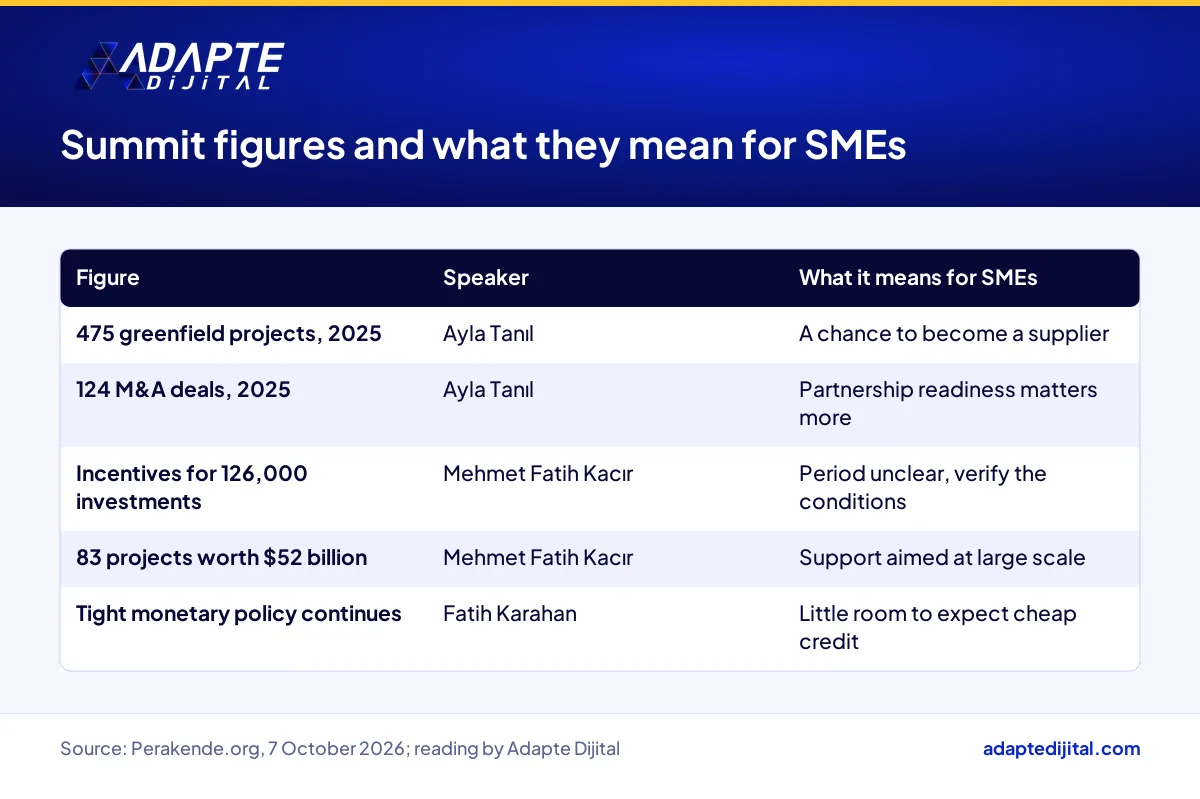
Three speakers shared three sets of figures. Kacır gave incentive and project support numbers, Tanıl gave foreign direct investment and M&A data, and Karahan assessed productivity and monetary policy. Each figure is the speaker’s own statement, reported by Perakende.org. Below, every figure comes with its source and a one-line reading.
Where does the rise in Turkish M&A deals open a door for SMEs?
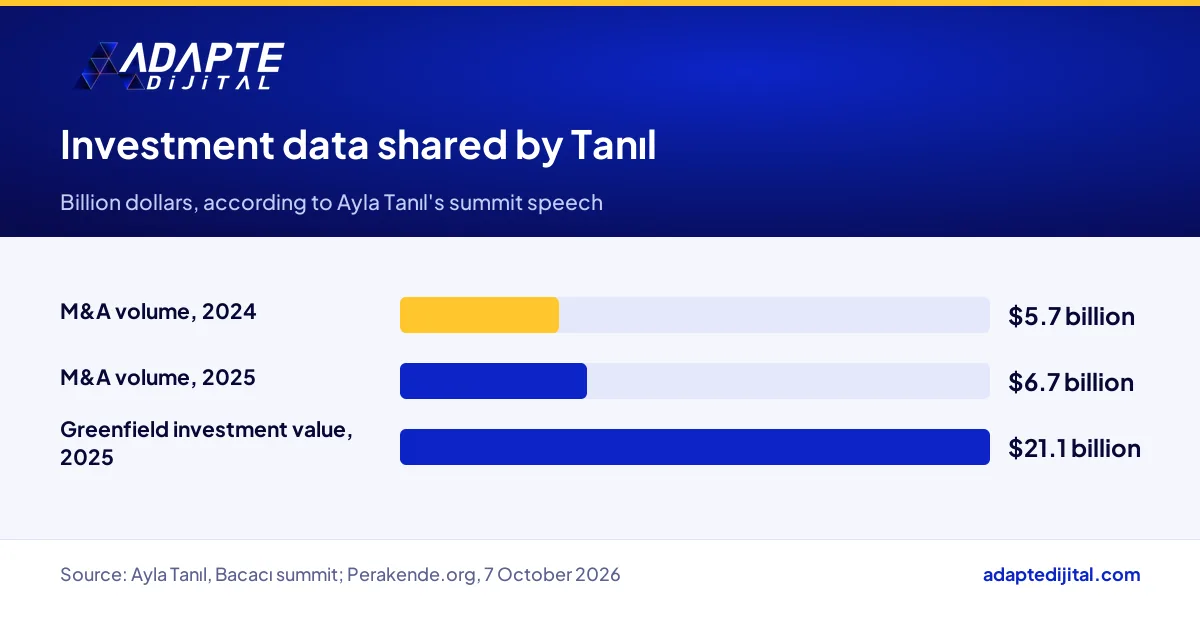
It opens through a larger pool of companies that buyers look at. According to Tanıl, the number of M&A deals rose from 93 in 2024 to 124 in 2025, while volume grew from $5.7 billion to $6.7 billion. Reading: deal count grew faster than volume, which suggests smaller deals are entering the market. The exact breakdown is not in the report.
Which Turkish businesses does the investment and incentive wave help, and which does it squeeze?
It helps businesses that can supply large investments. SMEs that provide packaging, logistics, maintenance, catering or facility services around defence, health, petrochemical and solar projects may see indirect demand. Retailers selling to the local market, side by side with foreign competitors, face a harder time. The business most exposed to tight monetary policy is the one that finances stock with debt.
Where can a Turkish SME look for growth capital while monetary policy stays tight?
In three places: incentives, partnerships and its own cash flow. According to Karahan, productivity indicators fell in 2022-2024 and recovered in 2025, led by industry. Reading: the recovery starts in industry, and its effect on retail and services may come later. In this picture, a plan built on cheap credit is risky.
Why do investors and supply chains look at an SME’s digital data?
Because digital data is the fastest way for an outsider to check that a business is really growing. Web traffic, search visibility, e-commerce conversion rate and repeat customer rate offer a second line of evidence next to the financial statements. Bacacı itself announced a plan in March 2026 to invest about TL 500 million in AI and data-driven transformation. Data is on investors’ agenda too.
What should a Turkish business owner looking for growth capital do this week?
BU BÖLÜMÜN ÖZETİ
- Summarise the last 12 months, financial and digital
- List the large investments in your region
- Review your management team against your growth plan
This week, prepare your file, map supplier opportunities and lay your financing options side by side. None of these is an investment decision; together they build the ground you need to make one. We read other developments on the Turkish retail agenda on our retail page.
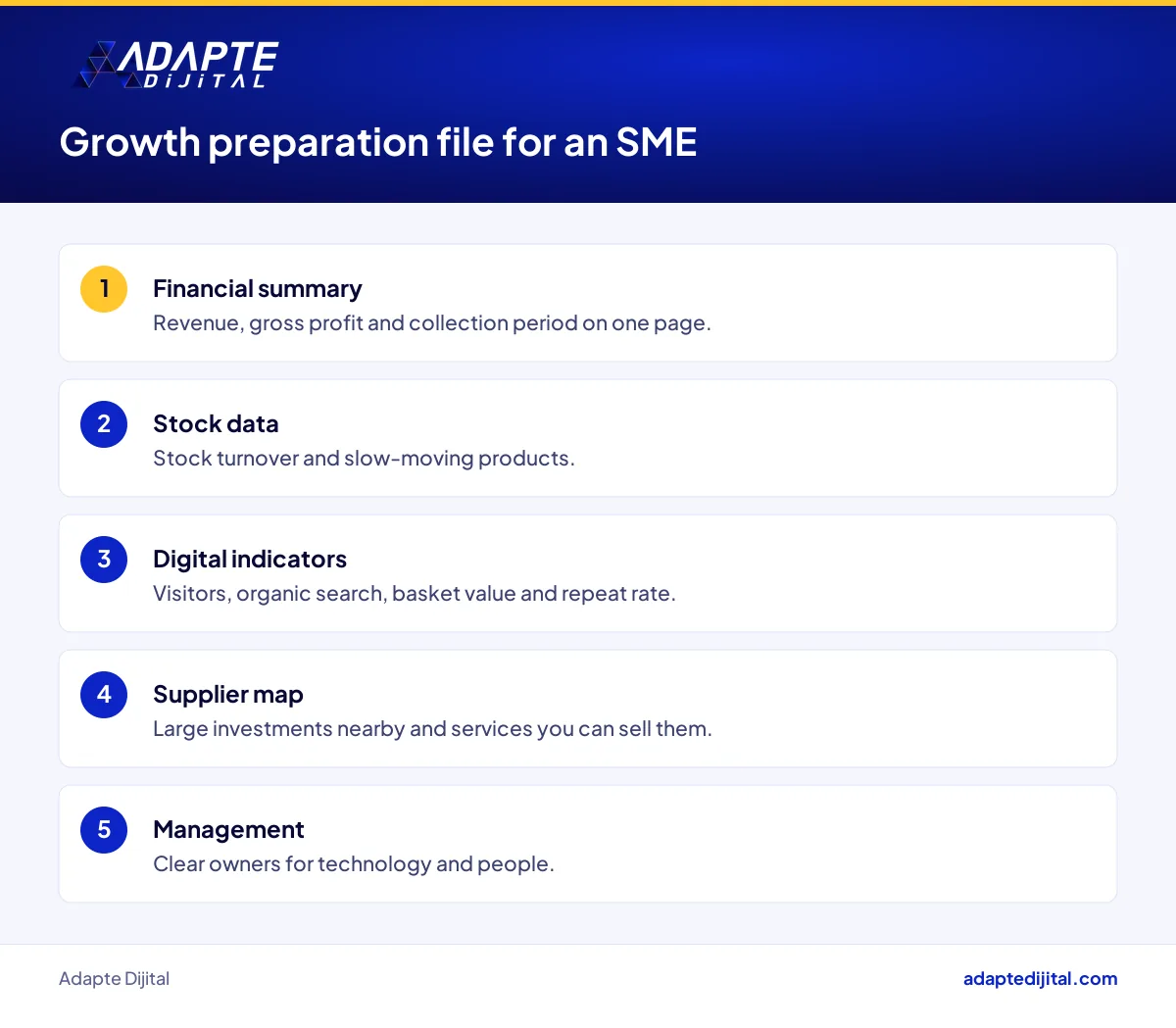
Summarise the last 12 months, financial and digital
Put revenue, gross profit, stock turnover, collection period and the four digital indicators on one page. That page becomes common ground for your bank, a potential partner and an incentive application.
List the large investments in your region
Note the industrial and production investments closest to you. Write down which of your services you could sell them: packaging, maintenance, catering, logistics or employee benefits. We covered the employee benefits side separately through Pluxee’s CarrefourSA campaign.
Review your management team against your growth plan
Partnership and investment talks ask who is in charge of technology and people. You can read the large-retailer version of that question in Teknosa’s CTO and CHRO appointments.
Quick Summary
- According to Tanıl, Türkiye attracted 475 greenfield projects worth $21.1 billion in 2025 (Perakende.org, 7 October 2026).
- According to Tanıl, M&A deals numbered 93 in 2024 and 124 in 2025 (Perakende.org).
- According to Kacır, incentives cleared the way for 126,000 investments worth TL 26 trillion; the period is not stated (Perakende.org).
- According to Karahan, tight monetary policy will continue until price stability is reached.
- For SMEs, the route to a share runs through supplying, partnership readiness and orderly data; this is a reading, not investment advice.
Short Glossary
- Greenfield investment
- Greenfield investment is the type of investment used when a foreign investor builds a new facility instead of buying an existing company.
- Mergers and acquisitions (M&A)
- M&A is the type of deal used when one company takes control of another or two companies combine into one structure.
- Project-based support
- Project-based support is the incentive model used by the state to give tailored support to specific large investments.
Frequently Asked Questions
Next Step
If you want to build your financial and digital preparation file together, fill in the consult your expert form.
Sources: Perakende.org, 7 October 2026 · SPK, 9th World Investor Week statement · Ensonhaber, March 2026 · Investment Office of the Presidency of the Republic of Türkiye · This is not investment advice.
Updated: October 2026
Sık Sorulan Sorular
According to Kacır, incentives cleared the way for 126,000 investments worth TL 26 trillion and 4 million skilled jobs. Reading: the volume is large, but the report does not say which period it covers, so do not treat it as an annual pace.
According to Kacır, project-based support backed 83 projects worth $52 billion in defence, health, petrochemicals and solar cells. Reading: this support targets large-scale production, so for retail and service SMEs the door opens only through the supply chain.
According to Tanıl, Türkiye attracted 475 greenfield projects worth $21.1 billion in 2025, with more than 47,000 jobs expected. The number of projects rose 27 percent and their value 62 percent. Reading: value grew faster than count, which points to larger projects; the report does not make clear who published the data.
No. But preparing the file a buyer would ask for helps every business. Clean financial statements, separated costs and measurable customer data do the same job in a partnership or a loan meeting.
Those with a known brand, repeat customers and profit they can document. If revenue is high but cash is not coming in, an investor closes the file on page one.
The second session was titled “Changing Investment Identity: From Traditional Finance to Venture Capital and Digital Assets”. What the panellists said is not in the report. The title still points in a direction: next to bank loans, venture capital is now on the table.
Service businesses close to organised industrial zones and new production sites. A new factory brings needs such as staff shuttles, catering, workplace safety and maintenance. For these firms, demand arrives when a large investment knocks on the door.
The retailer that funds its stock with short-term loans. According to Karahan, tight monetary policy will continue until price stability is reached. With full shelves and an empty till, this period can feel long.
Shopping malls and high-street shops in the regions receiving investment. More jobs may lift local spending, but the report gives no regional data, so read this as an expectation.
The report does not give the SME share of the incentive figures. Check incentive conditions for your investment type and region with the official source; this is not legal or financial advice. For contact with international investors, the official point of reference is the Investment Office of the Presidency of the Republic of Türkiye.
According to SPK, Türkiye’s Capital Markets Board, about 11 million people used capital market instruments as of October 2025, about 6.4 million of them equity investors. Reading: interest in capital markets is broad, but a public offering or crowdfunding is a costly route that needs preparation.
Because when outside money is expensive, the cheapest money is the money lying in your stock. Clearing slow-moving SKUs and shortening collection times come before any loan.
Monthly visitors, share of organic search, average basket value and repeat customer rate. Keep them for at least one year back, measured the same way. Inconsistent data raises more questions than no data.
When a buyer checks a new supplier online, your service page, reference list, certificates and contact details are what they find. If those are out of date, the customer turns away at the door. For a service business near an industrial zone, local search visibility is the first shop window.
It is an investment to the extent it shortens partnership and loan talks. We set up this discipline with businesses in our digital consulting work.
The report does not give the share of the incentive figures that goes to SMEs. Check which incentive fits your own investment with the official source.
Not on its own. The rise Tanıl cites shows an active market; a buyer’s interest depends on clean financial statements and measurable growth.
That is a financial decision that depends on your situation. Before any loan, review internal sources such as stock turnover and collection period, and talk to your accountant if needed.