
Craftgate links multiple virtual POS to Shopify stores, how can payment success rise?
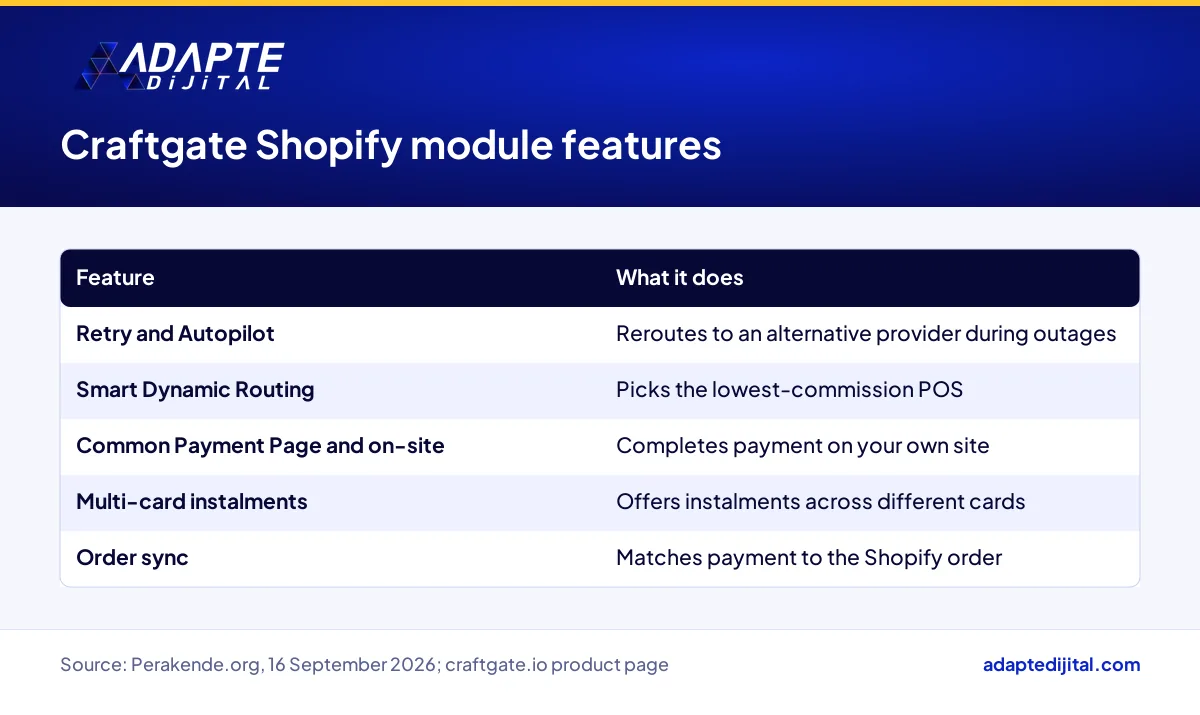
Craftgate’s Shopify E-Commerce Module lets mid-sized and large stores connect bank virtual POS accounts, e-money institutions and alternative payment methods to Shopify through a single integration (Perakende.org, 16 September 2026). A virtual POS is the bank-provided gateway that takes card payments online. The module offers retry that reroutes a payment to an alternative provider during an outage, dynamic routing to the lowest-commission POS, multi-card instalments and order sync. In the report, Derimod’s e-commerce director Uğur Kargı says the brand’s payment success rate has risen above 80%.
What this means for you: if you sell on Shopify, there is now another way to connect Turkish banks’ virtual POS accounts and instalment options to your store. The core gain is ending your dependence on a single POS. An outage on the bank side no longer has to mean a lost order.
What does Craftgate’s Shopify E-Commerce Module change in payment infrastructure?
The module connects several payment providers to Shopify through one integration and distributes traffic between them by rule. According to the product page, payment can be completed on site without an external redirect. Management runs through the Shopify admin or an API. The store owner does not have to build a separate integration for each bank.
Why is relying on a single virtual POS a risk for a Shopify store?
For three reasons: there is no alternative during an outage, you have no options when negotiating commission, and your instalment offer depends on one bank’s terms. A short disruption on the bank side puts every order arriving in that window at risk. The system described in the report targets exactly that gap.
How does Craftgate’s backup routing handle a payment request, step by step?
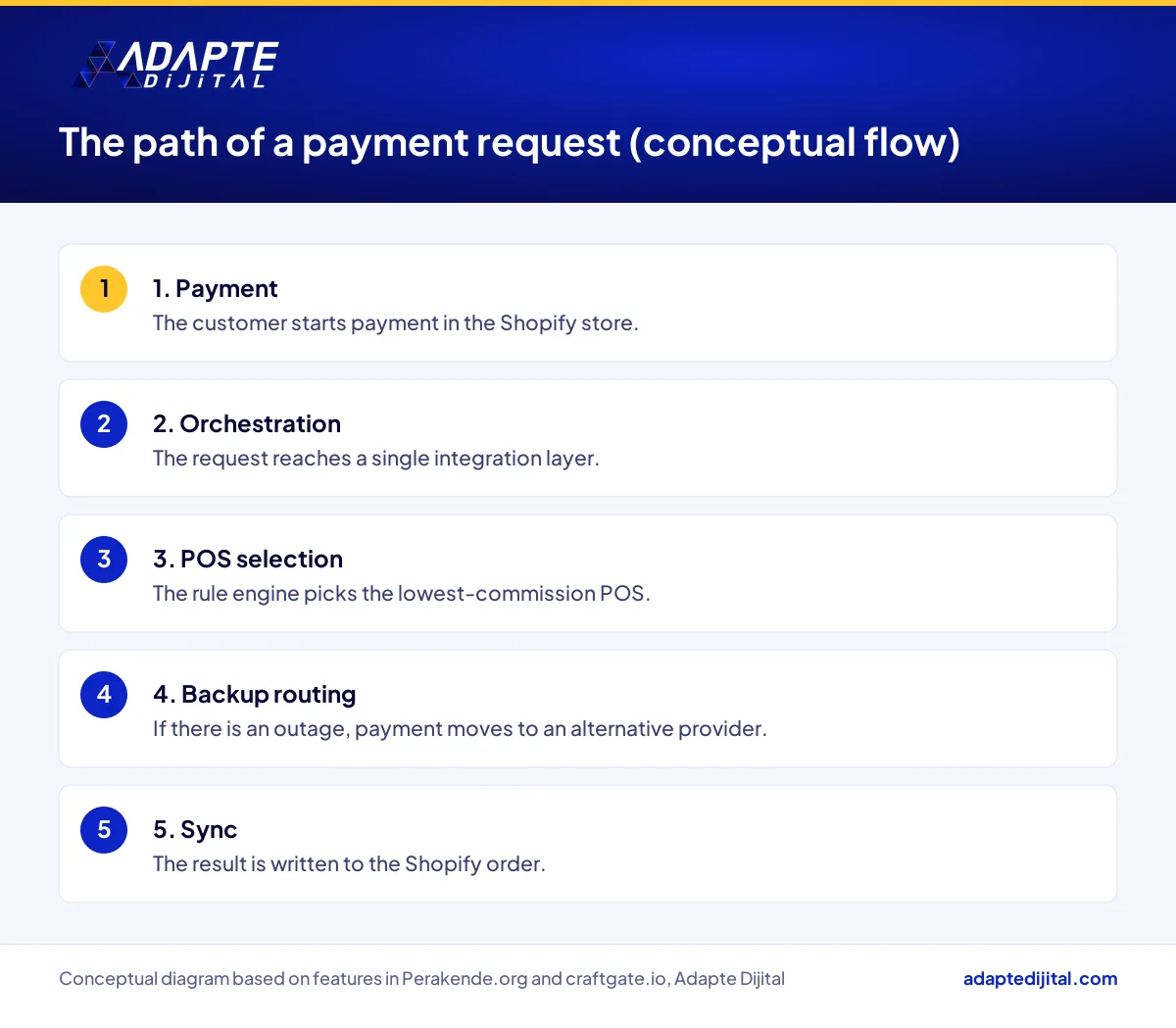
Based on the features described in the report and on the product page, the conceptual flow runs like this. The customer pays, the request reaches the orchestration layer, the rule engine picks a POS, retry switches to an alternative provider if that POS fails, and the result is written to the Shopify order. This diagram is conceptual; the report gives no technical detail.
Which businesses does multi-POS on Shopify affect, and how?
The direct impact is on mid-sized and large stores selling on Shopify; the report does not define that threshold by revenue or transaction volume. In Türkiye in autumn 2026, the effect shows most clearly on stores that sell high-ticket items with instalments. Derimod and Normod appear in the report as examples.
How does payment success rate show up in a Shopify store’s conversion data?
Payment success rate is the last link in the conversion funnel. If a visitor who arrived through ads, search or content drops out at payment, all the earlier spend is wasted. In Baymard’s 2026 compilation, 17% of US shoppers abandon carts over a long checkout and 17% over site errors (as reported by Perakende Türkiye).
What should a Shopify store owner do this week for payment success?
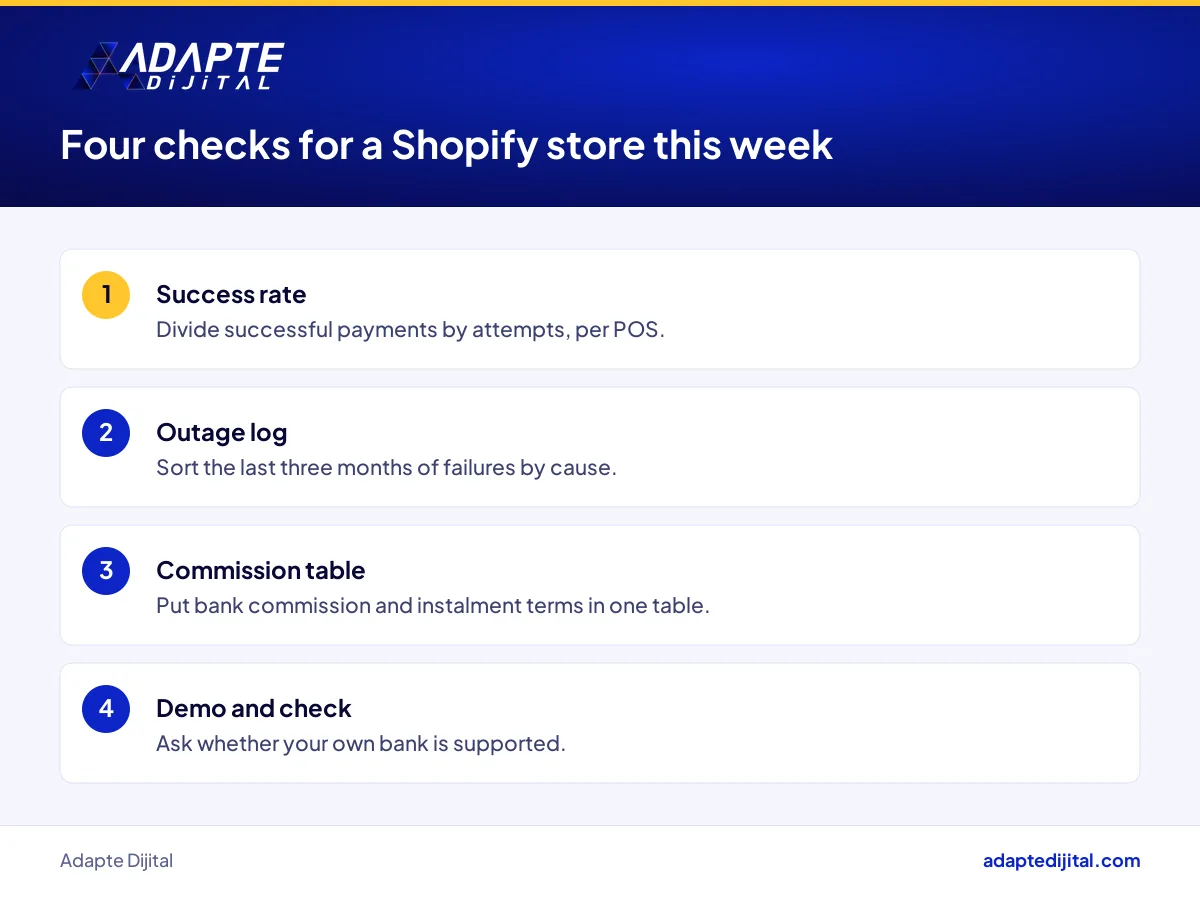
Take four steps this week. Work out your payment success rate per POS, list recent outage records, put your commission and instalment agreements in one table, and request demos to check whether your banks are supported. The module’s price is not in the report or on the product page, so do not decide without a quote.
Quick Summary
- Craftgate’s Shopify E-Commerce Module connects virtual POS accounts and alternative payment methods to Shopify through one integration (Perakende.org, 16 September 2026).
- The module offers retry, dynamic routing, multi-card instalments and order sync.
- Derimod’s e-commerce director Uğur Kargı says the payment success rate has risen above 80% (Perakende.org).
- Derimod’s rate before the switch and the module’s price are not in the report.
- Store owners should first measure payment success rate for each POS.
Short Glossary
- Virtual POS
- A virtual POS is the payment infrastructure used to collect online card payments on a bank’s behalf.
- Payment orchestration
- Payment orchestration is the setup used to manage several payment providers from one layer and route transactions by rule.
- Payment success rate
- Payment success rate is the metric used to show successful payments as a share of all payment attempts.
Frequently Asked Questions
Next Step
If you want to review your store’s payment infrastructure and POS mix together, fill in our consult your expert form.
Sources: Perakende.org, 16 September 2026 · Craftgate, Shopify E-Commerce Module · Craftgate, ready-made e-commerce integration page · Perakende Türkiye, 24 September 2026 (Baymard figures as reported)
Updated: October 2026
Sık Sorulan Sorular
Payment orchestration is a system that manages several payment providers from one layer. Every payment request passes through that layer and goes to a POS according to a rule. In this module, the rules named are commission level and provider outages.
The Common Payment Page (CPP) is a single payment screen used across different providers. On-site payment means the customer finishes paying on your own site without being sent to another page. It is a type of solution aimed at reducing drop-offs caused by redirects.
Craftgate’s Shopify E-Commerce Module page lists providers including GarantiPay, Edenred, Stripe, Adyen and PayTabs. The page does not give a full list of supported banks. Confirm with the sales team whether your own bank is on it.
In a single-POS store, when the bank does not respond, the payment fails and the order drops. A customer you brought in with ads, who has already filled the cart, is lost at the till. The till stays quiet while the ad bill keeps running.
With several POS accounts connected, each transaction can be routed to the lowest-commission channel. That directly affects your cost per transaction. The report does not give a savings figure for this routing, so you need to work it out from your own commission table.
The module lists multi-card instalments among its features, alongside campaign options. That widens the instalment offer beyond a single bank’s terms. Which banks and cards are covered is something to confirm with the provider.
The Smart Dynamic Routing feature sends each payment to the lowest-commission POS. That is the only selection rule the report spells out. Any other inputs the engine may use are not described, so do not assume them.
When the chosen provider has an outage, the payment is routed to an alternative provider. The backup channel is the answer to the order a single-POS setup would lose. How quickly the switch happens is not stated in the report.
Even if a payment passes through a different provider, the order has to show the right status in Shopify. Sync matches the payment to the order record. Without it, stock, shipping and accounting fall out of line.
Derimod moved to Shopify in 2023. Uğur Kargı says its payment success rate has risen above 80%. The report does not give the rate before the switch, so the size of the gain cannot be calculated.
Engin Göndiken, founder and CEO of Normod, says managing the setup from a single platform brings operational efficiency. So the gain is sought not only in the payment rate but also in team time. On Craftgate’s side, the statement comes from marketing manager Taylan Kaymakcı.
Craftgate’s ready-made integration page lists WooCommerce, Drupal Commerce, OpenCart, Akinon and Inveon besides Shopify. For a small business selling on WooCommerce, the question is the same: one POS, or a setup with a backup. We look at whether to join wallet campaigns in our piece on Vodafone Pay’s autumn perks for merchants.
The formula is: payment success rate = successful payments ÷ payment attempts. Track it separately for each POS. Only then can you see which bank declines more, and at what time of day.
Failed payments do not show up as conversions in your ad dashboard. The campaign looks weak, when the problem may sit in the payment layer. We also unpack how cart abandonment ties to the checkout step in our piece on Baymard’s cart abandonment figure.
AINEO Motor is our system of calculation engines embedded in business articles, where readers enter their own numbers and get the rate. Formulas like payment success rate and commission per transaction suit this setup. The result comes from your data, not from the engine.
Pull the last three months of failed transactions from your payment provider’s dashboard. Sort the failures into bank declines, timeouts and technical errors. If the technical error share is high, backup routing should be a priority for you.
Write each bank’s commission rate, instalment options and contract term into one table. Before moving to a new setup, check the termination terms of your current contracts. Verify with the official source; this is not legal or financial advice.
Changing payment infrastructure is not only a decision for the tech team; it involves finance and operations too. We discuss what leadership changes signal in retail in our piece on Teknosa’s new board chair. We handle Shopify payment setup and measurement as part of our e-commerce consulting work, and you can find more payment news on our retail page.
Craftgate’s module is designed to connect bank virtual POS accounts to Shopify. Check with the provider whether your bank is supported, because the full bank list is not on the product page.
Pricing and commission structure are not given in the report or on the product page. The product page works through demo requests.
The report describes the module as being for mid-sized and large stores without giving a threshold. Measure your own payment success rate and outage records first, and let the numbers show the need.