
How to do AI SEO: introducing your business to AI answers with 108 articles
How to do AI SEO, in one line: you make sure AI can read your website, recognise your business and find the answer to a question on your own page. It stands on three legs: technical readability, entity setup and content written for one question at a time. In Adapte’s AI SEO campaign, all three are built in 30 days, for a fixed TRY 36,000 + VAT, with 108 articles.
Look, up front: nobody can guarantee that ChatGPT, Gemini, Perplexity or Google’s AI answers will mention you. What gets built is infrastructure, and it is measured with a diagnosis card at the start and at the end.
What does AI look at before it mentions a business?
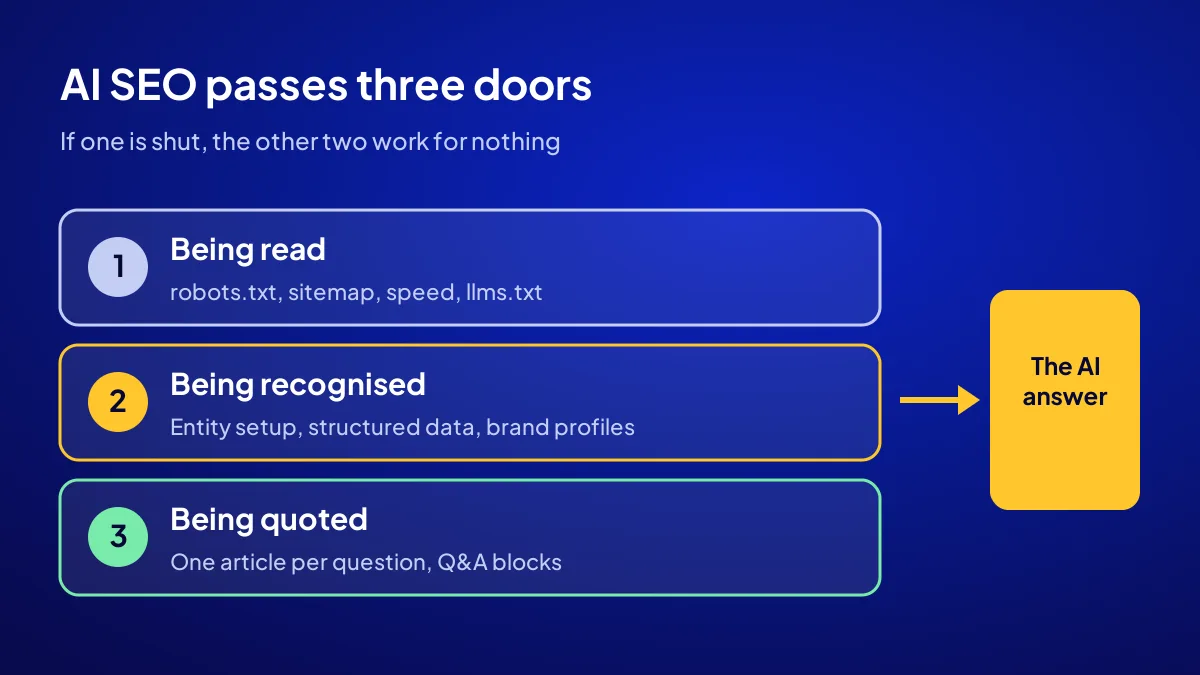
AI first reads pages, then works out who is who, then picks the source that answers most clearly. So there are three doors: being read, being recognised, being quoted. Get stuck at one and the other two work for nothing. Google’s 2026 guide agrees: its AI features sit on its core search and quality systems.
Why 108 articles, and why 6 question groups?
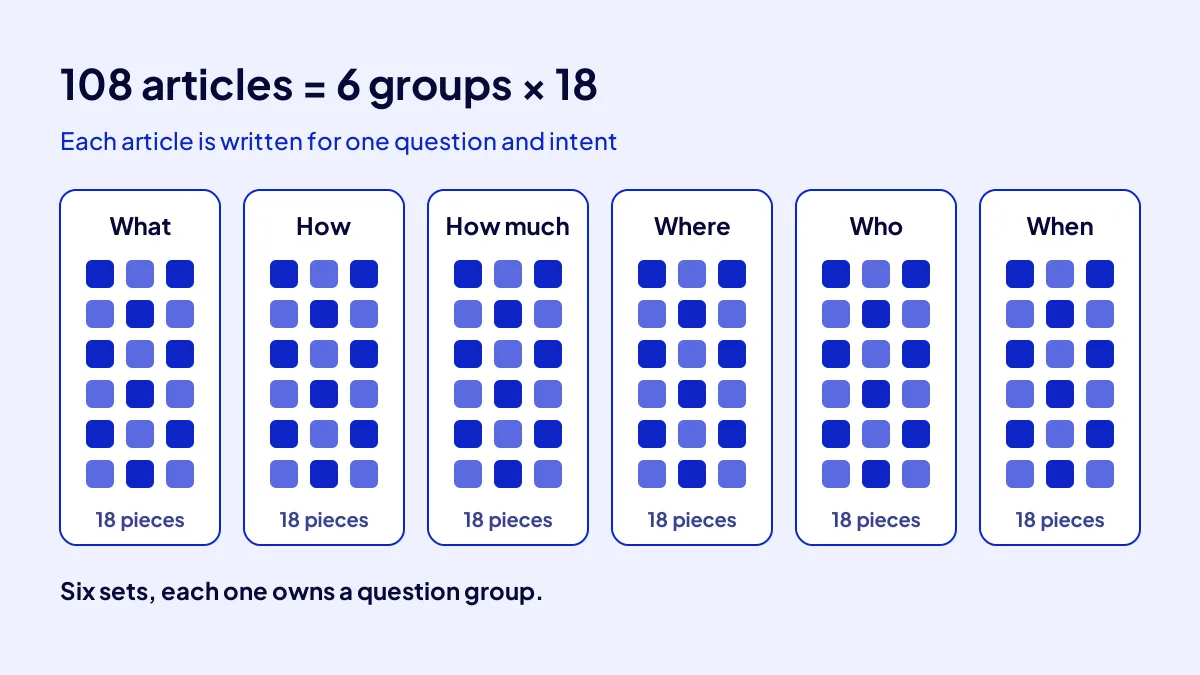
Your customer never comes with just one question. They ask what, how, how much, where, who and when, and each needs its own page. 108 articles means 18 pieces in each of 6 question groups, each written for a specific question and intent. Whatever AI asks, a page on your site was written for it.
Here is what I see: long questions climb fast
In adaptedijital.com’s Search Console data for the three months from 14 June to 13 September 2026, the query “how to open a dental supply store” (in Turkish) sits at an average position of 2.5 and gets 11 clicks from 219 impressions. A short term like “digital agency” gets 478 impressions, an average position of 66 and not one click. Long, intent-rich questions climb fast; short terms are a crowded door.
The set of 18 is our working unit
Adapte works in sets of 18: one main page plus the articles that feed it. 108 articles is six sets, each owning one question group.
In what order does the 30-day setup run?
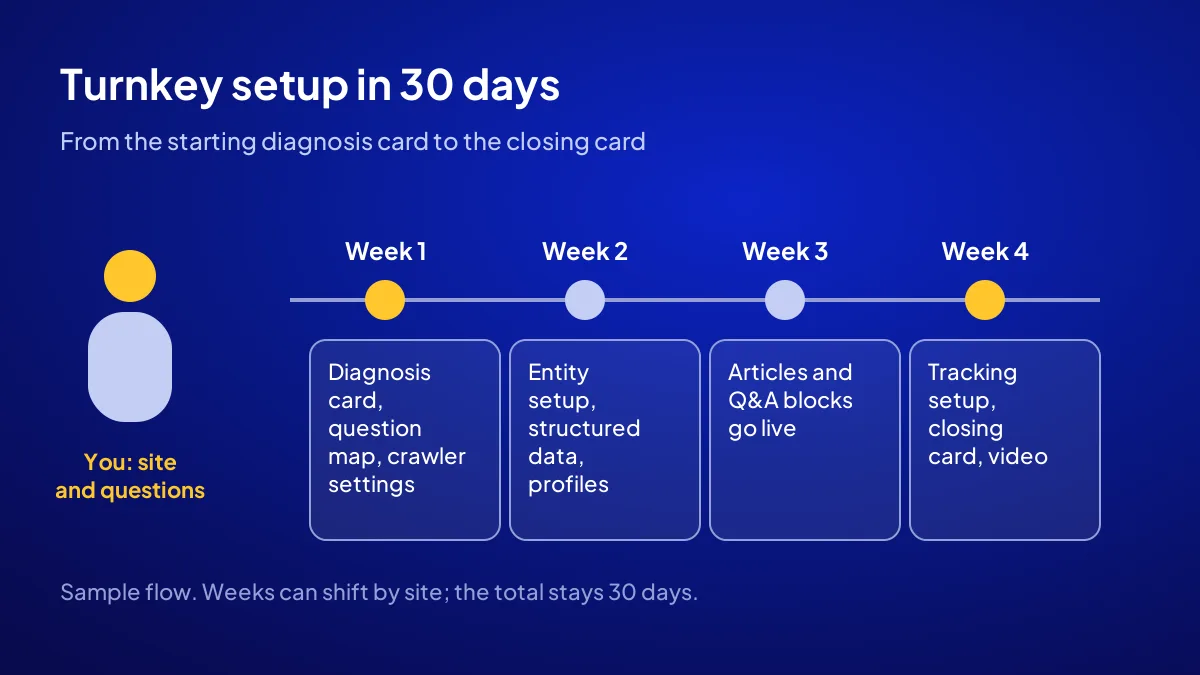
Three steps: you share your site and target questions, the starting diagnosis card comes out, then the turnkey setup begins. Delivery takes 30 days. The table is a sample flow; weeks can shift, the total does not.
| Period | Work done | What we need from you |
|---|---|---|
| Week 1 | Starting diagnosis card, question map, crawler and llms.txt settings | Site access and target questions |
| Week 2 | Entity setup, structured data, brand profiles and directory signals | Confirm business details |
| Week 3 | Articles go live, Q&A blocks added to existing pages | Short notes where sector knowledge is needed |
| Week 4 | AI traffic tracking in GA4, Bing Webmaster Tools and Search Console setup, closing diagnosis card, handover video | Watch the video and send questions |
Why is being seen not the same as being recommended?
BU BÖLÜMÜN ÖZETİ
- Mobile click-through is more than three times desktop
- A ditch I fell into too
- Classic SEO is not ending; a floor is added on top
Impressions on Google do not mean clicks, and one AI mention is not a recommendation. Our own site shows it: 142,296 impressions and 1,699 clicks in three months, an average click-through rate of about 1.2 percent. Most impressions never become a click.
Mobile click-through is more than three times desktop
In the same period, 1,267 clicks, about three quarters, came from mobile. Mobile click-through rate is 1.86 percent, desktop 0.57 percent. In our data, the person who clicks is usually on a phone, so answering on the first phone screen is not up for debate.
A ditch I fell into too
I have watched search results for years and tested more than 100 domains and sites. On a keyword I could not move for years, I saw a keyword-rich domain reach the top within a month. The lesson: search engines and AI both know you by the signal that says clearly who you are.
Classic SEO is not ending; a floor is added on top
AI SEO is built on top of classic SEO, not instead of it. For the detail, read our what is GEO versus SEO guide.
How are results measured, and why is there no guarantee?
Measurement comes from AI-referred traffic in GA4, Bing Webmaster Tools and Google Search Console. The starting and closing diagnosis cards are compared on the same questions. There is no guarantee, because the company running each AI system decides whom it mentions. We build readability and recognisability, then measure.
GA4: separating visitors who come from AI
GA4 tracks visitors from ChatGPT, Gemini or Perplexity as their own group. The step-by-step setup is in measuring AI traffic in GA4.
Bing and Search Console: seeing the citation
In February 2026, Microsoft previewed an AI performance report in Bing Webmaster Tools showing Copilot citations. In June 2026, Google announced generative AI performance reports for Search Console, rolling out gradually. Both tools are set up in the package.
Who is TRY 36,000 for, and why only 12 businesses?
The package is a fixed TRY 36,000 + VAT; with 20 percent VAT that is TRY 43,200 (check the current rate on your invoice). Coupon holders get 10 percent off. Places are capped at 12 businesses per period so every setup ships in 30 days with the same care.
Who benefits most?
- Businesses with a website whose name never appears in AI answers
- Clinics
- Law firms
- Consultants
- Manufacturers and B2B companies
- Online stores and brands
What 3 things should you prepare before applying?
Applying is quick, but preparation shapes the result. Let me ask you one thing: how does your customer phrase the question before they come to you? Write those sentences down and the card and the articles land in the right place.
- Questions in your customers’ own words. At least 9, as you hear them at the counter.
- Your site address and admin panel access.
- The single correct version of your business details: name, address, phone and opening hours.
Quick Summary
- AI SEO is the infrastructure for being read, recognised and quoted.
- The package is a fixed TRY 36,000 + VAT, TRY 43,200 with VAT, 10 percent off with a coupon.
- 108 articles across 6 question groups, each written for one question.
- Delivery in 30 days, with a diagnosis card at the start and at the end.
- Measurement runs through GA4, Bing Webmaster Tools and Search Console.
- No recommendation guarantee; 12 businesses per period.
Short Glossary
AI SEO: AI SEO is the set of work used to make a business readable, recognisable and quotable in AI answers.
Entity: An entity is the concept search engines and AI use to recognise a business as a single record, with its name, address and connections.
Diagnosis card: A diagnosis card is the summary report used to compare a site’s AI visibility before and after setup on the same questions.
Next Step
Your decision fits in one sentence: if your customer asks AI the question, the answer has to live on your site. Apply for the AI SEO campaign and get your starting diagnosis card.
Frequently Asked Questions
Source: Google Search Central — Google’s guide to optimizing for generative AI features on Google Search
Sık Sorulan Sorular
If your site is closed to AI crawlers or loads slowly, even great content goes unread. robots.txt, the sitemap, speed and llms.txt live here. Our what is llms.txt article explains honestly what that last file does and does not do.
If three businesses share your name, AI needs to know which is which. Address, phone, brand profiles and structured data (schema) settle it. Spell your name three ways and AI may see three businesses; even the tax office is less confused. The what is an entity in SEO article covers the logic.
AI loves the paragraph that answers the question directly. An about-us page does not answer “how much is a dental implant in Beylikdüzü”. A page written for that question does.
Every piece follows the FORM-97 standard: answer first, question-style subheadings, sourced figures, a summary and FAQs. The “who is searching, what are they asking” axis comes from our 1K9N method.
It is turnkey. In week one we need your target questions and a check of your details. The rest runs on our desk while you keep the shutters up.
Nothing is deleted. Your service and product pages get Q&A blocks, clear answers AI can quote.
The gap between the starting card and the closing card. Which questions your site answers, which settings are open, which profiles are linked: all in writing. If someone promises to make you number one in ChatGPT, walk to the door, not the till.
A business with no website needs one first; there is nothing for AI to read. If the till is not ringing and you need cash today, AI SEO is not an ad that rings the phone in week one. It makes sure the answer is yours when the customer asks.
On the AI SEO campaign page you share your site and target questions. The starting card comes out and the 30-day setup begins with payment. Mention any coupon code when you apply.
Where your site stands today on your target questions. On day 30 the same questions are measured again.
Classic SEO focuses on ranking pages in search results. AI SEO focuses on AI reading the site, recognising the business and answering from its paragraphs. It is built on top of classic SEO.
No. There is no recommendation guarantee. The campaign builds readability and recognisability infrastructure and measures it with starting and closing diagnosis cards.
Each article targets one question and intent across 6 question groups and follows the FORM-97 standard: answer first, question headings, sourced facts, FAQs.
AI-referred traffic is tracked in GA4, Bing Webmaster Tools and Search Console are set up, and starting and closing diagnosis cards are compared.
So every setup ships in 30 days with the same care.
30 days: site and target questions, starting diagnosis card, turnkey setup, handover video.
Updated: October 2026