
Website valuation calculation: a 6-step method using traffic, content and revenue

A website valuation calculation takes the average monthly net profit of the last 12 months, scales it by a multiple and subtracts the bargaining room your risks create. For a site with no revenue, you add two figures instead: the cost of building the same site from scratch and what its traffic would cost if bought with ads. The method has 6 steps and fits into one afternoon.
There is no single correct number, only a range a buyer will pay. Your job is to build its floor on your own data; each step below names the figure and the threshold.
Which three components make up a website’s value?
A website’s value comes from three things: the money it earns, the traffic it gathers and the content sitting on it. If there is money, the calculation rests on it, because that is what a buyer pays for first. If not, traffic and content take over, depending on your site’s stage.
| Site status | Method | Key figure |
|---|---|---|
| Earns regular revenue | Monthly net profit × multiple − risk discount | Average monthly net profit, last 12 months |
| Has traffic, no revenue | Traffic equivalent + rebuild cost | Monthly organic clicks and cost-per-click estimate |
| Newly built | Rebuild cost as the floor | Domain, page and content count |
Steps 1 and 2: How do you measure and split traffic?
The first job is to pull monthly clicks for the last 12 months from Search Console and sessions from GA4. Count clicks, not impressions: a buyer pays for people who arrive. Then split traffic by source and page; leaning on one of either pulls value down.
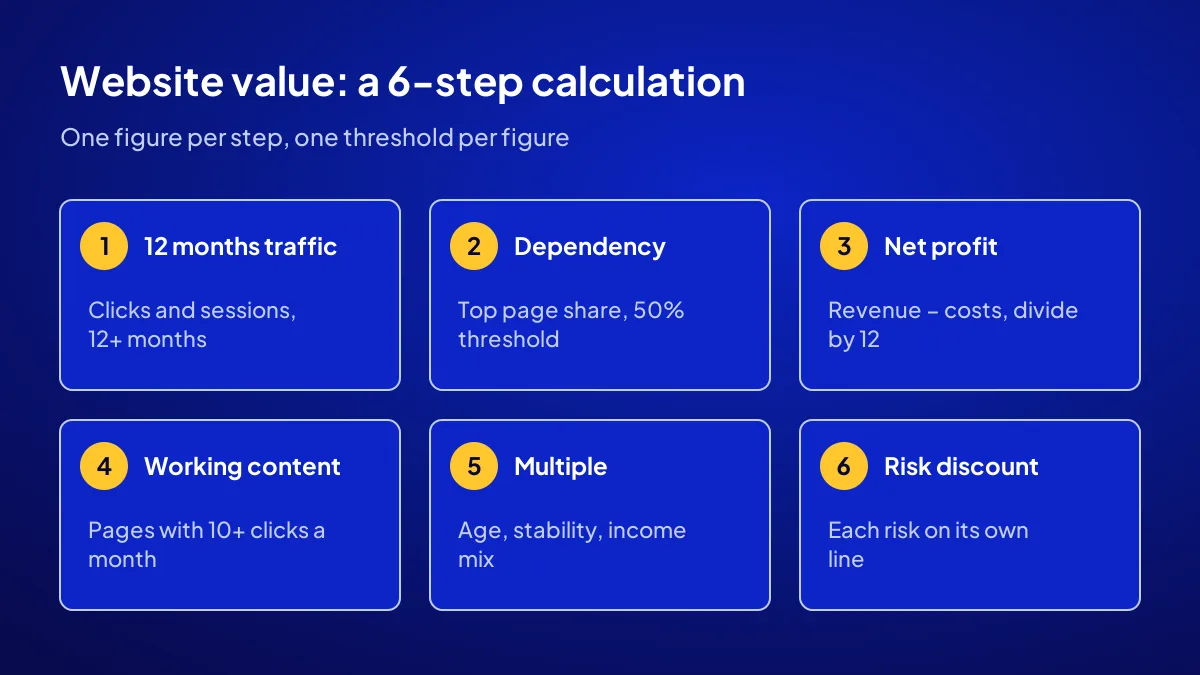
1. Build the twelve-month table
Threshold: at least 12 months of clicks and sessions. Shorter data hides seasonal swings, and one holiday-month peak can inflate the whole year.
2. Measure dependency
Our threshold is 50 percent: if your strongest page brings more than half the traffic, put it on the risk line. Do the same for organic, social and paid sources.
Steps 3 and 4: How do you pin down revenue and content?
In step three you find net profit after costs, not annual revenue. In step four you count content, but only the part that brings traffic. Together they answer the buyer’s real question: what does this site leave me each month? Put turnover on the table and you will walk away from the first meeting empty-handed.
3. Find average monthly net profit
Subtract hosting, domain renewal, content, ads and software from 12 months of revenue, then divide by 12. Add your own labour as a line too, since the buyer will either do that work or pay someone for it.
4. Work out the working-content ratio
Count pages that get at least 10 clicks a month and divide by total pages. If 40 of 108 articles pass that threshold, the ratio is 37 percent. A higher ratio means traffic is spread across the whole shelf.
Most common mistake: Writing turnover as profit. A site selling TRY 10,000 a month with TRY 7,000 in costs brings TRY 3,000 into the calculation.
Steps 5 and 6: How do you apply the multiple and the risk discount?
In step five you scale monthly net profit by a multiple. The site’s age, traffic stability and whether revenue depends on one source set that multiple. In step six you list the risks and take each one off the price. We gathered current market multiple ranges in the website and domain market in numbers.
5. Choose the multiple with a reason
A site older than 12 months, with steady traffic and more than one income source, moves toward the upper band. A new, volatile site on a single income drops to the lower band.
6. Put the risk discount in writing
Write each risk on its own line: single-page dependency, traffic falling over the last 6 months, revenue tied to one ad network. If you write them before the buyer finds them, the negotiation runs on your table.
How do you value a website that earns nothing?
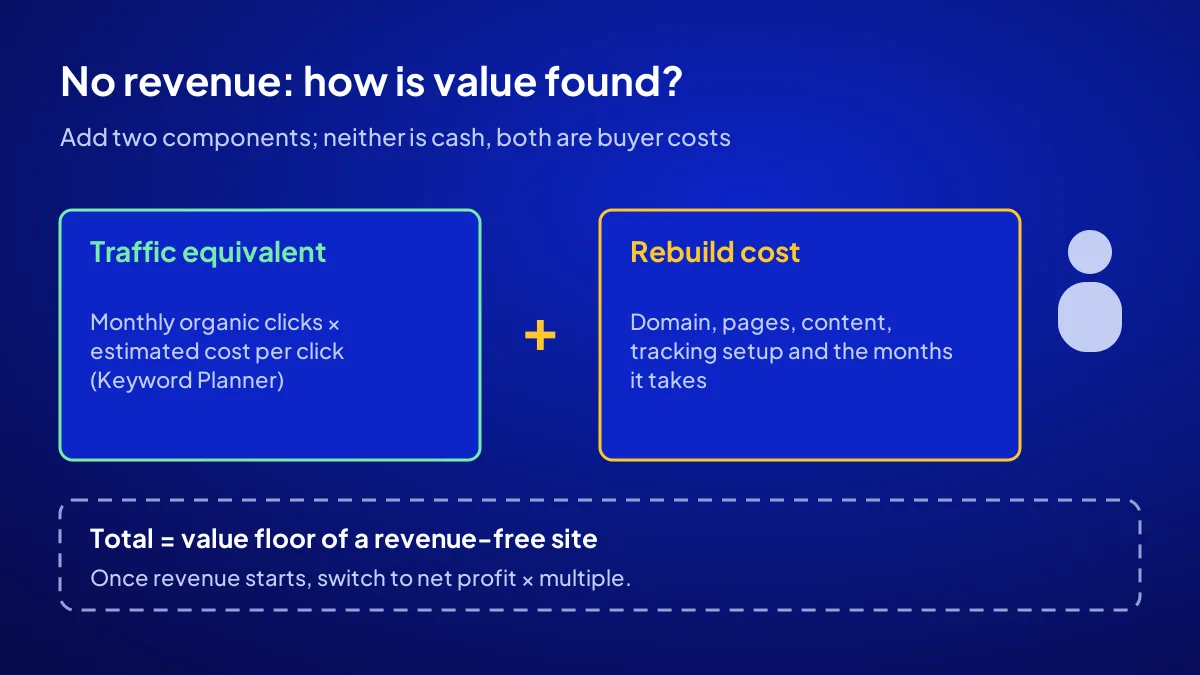
For a revenue-free site you add two components: traffic equivalent and rebuild cost. Traffic equivalent is what your monthly organic clicks would cost if bought as ads on the same keywords. Rebuild cost is the money to recreate the same domain, pages and content from scratch, plus the months it takes. Neither is cash in the till.
Worked example: what is a two-year-old content site worth?
Here is a hypothetical example. Say you own a two-year-old site about pet care in İzmir and are thinking of selling in 2026. The numbers are illustrative; your site’s value comes from your own data. Fill the table line by line with yours.
| Line | Example value | Note |
|---|---|---|
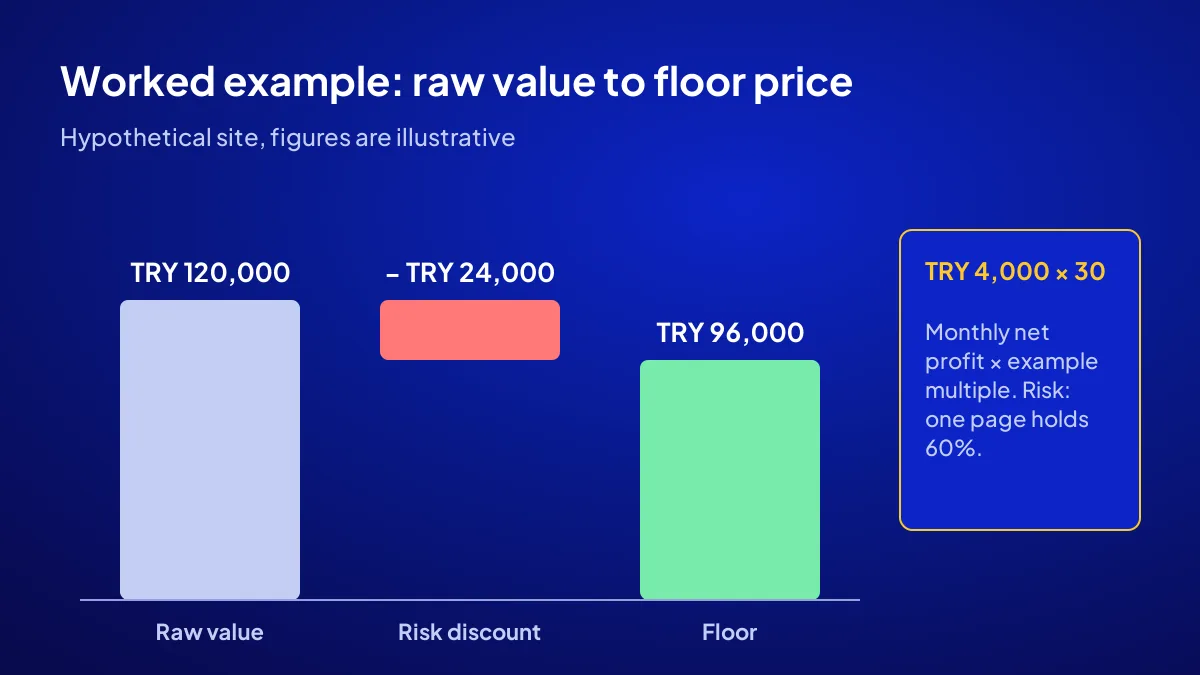
| Average monthly net profit | TRY 4,000 | 12 months of revenue − costs, divided by 12 |
| Assumed multiple | 30 | Buyer offer, example |
| Raw value | TRY 120,000 | 4,000 × 30 |
| Risk: one page brings 60 percent of traffic | − TRY 24,000 | 20 percent bargaining room, example |
| Floor to put on the table | TRY 96,000 | Negotiation opens here |
How do you build an asset that is measurable from day one?
Valuation runs on data collected from day one. That is why the START package in Adapte’s Own a Digital Asset campaign sets up GA4 and Search Console along with the site. The domain is in your name and renting or selling later is possible. There is no earnings guarantee; potential is shown with data.
Places and coupon
The campaign has 12 project places and the last day is 1 November 2026. A 10 percent coupon applies; just mention the code when you apply or in the meeting. Details are on the Own a Digital Asset campaign page. You can read the ownership logic in owning a digital asset, and the wider return maths of digital investment in digital transformation ROI.
Your calculation template, one cell per line:
- Twelve-month clicks and sessions table
- Traffic share of the strongest page (threshold 50 percent)
- Average monthly net profit
- Working-content ratio (10 clicks a month threshold)
- Multiple with a written reason
- Written risk discount
Quick Summary
- For a site with revenue: monthly net profit × multiple − risk discount.
- For a site without revenue: traffic equivalent plus rebuild cost.
- Work with at least 12 months of data and count clicks, not impressions.
- If one page brings over 50 percent of traffic, list it as a risk.
- Use net profit after costs, never turnover.
- START sets up GA4 and Search Console from day one.
Short Glossary
Multiple: A multiple is the factor used to turn a site’s monthly net profit into a sale price.
Traffic equivalent: Traffic equivalent is the measure used to show what organic clicks would cost if bought as ads.
Risk discount: A risk discount is the bargaining room used to take weak points such as dependency or decline off the price.
Next Step
If you want a site whose value you can measure from day one, apply to the Own a Digital Asset campaign and start with an Asset Value Card for your sector.
Sık Sorulan Sorular
A site where the till keeps ringing always finds a higher price than a revenue-free site with the same traffic.
No. It saves the buyer ad spend and months of setup. Its value is lower, but not zero.
Google Ads’ Keyword Planner shows monthly search estimates and cost-per-click estimates for a keyword. Enter your top keywords and multiply monthly organic clicks by the average click cost.
Domain, design, pages, content, tracking and the months a new site needs to hold a place in search.
If you spend 3 months before the sale strengthening other pages and push dependency below 50 percent, that TRY 24,000 line leaves the table. Deleting a risk line is often cheaper than new content.
Back every line with a screenshot. A number without proof is like haggling at a market stall; it comes down fast. We listed the remaining steps of a sale in how to sell a website.
Sector analysis, domain selection (1 year of hosting included), a 6 main and 12 sub-page site, 108 pieces of content in 6 keyword groups and an Asset Value Card. The price is TRY 36,000 + VAT, paid upfront at a fixed price. With 20 percent VAT that is TRY 43,200; check the current rate on the invoice.
Yes. The asset is yours, the domain is registered in your name, and renting or selling it later is possible. No sale price or earnings guarantee is given; potential is shown with data.
Yes. Add the ad-cost equivalent of monthly organic clicks to the cost of rebuilding the same site from scratch. The figure is not cash; it reflects costs the buyer would otherwise carry.
At least 12 months. Shorter data hides seasonal rises and dips and can make the value look higher or lower than it is.
Updated: October 2026