
Ready-made website prices: what sets TRY 60, 90 and 180 thousand assets apart?
Ready-made website prices at ASSETOR come in three fixed steps: the Silver tier at TRY 60,000, the Gold tier at TRY 90,000 and the Platinum tier at TRY 180,000. The price depends on the asset’s tier. What is sold is not an empty template but an e-commerce site, production business or service platform that is set up, working and already collecting demand.
The clearest way to weigh these three numbers against your own maths is a single measure: takeover cost per request. You divide the price by the number of recorded requests the asset collected over the last 12 months. Below I build that calculation step by step, with thresholds.
How much are ready-made websites and what is the ratio between tiers?
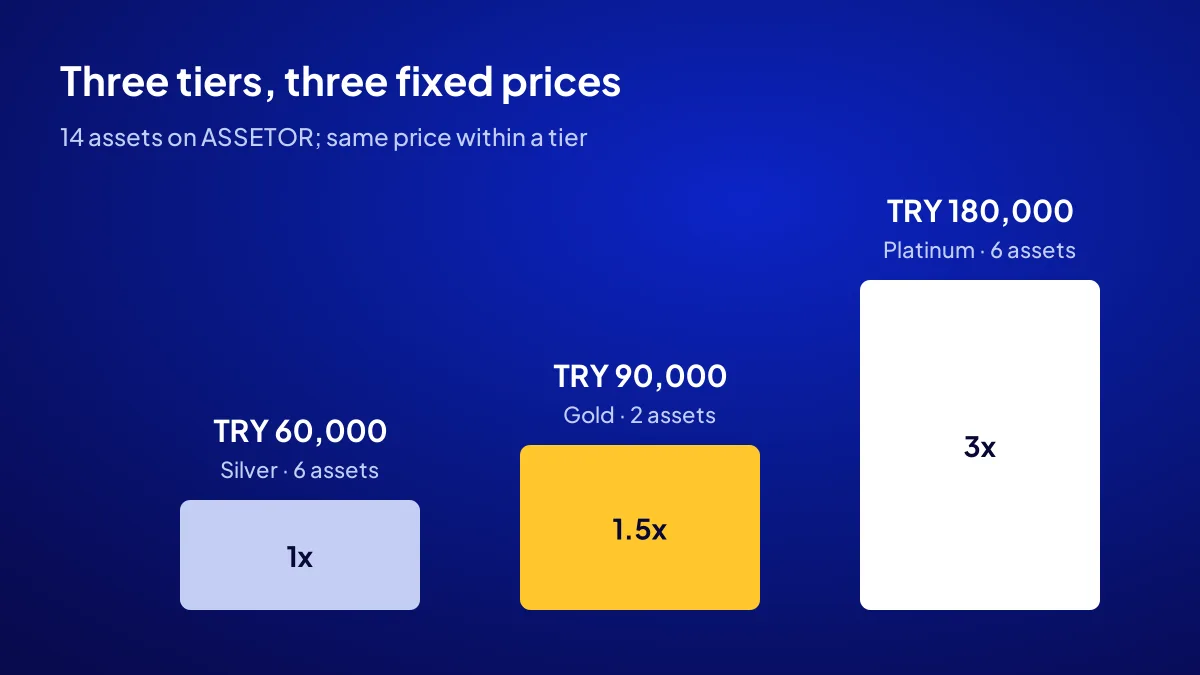
ASSETOR lists 14 assets in three tiers. Silver has 6 assets at TRY 60,000, Gold has 2 assets at TRY 90,000 and Platinum has 6 assets at TRY 180,000. Gold is 1.5 times Silver; Platinum is 3 times Silver and 2 times Gold.
| Tier | Number of assets | Price | Ratio to Silver |
|---|---|---|---|
| Silver | 6 | TRY 60,000 | 1x |
| Gold | 2 | TRY 90,000 | 1.5x |
| Platinum | 6 | TRY 180,000 | 3x |
Within a tier, the price does not change
Assets in the same tier carry the same price. So your job is not haggling but finding the asset with the most proven demand inside the tier. We explain what the tiers mean in Platinum, Gold, Silver asset tiers.
VAT and invoicing
Clarify in the meeting whether VAT is included and whose name the invoice goes to. Check the current rate on the invoice.
Which 6 steps do you follow to measure the price?
Six steps are enough to measure the price, and each step has a number. First you ask for 12 months of data, then you count recorded requests, then you work out the cost per request. The last three steps test how solid that number is.
- Ask for 12 months of data. The Search Console performance report shows the last 3 months by default. Have the date range widened to 12 months; you cannot weigh a price without seeing the season.
- Count recorded requests. Forms, call logs and orders: only dated, recorded ones count, not “lots of people call”.
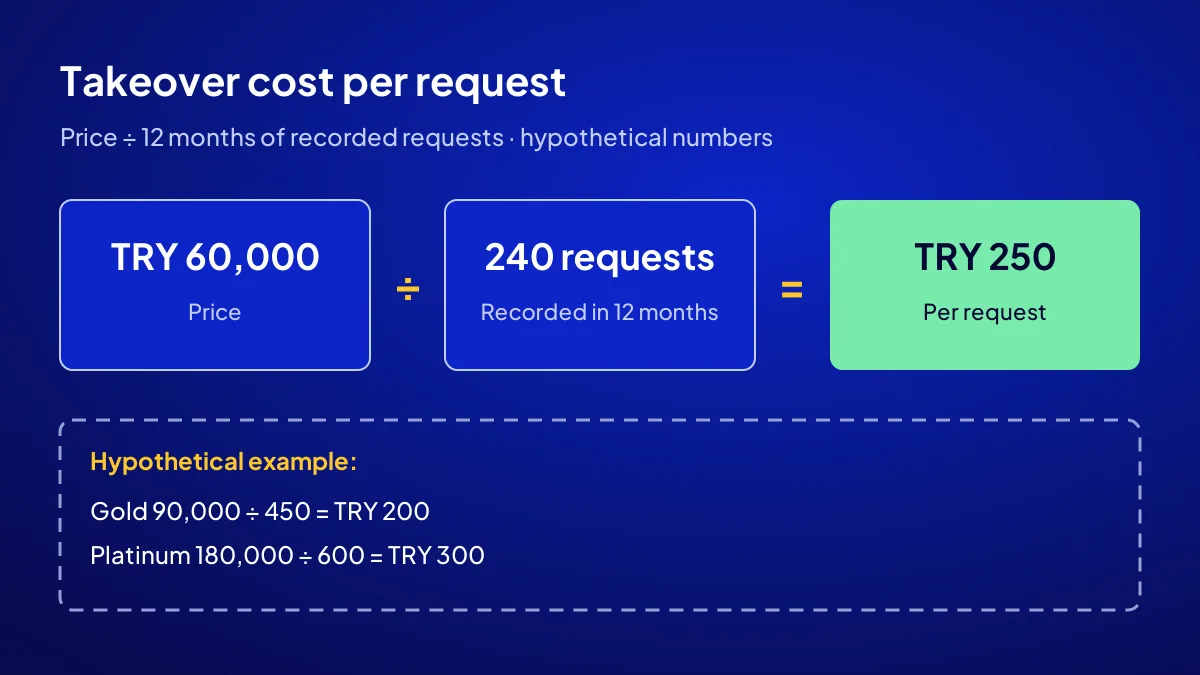
- Work out the cost per request. Divide the price by 12 months of recorded requests. TRY 60,000 ÷ 240 requests = TRY 250.
- Check the peak month’s share. If one month brings more than 30 percent of yearly demand, the asset is seasonal; plan your cash around that.
- Measure single-source dependence. If more than half the demand comes from one page or one query, note the risk.
- Run the same maths on the other tier. Put the price ratio and the demand ratio side by side.
What not to count in step 2
Impressions and visits are not demand. Demand is a customer action that leaves a trace: a submitted form, a logged call, a placed order. Talk is cheap; records are what count.
How do you calculate takeover cost per request across the three tiers?
Takeover cost per request is the price divided by 12 months of recorded requests. The table below is an example built on entirely hypothetical request counts. For each real asset, you take the numbers from the seller’s records.
| Tier (hypothetical example) | Price | Recorded requests in 12 months | Cost per request |
|---|---|---|---|
| Silver | TRY 60,000 | 240 | TRY 250 |
| Gold | TRY 90,000 | 450 | TRY 200 |
| Platinum | TRY 180,000 | 600 | TRY 300 |
Which 6 factors separate two assets in the same tier?
Since the price is the same within a tier, six factors decide the choice. The first is the most critical: the volume of recorded demand. Score each factor from 1 to 3; the highest total is your strongest candidate in the tier.
- Recorded demand volume: how many forms, calls and orders in 12 months.
- Demand continuity: are the last 3 months below the average of the previous 9.
- Source variety: how many different pages and queries bring the demand.
- Asset type: an e-commerce site, a production business or a service platform.
- Content depth: number of published pages and articles.
- Your fit with the work: how many hours a week you can run it.
Scoring example
Six factors, up to 3 points each: 18 in total. Fourteen and above is a strong candidate, 10–13 is worth inspecting, and 9 or below is a sign to look at another asset in the tier. These thresholds are our suggestion.
Do not skip the pre-check
This scoring weighs the price, but it does not measure the asset’s technical and legal health. For that, run the separate list in how to inspect a site before buying.
How does the takeover work before you pay, and is there a guarantee?
At ASSETOR the process has three steps: inspect, choose, take over. You review the assets, choose the one that fits, and take it over. No promise of earnings is made. The price pays for a structure that is set up and collecting demand; it is not a promise of future income. The current list is on the ASSETOR digital assets for sale page.
3 questions for the meeting
Is VAT included in the price? Which accounts and files are handed over in the takeover? Which report shows me the recorded demand data? Write the answers down.
The full picture
The price maths is one piece. You will find the full logic of taking over in the guide to buying a ready-made online business.
Price check template: which 6 lines do you fill in?
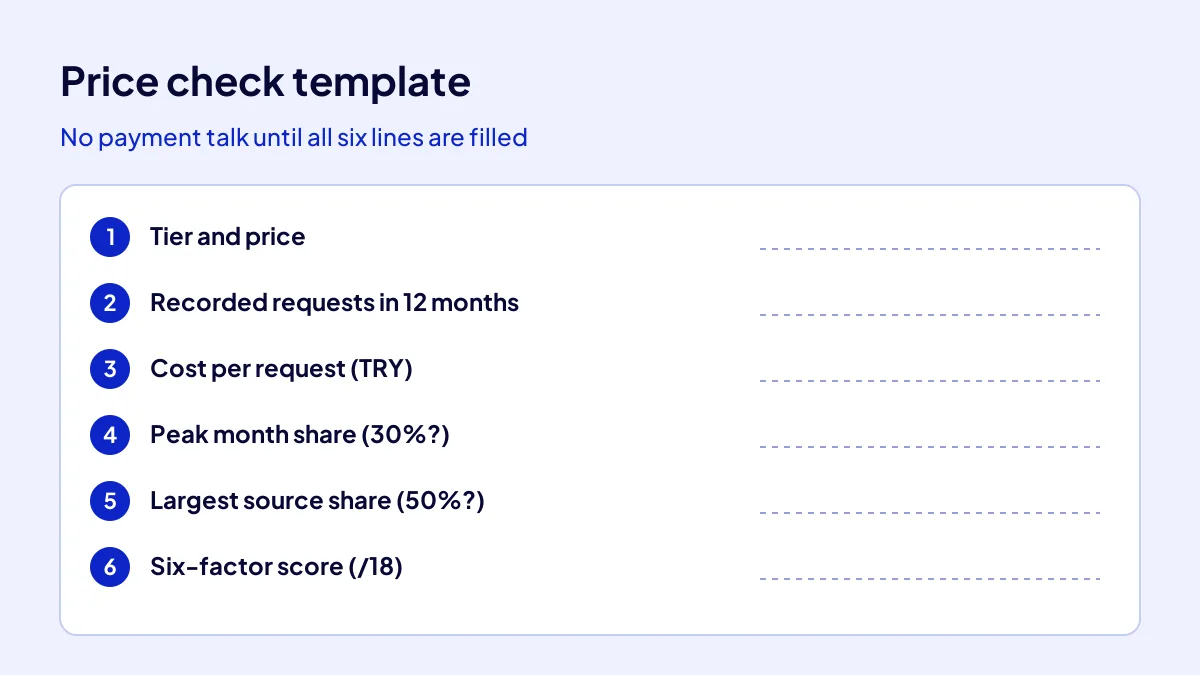
Write the six lines below on a separate page for each candidate asset. Do not talk payment until all of them are filled. An empty line is a risk whose answer you do not know.
- Tier and price: Silver 60,000 / Gold 90,000 / Platinum TRY 180,000.
- Recorded requests in 12 months: ___.
- Cost per request: price ÷ requests = TRY ___.
- Peak month’s share: ___ percent (above 30?).
- Largest single source’s share: ___ percent (above 50?).
- Six-factor score: ___ / 18.
Show the template to your accountant
Show the filled template to your accountant before paying. They read the invoice, VAT and cash lines better than you do.
Use the template to compare
Lay the templates of two or three candidates side by side. The one with a low cost per request and a high score is the one that best earns its price.
Quick Summary
- Ready-made website prices at ASSETOR: Silver 60,000, Gold 90,000, Platinum TRY 180,000.
- Takeover cost per request = price ÷ 12 months of recorded requests.
- Ask for at least 12 months of data; you cannot weigh a price without the season.
- If one month passes 30 percent or one source passes 50 percent, note the risk.
- Within a tier, an 18-point six-factor table makes the choice.
- No earnings guarantee is given; the price is not a promise of future income.
Short Glossary
Takeover cost per request: Takeover cost per request is the comparison measure found by dividing an asset’s price by the requests it recorded over the last 12 months.
Recorded request: A recorded request is the term used to count dated, traceable customer actions such as a form, a logged call or an order.
Seasonal asset: A seasonal asset is the term used to describe a digital asset that collects most of its demand in certain months of the year.
Next Step
If your maths is ready, it is time to look at candidates. Browse the digital assets for sale on ASSETOR and fill in the template for each one.
Frequently Asked Questions
Source: Search Console Help — Performance report (Search results)
Sık Sorulan Sorular
If the three months of data fall in summer, an AC service looks bright and a winter coat store looks dim. You do not buy a field after seeing it in one season.
In this example Gold costs 1.5 times Silver but is cheaper per request. Platinum is the most expensive per request. The method teaches you to look at demand, not price.
No. The quality of demand matters too. A TRY 200 request that never turns into a sale costs more than a TRY 300 request that does. To see whether demand turns into sales, use the calculation in is my store profitable.
Most common mistake: Comparing tiers by price alone. Without working out cost per request, you cannot know which one is expensive. A buyer who buys blind may find the “cheap” asset has no demand to keep the till ringing.
At ASSETOR the price depends on the asset’s tier: Silver TRY 60,000, Gold TRY 90,000, Platinum TRY 180,000. Assets in the same tier share the same price; recorded demand and its continuity decide the choice.
Divide the asset’s price by the number of recorded requests it collected over the last 12 months. For example, a TRY 60,000 asset with 240 recorded requests in 12 months has a cost per request of TRY 250.
No. ASSETOR makes no promise of earnings. The process is inspect, choose, take over, and the result depends on how you run the asset.
Updated: October 2026