
OSGB Authorisation Certificate: When Should You Apply?
An application to authorise a joint health and safety unit (OSGB) is made once the staff are in place and the premises are ready. Timing matters in this branch, because the assessment runs on staff and premises; an application filed with gaps leaves the file waiting.
We set the process out in order: which step comes when, and at what point the application should be filed.
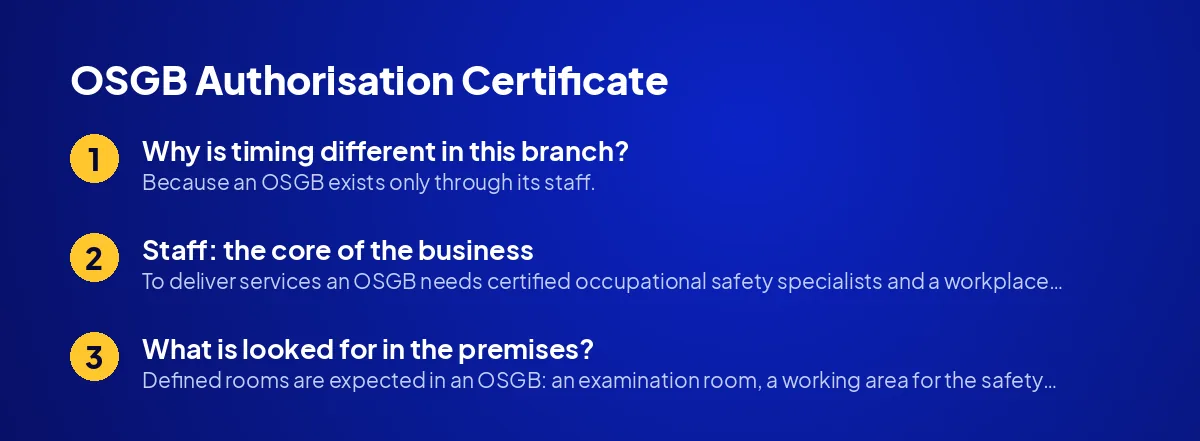
Why is timing different in this branch?
Because an OSGB exists only through its staff. An occupational safety specialist, a workplace doctor and, depending on scope, other health personnel; authorisation looks at whether those people are there and at their qualifications.
What it means for you
There is no point applying before the staff contracts are signed. Nor will the file move forward until the conditions for the premises are met. Applying before both are complete does not shorten the process; it lengthens it.
The calendar: which step, when
| Time | Step | Note |
|---|---|---|
| Preparation | Staff discussions | The item that sets the pace |
| Preparation | Obtaining the premises conditions list | Ask for it in writing |
| Week 1 | Company formation | Trade registry and tax |
| Week 1-2 | Lease and building plan | Based on the room conditions |
| Week 2-4 | Setting up the premises | Examination and training areas |
| Week 3-4 | Signing the staff contracts | Qualifications into the file |
| Week 5 | Authorisation application | With a complete file |
| Week 6-10 | Assessment and site inspection | Duration varies |
| After | Municipal licence and trading | Alongside the authorisation certificate |
Staff: the core of the business
To deliver services an OSGB needs certified occupational safety specialists and a workplace doctor on its staff. Your specialists’ class determines the hazard class of workplace you can serve.
The question of class
Serving workplaces in the very hazardous class requires a higher class specialist. Think about your target customers and your staff’s class together, or you will be quoting for customers you cannot contract with.
Stability of the staff
Specialist turnover is high in this field. A change of staff requires notifications that affect your authorisation, so set that tracking up from the start.
What is looked for in the premises?
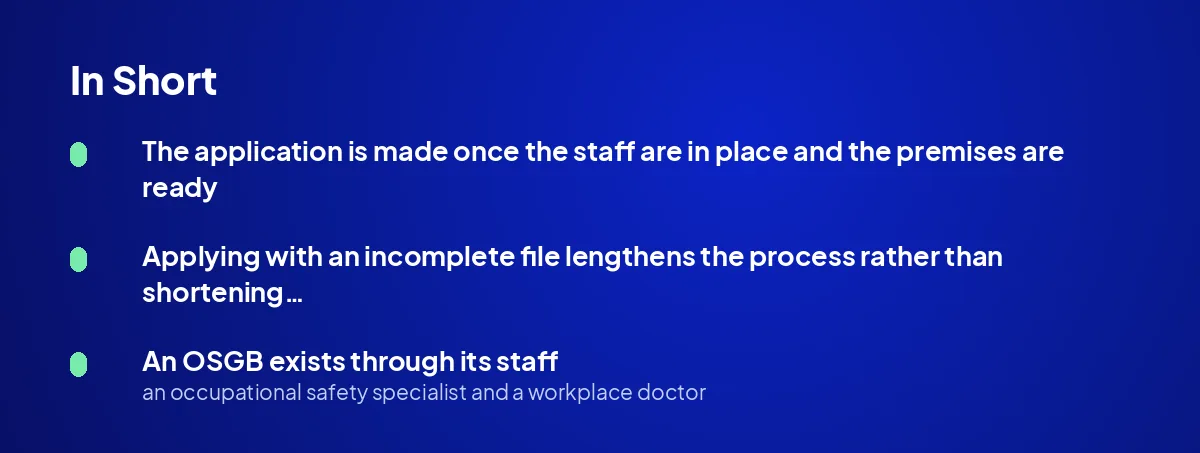
Defined rooms are expected in an OSGB: an examination room, a working area for the safety specialist, a training area and an archive. The legislation sets these out in detail.
When viewing premises, then, look at how the space divides rather than at the floor area. An open-plan office may be unsuitable on the examination room condition alone.
After you start trading
Obligations continue once the authorisation certificate is in hand, and in this branch inspection is continuous.
What has to be tracked
- Notification of changes to the staff
- Contract records for the workplaces served
- Tracking of specialist and doctor service hours
- Training records and attendance certificates
- Examination and test records
The third item causes the most trouble: the total service time one specialist can provide is capped. Build your customer portfolio around the capacity of your staff.
The customer side: contracts and continuity
An OSGB’s income comes from the workplaces under contract, renewed annually. It produces steady revenue, but losing a customer is felt immediately.
Make the scope of service explicit in the contract: how many visits, which training sessions, which reports. A vague scope brings customer dissatisfaction and a workload problem for your staff.
Contracts and reporting are the body of the work
An OSGB’s daily work is largely contract tracking and reporting. How many businesses you work with, which risk class each sits in, and which service is due when: all of it has to be tracked.
What has to be tracked
- Contracted businesses and their risk classes
- The specialist and doctor assigned to each business
- Service hours and the calendar they sit on
- Visits made and reports issued
- Training records and attendance lists
The third item is the first place an inspection looks: the time that should be given according to risk class and the time actually given have to match.
Working out capacity
The total time a specialist or doctor can serve is capped. You have to limit contracts to that capacity; signing beyond it puts your service quality and your authorisation at risk.
Growth decisions are therefore taken together with recruitment. Winning contracts first and then looking for staff is the commonest planning mistake in this business.
The reality of pricing and competition
Competition in the OSGB market is intense and price pressure high. The business stays sustainable only if price is built correctly on service hours.
Where is differentiation built?
- Reporting that is timely and readable
- Carrying real knowledge of the customer’s own sector
- Training that can genuinely be applied
- Standing beside the business when it faces an inspection
The fourth item does more for loyalty than anything else: a business that has been through an inspection does not change the OSGB that stood beside it.
For neighbouring branches see our medical device manufacturing and home healthcare service articles as well.
Which businesses make sense to work with?
An OSGB’s portfolio sets its workload and income together. Not every contract brings the same work.
Businesses in the very hazardous class require more service time; the fee is higher, but they take a large share of your specialist capacity. Small businesses in the low hazard class need less time; the fee is smaller, but there are more contracts to manage.
Geographic concentration counts too: businesses in the same area cut the time a specialist spends travelling. A scattered portfolio consumes more labour for the same number of contracts.
Training is a competence in its own right
Occupational health and safety training is the visible face of the service. Employees at a client business come to know the OSGB through those sessions, and that is where their sense of quality forms.
There is a wide gap between a session read off slides and one built on examples from the business’s own machines and floor. The second is genuinely applied, and it raises the perceived value of the service.
Training records are also an item inspections look at: who attended, which subjects were covered, how long the session ran. Signing attendance lists on the day and filing them is easier than reconstructing them later.
In Short
- The application is made once the staff are in place and the premises are ready
- Applying with an incomplete file lengthens the process rather than shortening it
- An OSGB exists through its staff: an occupational safety specialist and a workplace doctor
- The specialist’s class determines the hazard class you are able to serve
- An examination room, a working area, a training area and an archive are looked for
- When viewing premises, look at how the space divides, not at the floor area
- Total service time per specialist is capped; build the portfolio around that capacity
- The scope of service in the contract must be explicit: visits, training, reports
- Limit contract numbers to the capacity of your specialists and doctors
- Pricing below the required service time puts your authorisation and reputation at risk
- Geographic concentration consumes less labour for the same number of contracts
For the order of licences see the business licence roadmap, and for capital and profit margin bands our medical sector page.
Quick Glossary
OSGB: an authorised unit delivering occupational health and safety services to workplaces. Hazard class: the classification of workplaces by their level of risk. Authorisation: the official permission an establishment obtains in order to deliver the service. Service time: the minimum time a specialist or doctor must devote to one workplace.
Next Step
Let’s work out your set-up calendar and staffing plan together: consultation request form.
Frequently Asked Questions
Updated: September 2026
Sık Sorulan Sorular
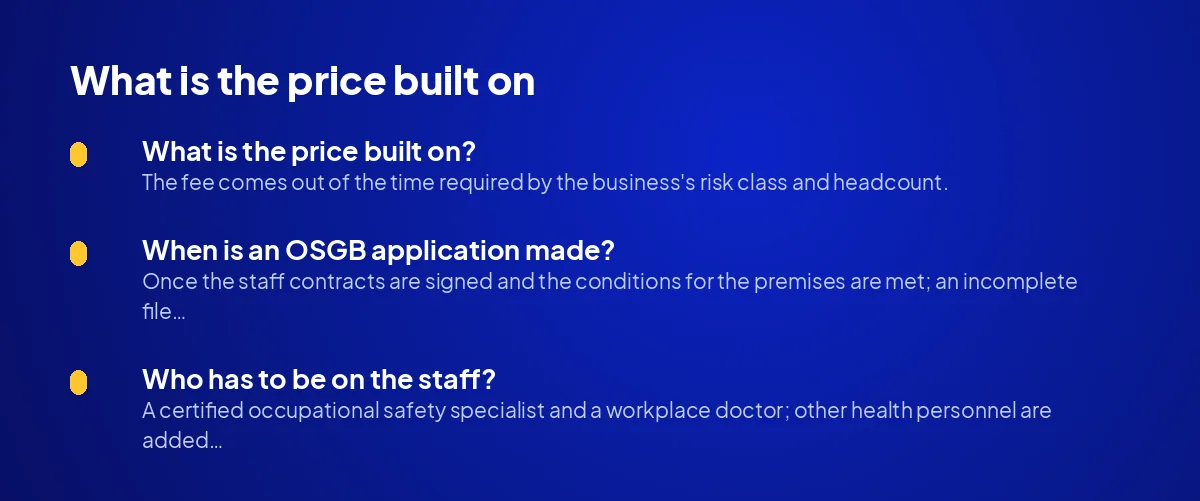
The fee comes out of the time required by the business’s risk class and headcount. That time is known, so your cost is largely known too.
Quoting a lower price by delivering less than that time looks possible, but it risks your authorisation and your reputation. Staying off that road is the only sound long-term position.
Once the staff contracts are signed and the conditions for the premises are met; an incomplete file lengthens the process.
A certified occupational safety specialist and a workplace doctor; other health personnel are added according to the scope of service.
It directly determines the hazard class of the workplaces you are able to serve.
An examination room, a specialist working area, a training area and an archive; ask for the list of conditions in writing.
Change notifications have to be filed; set up the tracking from the start, because turnover is high in this field.
It depends on the total service time capacity of your staff; the cap cannot be exceeded.
The scope of service has to be explicit: the number of visits, the training to be delivered and the reports.
The premises and the staff are inspected on site during the assessment process.
Two to three months if the staff and premises are ready; if those items are missing the timing cannot be predicted.
Source: Ministry of Labour and Social Security — Directorate General of Occupational Health and Safety