
Cleaning Company Licences and Permits: The Eight-Step Order

In a cleaning company the weight of the set-up gathers not in the size of the office but in how many people you send to which job. A business serving households single-handed does not hear the same questions as a firm putting thirty people into an office block.
The eight steps below follow the order of decisions, not the order the authorities keep. Here one threshold moves ahead of the rest: taking on the first member of staff. Headings want closing before you cross it, and closing them afterwards is both expensive and wearing.
Step 1: separate out which cleaning work you will sell
Your first task is a list of services. On one sheet write every line you will sell on opening day: domestic and flat cleaning, office and business-park cleaning, post-construction cleaning, facade and window cleaning, communal areas on housing estates.
That sheet is the spine of the set-up. It settles which door you go to, how many people you begin with and what equipment you buy. Writing in the facade and height line changes the staffing side entirely.
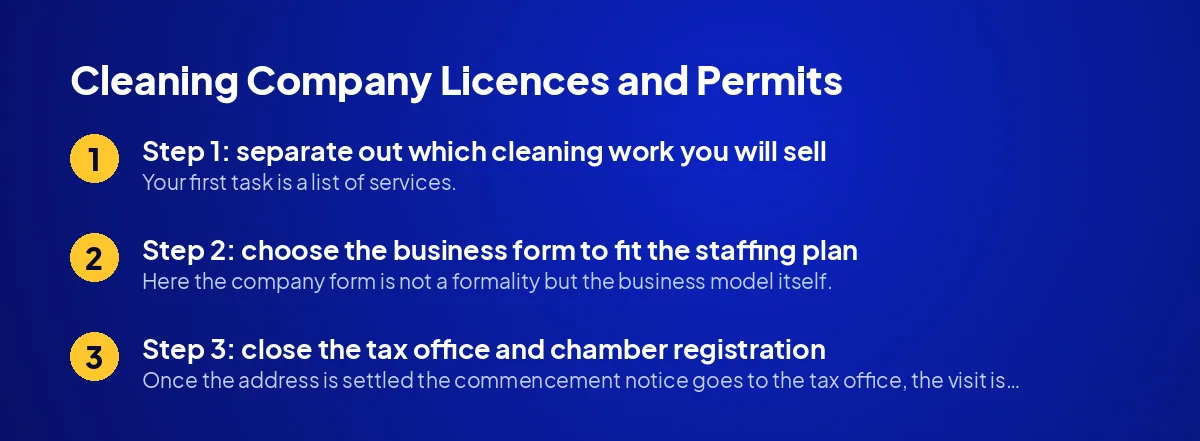
Step 2: choose the business form to fit the staffing plan
Here the company form is not a formality but the business model itself. If you mean to go after corporate clients, tender and procurement desks generally look for a limited or joint-stock structure.
A sole trader is set up quickly at a small scale, yet liability grows heavier as headcount rises. Take the decision with your accountant, and put how far you plan to grow on the table.
Step 3: close the tax office and chamber registration
Once the address is settled the commencement notice goes to the tax office, the visit is made and the tax certificate issued. For a company, registry entry and chamber registration run at this stage.
This link works mechanically, yet it feeds every application that follows. A day lost here pushes your recruitment timetable back by the same amount.

Step 4: think of the office and the store as two places
A cleaning company needs two spaces: the office where clients are met and papers kept, and the store where chemicals and machinery stand. Squeezing both into one narrow unit makes trouble later.
Check three headings before taking premises. All three are either costly or impossible to put right afterwards.
- Whether the building holds an occupancy permit and suits commercial use
- Whether the zoning status of the address allows this activity
- Whether condominium consent can be obtained if the building is residential
Add one question peculiar to the store: can the chemical drums be ventilated and partitioned off. That question meets you at the licensing desk and on the occupational safety side alike.
Step 5: build the licence file
The workplace opening and operating licence is taken from the district municipality. Cleaning companies on an office arrangement are typically assessed towards a sanitary establishment; that direction can shift once chemicals gather in the store.
The following headings are typically asked for. The final list always appears on the municipality’s own form.
- Application form and declaration
- Lease agreement or a copy of the title deed
- Occupancy permit and information on the zoning status
- Tax certificate and chamber registration document
- Trade registry gazette and signature circular for companies
- Identity document and photograph
- Condominium consent in a residential building
- A fire brigade report according to the premises and the activity
- Social security workplace notification if staff will be employed
This is a framework, not a closed list. Municipalities may ask for further papers of their own; request the class assessment from the licensing unit in writing.
Step 6: headings to close before the first member of staff
This step is the breaking point of the set-up. In cleaning work turnover grows with people, and obligation grows at the same pace. Settle the following before you take on the first person.
- Opening the social security workplace file and setting up the notification routine
- Deciding who will supply the occupational health and safety service
- Having the entry papers, the personnel file and the employment contract template ready
- Buying personal protective equipment together with a record of issue
- Establishing the payroll and timesheet routine with your accountant
Five headings look small on paper. When an inspection arrives these are the first places asked about, and a gap in them cannot be put right retrospectively.
Step 7: put the chemical and equipment side in order
Ask your supplier for the safety data sheets of the products you use and keep them in one folder. That folder serves you in staff training and when a question comes.
If working at height, facade cleaning or heavy machinery is on your list, equipment and training open a heading of their own. Solve those lines before promising anything to a client.
Step 8: set up your quotation and contract routine
A corporate client expects orderly paperwork as much as the service itself. Winning large work is hard without a contract template, a monthly service report and a staff list to hand.
Before opening, prepare a quotation template, a contract template and a monthly report template. All three are built in an afternoon and more than earn their place at the first tender.
The eight steps and their authorities
The table below shows which step is settled at which door. Practice differs from district to district.
| Step | Authority concerned | When it begins |
|---|---|---|
| List of services | An internal business decision | At the very start |
| Registration and tax | Trade registry and tax office | Once the address is settled |
| Chamber registration | Trade chamber or tradesmen’s chamber | After registration |
| Licence | Licensing unit of the district municipality | Once the papers are complete |
| Personnel file | Social security and the safety service | Before the first recruitment |
Do not read the table as a settled ruling. A heading arising and a heading being compulsory are two things; ask the competent authority for written confirmation on your own file.
The one rule that does not change about fees
The licence fee, the signboard tax and items of that kind vary with each municipality’s own schedule, and that schedule is renewed every year. Do not carry a figure quoted for the neighbouring district into your budget line.
Before the file is opened, ask the revenue department for the schedule in force, in writing. To see the capital, margin and monthly cost bands, glance at our business services sector page.
Timetable: how long each step takes
| Stage | Typical duration |
|---|---|
| List of services and premises search | A few days |
| Registration, tax and chamber entry | Up to a week |
| Fitting the store and buying equipment | Weeks, according to scope |
| Municipal licence | Weeks if the papers are complete |
| Personnel file arrangement | A few days |
The way to shorten the total is to run the steps in parallel. For the order of the authorities see the business licence roadmap; if the laundry side tempts you read our dry cleaning article, and if pest control joins your list our pest control company article.
In Short
- The weight gathers in headcount, not in the office floor area
- Write every service line you will sell on opening day on one sheet
- The facade and height line changes the staffing side from the outset
- Aiming at corporate clients, a company structure eases the road
- Keep the office and the chemical store apart, and ask about ventilation
- On an office arrangement it leans towards a sanitary establishment
- Ask the licensing unit for the class assessment in writing
- Social security file and safety service come before the first hire
- Ask the supplier for safety data sheets and keep them in one folder
- Quotation, contract and report templates are prepared before opening
- Fee items follow the municipal schedule and are renewed annually
Quick Glossary
Social security workplace notification: the notice opening the social security registration of a business about to employ staff. Safety data sheet: the supplier’s document showing the contents and safe use of a chemical product. Personal protective equipment: gloves, masks and similar kit worn against the risk peculiar to the job. Personnel file: the entry and identity papers kept for each employee.
Next Step
Let us build your service list, staffing plan and licence timetable together: consultation request form.
Frequently Asked Questions
Updated: September 2026
Sık Sorulan Sorular
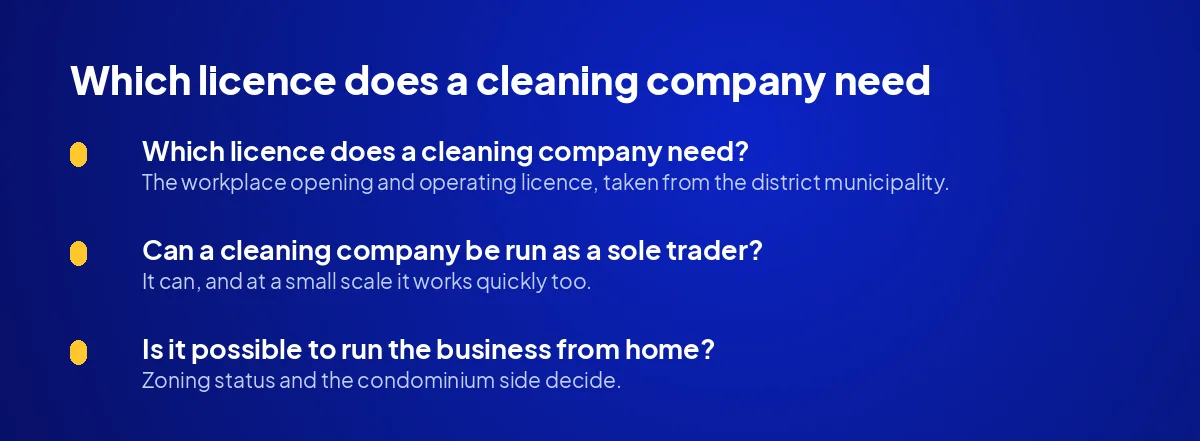
The workplace opening and operating licence, taken from the district municipality. Which class you are assessed in is settled by the scope of your activity.
It can, and at a small scale it works quickly too. On the corporate and tender side a company structure is very likely to be looked for.
Zoning status and the condominium side decide. The question grows heavier if chemicals and machinery stand at the same address.
The social security workplace file is opened, the safety service arranged, and the personnel file and contract template prepared.
In general cleaning work no special qualification is usually sought. Working at height and heavy machinery open a separate training heading.
Ask the supplier for a safety data sheet and keep them in one folder. That folder also serves you in staff training.
It varies with the premises and the activity. The likelihood of it arising rises once flammable chemicals gather in the store.
It depends on the municipality’s schedule and is renewed annually. Ask the revenue department for the amount in force in writing.
Between a few weeks and two months if the address suits and the papers are complete. Should the store alterations grow, the timing moves outside that band.