
Business Service Companies: Cost, Capital, Profit Margin and Earnings

At first sight what separates setting up a service business from selling a product looks like an advantage: no shelves, no stock, no wastage. That is why so many people wanting to work for themselves converge on this line. Inside it the picture changes. What a service business sells is not an object but someone’s time and competence. Capital is tied to the payroll rather than the shelf, the largest line in the expense table becomes people rather than purchases, and the limit on growth becomes the capacity of the team rather than the size of the store room.
The second difference lies on the permission side. A shop selling goods usually runs along one spine. On the service side each branch goes to its own authority: a nursery answers to one body, a driving school to another, a private security company to something else again. Of the seventeen branches here, some open with a municipal licence alone, while others cannot trade for a day without an authorisation certificate from a ministry or a governorship. So the question of which branch to start with is also the question of which door you are willing to pass through.
This page opens the service line through four questions: what the set-up comes to, where the capital is tied, how the margin is formed and what is left at the end of the month. The seventeen branches at the foot of the page each have their own page for papers and permissions. The short descriptions below are there so you can tell in a few lines which is yours.
The four questions of setting up on the service side
The error of using these four words interchangeably goes off earlier in services, for one reason: the outlay is fixed and the income uneven. A team that cannot fill the month produces exactly the same cost.
Cost is what you pay even if no work comes in. Rent, team wages, vehicles, insurance, software, bookkeeping, occupational safety services. Here is where it parts from product selling: staff expense does not rise and fall with sales. A fixed head count means a fixed cost.
Capital is the money you put into the business and that stays there. Equipment, vehicles, fitting out the premises, the cash to carry the first three months of payroll and, if your branch calls for it, the price of meeting the conditions sought for an authorisation certificate. In most service businesses the largest piece is invisible: the cash that keeps the team standing until the first customer pays.
Profit margin is the share left on top of a job sold. In product selling it is worked out from the label, in services from the hour. How many people and how many hours a job takes sets its margin directly. Two jobs at the same price are not the same job when one takes two hours and the other five.
Earnings are what remains, and here they hang on one further variable: occupancy. Your margin may be good and your price right, but a team idle half the month leaves nothing. In this sector profit is made as much by a full diary as by a good price.
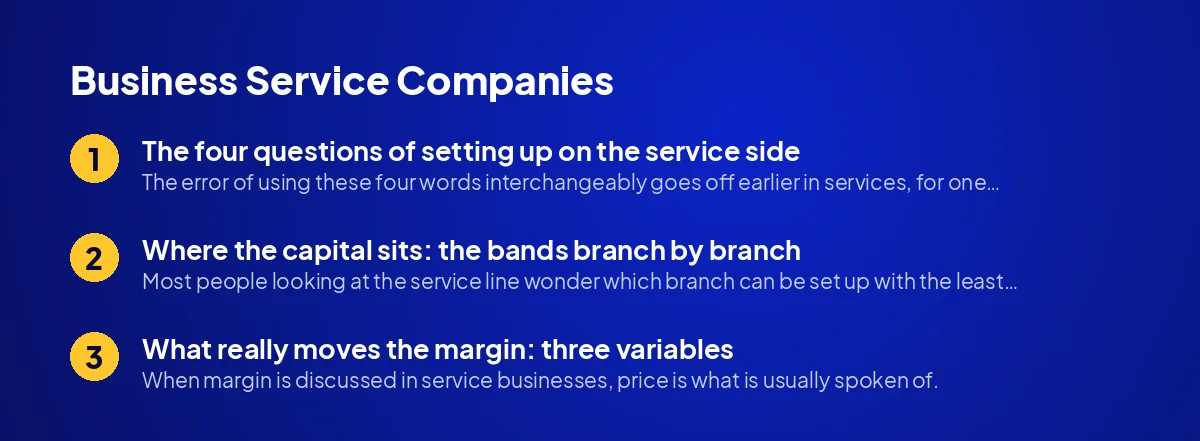
Where the capital sits: the bands branch by branch
Most people looking at the service line wonder which branch can be set up with the least money. What settles it is not the name of the branch but the item the money is placed in. Below, the seventeen branches are gathered into six groups, with each group’s weight of capital, the item it settles into and the speed of return side by side.
| Branch group | Weight of capital | Where it is tied | Speed of return |
|---|---|---|---|
| Teams sent into the field: cleaning, pest control, removals, private security | Between middling and wide | In the payroll and the vehicles; almost no stock | Quick but uneven; tied to the collection term |
| Service in a shop arrangement: dry cleaning, tailoring, photography, printing | Middling | In fixtures and machinery; mastery counts too | Middling; daily takings flow steadily |
| The animal side: pet shop, pet grooming | Middling | In stock and the layout of the premises; goods with service | Middling; repeat custom is high |
| Heavy permission regime: nursery, driving school, veterinary clinic | Wide | In premises, equipment and the certificate’s conditions | Slow; long set-up, income in stages |
| Desk work and agency: estate agency, online service selling | Narrow | In visibility and the payroll; few fixtures | Quick; the commission line swings widely |
| Technical service and field craft: plumbing, technical service, courier branch | Between narrow and middling | In tools, vehicles and the craftsman’s competence | Quick; workmanship pays the same week |
What those six lines say is this: on the service line the capital band shifts with the weight of the permission regime far more than with the size of the branch. A technical service built on one craftsman, one vehicle and one telephone stands beside a nursery requiring conditions on premises, conditions on staff and an authorisation certificate. Which branch you begin with is settled less by the size of your purse than by how long you can wait at a given door.
What capital sitting in the payroll means
Here lies the trap peculiar to this line. Buying equipment, buying a vehicle and taking an office do not make the business ready. A service business can only sell once its team is in place, and the team starts work before the first payment arrives. With corporate customers the distance grows longer: the service is given this month and paid for in the months that follow. The capital plan is therefore built not with a list of equipment but with the cash to carry the payroll until the money comes in.
What really moves the margin: three variables
BU BÖLÜMÜN ÖZETİ
- The first: how many hours a job takes
- The second: the occupancy rate
- The third: staff turnover
When margin is discussed in service businesses, price is what is usually spoken of. Yet price is one of three variables, and the easiest to copy.
The first: how many hours a job takes
On the service side the real unit of cost is the hour, not money. Not knowing with how many people and in how many hours you finished a job, you cannot know whether you did it at a profit. The commonest loss comes from here: the price follows the customer’s expectation while the time follows the reality of the work. A business that knows its hourly cost can turn a bad job down at the outset.
The second: the occupancy rate
In product selling, goods unsold wait on the shelf. In services an hour unsold vanishes and never returns. A day the team spends idle produces that day’s cost in full and leaves no income. The quickest way to lift the margin is therefore not a price rise but the ordering of the diary. A continuing service agreement can leave higher earnings than one-off work even at a lower unit price.
The third: staff turnover
This item never appears in the margin table, yet it erodes the margin most quietly. Every employee who leaves takes three costs with them: the time to find a replacement, the time to train them and the drop in quality over that period. Customers are lost more often to a change in the team they knew than to price. Keeping turnover low means a higher margin on the same price, and wages alone will not do it: a settled working calendar and a clear definition of duties are needed too.
Papers and permissions: the spine of the service side
The seventeen branches go to different authorities, but all begin along the same spine. A lease agreement or title deed, the commencement notice and the tax certificate, registry enrolment if you form a company, registration with the trade chamber, the workplace opening and operating licence, a fire brigade report according to the premises and, if you employ staff, social security registration.
To see step by step where this spine begins and ends, the business licence roadmap page will show the way. Take the order seriously; each authority asks for the paper the one before it issued.
Two headings sit on top of the spine. The first is the variety of the permission regime: some branches run on a municipal licence alone, while others need an authorisation certificate from a ministry, a governorship or a provincial directorate. Driving schools, nurseries, private security, removals, estate agencies and veterinary work belong to this group, and share one feature: without the certificate the activity cannot begin, and it cannot be completed afterwards. Rather than hunting an exact head count, floor area, capital sum or training condition, identify the competent authority and take written confirmation for your own file; these conditions are renewed as the legislation changes.
The second is the staff side. Taking on the first employee is the true breaking point of the set-up here. The social security file, the occupational health and safety service, the personnel file and the payroll arrangement belong in place before that first person. None of them can be put right retrospectively.
Which branch does one start with on the service line?
The decision is squeezed between three expectations: little money, a quick set-up, a wide margin. No branch offers all three. You decide by saying at the outset which you can forgo.
Low capital with a quick set-up puts you in field craft and desk work. Plumbing and technical service, tailoring and alterations, online service selling and pet grooming stand in this corner. The price is that the margin depends on your own labour; on a day you are not in the field the takings stop.
A wide margin with a quick set-up points to branches that build a team and sell a service package. A cleaning company, pest control, photography and printing are here. The risk sits on the customer side, in whether you can establish a steady flow of work.
A wide margin with low risk in a heavily permitted branch costs you capital and time. A nursery, a driving school, a veterinary clinic and private security are in this corner. The set-up is long and the barrier high; once crossed, competition falls away to the same degree.
Coming to this line for the first time, one route works: begin alone or with a small team, learn your customer base and your hourly cost, then build the payroll up. A business that advances in that order already knows what it will fill the team with.
The seventeen branches: documents and permits
BU BÖLÜMÜN ÖZETİ
- Cleaning company
- Pet shop
- Pet grooming salon
- Pest control company
- Removals company
- Private security company
We have written the papers and permission side branch by branch. Find your own trade in the lines below and move to that article.
Cleaning company
The most chosen branch on the line: a light set-up, with growth resting entirely on managing staff. Once façade work and working at height enter, equipment and training grow heavier. See the papers required to set up a cleaning company.
Pet shop
Product selling and service run together here, and once live animal selling joins the list the permission side changes markedly. Repeat custom is high. We gathered the pet shop licence file.
Pet grooming salon
Workmanship sold without stock, on narrow capital. The margin follows the groomer’s speed and a full appointment diary. You will find the opening steps for a pet grooming salon.
Pest control company
The products used and the authority to apply them part this branch from cleaning; a responsible person and record discipline sit at its centre. The margin gathers in regular contracts. Read the permission side of a pest control company.
Removals company
Vehicles, drivers and an authorisation certificate carry this branch; capital is tied in the vehicles and no carriage may be undertaken without the certificate. See the authorisation certificate arrangement in a removals company.
Private security company
One of the heaviest permission regimes on the line: the operating permission, staff training and the identity card arrangement all come before the work. Long set-up, narrow competition. We listed the headings for founding a private security company.
Courier branch
You operate a branch of a network rather than your own brand, so the parent company largely sets the conditions; capital sits in the premises and the vehicles. We gathered the paperwork for opening a courier branch.
Veterinary clinic
Professional authority, a condition on premises and equipment investment are required together, putting the capital band among the widest here. Against that, demand is steady. Move to the documents wanted for a veterinary clinic.
Dry cleaning
Machinery and chemicals tie the capital into fixtures, while layout and ventilation are asked about at the licensing desk. Turnover is daily. You can find the licence steps for a dry cleaning shop.
Tailoring and alterations workshop
One of the narrowest set-ups on the line, calling for no investment beyond machines and mastery. The margin follows the speed of the hand. We set out setting up a tailoring and alterations workshop.
Photography studio
The capital tied in equipment is visible, but the real capital is the portfolio; demand follows the calendar and the season for events. Look at the opening file for a photography studio.
Printing and digital press
A machine-weighted branch: capital is tied to the printing line and the margin set by how full the machine is. Corporate customers bring contracted work. We gathered the printing and digital press permissions.
Nursery and day care
Conditions on premises, staff and inspection are among the most closely regulated, and the opening permission waits until they are met. The set-up is measured in months. See the application process for a nursery and day care.
Driving school
A training permission, a condition on premises, a body of instructors and a fleet of vehicles are wanted together, so both capital and set-up period are wide. Find the conditions and papers for opening a driving school.
Estate agency
Narrow capital, but an entry condition resting on an authorisation certificate and professional competence. Commission income is uneven, and the quality of the portfolio sets the margin. Move to authorisation certificate and registration for an estate agency.
Online service sales
The narrowest door, with no physical premises to carry. Against that, distance selling, returns and electronic commerce registration bring their own duties. Look at the duties in online service selling.
Plumbing and technical service
It can begin with one craftsman, one vehicle and one telephone, yet professional competence is sought. Workmanship pays the same week; growth comes with a team. We gathered the documents for a plumbing and technical service company.
Next in line: articles on earnings, margin and running cost
The part published on the service line today is the papers and permission side: for each of the seventeen branches, which authority to go to, which papers are wanted and how the order is built. The line that follows takes up earnings, margin and cost branch by branch, opening each one’s hourly cost, expected occupancy and expense structure. Each will be linked from this page once it is published.
In Short
- A service business sells not an object but someone’s time and competence
- Capital is tied to the payroll, the vehicles and the certificate’s conditions, not the shelf
- The outlay is fixed and the income uneven; an idle day produces its cost in full
- The real unit of cost is the hour; whoever does not know their hourly cost cannot quote
- Three things set the margin: hours per job, the occupancy rate and staff turnover
- A continuing service agreement can leave more earnings even at a lower unit price
- Where teams go into the field, the collection term sits at the centre of the cash plan
- The permission regime separates the branches: the municipality for some, a ministry or governorship for others
- Where a certificate is needed, activity cannot begin without it and cannot be completed later
- Conditions and competence items are renewed; take written confirmation for your own file
- The social security file and the occupational safety service come before the first employee
- Beginning alone and learning your hourly cost is safer than building a payroll from the start
Quick Glossary
Authorisation certificate: the permission taken from the competent authority to give a particular service, being the precondition of the activity. Occupancy rate: how much of a team’s or a premises’ workable time is filled with income-earning work. Man-hour: the cost measure gathering into one unit how many people did a job in how many hours. Continuing service agreement: an arrangement binding a customer to regular service over a set period. Personnel file: the engagement and identity papers kept for every employee.
Next Step
Let us settle together which branch you begin with, what your hourly cost is and the expense table for your first team: consultation request form.
Frequently Asked Questions
Updated: September 2026
Sık Sorulan Sorular
Because the unit of cost is the hour, not the label. Two jobs at the same price do not leave the same margin when one is finished in two hours and the other in five.
Field craft and desk work are the narrowest door. Plumbing and technical service, tailoring and alterations, online service selling and pet grooming belong to this group.
That your money is tied less in equipment than in the cash keeping the team standing until the first payment arrives. With a corporate customer that distance grows longer.
A separate permission or certificate comes into play on the removals, private security, driving school, nursery, estate agency and veterinary side. Identify the competent authority and take written confirmation for your own file.
Because conditions on premises, staff and inspection have to be met on site before the permission is granted. Here the set-up is measured in months, not weeks.
It is possible and usually safer. Alone you learn your hourly cost and your type of customer; building the payroll afterwards produces fewer mistakes.
Corporate work brings volume and continuity on a long collection term. Individual work pays quickly but flows irregularly; a business carrying both runs more evenly.
Every employee who leaves produces cost from three directions: finding a replacement, training them and the drop in quality over that period. It never shows in the expense table but quietly erodes the margin.
Time spent idle. An hour unsold does not wait on a shelf, it vanishes, while that day’s cost is paid in full.
Source: Ministry of Trade — Tradesmen, Craftsmen and Service Sector Procedures