
How Does ChatGPT Decide Which Brands to Recommend? Can an AI Visibility Consultant Map It?

You type the question a customer would ask into ChatGPT and read the answer: three competitors, and your name nowhere. The first reaction is almost always the same — “How does it decide? Who told it about them?” The second follows close behind: “Is there somewhere I can apply?”
There is not. But the decision is not a mystery either. Assistants recommend brands through a logic that can be described, observed and — within limits — influenced. Once you see that logic, the market’s strange offers stop sounding convincing, and the right consultant becomes much easier to recognise.
This article draws that map: where the assistant gets to know your brand, what it weighs when recommending, how a consultant charts your position, how this knowledge protects you at the meeting table and, honestly, what the map cannot show.
Where Does the Assistant Get to Know Your Brand?
Everything starts with a simple question: what does the assistant know about you, and where did it learn it? There are two channels, and each works differently.
The two channels in detail:
What Does It Weigh When Recommending? The Four Scales
Knowing you is not enough; the assistant has to choose you over others. Our field observations point to four scales in that decision.

How each scale works:
How Does a Consultant Chart This Map?
Scales are a concept; the map is a document. A good consultant turns the concept into a concrete picture of your situation in four steps.
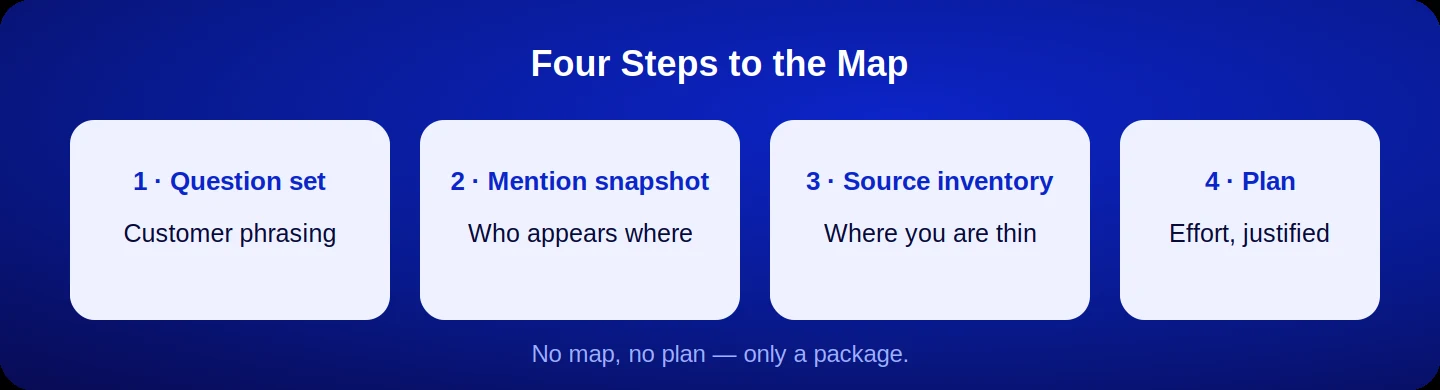
The steps in practice:
How Does This Knowledge Protect You at the Table?
You do not need to become an expert. Knowing the map is enough to protect yourself in four situations.
Four protections:
The Limits of the Map: What We Don’t Know
An honest map shows its blank areas too. Four boundary stones should be known before any contract is signed.
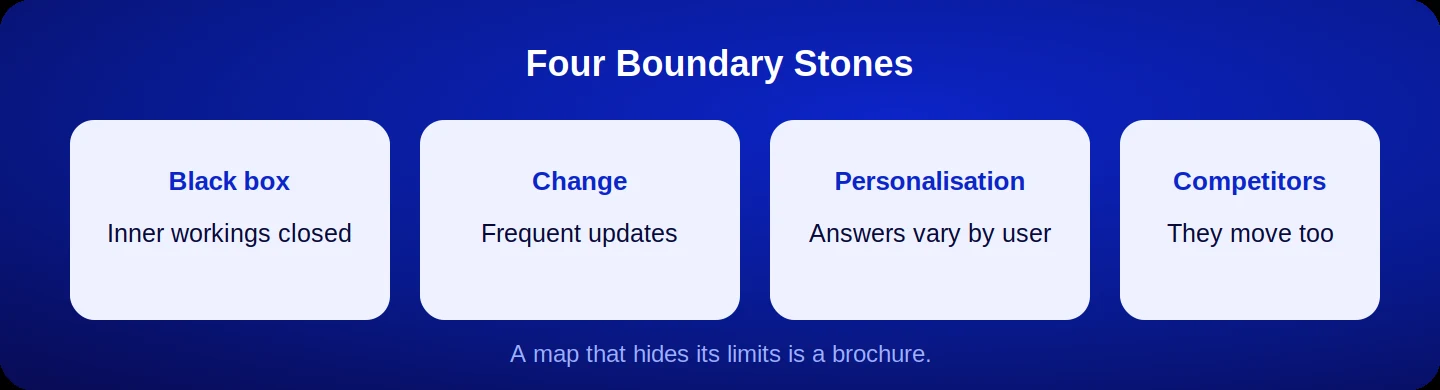
Living with the limits:
Meeting Test and Map X-Ray
BU BÖLÜMÜN ÖZETİ
- “Can you show me where my brand is mentioned today?”
- “Which scale does each item in this proposal strengthen?”
- “What can’t you control?”
- “What do we get if we start small?”
Let us close with the rulebook. Four questions:
What good answers sound like:
“Can you show me where my brand is mentioned today?”
A good answer offers a snapshot — or proposes to take one as the first step, with a clear method. An answer that jumps straight to packages and prices has skipped the map, and everything built on it will be guesswork.
“Which scale does each item in this proposal strengthen?”
A good answer links each item to footprint, question fit, consistency or frame. An answer full of general terms and no links is a sign that the proposal was written for a template rather than for you. The discipline of demanding measurable gains is familiar from the umbrella series too.
“What can’t you control?”
A good answer names the four boundary stones without being asked twice. An expert who knows their limits turns to analysis in a bad month; one who does not turns to excuses. The same logic applies to finding waste in any channel, as in the Google Ads consulting article.
“What do we get if we start small?”
A map X-ray: your question set, a multi-assistant mention snapshot, a source inventory and a plan justified item by item — fixed fee, the outputs are yours. Write down the ten questions your customers ask most and bring them to a preliminary assessment; the full scope is on our AI SEO service page. Neighbouring doors: the selection guide, the small brand question and the first-meeting questions.
Field Notes
· The most common finding of first maps: the brand has plenty written about it, but in places that assistants never cite. Visibility effort that ignores the source inventory often lands in the wrong neighbourhood.
· Brands that bring their own customer questions to the first meeting shorten the mapping phase noticeably; the question set is half-built before the work starts.
· “Where is the registration desk?” remains the fastest filter we know. It takes five seconds and ends the conversation with the wrong seller politely.
Mini Glossary
Two feeds: Learned knowledge from training and live search at answer time — the two channels through which assistants know brands.
Four scales: Footprint thickness, question fit, consistency and frame — the observed factors in recommendations.
Source inventory: The list of sources shaping answers in your segment, and your presence in each.
Quick Summary
· Assistants know brands through training texts and live search; they recommend based on your total footprint, not your advertising.
· Four scales decide: footprint thickness, question fit, consistency and frame. There is no registration desk and no position for sale.
· A good consultant maps before planning: question set, mention snapshot, source inventory, justified plan — and names the limits honestly.
Your Next Step
Tonight, ask three assistants the question your best customer would ask, and note who is mentioned and with which words. That note is the first draft of your map. Bring it to a preliminary assessment, and we will turn it into a real one together.
Frequently Asked Questions
My “about us” page is excellent; isn’t that enough?
It is a good start, but it is only one source — and your own. Assistants weigh what others say about you as well: industry content, comparisons, reviews, news. A strong about page improves consistency and question fit; it does not thicken your external footprint on its own. Think of it as the anchor of your story: necessary, clear, well written — and then echoed in the places assistants actually read.
If I advertise, will ChatGPT recommend me?
Not directly. Organic recommendations in assistant answers are not bought through ad spend. Advertising can indirectly help — more people know you, more people talk about you, more content mentions you — but the recommendation itself comes from the footprint. Where assistants introduce advertising formats, those are separate, labelled placements and do not replace organic mentions. Treat advertising and AI visibility as neighbours with separate books.
Once the map is drawn, is the job done?
No; the map is the starting point. Sources change, competitors move and assistants update, so the map is refreshed at regular intervals — usually through the same measurement that tracks progress. The first map takes the most effort; later updates are lighter. A map drawn once and filed away is like a photograph of a river: accurate on the day it was taken, misleading a season later.
Sık Sorulan Sorular
During training, a language model reads an enormous amount of text and forms associations: which brands are mentioned in which contexts, with which qualities, alongside which questions. If your brand appears frequently and consistently in that body of text, the model “knows” you; if you appear rarely, you are a faint shape in its memory. This knowledge is not updated day by day; it changes with new model versions, which is why today’s efforts reach this channel with a delay.
Many assistants search the web while answering, read current pages and build the answer from them — often citing the sources. This channel is far more responsive: a well-structured page published today can appear in answers within weeks. OpenAI explains how its assistant uses search in its help centre; the principle is simple: what can be found and read today can be recommended today.
Mostly the same effort, with different timing. Clear, consistent and widely echoed information about your brand feeds both channels: live search finds it quickly, and future model versions learn it slowly. The practical difference is patience and measurement: movement in the live channel is visible early, while the memory channel needs longer horizons. A consultant who promises results only through one channel is describing half the picture.
Yes, and it varies from assistant to assistant, even from question to question. For current, local or price-related questions, assistants lean more on live search; for general knowledge questions, they lean more on memory. Providers also update these behaviours frequently. That is why measurement is always done across several assistants — a point we return to in the measurement article.
Because an assistant cannot recommend what it barely knows. Footprint thickness is the total of reliable texts about your brand: your own pages, industry content that mentions you, lists and comparisons you appear in, reviews and news. A brand with a thin footprint remains an uncertain option for the assistant, and uncertain options rarely make the shortlist. Most of the work of AI visibility consists of thickening this footprint in a planned way.
The assistant does not recommend “the good brand”; it recommends “the right brand for this question.” If your content answers the real questions of your customers — price range, process, suitability for a specific need or location — you fit those questions. A site that only says “we are a leading company” fits no question. Question fit is achieved by speaking your customer’s language, not your brochure’s.
Different addresses, different service lists and different descriptions across your site, profiles and directories confuse the assistant. Faced with contradictory information, it either chooses cautiously — that is, leaves you out — or blends the stories and describes you wrongly. Consistency is the quiet scale: it does not win you anything on its own, but its absence costs you a lot. How wrong narratives form, and how they are corrected, is covered in the wrong narrative article.
The qualities attached to your name: “affordable”, “premium”, “fast”, “for beginners”, “specialist.” The assistant matches these frames to the question — a user asking for “the most reliable” and a user asking for “the cheapest” will hear different names. Being mentioned in the wrong frame can call the wrong customers; being mentioned in the right frame brings the customer who is ready to buy what you sell.
From your customers, not from keyword tools alone: the questions your sales team hears, the phrasing on the phone, the concerns raised before purchase. The set covers several layers — general (“the best X”), intent-driven (“who would you recommend for Y on this budget”) and local or niche (“X in my district”). A set built only from easy questions flatters the result; a representative set tells the truth.
The set is asked across several assistants, and each answer is recorded: are you mentioned, in which position, with which qualities, and who else is at the table? The result is a table, not an impression — your starting line. Every later report is compared with this first snapshot; without it, progress cannot be proven.
Where your footprint is thick and where it is thin: which sources appear in answers for your questions, whether you are in them, how your site covers the questions, how consistent your information is across the web. The inventory usually produces a surprising finding — the brand is strong in places that are never cited and absent from the places that are. That gap is where the plan will aim.
Every item in the plan should point to a finding on the map: “these questions are not covered on your site”, “these three sources shape answers in your segment and you are not in them”, “your description differs across four profiles.” A plan built this way is justified line by line. Planning without mapping is how budgets end up in the wrong place — the item-by-item logic is in the budget article.
Because you now know there is no desk: assistants learn from sources, not from applications. When someone offers to “register your brand with ChatGPT”, you can simply ask, “Where is the registration desk?” The pitch cannot survive that question. The other lines of that family are catalogued in the charlatan article.
“Which scale does each item in this proposal strengthen?” A good proposal answers easily: this content improves question fit, this source work thickens the footprint, this clean-up fixes consistency. A proposal whose items cannot be linked to any scale is selling activity, not effect.
The right questions: which questions moved, on which assistants, with which frame, compared with which snapshot? Knowing the map, you are no longer a passive listener to a success story; you read the report as a manager. A client who can read a report is the best protection against guarantee-style promises.
Because you see how the chain works: sources are built, found, weighed and reflected in answers — and each link takes time. Seeing that, you no longer expect results in the first week, but you also stop accepting indefinite vagueness. The honest timeline sits in between, and is described in the timing article.
No one outside the providers knows exactly how a model weighs sources. The four scales are strong patterns from observation, not a published formula. That is why a consultant who claims to have “decoded the algorithm” is overselling; the honest language is “we observe, we test, we measure.”
Through measurement rhythm: when assistants update their behaviour, a regularly measured project notices it within weeks and adjusts; an unmeasured project notices months later, if at all. Change is not a reason to avoid the work; it is a reason to measure it regularly.
It makes single screenshots meaningless, not measurement itself. Because answers can vary with phrasing and context, measurement relies on samples — the same set, several assistants, regular intervals. One screenshot is a frame; a sample is a film. Decisions are made on the film.
Because mention share is relative: while you thicken your footprint, others thicken theirs. Your share can stay flat even while your work is progressing, simply because a competitor is moving faster. A good report therefore always shows competitors alongside you — a point developed in the competitor article.