
Where Does an AI Visibility Budget Go: Content, Technical Work or Brand Reputation?

The proposal is in your hand: one line, one figure — “AI visibility work, this much per month.” Leaving aside how big the figure is, what really bothers you is its silence: what is inside that number? When you buy a car you ask them to open the bonnet; when you buy a house you check the deeds; but when you buy a service, you often sign for a closed box.
The price of a closed box is not only overpaying; the real price is under-receiving. If the box contains no measurement, you have bought work without a report card; if it contains no external sources, half a job; if it contains no diagnosis, work done blindfolded — and you only notice months later.
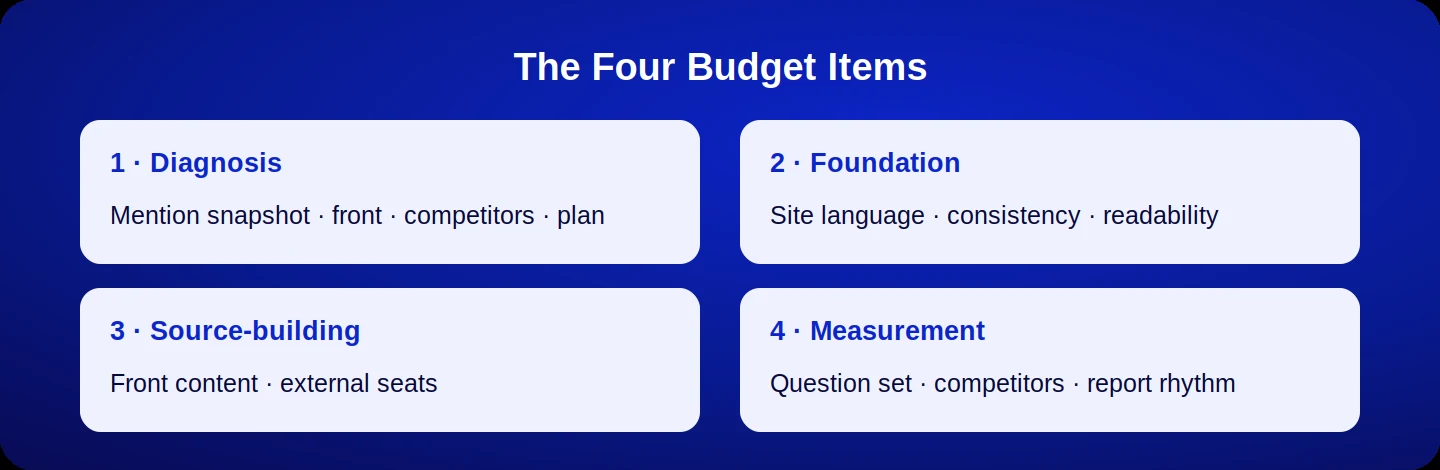
This article opens the box: it explains the four items an AI visibility budget goes to, shows how their weight shifts over time and says which distributions should raise suspicion. After reading, no one-line proposal will look like a figure to you; it will look like an incomplete list.
The Blindness of a Lump-Sum Price: Why Look Item by Item?
First, let us break the habit: “if the total is acceptable, the rest is the agency’s business” costs dearly in this field, in four different ways.
How the four blindnesses work:
Item One: Diagnosis — Where the First Money Goes
Now let us open the box item by item. The first item is the one most brands think “could be skipped” — and which, when skipped, blinds the whole project.
The four parts of diagnosis:
Items Two and Three: Foundation and Source-Building
The diagnosis has given the map; now construction. The two items are neighbours but must not be confused: one repairs the house, the other builds the neighbourhood.
The inner breakdown of the two items:
Item Four: Measurement — The Smallest Slice, the Biggest Insurance
The last item is a candidate for the smallest slice of the budget — and the slice that backfires most expensively when cut.
Four facts about measurement:
The Dance of Ratios: How Does the Budget Shift Over Time?
You know the four items; now the time dimension. In a healthy project the weight of the items does not stand still — it shifts in a particular order.

Reading the shift:
Meeting Test and Budget X-Ray
BU BÖLÜMÜN ÖZETİ
- “Can you split the proposal into four items?”
- “Which item did this month’s money go to, and what changes next month?”
- “If my budget tightens, what do we cut?”
- “What do we get if we start small?”

Closing rulebook. Four questions:
What good answers sound like:
“Can you split the proposal into four items?”
A good answer has already split it, or does so in five minutes: diagnosis, foundation, sources, measurement — concrete tasks under each. Resistance — “our package is a whole” — says the box does not want to be opened; a box that isn’t opened is a box that isn’t bought.
“Which item did this month’s money go to, and what changes next month?”
A good answer shows period awareness: “set-up is done, foundation has dropped to maintenance, the weight is shifting to sources.” A proposal that repeats the same sentence month after month (“all good, we’re working”) does not know the budget’s dance — a narrative that never shifts is often a budget that isn’t working.
“If my budget tightens, what do we cut?”
A good answer knows the priorities by heart: the front is narrowed, the production rhythm reduced, measurement and diagnosis protected. “Let’s cut measurement; that report thing is a formality anyway” is the answer of someone who thinks the box’s most valuable item is a formality — and that person is proposing not to be audited.
“What do we get if we start small?”
A budget X-ray: a four-item analysis of the proposals you hold — which item is full, which empty, which inflated — plus a first-quarter plan built item by item for your own file; fixed fee, the outputs are yours. Bring your proposal to a preliminary assessment and we will open the box together; our own item structure is set out on our AI SEO service page. Neighbouring doors: the pricing logic and the who-should-do-it question.
Field Notes
· The reaction to a request to open the box says more than the proposal itself: a good agency produces its item list gladly — it wants its effort seen. The one that resists is usually protecting a gap it would rather keep hidden.
· The item most often found empty is the outer face: under “source-building” there is only content for the client’s own site. Building that never leaves the house is painting walls indoors.
· Brands that accept “let’s cut measurement” say the same thing in month three: “we don’t know if it’s working.” The small slice that was cut takes the flavour out of the whole cake.
Mini Glossary
Four items: Where the budget goes: diagnosis, foundation alignment, source-building, measurement.
Outer face: The off-site half of source-building — the work of earning seats: correspondence, pitches, follow-up.
Maintenance mode: An item whose set-up is complete shrinking to regular checks — the foundation’s second-period state.
Quick Summary
· A one-line proposal is an incomplete list: the budget is split and read across four items — diagnosis, foundation, source-building, measurement.
· Weight shifts with time: the first quarter is set-up (diagnosis + foundation), the settled period’s body is sources; measurement is a fixed slice every period and is never cut.
· Alarm profiles: no diagnosis, zero measurement, an “all content” package with an empty outer face, endless foundation work, a marathon invoice in month one.
Your Next Step
Take the proposal on your table, write the four item names in the margin and assign each line to an item. The lines you cannot assign and the items left empty are your questions — bring the list to a preliminary assessment, and we will complete it together.
Frequently Asked Questions
If I buy the four items from different places — diagnosis from one, content from another — won’t it be cheaper?
Sometimes on paper; in practice two costs arise: coordination (tying four suppliers to the same front, language and plan is your working time) and disconnection (whoever writes the diagnosis doesn’t see the content, whoever produces content doesn’t read the measurement — the items stop feeding each other). The strength of the items lies not in their separation but in their chain: diagnosis chooses the front, foundation mends the bucket, sources fill it, measurement audits everything. Piecemeal buying is economical only if you have a strong internal coordinator; otherwise the saving is paid for from your calendar.
The agency showed the items but won’t give the ratios; is ratio secrecy normal?
Asking for a penny-by-penny cost breakdown is not realistic — an agency’s internal costs are its own kitchen; but the order of weight is not a kitchen secret: “this period the weight is here, measurement is fixed at this rhythm” can be said in any proposal. What you want is not a percentage table but a period narrative: which item leads in which quarter, and why. A proposal that cannot tell this story may not be hiding ratios; it may never have thought about them — which is more worrying than secrecy.
If my own developer does the foundation work, does it come off the budget?
It does, and it is a legitimate set-up — with two conditions: the task list must come from the diagnosis (your developer takes what to fix from the plan, not from guesswork) and the acceptance criteria must be written (which check must pass before “foundation done” is declared). Without these, the classic friction arises: the agency says “the foundation isn’t ready”, your developer says “I did it”, and the work stalls in between. The right model is a division of labour: diagnosis and acceptance outside, implementation inside — a small-scale version of the lane logic in the dual-model article.
Sık Sorulan Sorular
Two proposals, two figures: one is half the other. Cheap or expensive? You cannot tell without the items — if the half-price proposal has dropped measurement and external source work, it is actually more expensive: finishing the missing work is paid for separately. An item list is the only ground on which proposals can be weighed on the same scale; the protections in the pricing article stand on this ground too.
On a lump sum, negotiation is a blunt knife: when you say “bring it down a bit”, you don’t see what gets cut — and what gets cut is usually the quietest item: measurement. With an itemised proposal, negotiation gets smart: you narrow the front, reduce the rhythm and leave the backbone alone. A client who knows what can be trimmed takes the discount from the scope, not from the agency.
At month’s end, the question “what was done?” is left to storytelling in a project without items. In an itemised project the same question answers itself: was the diagnosis delivered, are the foundation tasks on the list, how many pieces of content and seat steps this month, did the report arrive? An item is the invoice’s conscience — without it, conscience is left to the story too.
A single figure makes shortfalls invisible: a proposal that only produces content can look like a full package as long as there is no item list, under the name “AI visibility package.” The classic hiding places of the gap: diagnosis (“not needed, we know the sector”), external sources (“content will take care of it”) and measurement (“you’ll feel it”). All three are familiar phrases from the filter article; the item list is their antidote.
Your starting reality: in your market’s question layers, who is mentioned today, where you are and in which frame — the zero frame of the rulebook in the measurement article. A project that starts without this frame is a race without a finish line: three months later progress cannot be accounted for, because nobody knows where it started.
The battlefield: in which question slices there is demand, where competitors’ footprint is thin, where you have a real claim — the demand–gap–right intersection of the narrow-front article. The classic waste of projects without diagnosis is here: months of production on a front that cannot be won — honest effort, wrong address.
Because the order is fixed: first the snapshot and the front, then the plan that says “on this slice, at this rhythm, with these sources.” A plan that comes before the diagnosis was written for a template, not for you — the same recipe for every client. Check the date of the plan in the proposal: if it predates delivery of the diagnosis, the first item in the box is missing.
A small but intense slice of the budget: one-off, clearly bounded, with an output that lands in your hands — and its best feature is that it holds value independently of the agency: the diagnosis report is yours and stays with you even if you don’t continue. That is why the door to a small start is always the diagnosis; the guide’s five steps open from there too.
Correcting what you already have: translating your site’s pages into question language, fixing service and identity details with the same sentence on every asset, clarifying the structure so assistants can read it. If the technical side goes deep, website consulting muscles come in; but the essence goes beyond technique — tidying up your story. A scattered story enters the scales incomplete, however much content you produce.
You cannot carry water in a leaking bucket: if new content flows into an inconsistent identity and a messy site, part of the effort leaks out through the holes. Foundation tasks are usually first-quarter work — intense, one-off, then switching to maintenance mode. If you see an open-ended “site improvement” item in a proposal, ask: which tasks, finishing in which month? Foundation work that never ends is the budget’s silent leak.
The inner face: deep, authentic content that fills your front’s questions — the long-breathing body of the project. The outer face: the seat pan of the scales — the effort of earning a place in industry publications, comparisons, directories and reputation spaces. The second face is invisible labour: correspondence, pitches, follow-up — it cannot be counted on the invoice like “content”, but it often sets the ceiling of your share. If the proposal has no concrete item for the outer face, the box is half empty.
Ad spend: assistant visibility is not bought with an advertising budget — the advertising side lives on its own account with its own scoreboard; a proposal that writes both budgets on the same line blurs both jobs. Social media management is a separate craft too: it touches some places, but it is not an item in this box. Clear boundaries protect both auditing and comparison.
Because it is labour: maintaining the question set, regular querying, recording, competitor comparison, a report with diagnostic commentary — none of it happens by itself. “We’ll give you the report for free” looks like generosity; in practice free work gets free priority: in a busy month it is the first to thin out. Measurement being its own item means its rhythm comes under contractual protection.
Because what is cut is not information but your ability to manage: in an unmeasured project an unproductive item cannot be caught, a bad month cannot be diagnosed, continue-revise-exit decisions cannot be made — the whole budget is spent in the dark. Giving up oversight of a hundred per cent to save a few per cent is the worst bargain arithmetic allows.
As tracking tools spread, the muscle work of measurement gets cheaper; but the three tasks we separated in the measurement article — building a representative question set, turning figures into a diagnosis, linking the diagnosis to a plan — remain labour. If “we have a tool” stands in for the measurement item in a proposal, beware: the item is an interpreted report rhythm, not a tool subscription.
Measurement writes the other three items’ report cards: are the foundation tasks done — the consistency scan says; is the content filling the front — the front breakdown says; are the seats working — the source-trace column says. So the fourth item is the guard of the first three; a proposal that cuts it is also proposing to leave itself unaudited. What GİB guidance is to the discipline of documenting expenses, the measurement item is to the project: unrecorded spending is indefensible spending.
Because the order demands it: without a snapshot the front cannot be chosen; without a repaired foundation content does not flow efficiently. The first quarter’s budget therefore leans on diagnosis and foundation; production starts, but it is not yet the body. In this period the answer to “why so little content?” lies in the plan — the timeline in the timing article describes this curve of the budget too.
To source-building: the foundation drops into maintenance mode, the diagnosis thins to an annual refresh, and the body of the budget flows into content rhythm and seat work. The health sign of this period is sameness: similar production month by month, similar reports, no surprises. It looks boring; boredom is the skin of a settled system.
Two honest options: the budget grows (the new front’s questions and seats are added) or the budget stays fixed and the timeline stretches — the expansion is laid slowly. The dishonest third way is to say “we’re covering two fronts now” on the same budget: two fronts, one budget, half a footprint each. The signal for expansion comes from the scoreboard, not the budget: if the narrow front is saturated, expand; if not, deepen.
Four profiles: starting without diagnosis (“we know the sector”), zero measurement (“you’ll feel it”), everything labelled content (outer face empty) and open-ended foundation work (endless improvement). There is also the reverse: a first month swollen with heavy source commitments before any results — a marathon invoice before the run. A healthy distribution starts small and grows with the scoreboard; that is how the discipline of digital consulting translates into this field.