
How Is AI Visibility Consulting Priced? Does a Retainer or a Project Protect Me Better?
You have three proposals, and all three describe the same work: “AI visibility consulting.” One is a quarter of another; the third sits exactly between them. Which is expensive and which is cheap? The real question is this: are these three figures the price of the same thing?
Most of the time, no. In a new market the same label covers very different work: one only produces content, one only delivers reports, one takes on all four items. Because the labels are identical, the figures are assumed to be comparable; in reality what is being compared is not prices but scopes.
This article explains how price is built: which models exist, which variables push the figure up or down, when cheap and expensive are genuinely cheap or expensive, and which three protections to look for before signing a proposal. Our prices are on our page; here we teach you how to read a price.
Why Is There No Single Price? Four Variables Behind the Figure
A website build or an ads management service has a roughly known market. This field does not yet — and the reason is not opportunism but the nature of the work.
Four variables that set the figure:
Three Pricing Models: Which One Suits You?
Three models circulate in the market. All three are legitimate; what is wrong is choosing the one that doesn’t fit you.

Inside the models:
When Is Cheap Cheap, and When Is Expensive Expensive?
A figure on its own is not a measure of quality; but the extremes say something. Let us read both honestly.
Four readings:
Three Protections Before Signing
Even if the figure looks right, a proposal without these three protections is not signed. All three are simple; all three are often forgotten.
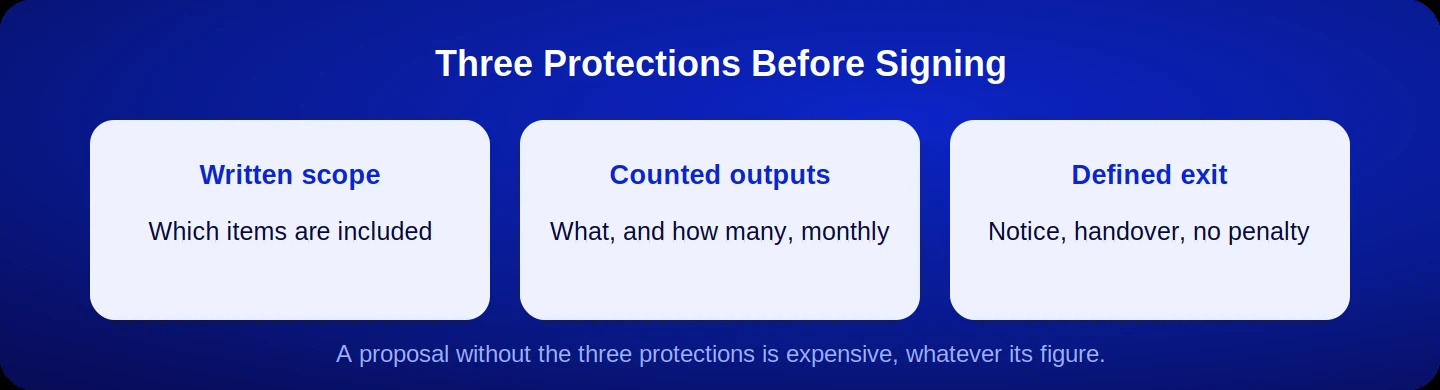
Inside the protections:
Managing the Price Wisely: A Tight Budget or a Generous One
You have found the right proposal; now comes fitting your budget to it — or fitting it to your budget.

Four management principles:
Meeting Test and Price X-Ray
BU BÖLÜMÜN ÖZETİ
- “Which items does this figure pay for?”
- “What changes if we halve the budget?”
- “What happens if we want to leave?”
- “What do we get if we start small?”
Closing rulebook. Four questions:
What good answers sound like:
“Which items does this figure pay for?”
A good answer lists the four items and shows concrete tasks under each. “Our package is a whole and can’t be split” says the box does not want to be opened. You cannot evaluate the price of a box that won’t open; and you should not sign what you cannot evaluate.
“What changes if we halve the budget?”
A good answer knows the priorities: the front narrows, the rhythm shrinks, the backbone — diagnosis and measurement — is protected. If the answer is “then we’ll drop the report”, it thinks the most valuable item is the easiest to sacrifice. Whoever doesn’t know where to cut doesn’t know where to spend either.
“What happens if we want to leave?”
A good answer is clear and short: this much notice, handover of these contents and data, penalty-free separation. If a long, penalty-laden, complicated answer comes back, that proposal’s real price is higher than its written figure — because the cost of exit is part of the price.
“What do we get if we start small?”
A price X-ray: an analysis of the scope and protections in the proposals you hold — which is incomplete, which inflated, which balanced — and a budget proposal built for your front. Our current packages and prices are clearly set out on our AI SEO service page; bring your proposals to a preliminary assessment and we will read them side by side. Neighbouring doors: the budget items and the charlatan filter.
Field Notes
· Of the three proposals brought to us, two usually don’t match in scope: one skipped measurement, the other skipped external source work. When the items are compared, the price comparison changes completely.
· The most commonly missing protection is a defined exit: the proposal has price and scope, but no separation terms. That gap turns into a big question in the relationship’s first bad month.
· The shared relief of brands that choose set-up plus maintenance: the question “why are we paying the same every month?” never arises, because the figure follows the curve of the work.
Mini Glossary
Scope: The written list of items and fronts included in a proposal — the precondition for reading a price.
Set-up plus maintenance: A two-stage pricing model: intense at the start, lighter in the settled period.
Three protections: Written scope, counted outputs and defined exit — the minimum to look for before signing.
Quick Summary
· There is no single price; four variables set the figure: scope, front width, starting footprint, production rhythm.
· Three models are legitimate — one-off diagnosis, monthly ongoing, set-up plus maintenance; choose by your in-house capacity. Performance-based pricing is rare and risky here.
· Compare scopes, not figures; look for three protections before signing. On a tight budget, cut the front and rhythm, protect diagnosis and measurement.
Your Next Step
Put the proposals you hold side by side and mark the three protections in each: written scope, counted outputs, defined exit. Bring the missing ones to a preliminary assessment; you will find our current prices on our service page.
Frequently Asked Questions
Should AI visibility consulting cost more than classic SEO?
Not necessarily. Some items are shared — content, site structure, technical maintenance — and some are new: multi-assistant mention measurement, alignment with question language, frame tracking, a new prioritisation of external source-building. A price difference can only be justified by the effort of these new items. If a higher figure is asked for the same items, what you are paying for is the label, not the work. The reverse is true too: if your current SEO work is solid, AI visibility work can be built on top of it at a lower additional cost.
Is it better to pay monthly or per project?
It depends on the nature of the work and your in-house capacity. With per-project payment — such as a one-off diagnosis and plan — spending is limited and predictable, but execution is left to you. With monthly payment the rhythm is secured, but counted outputs and a defined exit are essential. For most SMEs the balanced route is to price the set-up period like a project and the subsequent maintenance monthly. Whichever model you choose, tie the payment schedule to the effort schedule: large sums paid upfront before work is done reduce your power to audit.
What information should I prepare to get a more accurate quote?
Prepare four things: a list of the questions your customers ask most, the regions you serve and your priority services, the competitors you know, and an inventory of your current digital assets — site, profiles, listings. This helps the agency estimate your front width and starting footprint more accurately, so the quote is based on you rather than the average. The most accurate price still comes after a diagnosis: a short diagnosis provides a more reliable budget basis than a long estimate.
Sık Sorulan Sorular
It is the biggest factor: how many of the four items are included can change the figure several times over. A service that only provides measurement and one that takes on everything from diagnosis to source-building can carry the same label. Read the item list before reading the figure; a figure without a list is the tag on a package whose contents you can’t see.
Each question slice demands its own content, its own sources, its own measurement. Working for one service in one district and working for ten services nationwide are not done with the same effort. A narrow front delivers results faster and costs less — the strategy in the small brand article is a smart starting point on the budget side too.
For a brand that has produced content for years, has tidy details and is known in its sector, the work is mostly alignment: translating what exists into question language, tidying scattered pieces. For a brand starting from zero, something recognisable must be produced first. Same front, same target — but a different start, different effort, a different price. Only a diagnosis shows this difference; a price given without diagnosis is pricing the average, not your starting point.
The difference between two and twelve pieces of content a month, between one and five source steps, is reflected directly in the figure. Rhythm is also a determinant of the timeline: a denser rhythm means faster progress, but only if the front and foundation are ready for it. Rhythm is the dial between budget and patience — you choose which one to turn down.
A brand with its own team looking for a roadmap: a diagnosis report, front selection, question set and priority plan are delivered; the in-house team runs the execution. The advantage is clear — a limited, predictable spend and an output that is entirely yours. So is the risk: if the plan stays on the shelf, its value disappears. If your in-house team lacks the time and the muscle, this model is a ticket for a journey left half done.
Rhythm: all four items run externally, with similar volumes of production, source work and reporting each month. It is the most comfortable model for brands with limited in-house capacity. The point to watch is tying continuity to counted outputs: “monthly work” cannot be audited unless what is produced each month is written down. And the exit: without a defined exit, an ongoing model can turn into dependency.
Because it follows the natural curve of the work: in the first period diagnosis and foundation need intense effort; in the settled period the work drops into maintenance mode. This model builds the budget to that curve — higher at the start, lighter afterwards. It makes budget swings predictable and removes the question “why the same figure every month?” The signal to move into maintenance comes from measurement, not the calendar.
Because the result cannot be controlled: no agency controls assistant answers, systems update, competitors move. A performance-based model is either built on a vague metric — such as mentions on easy questions — or the agency quietly adds the risk to the price. Both work against you. What is reasonable is the principle of guarantee inputs, target outputs: effort and measurement are priced, and the result is set as a target.
Usually one of three things: the scope is narrow (only content, no external sources or measurement), production is automated (mass-produced, careless text) or the work is in inexperienced hands. The first is fine if said honestly — narrow scope, narrow price. The other two risk contaminating your footprint: careless mass content does not strengthen you in the assistant’s eyes; it blurs you.
When the scope is clearly written, the outputs counted and measurement included: a narrow front, a small rhythm, but a complete cycle. Such a proposal is the smartest start for a small brand — small but whole. The healthy kind of cheapness narrows the scope; the unhealthy kind quietly deletes items.
When the scope is broad, the front spans several regions or services, competitor density is high and source-building requires heavy effort. A justified high price can show its reasoning item by item: which effort, what volume, over what period. Expensiveness with a justification is simply correctly priced work.
When no justification can be shown: when the “AI expertise” label has been added as a premium on the same old SEO package, when the items are the same but the figure has multiplied. A new and fashionable field is the most fertile ground for label inflation. The test is simple: put the same agency’s classic SEO proposal next to its AI proposal — if the items are the same, what you are paying extra for is a word, not work. The way to recognise relabellers is the four competence tests.
Because it is the ground for the other two: if it isn’t written which of the four items are included, on which fronts the work happens and which tasks are out of scope, arguing at month’s end about what was left undone is impossible. Writing down what is out of scope matters too — the sentence “this is not included” blocks surprise invoices later.
With quantities and rhythm: how many pieces of content, how many source steps per month, at what interval measurement runs, in which week the report arrives. “Regular content production” cannot be audited; “this many in-depth pieces per month” can. Counted outputs are also the justification of the price: they show what the figure pays for and make it possible to weigh two proposals on the same scale.
Because you know you won’t be held hostage if the target is missed: a reasonable notice period, handover of produced content and data, penalty-free separation. That is what a guarantee-seeking instinct really wants — a way out. A proposal demanding long, penalty-laden commitment may not trust its own work; an agency confident in its work keeps the exit easy, because it knows it will keep the client with results.
That the proposal, price and terms are open and comparable: transparency in commercial relationships protects buyers and is the basis of a healthy market. For the general framework of competition rules in Türkiye, the Competition Authority is a useful reference. In practice, keep your rule simple: never put a price on a promise that isn’t written down — spoken words are forgotten on invoice day.
The front is narrowed and the production rhythm reduced — but diagnosis and measurement are protected. These two are the backbone: a project without diagnosis spends in the wrong place, a project without measurement spends in the dark. The smartest use of a tight budget is a small but complete cycle: one narrow front, a simple rhythm, regular reports. A small project with a solid backbone grows over time.
Haste: a generous budget creates the temptation to expand early — entering several fronts at once and leaving a thin footprint on each. Even a generous budget should be used in order: first settle one front, then expand. Extra money does not replace patience; the chain’s discovery and weighing links do not speed up with money, only with consistency.
Public programmes supporting consultancy and digitalisation spending for SMEs open from time to time; their terms and scope change, and current announcements should be followed. These supports can lower the total cost but should not change the scope decision: support is used to lighten the cost of the right work, not to make the wrong work attractive.
When the period changes: when set-up ends and maintenance mode begins, when the front widens or narrows, when the rhythm changes. A fixed figure is for fixed work; when the work changes, it is natural for the figure to change too — in both directions. If you are still paying a set-up-period price in the settled period, you are paying for work that isn’t being done. Price should be on the agenda of end-of-quarter meetings as well.