
How Long Does AI Visibility Work Take to Deliver? Where Should Patience End?
Somewhere in every meeting the question arrives — sometimes in the first minute, sometimes just before signing: “So when will we see something?” It looks innocent, but inside it hide a budget plan, a partners’ meeting, perhaps a limit to patience. Answer it wrongly and the project is built on disappointment before it even starts.
Two wrong answers circulate in this field. One says “results in month one” and later makes you pay for speed with shortcuts. The other says “be patient, this is a long game” and hides the timeline in fog — and unmeasured patience turns into unchecked invoices.
The right answer is not somewhere between the two, but somewhere else: a timeline is not a date, it is a sequence of milestones. This article sets those milestones in order, shows what determines speed and explains how to answer “are we on the right track?” halfway along the road.
Why Isn’t a Timeline a Single Date? The Links of the Chain
To understand the timeline, you first need to see how effort reaches an answer. The road between them is not one step but a series of links waiting on each other.
How the four links turn:
Milestones: What Should You See, Month by Month?
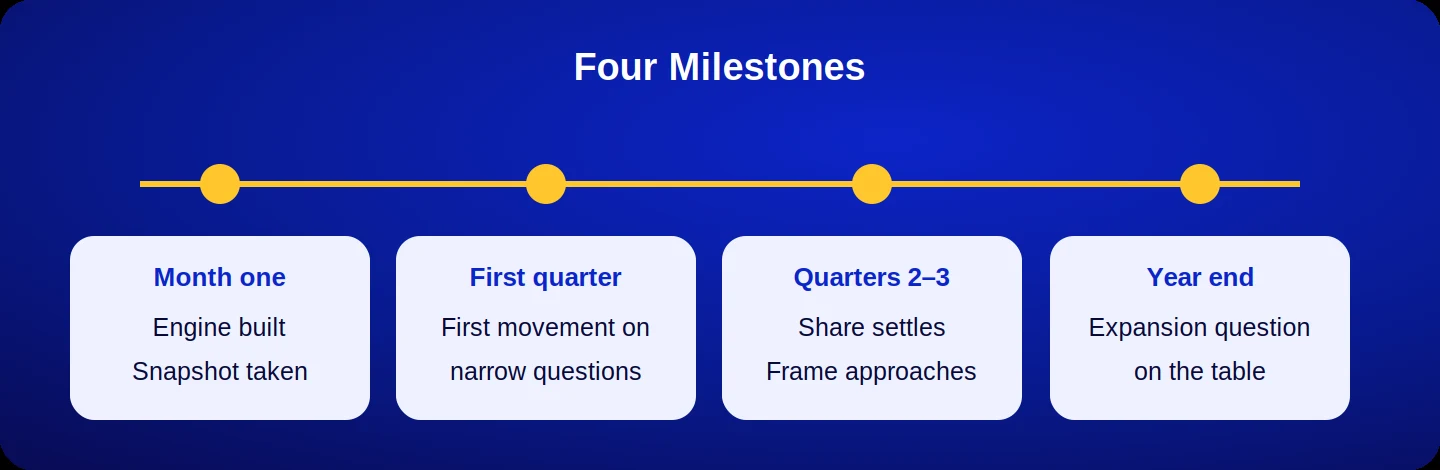
Now the timeline itself. The dates shift from brand to brand; the order of the milestones does not.
Inside the milestones:
Four Variables That Determine Speed
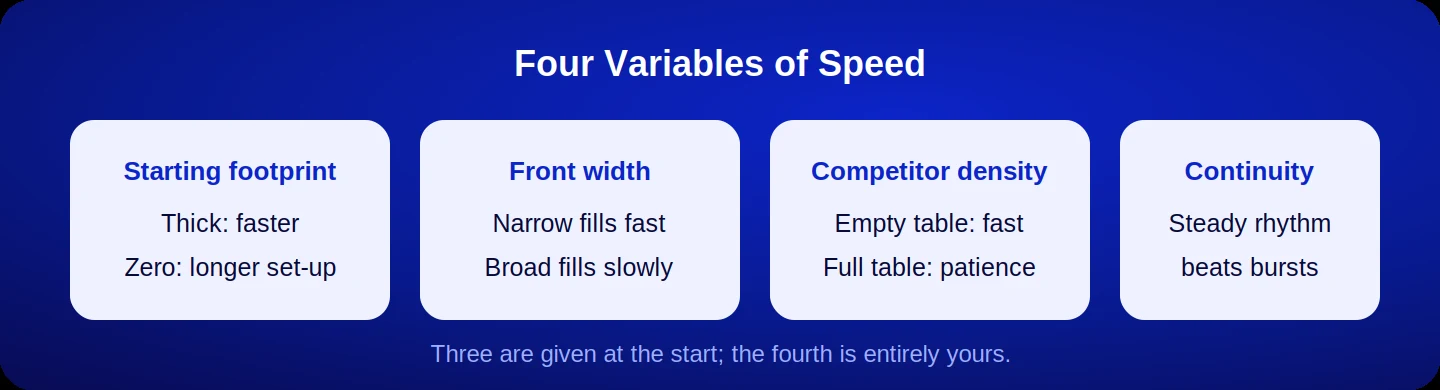
The same work produces fast results for one brand and slow results for another. The difference comes not from luck but from starting conditions.
The effect of the variables:
Four Traps That Stretch the Timeline
Even projects that start with the right variables can slow down along the way. These are the traps we see most often in the field.
Four big traps:
Halfway Along: How Do You Know You’re on the Right Track?
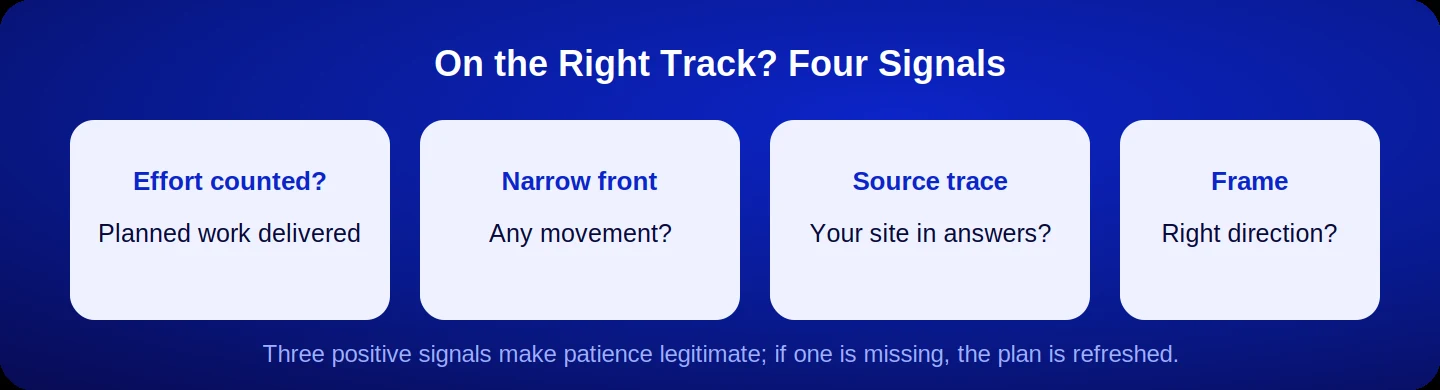
The hardest question comes at the end of the first quarter: the result is not big yet, but effort has been spent. Continue or revise? Four signals give the answer.
Reading the signals:
Meeting Test and Timeline X-Ray
BU BÖLÜMÜN ÖZETİ
- To the agency: “What exactly will I see in the first three months?”
- “What can I do to speed up the timeline?”
- “If we’re behind target in month six, what happens?”
- “What do we get if we start small?”
Closing rulebook. Four questions:
What good answers sound like:
To the agency: “What exactly will I see in the first three months?”
A good answer speaks in milestones: deliverables in month one, signs to look for in the first quarter, items to discuss if we don’t see them. If an empty sentence like “you’ll start seeing results” comes back, the follow-up is ready: “At which figure, on which question?” A timeline that doesn’t become concrete cannot be argued about later.
“What can I do to speed up the timeline?”
A good answer states your share: quick approvals, sharing customer questions, early delivery of proof material — cases, photos, reviews — and consistency on your own channels. Half the speed is in the agency’s hands, half in yours. “We’ll handle it, you just wait” looks comfortable but takes half the timeline off the table.
“If we’re behind target in month six, what happens?”
A good answer gives a protocol: an effort audit, a front revision, a plan refresh — and a defined exit if needed. If “a bit more patience” arrives on its own, beware: patience is legitimate only when supported by signals; patience without signals is the politest disguise of dependency.
“What do we get if we start small?”
A timeline X-ray: a measurement of your starting footprint, an analysis of front width and competitor density, then a first-quarter plan with milestones built for you — fixed fee, the timeline is yours. Write your budget periods and expectation dates and send them for a preliminary assessment; let us draw a realistic timeline together. The full scope is on our AI SEO service page. Neighbouring door: the pricing logic.
Field Notes
· The sentence we hear most often at the end of month one is “nothing has changed yet”; when we open the set-up list together, it becomes “so this was that month.” Discussing the timeline up front prevents the first crisis up front.
· The earliest signal is often not mentions but source lists: a site appearing as a source on assistants that search live arrives a few weeks before mentions do.
· What the fastest-moving projects share is not a big budget but a steady rhythm: brands producing the same volume every month without interruption leave intense-but-intermittent ones behind.
Mini Glossary
Milestone: A concrete sign expected in a given period of the timeline — and discussed if it doesn’t appear.
Two-speed answers: Movement seen early on assistants that search live, and late on answers that lean on memory.
Litmus front: The narrow question slice that first shows whether the mechanism is working.
Quick Summary
· A timeline is a sequence of milestones, not a date: month one set-up, first quarter movement on narrow questions, quarters two and three settling, year end the expansion question.
· Four variables set the speed: starting footprint, front width, competitor density and continuity — the last is entirely in your hands.
· Traps stretch the timeline: starting without diagnosis, skipping the foundation, trying shortcuts, proceeding without measurement. Halfway along, check four signals: effort, narrow front, source trace, frame.
Your Next Step
Look at the timeline section of the proposal on your table: is there a date, or are there milestones? If there are no milestones, ask your agency in writing this week for the first quarter’s concrete signs. Bring the answer to a preliminary assessment — realistic or fairy tale, let us look together.
Frequently Asked Questions
My competitor says they got results in six months; why can’t we in the same time?
You might, or you might not — because speed is a function of starting conditions, not intention. If your competitor’s starting footprint, chosen front, the competition at the time and production rhythm differ from yours, the same timeline cannot be expected. It is also unclear which figure and which question set their “we got results” rests on. The right comparison is not the competitor’s timeline but your own starting snapshot: the diagnosis draws a timeline that belongs to you, and you measure your progress against it.
If we pause the work for a few months, will we lose what we’ve gained?
Not immediately — footprint does not vanish the moment the tap closes the way advertising does; live content and mentions in external sources keep working. But over time erosion begins: information goes stale, competitors keep producing, the freshness pan lightens. A short break is usually tolerated; a long one creates a warm-up cost. The best route, if the budget tightens, is to reduce the rhythm rather than stop completely: keeping measurement and a maintenance tempo while cutting production is always cheaper than restarting.
Once we get results, can we stop, or does it go on forever?
It doesn’t stop, but it shrinks: visibility is not an asset you win once and lock in a safe, but a position that needs maintenance — like a shop window. The set-up and growth periods need intense effort; in the settled period the work drops into maintenance mode: regular measurement, freshness updates, additions for new questions. That maintenance is a small fraction of the initial investment. And you don’t have to depend on an ongoing agency: in a well-built system, a large part of the maintenance can be handed over in-house.
Sık Sorulan Sorular
The first link is in your hands: content is written, a page is fixed, company details are aligned, a story is pitched to a source. This link turns quickly but shows nothing on its own — a page that is live is not yet in anyone’s view. This first period in which effort is invisible tests knowledge, not patience: if what was done is counted, its invisibility is an expected state, not a worry.
The crawling and indexing of live text, the noticing of a mention in an external source — these turn with the cycles of search systems and assistants. There is no button to speed this link up; at most you can remove obstacles: readable structure, a clean site, accessible pages. The general rules of the discovery link — the foundation described in the foundation–roof article — still apply.
For information that has been seen to accumulate before it is reflected in answers: a single page rarely tips the scales; weight forms as footprints pointing in the same direction multiply and different sources say the same sentence. The four scales weigh together, not one by one — which is why the first pieces of content often pass silently and the tenth piece turns up the volume of the first nine.
Because assistants work in two ways: those that build answers by searching live reflect new footprint relatively early; answers that lean mainly on model memory wait for update cycles — and those cycles are not on your calendar. The same work can show up as movement within weeks at one door and as settling after months at another. That is why measurement is done across several assistants: whoever looks at a single door mistakes half a timeline for the whole.
Because month one’s job is not to build but to prepare the building site: the diagnosis is delivered, the question set is built with you, the starting snapshot is taken, the first round of foundation repair is done. The question to ask at the end of this month is not “have we started being mentioned?” but “is the engine running?” A project that does not discuss this distinction up front is shaken by an unfair disappointment at the end of month one.
The earliest sign in the narrowest place: first mentions on niche and local questions, your site starting to appear among the answer sources of assistants that search live, first improvements in the frame column. These are small figures but they show direction — and the first quarter’s report card is direction, not size. That is why the narrow-front strategy is fast: the slice in the small brand article is where the first movement shows earliest.
On the narrow front, mention share stops fluctuating and settles at a steady level; progress appears in the position column and the frame approaches its target. The business-link counters — source question, brand searches, contact channels — give their first meaningful signs in this period. Here the project stops being a “trial” and becomes a “system”: the rhythm has settled, reports produce no surprises, the body of the budget has shifted to source-building.
The expansion question: if the narrow front is near saturation, move to the adjacent slice — a neighbouring region, a related service, a higher question layer; if not, keep deepening. This decision comes from the scoreboard, not the calendar: not “it’s been a year, let’s grow” but “the narrow front’s share has settled at this level” opens the door. Whoever expands early thins out on both fronts.
A brand that has produced content for years, is known in its sector and has tidy company details starts the race ahead: the work is alignment rather than construction — translating the existing footprint into question language, tidying the scattered bits. A brand starting from zero must first produce something to be recognised. Both are legitimate; but the same timeline should not be expected. That is the first benefit of diagnosis: drawing a realistic timeline for your starting point.
Because on a narrow slice there are few questions, competitors’ footprint is thin and each new piece of content adds relatively large weight to the scales. A journey that could take years on “the best in the country” is measured in quarters on “in this district, for this need.” Choosing the front is therefore not just strategy but a timeline decision — and it is no coincidence that it is among the first steps of the guide.
Taking a seat at an empty table is easy; making room at a full one takes time. If your competitors’ footprint on the front is thick, overtaking them requires leaving not just footprint but more consistent and deeper footprint than theirs. In that case the timeline stretches but the strategy doesn’t change: the gap is first closed on a narrow slice, then expanded — the four homework tasks of the competitor article are the handbook for a full table.
The first three variables are given to you at the start; the fourth is entirely in your hands. Four pieces of content every month deliver faster results than twelve pieces every three months — because the discovery and weighing links feed on continuity and cool with interruption. A project that proceeds in bursts warms up again from near zero each time. If you want speed, buy rhythm, not intensity. For the public framework that treats digital transformation as a long-term capacity effort, Ministry of Industry and Technology resources are worth a look; the principle there applies here too: lasting capacity is built through continuity, not campaigns.
If production begins before a front is chosen, the first months go on content written for questions that cannot be won. The effort is honest, the address wrong; a diagnosis done three months later says most of the first three months must be redone. The few weeks gained by skipping diagnosis are usually paid back in months — the timeline equivalent of the first item in the budget article.
It is like carrying water in a leaking bucket: with inconsistent details, contradictory pages and a mixed identity, new content enters the scales incompletely. The assistant reads a scattered story with low confidence; footprint accumulates but does not turn into weight. Foundation repair is the first quarter’s dull work — dull but accelerating. Skip it, and every following quarter moves a little slower.
The most painful paradox: the shortcut taken to speed up — mass low-quality content, bought mentions, fake reviews — may produce a brief flicker, but it contaminates the footprint. Cleaning contaminated footprint takes longer than building clean footprint. A shortcut doesn’t shorten the timeline; it adds a repair chapter in front of it. That chapter’s damage map is in the risk article.
Because it doesn’t even show you are slowing down: without measurement, it is invisible which front is moving and which has stopped; the plan isn’t revised and unproductive work continues for months. Measurement manages the timeline — a timeline without measurement is just time passing. A project that cannot answer “where did we come from, where are we now?” with numbers at the end of each quarter is following hope, not a timeline.
Because if there is no result, the first question is “was it done?”: did the planned content get produced, are the foundation tasks finished, were the seat steps taken? If effort is missing, the problem is not the timeline but execution — and that is where the fix lies. Waiting for results from work not done is looking at an unsown field and counting the harvest. That is why counted effort is the first of the signable commitments.
That the mechanism works: if first mentions appear on niche and local questions, effort is reaching the scales — it is normal for the broad front not to move yet. If there is no movement even on the narrow front, look for the problem in front selection, content depth or the foundation. The narrow front is the project’s litmus paper: if the colour doesn’t change there, it never changes on the broad front.
By looking at the source lists in answers from assistants that search live: have your site or external sources about you started to appear? Even before mentions arrive, getting into the source list shows that the chain’s discovery link is turning. This signal often comes before mentions; it is a forerunner that announces them.
Because being mentioned quickly in the wrong frame costs more than being mentioned slowly in the right one: a premium brand that starts being described as “the budget alternative” seems to be speeding up but is calling the wrong customers. If the frame drifts in the wrong direction, correct the direction, not the speed — the wrong narrative article is the handbook for that correction.