
Is AI Visibility Work Risky: Can It Hurt My Google Rankings If Done Wrong?
A cautious business owner asks about the loss before the profit when entering new work: “What’s the worst that could happen?” That question isn’t cowardice; it’s a reflex earned over years. For someone who once lost rankings because of the wrong agency, or was embarrassed in front of customers by an exaggerated advert, “what’s the risk?” comes before “what’s the benefit?”
The honest answer has two parts. First: AI visibility work itself is not risky; done with the right method, it consists of tasks that strengthen your site and your brand. Second: the newness of the field also gives risky methods room to circulate — and the real danger lies not in the work itself but in shortcuts and carelessness.
This article names the risks one by one: how shortcuts contaminate the footprint, how existing SEO traffic can be disturbed, how the brand can slip into the wrong frame and where access security can leak. Then it describes the insurance for each. The goal is not to frighten you but to shrink risk to a manageable size.
The Right Question About Risk: The Risk of What?
“Is it risky?” is too broad on its own. The right answer starts by breaking the question itself into parts.
Four distinctions:
Shortcut Risks: Four Ways to Contaminate the Footprint
The biggest risk is shortcuts sold with a promise of fast results. In the short term they may produce a flicker; in the long term they contaminate the footprint.

The damage done by shortcuts:
The Risk of Disturbing Existing Traffic: The Most Concrete Danger
Less dramatic than shortcuts but more frequent: a well-meant edit knocking pages that bring in money today out of the rankings.
Four scenarios and their safeguards:
Brand, Data and Security Risks
Shortcut and traffic risks look technical. The risks below touch your brand and your data directly.
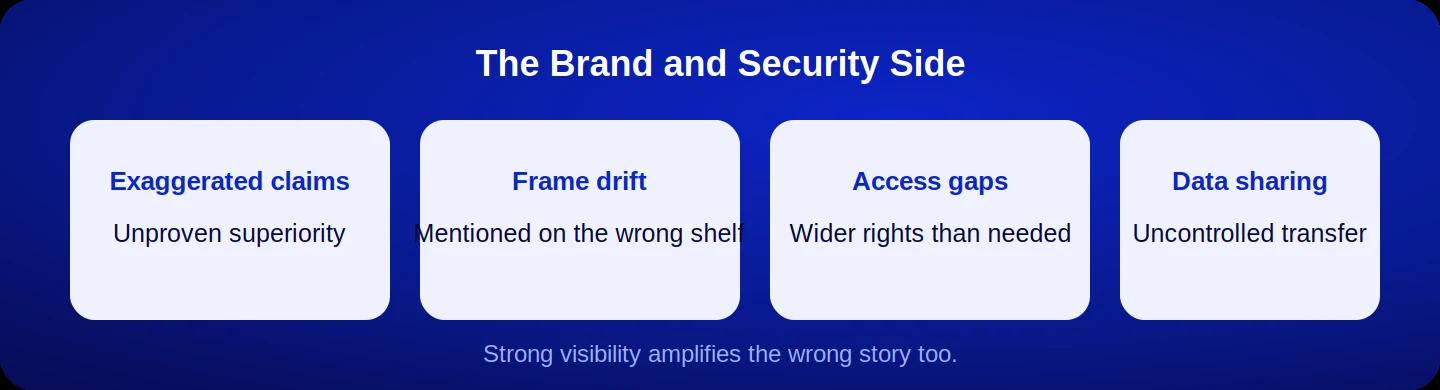
Anatomy of the four risks:
Managing Risk: Four Insurances
We have named the risks; now let us insure them. Four simple rules make most risks manageable.
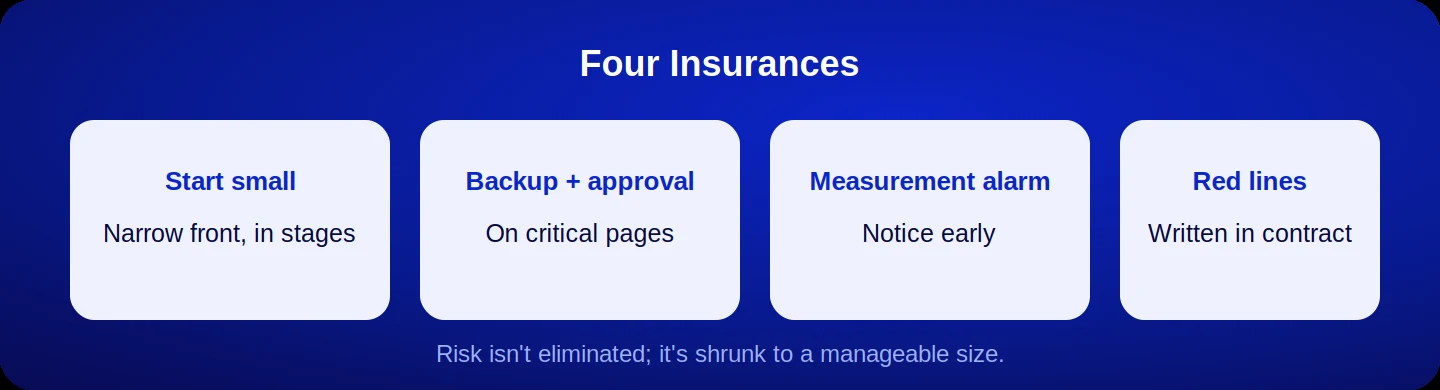
How the insurances work:
Meeting Test and Risk X-Ray
BU BÖLÜMÜN ÖZETİ
- “How will you protect my existing traffic?”
- “Which methods will you never use?”
- “What will you do if something goes wrong?”
- “What do we get if we start small?”
Closing rulebook. Four questions:
What good answers sound like:
“How will you protect my existing traffic?”
A good answer is concrete: additions rather than rewrites on traffic pages, a backup and approval process, monitoring after changes. “Don’t worry, nothing will happen” is an answer that doesn’t see the risk; it can’t manage a risk it can’t see.
“Which methods will you never use?”
A good answer lists its red lines unprompted and agrees to put them in the contract. An agency that hesitates or says “it depends” is keeping the shortcut door open.
“What will you do if something goes wrong?”
A good answer describes a rollback plan: alarm thresholds, restoring the backup, cause analysis, keeping you informed. Admitting that things can go wrong builds trust; claiming that nothing can go wrong does not.
“What do we get if we start small?”
A risk X-ray: a map of your site’s sensitive points — traffic-bearing pages, access status, risky leftovers in existing footprint — and a safe start plan. Fixed fee, the report is yours. Write your concerns for a preliminary assessment; our working principles and red lines are on our AI SEO service page. Neighbouring doors: first-meeting questions and the cost of waiting.
Field Notes
· The most expensive damage we have seen came not from a shortcut but from a well-meant rewrite: a traffic-bearing page lost its ranking while being written “better.” Because there was a backup, it was rolled back within two weeks.
· Good agencies react the same way to clients who want red-line clauses in the contract: “we don’t do those anyway, let’s write them in.” The reaction is the quickest reference check.
· The most common gap found in access audits: a fully privileged account belonging to an agency that left years ago. A five-minute check closes a serious security hole.
Mini Glossary
Shortcut: Methods that contaminate footprint with a promise of fast results — mass content, bought mentions, fake reviews, hidden manipulation.
Two-signature rule: Every change to ranking pages approved from two perspectives.
Red line: A list of methods written into the contract that will never be used.
Quick Summary
· The work itself is low-risk; risk comes from method. The real danger is shortcuts and careless edits.
· Four risk areas: footprint contamination, disturbed existing traffic, brand frame drift, access and data security.
· Four insurances: starting small and in stages, backup and approval on critical pages, measurement alarm, red lines in the contract. Doing nothing is a risk too.
Your Next Step
Run two checks this week: look at who can access your site and with what rights, and list your top ten traffic-bearing pages. Those two lists are the starting map of safe work — bring them to a preliminary assessment, and let us plan together.
Frequently Asked Questions
Is using AI-generated content a risk in itself?
Not in itself. The risk comes not from using the tool but from using it carelessly: unverified information, texts that copy each other, generic sentences with no real experience behind them and mass production. AI-assisted production is a valuable helper if it is structured by an expert eye, fed with real information, verified and edited in your brand’s voice. The measure is this: does the content genuinely give the best answer to your customer’s question? If it does, how it was produced is secondary; if it doesn’t, it is weak even if written by hand.
Can AI visibility work lower my Google rankings?
Done correctly, it usually does the opposite: content clarified for question language, consistent and in-depth, helps classic search too. The risk of a drop comes from careless rewriting of traffic-bearing pages, URL changes without redirects or low-quality mass content. These risks are managed with the two-signature rule, backed-up changes and regular traffic monitoring. The two jobs are not rivals; built correctly, they complement each other.
What should I do if a previous agency used shortcuts?
First a damage assessment: low-quality pages added to your site, bought mentions, fake profiles or reviews and hidden text embedded in pages are listed. Then the clean-up: whatever can be removed is removed, and what cannot be removed is outweighed with real, quality footprint. This process takes a little longer than normal footprint-building but is possible. Don’t get stuck on the shame of having been fooled; gather the documents and plan the clean-up. The steps of a clean exit are described in detail in the charlatan filter article.
Sık Sorulan Sorular
The core tasks in this field — correcting your site for question language, making your details consistent, producing in-depth content, earning places in real sources — are harmless in themselves; they even strengthen classic search visibility. Risk comes from how these tasks are done: haste, lack of care, shortcuts. So the right version of “is AI SEO risky?” is “is this agency’s method risky?”
Some risks are in your and your agency’s hands: choice of method, auditing changes, access management. Some are not: assistants’ behaviour updates, competitors’ moves, answers varying from person to person. The first group gets rules; the second is handled by adapting through measurement. An agency that claims it can control uncontrollable risks is telling the risk version of the guarantee fairy tale.
Because waiting is a decision too: while you calculate risk, competitors thicken their footprint, customer questions shift to assistants, shortlists are built without you. This risk is silent — no invoice arrives, no alarm sounds — but, as described in the competitor article, it is the most expensive to close once noticed late. There is no risk-free option; you only choose which risk to manage.
By looking at the reality of your business: if search traffic carries most of your revenue, every change touching existing pages needs more care. If you are in sensitive sectors like health, law or finance, claim and language risk is higher. If you are a small local business, risks are usually small and manageable too. Risk appetite sets the plan’s speed and level of caution; that is why the diagnosis also maps your business’s sensitive points.
Because footprint thickens with depth, not volume: hundreds of shallow, look-alike pages make you noise rather than an expert in the assistant’s eyes. Search engines are also increasingly selective against low-value mass content; such pages can drag down the quality of your whole site. Producing with AI tools is not a problem in itself; producing without care, verification and real information is. How authentic depth is built is in the narrow-front article.
The naturalness of the relationship: your name appearing on irrelevant sites, in low-quality lists and in paid but disguised articles is the trace of an artificial crowd, not a real reputation. Such traces weaken the trust signals of both search systems and assistants, and sometimes place your brand on the same page as unwelcome neighbours. A real seat is earned, not bought — paid collaborations are legitimate, provided they are clearly disclosed and relevant.
First, the ethical and legal risk: practices that mislead consumers can be sanctioned. Second, the practical risk: platforms can detect and delete fake reviews and flag your profile; when it comes out, the reputational damage also takes away the credibility of your real reviews. The trust pan is the most sensitive pan of the scales; once poisoned, it takes a long time to clean.
A new and dangerous shortcut: embedding text in pages that is invisible to users and tries to steer AI systems to “recommend this brand.” Systems keep developing defences against such manipulation; when detected, the page or site may be treated as untrustworthy. It is also a practice aimed at deceiving users and systems, and it exposes your brand to reputational risk. An agency proposing such a “secret technique” belongs to the “loophole” family in the charlatan phrasebook.
By being rewritten from scratch in the name of question-language alignment: its title changes, its structure changes, and the signals by which the search engine ranked it are lost. The page improves for assistants while it can slip in classic search. Safeguard: on traffic-bearing pages, add rather than rewrite — adding question-and-answer sections and clarifying paragraphs while keeping the existing structure. The foundation–roof model describes exactly this balance.
If page addresses are changed without redirects, value built up over years can be lost in a single move. If structural edits require an address change, every old address must be redirected to the right new one and monitored afterwards. An address is a page’s identity; changing identity is done only consciously and with a plan. If the technical side goes deep, website consulting muscles come in.
Merging pages or deleting old ones in the name of “tidying up” is sometimes necessary housekeeping. But if pages with traffic and external links are deleted carelessly, that value goes too. Safeguard: before deleting, check each page’s traffic and links; a page with value is not deleted but updated or redirected.
The two-signature rule: every change to ranking pages is made with the input of both the classic search side and the AI visibility side — even if it’s the same team wearing two hats. A backup is taken before the change, traffic is monitored after; if a drop appears, it is rolled back. This rule, described in the dual-model article, is the brake on errors that are hard to reverse.
As visibility grows, your claims get more attention too: unproven sentences like “industry leader”, “the best” or “100% success” can be repeated by assistants and push customer expectations somewhere unrealistic. They can also create risk under commercial advertising rules. The rule: every claim you make visible should be one you can prove. In fields like health, law and finance, the rule is even stricter.
Through inconsistent language: “affordable” in one piece, “premium” in another, “new start-up” on one profile, “long-established firm” on the site. Combining these mixed signals, the assistant may put you on a shelf you didn’t want. Once a frame sets in, correcting it takes time — the wrong narrative article describes that correction. The safeguard is setting a single target frame from the start and staying faithful to it in every piece of content — which is also a discipline of brand consultancy.
In rights wider than necessary given to the agency and tools: full admin access, shared passwords, uncontrolled plugin installs, accounts left open after parting. Each exposes your site to security risk. The rule is simple: everyone gets only the access their work requires, personal accounts, two-step verification and regular permission audits. For security alerts and good practice in Türkiye, USOM resources are a useful reference.
Customer data — form submissions, contact lists, sales information — is shared only when truly needed and only as much as needed. If customer stories are used for content, permission is obtained and identifying details protected. When internal documents are uploaded to AI tools, it should be known how those documents are processed. Data is not a resource spent on visibility but a trust to be protected; the ownership map in the dependency article is the ground for that protection.
By shrinking the size of the worst case: work that starts on a single narrow front with a limited number of pages and pieces of content also goes wrong in a small area, if it goes wrong at all. It expands as results appear. Even the worst case of a small step is bearable — this is the most effective insurance for both financial and operational risk.
On critical pages, a backup of the current version is taken before any change; the change is proposed in writing and approved; traffic and rankings are monitored after publishing. If a drop appears, the backup is restored. This process slows a few pages by a few days; in return, it makes irreversible errors impossible.
Three things: sudden drops in classic search traffic, unexpected declines on the mention scoreboard and unwanted shifts in the frame column. In a regularly measured project, these problems are seen within weeks and fixed while small; in an unmeasured project they are noticed months later, grown large. The measurement rulebook is therefore not just a report card but an alarm system.
With explicit prohibitions: no mass automated content, no bought mentions, no fake reviews, no hidden manipulation techniques, no unapproved changes to ranking pages. These clauses don’t bother a good agency — they are things it doesn’t do anyway. An agency they do bother has told you something important. Red lines are risk’s insurance in the contract.