
Will I Depend on an AI SEO Agency Forever? Can My Own Team Take Over?
The brand owner who asks this question has usually been burned once. Years ago they worked with an agency; when they wanted to leave, they couldn’t get their website password, argued over who owned the ad account and wrote three emails just to get the files of their own content. Now a new job is at the door, and the inner voice is clear: “I will never be held hostage again.”
That voice is right, and in AI visibility work it deserves extra attention. Here effort accumulates in invisible places: in a question set, in a measurement table, in relationships built with external sources. If ownership of these is not written down from the start, you may leave empty-handed on the day you part ways.
But fear of dependency sets its own trap too: never getting help and running the work alone with half the knowledge. This article describes the healthy path between the two extremes: getting help without becoming a hostage — an ownership map, knowledge handover, an exit drill and the order in which work can be brought in-house.
Where Does Dependency Come From? Four Roots
No agency contract says “we will hold you hostage.” Dependency is built quietly, through small oversights. Knowing its roots is half of preventing it.
How the four roots grow:
The Ownership Map: What Is Yours, What Is the Agency’s?
The first step towards independence is writing down, from the start, who owns what. Vagueness is the argument of the day you part.
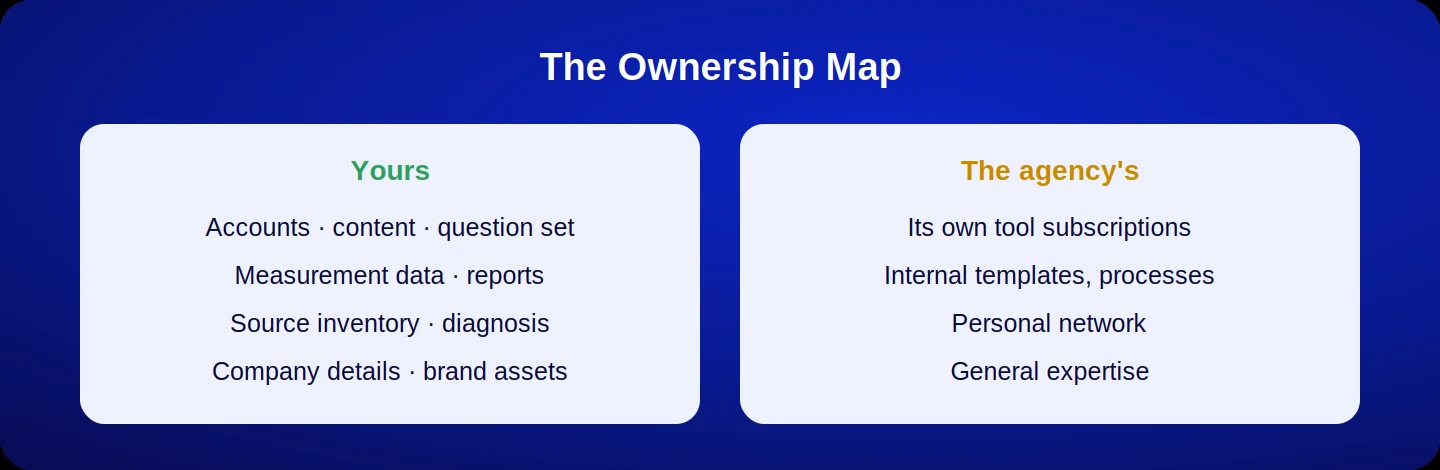
The details of the map:
A Handover Culture: A Little More Independent Every Quarter
The ownership map protects the day you part. A handover culture grows independence without that day ever being needed.
Four layers of handover:
The Exit Drill: Living the Day You Part in Advance
Think of it like a fire drill: seeing that the doors open before there is a fire. Even if you have no intention of leaving, test once a year whether the exit works.
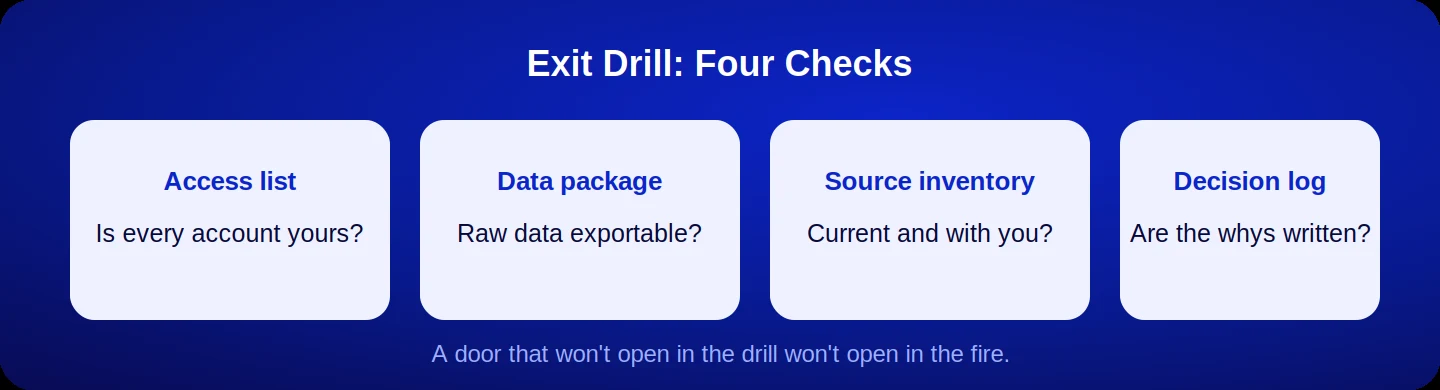
The steps of the drill:
Healthy Commitment: Being Able to Leave, and Not Wanting To
This article is not meant to push you away from agencies; it is meant to set the relationship on the right footing. Healthy commitment exists and is valuable.
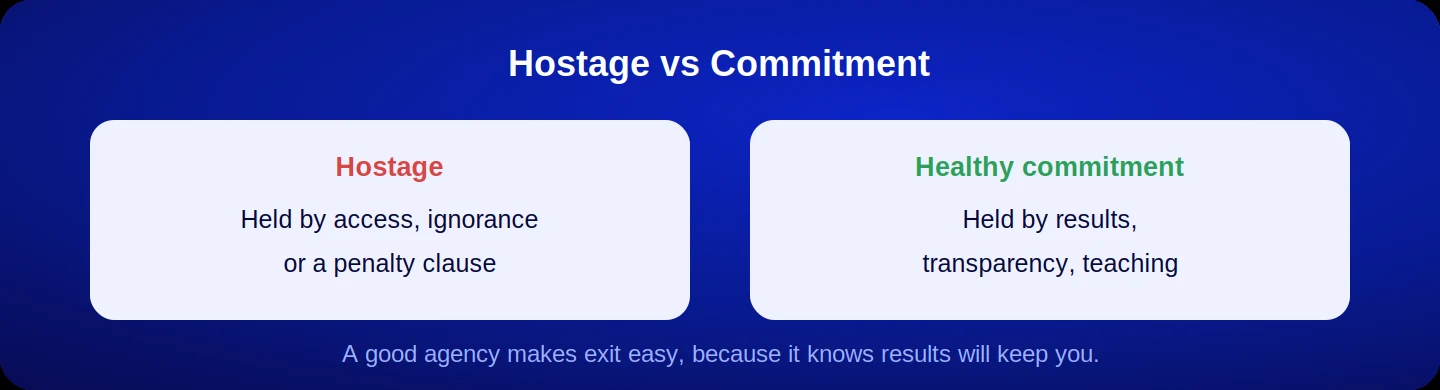
Signs of healthy commitment:
Meeting Test and Independence X-Ray
BU BÖLÜMÜN ÖZETİ
- “If we part, what stays with me?”
- “Which tasks will you teach us over time?”
- “Will you share your methods in writing?”
- “What do we get if we start small?”
Closing rulebook. Four questions:
What good answers sound like:
“If we part, what stays with me?”
A good answer recites the ownership map by heart: accounts, content, question set, measurement data, source inventory, decision log — all yours. A hesitant or vague answer like “we’ll talk about it” is announcing today the fight of the day you part.
“Which tasks will you teach us over time?”
A good answer gives a handover plan: these in the first quarter, those next, and the ones that will stay outside long term. “You can’t do these, leave them to us” markets dependency by making the work look complicated. A good expert is worth as much as they can teach.
“Will you share your methods in writing?”
A good answer is yes: question-set logic, measurement method and source strategy are explained openly. “That’s our special formula” is the sign of an agency that will also stumble on the measurement and language questions of the four competence tests. In this field there is no secret formula; there is careful effort and transparent method.
“What do we get if we start small?”
An independence X-ray: an audit of your current access and ownership situation, a list of tasks suitable for handover, and a work plan for your own project built from scratch with ownership in your hands from day one. Bring your current contract to a preliminary assessment and we will find the hostage clauses together; our working principles are on our AI SEO service page. Neighbouring doors: first-meeting questions and pricing protections.
Field Notes
· Almost every parting fight starts in the same place: the agency owns the account. An afternoon spent sorting out access prevents months of argument.
· The data-package request is the cheapest health test: brands working with agencies that send a complete package within a week also continue the relationship more comfortably.
· Clients who hold end-of-quarter sessions regularly give noticeably stronger briefs to their agencies — teaching doesn’t weaken the relationship, it deepens it.
Mini Glossary
Ownership map: A list of who owns everything produced in the project — accounts, content, data, inventory.
Decision log: A written record of key decisions and their reasons — the mind of the handover.
Exit drill: Testing once a year, without leaving, whether the exit doors work.
Quick Summary
· Dependency grows from four roots: access, knowledge, relationships and contract — each prevented with written rules from the start.
· The ownership map must be clear: every output produced for your project is yours, the agency’s general tools are its own. A handover culture grows independence every quarter.
· Run an exit drill once a year. The measure of a healthy relationship is being able to leave — and still not wanting to.
Your Next Step
Make one list this week: every account related to the project and its owner. Every line where the owner isn’t you is a task to fix today. If the list is long or your contract is vague, let us look together at a preliminary assessment.
Frequently Asked Questions
My current agency opened the accounts in its own name; how do I get them back?
First ask politely and in writing: for ownership of the account to be transferred to you, or for an owner-level permission to be set up in your name. Most platforms allow ownership to be transferred between users; technically the process is short. If the request is refused or stalled, look at the ownership and handover clauses in your contract; if they are vague, legal support may be needed. Most importantly, make it a rule that every account opened from now on is opened in your name from the start — fixing the past is hard, protecting the future is easy.
The agency says “our measurement tool is ours, we can’t hand over the data”; are they right?
Half right: the tool is theirs, and asking for its subscription or internal structure is not reasonable. But the results the tool produced for your project — the question set, mention records, competitor comparisons, reports — are your project’s data and the product of effort you paid for. Their raw form should be delivered to you regularly in an exportable format. Writing this tool-versus-data distinction into the contract from the start prevents the argument later.
To avoid dependency, should we do the work entirely ourselves?
It isn’t necessary and often isn’t efficient. Independence doesn’t mean doing everything yourself; it means understanding what is being done, owning the data and being able to change course any day you want. Keeping specialist work outside is a healthy division of labour as long as those conditions are met. Trying to run it alone often means moving slowly with half the knowledge. The right balance: simple, repetitive tasks in-house, expertise outside, knowledge and ownership always with you.
Sık Sorulan Sorular
It is the most classic and most painful: accounts were opened in the agency’s name, it holds admin rights, you are only a “viewer.” On the day you part, the first fight breaks out here. Yet the rule is simple: you own every account; the agency is a guest user. Analytics, search console, profiles, map listings — all are opened in your name, and the agency is given access; access can be withdrawn, ownership cannot.
Because it is invisible: even if the accounts are yours, you are still dependent if you don’t know what was done and why. If only the agency knows the logic of the question set, the reasoning behind the front choice and why a particular source matters, on the day you leave you hold the keys but not the location of the doors. The way to prevent knowledge dependency is method transparency — one of the four strokes of the real expert’s signature.
External source work requires relationships: ties with industry publications, directories and platforms. If these ties run through the agency’s personal network and are written down nowhere, they leave when the agency does. The solution is keeping the source inventory in your own file: what was done in which source, who was spoken to, which content is live where. The relationship is the agency’s; the record is yours.
Long commitment periods, early termination penalties, vague notice terms — on paper they look like “stability”; in practice they become a cage. An agency confident in its work knows it will keep you with results and has no need for penalty clauses. A proposal demanding long, penalty-laden commitment has skipped the third protection in the pricing article — a defined exit.
Because content is the main raw material of this work: every text, image and page you paid for is yours — and that sentence should be in the contract. Left vague, parting can bring arguments like “that content was published under our licence.” The product of paid-for work belongs to whoever paid, source files included. This rule guarantees that everything on your site stays in place after you part.
Because they are the map of your market: built from your customers’ questions, your competitors, your fronts. Even if the agency changes, the map remains useful — a new team doesn’t start from zero, it continues from the frame where you stopped. The measurement history is the same: months of accumulated mention records are the evidence of your progress. They should be delivered to you as raw data at regular intervals — method page included, as in the measurement article.
Its own tools, internal templates, working processes and general expertise: these are the agency’s capital and not specific to your project. Asking for an agency’s tool subscription or internal checklists is not reasonable. The line is: every output produced for your project is yours; the general tools used to produce it are the agency’s. A contract that draws this line clearly protects both sides.
Every access you grant an agency may also touch your customers’ data: analytics, form submissions, contact lists. How this data is processed, where it is stored and how it is deleted when you part should be written down. For the legal framework on personal data protection in Türkiye, KVKK is the reference point. The practical rule: give the agency the least access its work requires, and withdraw every permission one by one on the day you part.
The most repetitive and least specialised: keeping company details consistent, keeping profiles current, collecting customer questions and adding them to the list, simple content updates. These can be learned in the first quarter and run in-house. Every task brought in-house lowers cost and reduces knowledge dependency. If the agency resists this handover, it fears its work shrinking — and that tells you something too.
Work that needs expertise and scale: setting up and interpreting the multi-assistant measurement system, refreshing front strategy, the heavy labour of external source-building. Doing these in-house means either hiring an expert or a long learning curve. Keeping them outside is not dependency but an efficient division of labour — as long as the method is transparent, the outputs are yours and the exit is defined.
With end-of-quarter sessions: at the end of each quarter the agency explains that period’s decisions and their reasons to your team — why that front was chosen, why that content worked, what the measurement showed. A written decision log is kept. These sessions are both audit and learning; a year later your team understands the logic of the work as well as the agency, and either hands over or takes over its execution knowingly.
In small businesses the “in-house team” is often one person — perhaps you. In that case handover aims not at full execution but at the ability to understand and audit: reading reports, asking the right questions, knowing what to request if you need to move to another agency. Even that much breaks dependency to a large degree; the uninformed client is held hostage, the informed client chooses. If an ongoing outside eye is needed, the single-contact model on the digital consulting side is one way to strike that balance.
One by one: for every account related to the project — analytics, search console, map listing, social profiles, content management panel, project areas in measurement tools — check who the owner is. If it isn’t you, fix it today; trying to fix it on the day you part is searching for a key in front of a locked door. The list is kept in writing and updated whenever a new account is opened.
By asking: “Could you send the raw measurement data so far, and the question set?” How quickly and how completely this request is met shows the true health of the exit. If a tidy package arrives within a few days, the door is open; if it takes weeks, arrives in pieces or you hear “that data lives in our system”, the door is locked.
Because external source work is the most invisible and most easily lost part of this job: in which publication a story ran, in which directory a listing was opened, with whom which conversation happened. If the inventory isn’t current, the record of this effort leaves with the agency when you part. The inventory is added to the report every month; it shouldn’t require a separate request.
The logic: why that front was chosen, why that content was prioritised, why that source was dropped. Data says what happened; the log says why. If a new team — in-house or at another agency — starts working with the log, it won’t repeat the mistakes and will continue the right decisions. A handover without a log takes the data and leaves the mind behind.
Because it sees its value in expertise, not in repetitive work: moving simple tasks in-house is not a loss for it but a chance to focus on more valuable work. An agency open to handover knows that the relationship deepens when the client grows stronger. An informed client gives better briefs, approves faster, asks sharper questions — and stays longer.
When it builds up knowledge: over the years the agency learns your market, your competitors and your customers’ language; each new quarter builds on the previous one. That accumulation is real value and justifies continuity. But it is valuable in a relationship where it also flows to you in writing: if the decision log, data and inventory accumulate with you, a long relationship is a source of strength; if they accumulate only in the agency’s head, it is a source of dependency.
When the signals worsen: effort isn’t counted, measurement has thinned, reports are foggy, end-of-quarter questions go unanswered. If the four signals in the timing article are negative and revision hasn’t helped either, parting is not failure but management. If the exit door is ready, this decision is not an emotional fight but an operational transition.
If the door was prepared, a quiet handover: the data, inventory and log are delivered to the new hands — an in-house team or another agency — measurement continues with the same question set, progress is tracked without interruption. Your mention share doesn’t leave with the agency, because the footprint lives in your assets and in external sources. Properly built work goes on living independently of those who built it — that is real independence.