
If ChatGPT Answers and Keeps the Customer: Does AI Visibility Still Bring Traffic and Business?
Your question is sharp and goes straight to the point: “Say ChatGPT recommends me — but it also gives the answer itself, and the customer never visits my site. What have I gained?” This is the question marketers rarely ask in their polished presentations, yet it crosses the mind of every business owner who knows how to count: if the assistant eats the traffic, what is visibility good for?
The core of the worry is real; let us concede that from the start. The answer layer really does absorb some visits — people looking for information get their answer and leave. But the rest of the story is different from what is assumed: absorbed traffic and won customers are not the same thing.
This article builds the calculation honestly: which visits really disappear, which visits were never yours in the first place, why the few visitors who do arrive are worth more than before, and what the website’s job becomes in this era. By the end you will turn the question around: not “what happens if traffic drops?” but “what changes if the phone rings?”
The Legitimate Core of the Worry: What Does the Answer Layer Absorb?
Let us start without exaggeration: where is the loss real, and where does it hurt less than assumed?
Four findings:
The New Customer Journey: Four Stops From Answer to Till
Now let us draw the chain from start to finish — because without seeing where the gain is born, you cannot know what to measure.
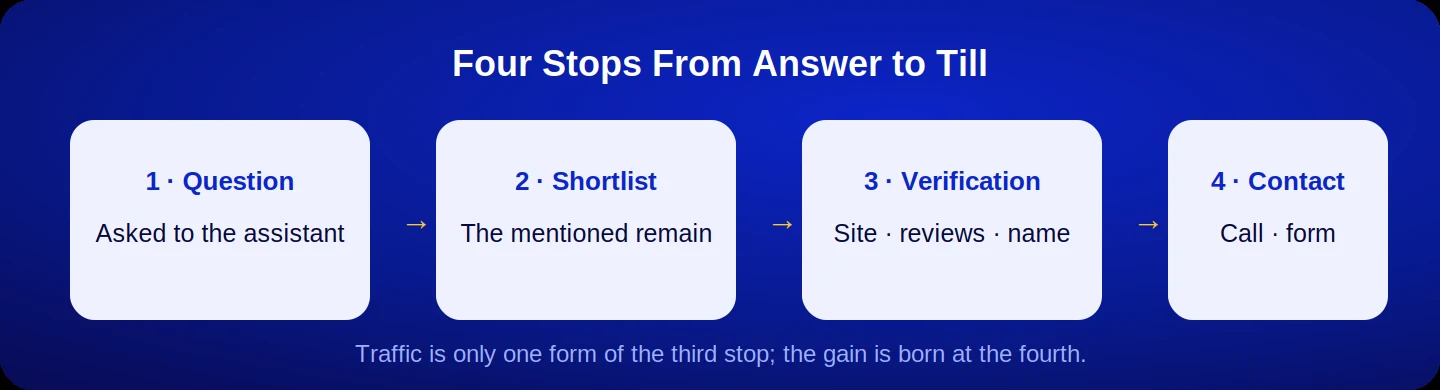
The language of the stops:
Less but Better: The Economics of Intent-Rich Traffic
Let us correct the numerical intuition: in a world where a hundred visitors leave and fifteen arrive, why might you be more profitable?
Four calculations:
The Site’s New Job: A Verification Station
Where traffic falls, the site does not become unimportant; it changes jobs. The shop-window era is over, the station era has begun — and the station has four shelves.
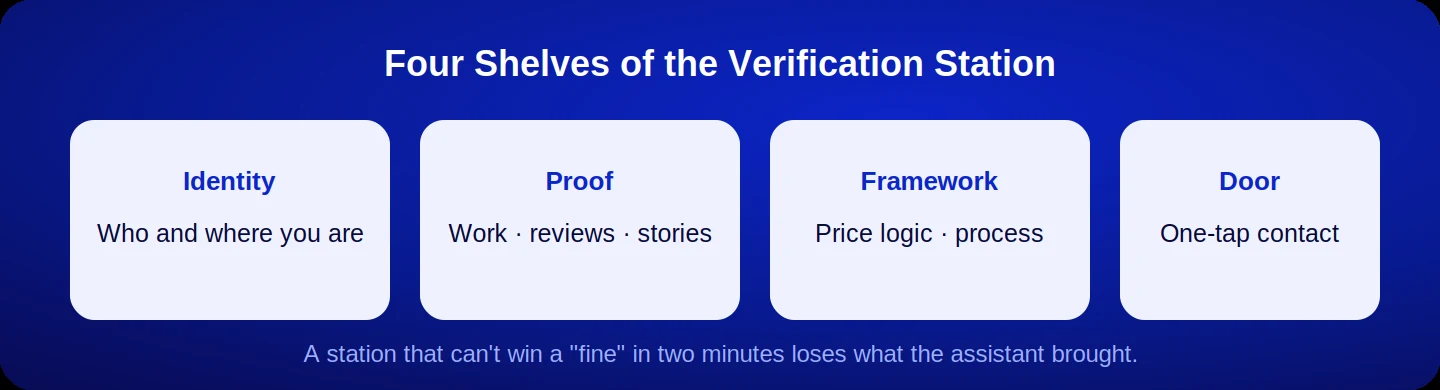
How the shelves are arranged:
Measuring Gain Without Traffic: Counting Four Channels
The last piece of the calculation: how is gain that never passes through the site counted? Four channels, four counters.
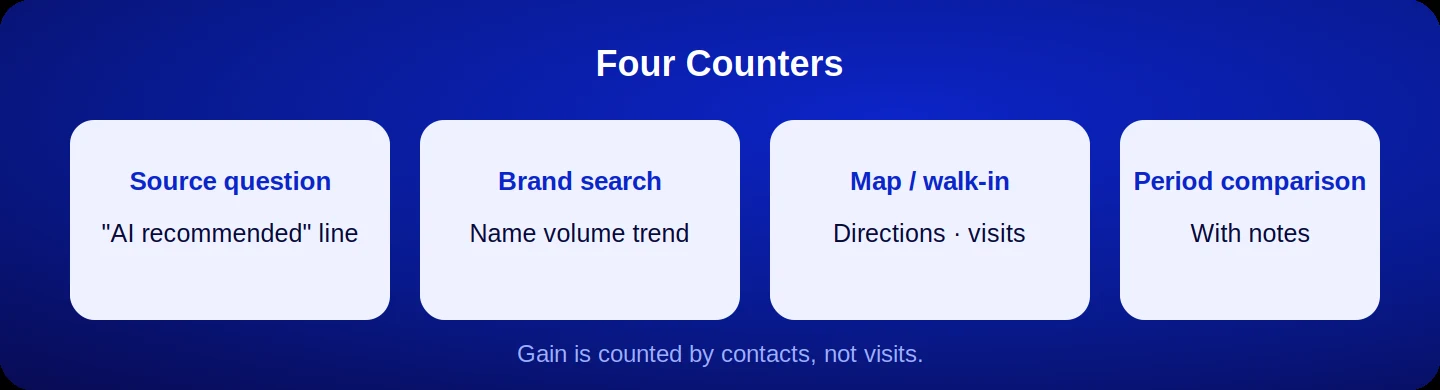
Setting up the counters:
Meeting Test and Gain X-Ray
BU BÖLÜMÜN ÖZETİ
- To the agency: “If traffic drops, how will you prove success?”
- “What would you turn my site into for this era?”
- To yourself: “What does the verifying eye see when it looks at me?”
- “What do we get if we start small?”
Let us close with the rulebook. Four questions:
What good answers sound like:
To the agency: “If traffic drops, how will you prove success?”
A good answer lists the indicator package: mention share, brand searches, contact channels, the source question — and openly says it demotes traffic from sole indicator. “We’ll grow the traffic too, don’t worry” is the answer of someone who has not noticed the game changed; whoever enters a new exam with an old report card loses both.
“What would you turn my site into for this era?”
A good answer speaks the language of the station: identity, proof, framework, door — and shows with examples which shelf is empty on your current site. If the answer is only “we’ll add content”, the verification side has not been considered: content builds mentions; the station turns mentions into money — they are separate jobs.
To yourself: “What does the verifying eye see when it looks at me?”
The honest experiment takes five minutes: search your name as if you had never heard of your brand, open your site on a phone and count two minutes. Do who you are, your proof, your price framework and your contact door become clear in that time? If not, there is a hole in the door for every customer the assistant will bring.
“What do we get if we start small?”
A gain X-ray: your mention snapshot, a four-shelf audit of your verification station and a four-counter measurement set-up — fixed fee, the report is yours. Bring the last three months of calls and form submissions to a preliminary assessment; the scope is on our AI SEO service page. Neighbouring doors: the measurement rulebook and the selection guide.
Field Notes
· Some brands that come to us saying “our traffic fell, we’re sinking” turn out to have had more calls in the same period — nobody was counting, so nobody noticed. The wrong counter gives a healthy patient a crisis diagnosis.
· The verification station’s most commonly empty shelf is the framework: sites with not a single sentence of price logic are the ones that lose the most decision-stage visitors.
· The face of a business owner hearing “ChatGPT recommended you” as a source answer for the first time is more convincing than every chart in this article.
Mini Glossary
Answer layer: The assistant answer between question and site — absorbing informational visits, filtering decision visits.
Verification station: The site’s new job: a two-minute confirmation stop with identity, proof, framework and door shelves.
Four counters: Measuring trafficless gain: source question, brand searches, map/walk-in, period comparison.
Quick Summary
· The answer layer absorbs informational traffic; decision traffic shrinks, sharpens and arrives for verification — the crowd that disappeared was mostly not customers.
· The journey has four stops: question → shortlist → verification → contact; the site moves from shop window to a two-minute verification station.
· Gain is measured by contacts, not visits: source question, brand searches, map and period comparison — if the four counters move together, mentions are reaching the till.
Your Next Step
Set up two counters this week: add the option “an AI assistant recommended you” to your greeting script, and look at the last six months of your brand searches. Bring the resulting picture to a preliminary assessment; we will audit your station’s four shelves together and close any holes.
Frequently Asked Questions
I run a content site and my income is advertising; does this calculation apply to me?
Honestly, no — your books need a different calculation. This article’s calculation is for businesses whose product is a service or goods: their loss is informational traffic, their gain is contact. A publisher’s product is traffic itself, so the answer layer squeezes the revenue channel directly; the game plan there is different: holding the intent-rich readers who leak through answers with in-depth content, diversifying the revenue model, producing the kind of reference content assistants cite. The same storm charts two different courses for two ships; they should not be confused.
Can I see visitors from assistants separately in analytics?
Partly: some assistants and AI search features arrive with a referral trace and can be tracked as a separate source in traffic reports; it is a growing slice and worth setting up. But don’t expect a full count: a large share of users read the answer and come by searching your name separately or by phoning directly — that flow carries no “assistant” label. The rule: referral data shows the floor, not the ceiling; the real picture is read from the sum of the four counters. Looking at one label and concluding “assistants bring nothing” is measuring the tip of the iceberg and belittling the sea.
If traffic is losing importance, why not cut SEO and content investment?
Because the inference is wrong: traffic is losing its throne as an indicator, while content is gaining its throne as raw material. Assistant answers feed on exactly that content; cutting production quickly means a thinning footprint and falling mentions. What changes is content’s job: it used to be written to gather visitors; now it is written to be mentioned in answers and to persuade at verification. The investment is not cut; its target is updated — same budget, new compass. How to set that compass is explained across the whole of this series.
Sık Sorulan Sorular
The old chain had two links: question → site. The new chain has a layer in between: question → assistant answer → (perhaps) site. The assistant gives an answer distilled from dozens of sources directly; some users stop there. This layer is the very change we described in the moved shop window article — and it will not be rolled back; the calculation is built on its existence.
Informational visits: traffic from “what is X”, “how do you do Y”, “what’s the difference” questions — they came to your site, read and left. This audience generated page views, but its rate of turning into customers was always low; the loss that is most visible is the loss that hurts least. The crowd looking at the billboard has thinned; those who walk into the shop are another account.
It is transforming, not vanishing: the person asking “whom do you recommend, which one should I buy?” reads the answer but does not finish there — money is about to change hands, and they want to trust. The need to verify kicks in: the name is searched, the site is checked, reviews are scanned, the phone is picked up. Decision traffic still comes to your door, smaller but sharper; the only case in which it doesn’t is when you are not on the shortlist at all.
Not traffic falling, but falling out of the mentions: if the answer layer never mentions you, the user builds their shortlist from competitors, and the verification visits and phone calls flow to them. So the loser of the zero-click era is not the unclicked site but the brand whose name is missing from the answer — the table in the competitor article is a picture of that silent flow.
Elimination: the user writes two or three names from the answer into their mind — the rest effectively do not exist for that question. This stop is the new version of the old “page one” threshold; the difference is its harshness: there is no page two. The mechanism for getting onto the shortlist is in the recommendation map; this article is about what happens after you are on it.
Because money is about to change hands: users trust the assistant for information, not for their wallet on its own — having heard the name, they want to see for themselves. Verification takes many forms: a quick look at the site, a brand search, reviews, social accounts, photos on the map. What they all share is brevity: within minutes the verdict is “fine” or “no.”
The site form is now just one channel: phone, messaging apps, directions from the map, a message via a social account, a walk-in visit — the user reaches the brand that passed verification through whichever door is shortest for them. That is why “on-site conversion” alone is a narrow window; without counting all contacts, the gain calculation stays incomplete.
At two fragile points: failing to make the shortlist (a mention problem — the main subject of this series) and dropping out at verification (you were mentioned, the user looked, then gave up). The second is talked about less but hurts: your own shop window loses the customer the assistant brought you. The next section dresses exactly that wound.
The quality of who arrives: most of the old hundred visitors were looking for information; the new fifteen are decision-stage people who filtered through the assistant’s answer to verify you. The probability of a customer per visitor closes the gap and, in most scenarios, overtakes it. If you want to follow the size of e-commerce and online shopping in Türkiye, ETBİS data is the place to look; in a market where the pie is growing, the issue is not the number of slices but their intent.
To publishers living on advertising revenue: their product was traffic itself, and their losses are real and structural. Your product is not traffic but your service: page views were never income for you, only a vehicle. The shape of the vehicle has changed; the road to the goal — contact — is still open. Don’t translate publishers’ economic troubles into your own business; your accounts are kept in different books.
The cost of buying clicks is clear, and it rises with competition; a verification visit arriving via an assistant’s recommendation carries no per-click bill — its cost is the four items of footprint-building, and it accumulates: the effort you pay for this month keeps working in next year’s answers. When the advertising tap closes the flow stops; footprint is a source that does not fall silent the moment you turn it off. The two are neighbours, not rivals; while the advertising side does its job, footprint lays the ground.
Total visitors — on its own: in the answer-layer era this figure trends structurally downwards and on its own shows neither success nor failure. The replacement is a package of indicators: mention share, brand searches, contact count, answers to the source question — the rulebook in the measurement article. An old indicator does not measure a new game; trying to make it do so produces wrong decisions.
The answers to the first ten seconds: who you are, what you do, where you are, whether you are real — an open address, a real team, a consistent story. The verifying eye looks for authenticity signals, not fancy slogans; an anonymous site furnished with corporate clichés leaves the question “is this company real?” unanswered. Clarifying identity is as much brand work as design work.
Demonstrable reality: completed work, named — and ideally photographed — customer experiences, case stories, countable results. The assistant put you on the “recommended” list; the proof shelf confirms within two minutes that the recommendation was deserved. An empty proof shelf is the most common reason verification visits give up — and the easiest to fix: you already have the material, it just isn’t on the shelf.
Hiding your price logic does not protect the customer; it drives them away: a decision-stage person who finds no answer at all to “roughly what will this cost, how does the process work?” cools off from uncertainty. An exact figure is not required; a framework is: what it depends on, how it proceeds, what the first step is. A site with a clear framework shortens the first phone call too — both sides start prepared.
Frictionlessness: the phone number must be one tap away, the messaging door visible, the form short, directions one click away. A user who passed verification has a warm decision; every extra step steals a degree of that warmth. The station as a whole — speed, mobile readability, clean structure — is the domain of website consulting; the measure here is a single sentence: can someone coming from an answer say “fine, I’m calling” within two minutes?
One line is added to the “how did you hear about us” list — “an AI assistant recommended you” — and asked consistently on the phone, in forms, in the shop. The most primitive-looking counter produces the most direct evidence: a customer who came via an assistant says so when asked. The counter’s enemy is forgetfulness; written into the team’s greeting script, it survives.
The trace of the verification stop: some of the users who see your name in an answer type it into a search engine. If your brand’s search volume rises together with mention share, the chain is working — this data is already in your hands through tools left over from your SEO years; it just needs reading with new eyes.
For local businesses it is the first counter: direction requests, searches through the map, walk-ins who say “we found you on the phone” — none appear in site traffic, all appear in the till. Local verification has different shelves too: an up-to-date map listing, photos, reviews; it is the counter side of the neighbourhood strategy in the narrow-front article.
With a noted comparison: in the quarter mention share rose, the sum of the four channels is compared with the previous period; advertising, seasonal and price effects in the same period are noted alongside. The goal is not laboratory proof but management judgement: if the channels move in the same direction, mentions are reaching the till — and that judgement is the legitimate ground for budget decisions.