
Building a Sock Brand: How Does a Brand Stand Out on a Cheap Shelf?
Socks have one of the lowest entry thresholds in textiles: production is widespread, minimum quantities are reasonable, samples arrive fast. Which is exactly why the shelf is crowded and prices sit near the floor. Here the question isn’t “how do I produce” but “why would they buy from me”.
For most people socks aren’t a considered purchase; they’re bought when needed, from the nearest place, at the most reasonable price. A brand has to break that habit — either with the product or with the structure around it.
This guide covers the reality of a sock brand: routes to standing out on a cheap shelf, subscription and multipack design, production and quality standards, channel decisions and the first 90 days’ output. Here the brand is whoever can build repeat purchase.
Three Ways to Stand Out on a Cheap Shelf
There are three ways to create difference between products that look alike; the fourth is cutting prices, and that doesn’t build a brand.
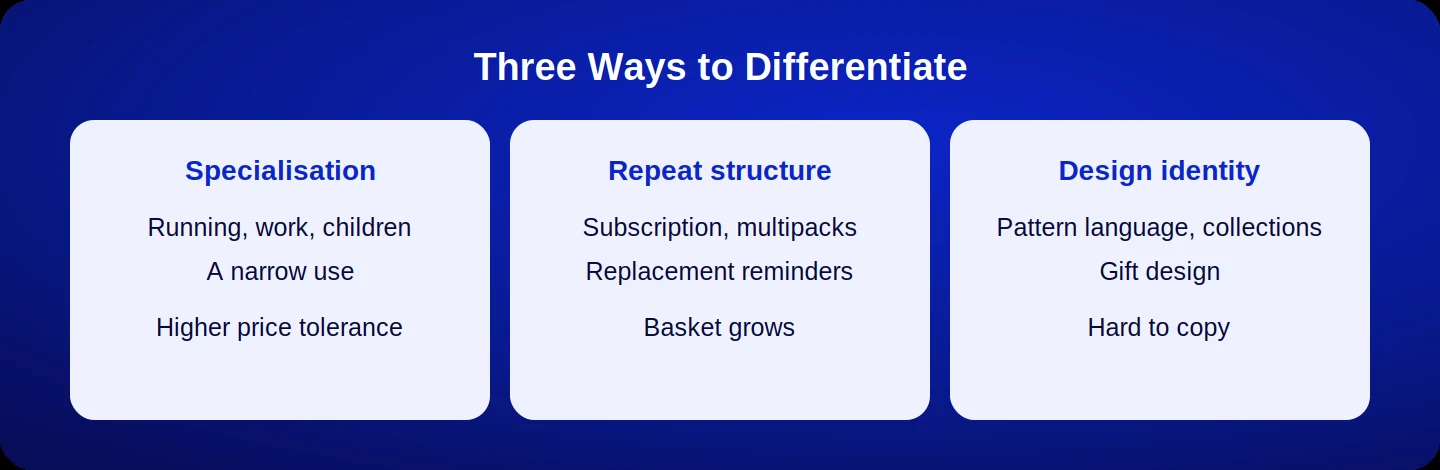
Inside the routes:
Where Is the Quality Difference and How Is It Explained?
In socks the quality difference is subtle but real; unexplained, it counts for nothing. Four elements:
Four elements:
Economics: The Maths of a Small Unit Price
Three lines set the margin here, and all three come from the small unit price.
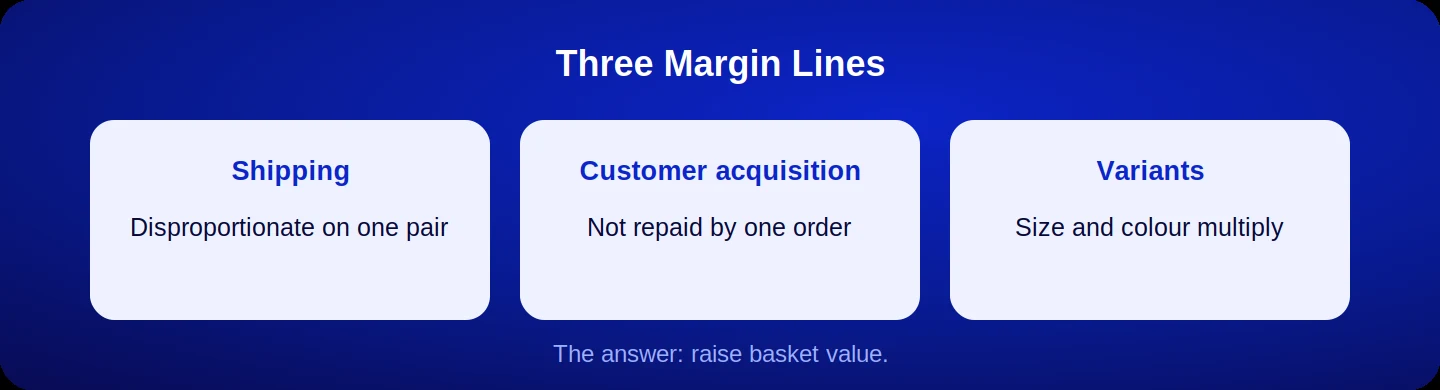
Inside the lines:
Production and Channel Decisions
Production is accessible; the real decision is where and how it will sell. Four headings:
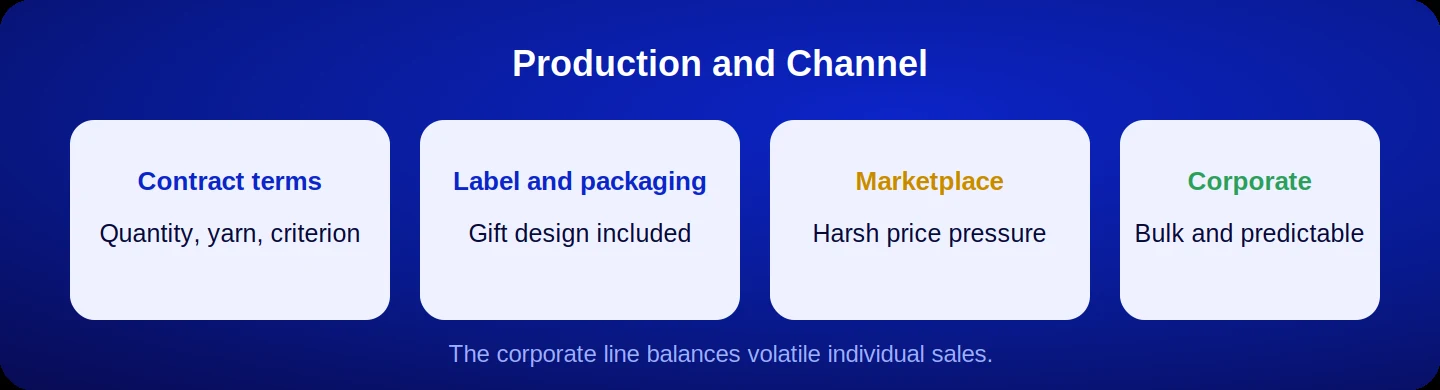
Four headings:
First 90 Days: Counted Output
BU BÖLÜMÜN ÖZETİ
- Month one: use and product choice
- Month two: pack design and labelling
- Month three: small batch, two channel tests
The aim of the three months isn’t a broad collection but validating one use and the repeat structure.
Four headings:
Month one: use and product choice
One use description, one product, a narrow size range. The sample is tested by wearing it for a day. An untested sample gets tested by the customer and the price is paid in reviews.
Month two: pack design and labelling
Three- and five-pack pricing, free-shipping threshold, labelling and packaging. The same month the repeat mechanism is set up: reminders or subscription.
Month three: small batch, two channel tests
Testing the individual and corporate channels at small scale. Data to collect: basket value, second-order rate, complaint reasons. Overall planning sits with digital consulting.
The Meeting Test and Basket X-Ray
BU BÖLÜMÜN ÖZETİ
- “Do you make a profit selling one pair?”
- “What will trigger the second order?”
- “How do you explain your quality difference?”
- “What do we get if we start small?”
The closing ruler. Four questions:
What good answers sound like:
“Do you make a profit selling one pair?”
A good answer says no and explains the pack structure. An answer saying yes usually hasn’t counted shipping; that calculation reveals itself within the first month.
“What will trigger the second order?”
A good answer names a concrete mechanism: subscription, reminder, pack advantage. Without one, you hunt for new customers every month and the advertising budget erodes.
“How do you explain your quality difference?”
A good answer says it states yarn, weight and stitching details. Unexplained quality gets levelled with the cheap equivalent.
“What do we get if we start small?”
A basket X-ray: a use description, pack and shipping-threshold calculations, a quality acceptance criterion and a corporate channel plan — fixed fee, the table is yours. Bring your sample to a preliminary assessment; the scope is on the brand consultancy page. Neighbouring door: the bag brand guide.
Field Notes
· Brands starting with single-unit sales lose margin fast to shipping and acquisition costs; those moving to multipacks turn profitable on the same advertising budget.
· Corporate and promotional orders balance the volatility of individual sales; brands opening that channel plan cash more comfortably.
· Brands testing samples by wearing them for a day catch elastic and stitching complaints before production; those who don’t learn the same thing from reviews.
Mini Glossary
Repeat structure: The subscription, pack or reminder arrangement that triggers a second order.
Shipping threshold: The basket value set for free shipping; a tool for growing the basket.
Weight: Knit density and mass; the invisible measure of durability.
Quick Summary
· You can’t build a brand on one product: specialisation, a repeat structure and a design identity are the three real routes.
· The quality difference is subtle but explainable: yarn, weight, elastic, stitching.
· Margin is set by shipping, acquisition cost and variants; the answer is growing the basket and opening the corporate channel.
Your Next Step
Do two calculations this week: your margin on a single pair including shipping, and your margin in a three-pack. The gap tells you what your structure needs to be. We’ll build the pack and shipping threshold together in a preliminary assessment.
Frequently Asked Questions
Should I sell patterned socks or basics?
They’re different businesses: basics are a regular-consumption product with high repeat purchase but harsh price pressure. Patterned socks are a gift and self-expression product with higher price tolerance but infrequent repeat purchase and more stock risk. The healthy route is usually building repeat purchase with basics and releasing patterned collections periodically in limited quantities. That way cash flow comes from the basics while margin and visibility come from the collections.
How do I set up corporate logo sock work?
It starts with clarifying whether the manufacturer can print or knit logos; minimum quantities here are higher than in individual sales. Then you prepare a sample set and a price table — corporate buyers want to decide quickly. Delivery discipline is critical: an order that misses an event date won’t bring that customer back. Relationships in this channel turn into repeat orders, so delivering the first job flawlessly is worth more than ten individual sales.
Does a subscription model work for socks?
It works if set up correctly: socks wear out regularly, so a replenishment logic is natural. The critical points are frequency and flexibility — too frequent and you get cancellations, too infrequent and it delivers no value. Letting customers postpone a shipment and making cancellation easy protects trust. Starting with a “replenishment reminder” instead of a full subscription is lower risk: send a reminder at intervals, measure the repeat orders, and move to subscription once demand is clear.
Sık Sorulan Sorular
A narrow use raises price tolerance: a runner, someone on their feet all day, someone with a perspiration problem or a specific need will pay extra for a product that does the job. Specialisation is the fastest exit from a price race and it lowers advertising cost too.
The margin on a single pair can’t carry shipping and customer acquisition. Multipacks, subscriptions and replacement reminders flip that arithmetic. In socks the first order usually breaks even and profit arrives at the second — the same model is set up on the same logic in the wellness guide.
Not with individual patterns but with a recognisable language: a colour palette, a theme, limited collections. A recognised pattern reminds people of the brand even when copied. An identity can’t be copied; a pattern can. Brand language is set up within brand consultancy.
There is always someone cheaper here, and a price war pushes margin to zero. A customer won on price leaves when something cheaper appears. Cheapness isn’t a positioning, it’s a waiting room.
Perspiration, softness and lifespan. The cotton ratio and the choice of bamboo, wool or technical yarn set the product’s character. A brand that doesn’t state its yarn gets levelled with the cheap equivalent on the same shelf.
Durability largely comes from here; a thinly knitted sock costs less and wears through faster. Customers don’t know the reason, they just say “poor quality”. Weight is the name of the invisible quality difference and it can be stated openly.
The most common complaint is socks slipping down; elastic quality and stitching decide that. Sample testing must involve walking and a full day of wear. A sample not worn for a day hasn’t been approved.
The toe seam can cause discomfort over long wear; a seamless toe can be explained as a point of difference. Shown visually on the product page, such details justify a price gap; the content side is built with digital media.
The shipping cost of a single pair is very high relative to the product price. So single-unit sales usually generate a loss here. Multipacks are the only tool that corrects the shipping maths.
Not by the first order but the second and third. That’s why a structure triggering repeat purchase is essential: reminders, subscriptions, pack discounts. The measure of advertising waste sits with advertising consultancy; if the second order doesn’t come, advertising produces losses.
Few sizes, few colours, starting with basic tones. On patterned products a collection approach keeps stock manageable. Every colour is separate stock — the logic matches the multiplication rule in the underwear guide.
Three- and five-packs, set design, family packs, gift boxes and a free-shipping threshold. Basket value is this category’s real lever; channel and payment design is planned with e-commerce consulting.
Before price: minimum quantity, yarn quality and a quality acceptance criterion. Sample approval must be written and sampling done on every batch. Without a written criterion the second batch becomes an argument.
Composition ratios, care information, size and production details; textile labelling rules apply. For export and production data in textiles and ready-made clothing, TİM resources point the way. Packaging is also the vehicle for gift design.
Price pressure is harsh on marketplaces; your own site allows subscription and pack design. The corporate channel — logo socks, team gifts, events — brings volume in a single order with higher price tolerance. The site side is built with website consulting.
Printed and custom socks are in demand as promotional items; production is predictable and collection is in bulk. This is the line that balances the individual channel’s volatility; the general assessment sits in the sector map.
Narrows the use description, calculates pack pricing and the shipping threshold, gets the quality criterion written and puts the corporate channel on the agenda. A consultant doesn’t design the pattern; they stop you losing money selling single pairs. Choosing a consultancy sits in the umbrella guide.