
Which Sector Should I Build My Brand In? A Sector-by-Sector Map of Brand Consulting
You have an idea: you’re going to build your own brand. Perhaps you’ve sold someone else’s product for years, perhaps customers keep asking for something you can’t stock, perhaps you have an audience and you’re looking for something to sell them. The question is the same: in which sector?
Search that question online and most of the pages you land on belong to contract manufacturers. Their answer is predictable: “in the category we produce.” That’s natural, but it isn’t neutral. A manufacturer sells you the idle hours on their line; they don’t factor in what your brand looks like three years from now.
This page looks from somewhere else: the brand owner’s side. Below you’ll find a separate guide for each of 25 sectors, each answering the same question with that sector’s own reality — what building a brand here actually involves, where the money burns, and which decision a consultant tests on your behalf.
The Four Measures Behind Sector Choice
Before the 25 guides below, let’s set the shared ruler. Whichever sector you look at, the decision comes out of these four headings.

Inside the measures:
Three Things a Contract Manufacturer Won’t Tell You
BU BÖLÜMÜN ÖZETİ
- The product is yours, the formula isn’t
- The minimum order is your risk
- Building a brand isn’t buying a product
Search results are dominated by contract manufacturers. What they tell you isn’t wrong, it’s incomplete. Three things are missing:
Three gaps:
The product is yours, the formula isn’t
Most contract work sells you a standard formula sitting on a shelf; the label changes, the contents stay the same. That’s fine as a start — the problem is marketing it as “our own formula” without knowing. The day you learn your competitor has the same formula, you start creating difference through price, and that is a price war, not a brand.
The minimum order is your risk
A manufacturer needs a floor to run the line. That floor sets your first investment and your first stock risk; if it doesn’t sell, the burden stays with you. Starting small and growing through sales is possible in most sectors, but it takes someone who will run the negotiation on the brand’s side.
Building a brand isn’t buying a product
The product is the easiest and quickest part. Name, positioning, packaging, sales channel, price architecture, content and repeat purchase — that is the actual work, and none of it is the manufacturer’s job. The whole distinction sits on the brand consultancy side; the sales channel is designed alongside e-commerce consulting.
The 25 Sector Guides: Open Your Own
BU BÖLÜMÜN ÖZETİ
- Digital, technology and gaming
- Clothing, accessories and personal products
- Food, drink and agriculture-based fields
- Care, health-adjacent and home
Each guide covers what building a brand in that sector actually involves. The order isn’t importance; open the one closest to you.
The fields:
Digital, technology and gaming
Low or no stock; entry is easy, differentiation is hard. Digital product brands, technology brands, gaming brands, electronics brands and AI product brands. Here the real question isn’t production but recurring revenue and community.
Clothing, accessories and personal products
Ruled by size, fit and returns: underwear, socks, bags, women’s products and adult products. In these fields the stock decision burns more money than the brand decision.
Food, drink and agriculture-based fields
Governed by documentation and shelf life: chocolate and confectionery, organic food, coffee, fermented products, fruit products and vegan products. For support and training programmes aimed at small businesses, KOSGEB announcements are worth following; one sentence on a label is a brand’s most expensive sentence.
Care, health-adjacent and home
Hair care, makeup, intimate care, natural oils, wellness, baby products, pet care, kitchenware and recycling. This group’s shared exam is trust: the bigger the claim, the heavier the burden of proof.
What Does a Consultant Do, and Not Do?
Whatever the sector, the work of a consultant standing on the brand owner’s side gathers under four headings.
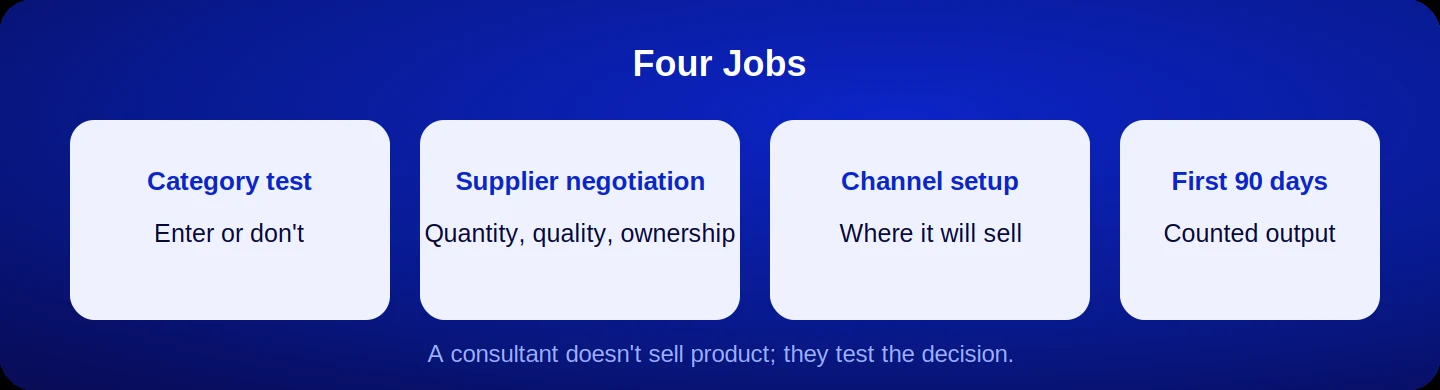
Inside the jobs:
Five Mistakes People Make Choosing a Sector
BU BÖLÜMÜN ÖZETİ
- Entering at the peak of a trend
- Starting too broad
- Pricing off competitors
- Leaving packaging to last
- Thinking about the channel later
These are the ones that repeat most. All are fixable — as long as they’re spotted before the first order.
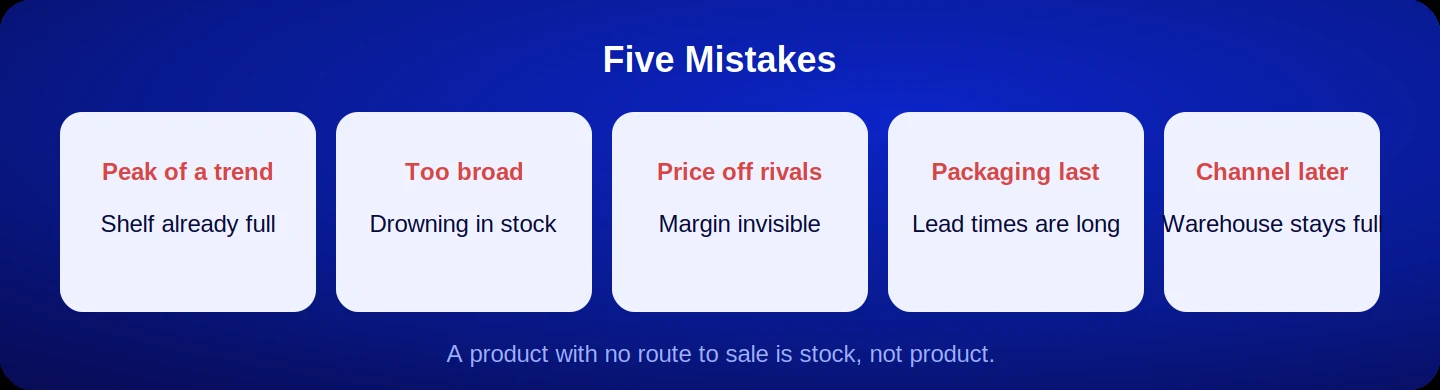
The mistakes:
Entering at the peak of a trend
When a category explodes on social media, most people entering are already late: the shelf is full, advertising has got expensive, prices have fallen. A trend is a good signal for validation and a bad one for timing your entry.
Starting too broad
Brands that open with “shampoo and cream and serum” drown in stock. Being good at one product grows faster than being average at five. Expansion comes after sales, not after the expectation of sales.
Pricing off competitors
Setting a price by looking at a rival ignores your own costs. Price is built on product, packaging, shipping, returns, marketplace commission and advertising. A brand that doesn’t know its margin loses more as revenue grows.
Leaving packaging to last
Packaging is your product’s first and often only speaking part; it is decided at the start of the production plan, not the end, because moulds and supply take time. For a consistent visual language, the digital media side comes in.
Thinking about the channel later
“Let’s produce first, we’ll find a way to sell” is the most common reason warehouses stay full. The channel is built first, the product flows after. A product with no route to sale is stock, not product.
Where to Start: Three Steps
BU BÖLÜMÜN ÖZETİ
- Write one page of advantage
- Put two categories side by side
- Start small and measured
If you’re ready to decide, the next three steps are enough. No long plan needed.
Three steps:
Write one page of advantage
What do you have? How large an audience, which channel, which trade knowledge, which supply relationship? That page sets both the sector choice and the first sales plan. If it comes out empty, don’t rush; accumulating an advantage first and building a brand second is cheaper.
Put two categories side by side
Open the two guides closest to you from the list above and fill in the four measures for both. The difference is usually clear. A choice made without comparing two categories is a preference, not a choice.
Start small and measured
Small first batch, one channel, one product. The aim isn’t profit but real sales data. For a preliminary assessment you can write to us; our first job isn’t recommending a product but filling in the category test with you. The scope sits on the brand consultancy page, the wider view under digital consulting.
Field Notes
· Those who already have an audience get their first sale noticeably earlier; a first customer bought through advertising is always the most expensive customer.
· A large share of first orders placed without negotiating the minimum quantity ends up waiting in a warehouse; split across two smaller batches, the risk halves.
· Where a label claim isn’t backed by documentation, the problem usually surfaces not at the moment of sale but at the moment of complaint.
Mini Glossary
Real advantage: What you hold today and your competitor doesn’t — audience, channel, supply or trade knowledge.
Entry threshold: The documentation, testing and minimum production burden of entering a category.
Endurance: The number of months the business can stand before the first sale arrives.
Quick Summary
· Sector choice is the overlap of three things: advantage, threshold, endurance.
· A contract manufacturer won’t tell you three things: the formula is shared, the minimum order is your risk, and building a brand isn’t buying a product.
· The 25 guides open sector by sector; a consultant’s work is the category test, supplier negotiation, channel setup and the counted output of the first 90 days.
Your Next Step
Write one page this week: the advantage you hold, the two categories you’re considering, and how many months you can last. Bring that page to a preliminary assessment and we’ll fill in the category test together.
Frequently Asked Questions
I have no sector experience — can I still build a brand?
You can, but then you need to enter with another advantage: an audience, a sales channel or a strong supply relationship. If you have none of the three, the most realistic route is building one of them first — starting a small community, learning a channel by selling on a marketplace, or working in the sector for a few months. Most inexperienced launches stall not because of the product but because there is no route to sale.
Why does cosmetics sit apart in this list?
A separate and deeper guide set was prepared for cosmetics; the category has its own branches — hair care, makeup, intimate care, natural oils — and each has different documentation, formula and shelf realities. Those branches appear individually in this list, while the general setup process for cosmetics is covered in its own set. If you’re still deciding, filling in the category test here first and moving to that set afterwards gives faster results.
Can you build brands in two sectors at once?
Technically yes, in practice it rarely works well. Two categories mean two stock structures, two channel learning curves and two content languages; most ventures have neither the cash nor the time to carry both. The healthy route is building one, then opening the second once sales are steady. The one exception is when both products sell to the same customer through the same channel — there the second product isn’t a new sector but an extension of the existing brand.
Sık Sorulan Sorular
Something that separates you from your competitor today: a customer list, a shop shelf, a relationship with a salon chain, insider knowledge of a trade, an audience that trusts you. “I love the product” is not an advantage — everyone is trying to sell what they love. Without one, whatever sector you pick, you spend the first year buying customers through advertising, which is the most expensive route there is.
Some categories are paperwork first: food, cosmetics, baby products, supplements. In others the threshold is a minimum production quantity — a line won’t run below a certain number, and that number sets your first order. A budget built without knowing the threshold is an incomplete budget; costing the product and forgetting testing and documentation is the most common mistake.
Building a brand usually means turning cash into product and letting it wait on a shelf. The more sizes, colours and variants, the more capital you tie up for the same revenue. In clothing and cosmetics, returns are a line of their own. Profit hides in turnover speed, not in the sale price — and that conversation belongs before the first order.
Two routes: build one or buy one. Building takes time — a small community, learning a channel by selling on it, a few months working inside the sector. Buying takes money: advertising, dealer relationships, a ready-made channel. There is no third route; a brand entering with neither advantage nor budget spends its first six months invisible.
The same person picks one sector if they can last six months and another if they can last two years. Fast-returning categories are usually crowded; slower ones are better protected but demand cash. Choosing a sector to fit the length of your pocket is nothing to be ashamed of — the reverse produces results that are.
The four measures go on one page: your advantage, the threshold, the stock burden, your endurance. Then two or three categories sit side by side and you see which is less risky for you. That page is half a day’s work and often the page that saves the venture — because “let’s not enter” is also a result.
Three things: keeping the minimum order reasonable, putting quality control in writing, and discussing your rights over the formula and the mould. An undocumented contract-manufacturing relationship is your most fragile point the day you grow. On the design and name side, registration runs through brand consultancy.
Selling on a marketplace means one kind of packaging and pricing, your own site another, dealers something else again. Designing a product before choosing a channel is building a house from the roof down. The site side sits with website consulting, the advertising side with advertising consultancy.
Name and positioning, a category decision, a supplier agreement, packaging and labelling, channel setup, a first content set and a first sales test. The measure isn’t a feeling that “the brand is built” but the delivery of those seven outputs — and if you’re unsure which consultancy to start with, the umbrella guide points the way.