
How to Start a Baby Care Brand in 9 Steps: Documents, Manufacturer and First Batch
A baby care brand is started in nine steps: define the buyer, pick a single product, find a contract manufacturer, take samples, get tests done, file the notification, prepare the label, produce the first batch, get onto the first shelf. The order does not change; testing comes before notification, notification before the label. The whole thing takes between four and eight months, and the longest steps are testing and notification.
For each step this guide says three things: how long it takes, which document it needs and which mistake is made most often. There are no cost figures, because cost depends on the manufacturer and the quantity; there are times and documents, because those do not change. At the end you will find a nine-point checklist.
Steps 1 to 3: buyer, product and manufacturer
BU BÖLÜMÜN ÖZETİ
- 1. Define the buyer
- 2. Pick a single product
- 3. Shortlist manufacturers
The first three steps are done at the desk and take two to four weeks in total. The buyer is defined in one sentence, the product is chosen within a single group, and the manufacturer is narrowed down from three candidates by how they handle the sampling process. Skip these three and the next six steps are done for the wrong product.
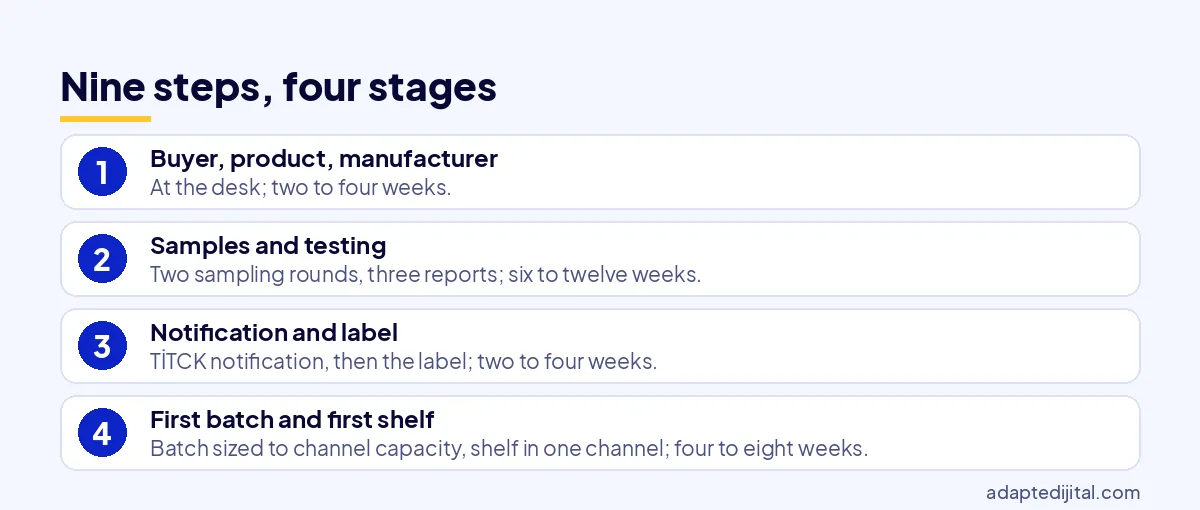
1. Define the buyer
Time: one week. Needed: a one-sentence persona and the type of expert who approves it (pharmacist, midwife, store). Output: this sentence narrows the product choice. The framework is in the pillar article.
2. Pick a single product
Time: one week. Needed: a product group decision (a single item such as shampoo, oil or nappy rash cream) and a review of competitors’ shelves. Output: a product brief covering ingredient expectations, age of use and fragrance preference.
3. Shortlist manufacturers
Time: two weeks. Needed: at least three contract candidates, and from each a capacity figure, a minimum order quantity and a document list. The detailed process is in the article on how to choose a contract manufacturer.
Steps 4 to 5: samples and testing
BU BÖLÜMÜN ÖZETİ
- 4. Take samples
- 5. Get tests done
- Common mistake
Samples and testing together take six to twelve weeks; this is the longest and most expensive part of the process. Sampling needs at least two rounds, and test reports are obtained after the sample is approved. No notification is filed until testing is finished, and no label is printed until the notification is filed.
4. Take samples
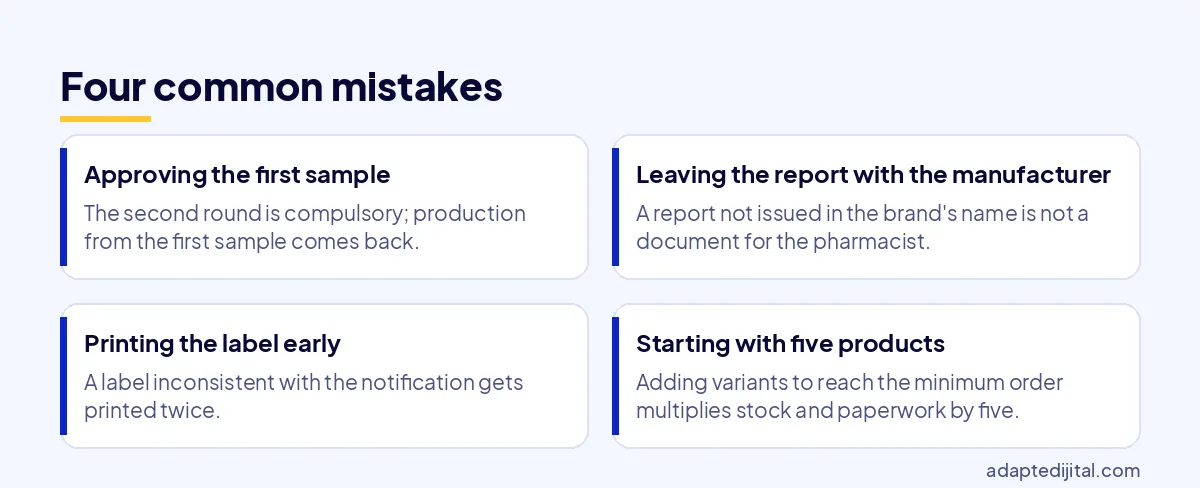
Time: three to six weeks, two rounds. Needed: a written assessment at each round (fragrance, texture, fit with the packaging) and an approval signature. Common mistake: approving the first sample and going straight into production.
5. Get tests done
Time: four to eight weeks. Needed: dermatological testing, microbiological analysis, stability testing; reports in the brand’s name. The concepts are explained in the article on dermatologically tested and hypoallergenic.
Common mistake
Leaving the test report in the manufacturer’s file. If the report is not issued in the brand’s name, the pharmacist does not count it as your document; that mistake cost four months in the pharmacy shelf case.
Steps 6 to 7: notification and label
Notification and label take two to four weeks. A cosmetic product is notified to TİTCK (the Turkish Medicines and Medical Devices Agency) before it is placed on the market; the notification is the brand owner’s responsibility. The label is printed after the notification, because the information on the label has to match the notification.
6. File the notification
Time: two weeks of preparation. Needed: the product formula, test reports and the responsible person’s details. The official framework is on the TİTCK pages; check current requirements with a specialist, as the rules change.
7. Prepare the label
Time: two weeks. Needed: ingredient list, usage warning, a batch number field, brand contact details and manufacturer information on a separate line. Common mistake: printing the label before the notification and printing it twice.
Steps 8 to 9: first batch and first shelf
BU BÖLÜMÜN ÖZETİ
- 8. Produce the first batch
- 9. Get onto the first shelf
- Common mistake
- The second batch rule
The first batch is kept small and the first shelf is opened in a single channel; these two steps take four to eight weeks. Batch size is set by channel capacity, not by a sales forecast: you produce for three pharmacies, not for thirty. The first shelf shows the turnover, and the second batch grows from that.
8. Produce the first batch
Time: three to four weeks. Needed: the approved sample, the printed label, a batch record and a quality control report. Common mistake: producing five products at once to reach the minimum order quantity.
9. Get onto the first shelf
Time: two to four weeks of meetings. Needed: the file (notification, report, return terms), a shelf card and a single recommendation sentence. The channel choice is in the comparison of pharmacy, baby store and your own site.
Common mistake
Trying to sell the first batch with advertising. Advertising before you have a shelf is asking for trust before you have documents; the order by stage is given in the hub article.
The second batch rule
The second batch is set by the turnover of the first shelf: for a product that sells out in three pharmacies in eight weeks, the second batch is double; for one that takes sixteen weeks, the same amount. Grow by the shelf, not by the forecast. This rule prevents stock from locking up your cash.
Total time and the critical path
BU BÖLÜMÜN ÖZETİ
- What can run in parallel
- What cannot run in parallel
- The only thing that shortens the timeline
The nine steps take four months at best and six to eight months in the normal case. The critical path runs through testing and notification: these two cannot run in parallel, they go in sequence. Shortening the sampling round does not shorten the timeline, because the second round is compulsory; the only thing that shortens it is asking three manufacturer candidates for samples at the same time.
What can run in parallel
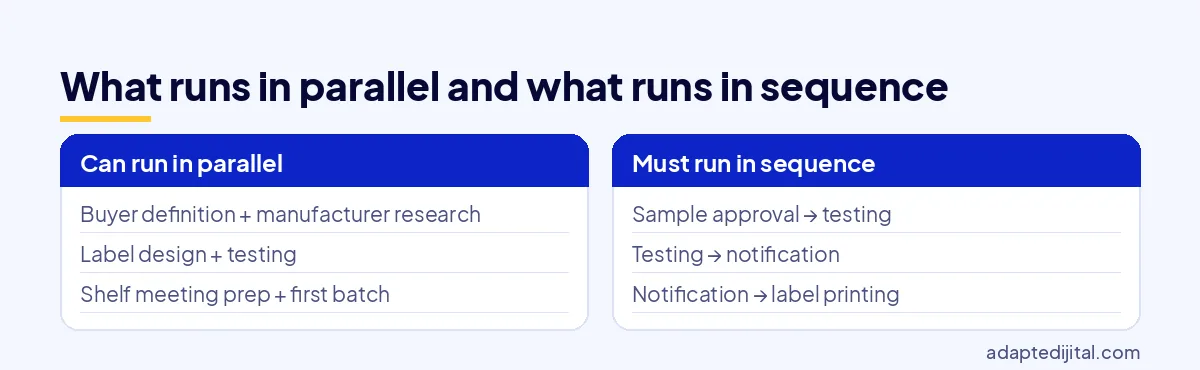
Buyer definition alongside manufacturer research, label design alongside testing, preparation for shelf meetings alongside first-batch production. These three pairs save time.
What cannot run in parallel
Sample approval and testing, testing and notification, notification and label printing. These three pairs go in sequence; bringing one forward makes you do the other twice.
The only thing that shortens the timeline
Asking three manufacturer candidates for samples in the same week. Tried one after another, each candidate adds three weeks; tried at the same time, all three are seen within three weeks. This is the only real time that can be gained across the nine steps.
For timing and the season decision there is the article on when a baby brand should launch.
The nine-point checklist
Tick the nine items below in order; if an item is not ticked, do not move to the next step. The list is for baby care products; for textiles and accessories the testing and document steps change, but the order does not.
The list
- Buyer written in one sentence, type of approving expert identified
- Single product group chosen, product brief written
- Document list and minimum order quantity obtained from three manufacturer candidates
- Two rounds of samples approved with written assessments
- Dermatological, microbiological and stability reports obtained in the brand’s name
- TİTCK notification filed, responsible person appointed
- Label consistent with the notification, with a batch number field and brand contact details
- First batch produced to channel capacity, quality control report kept
- First shelf opened with the file, a shelf card and a single recommendation sentence
Frequently Asked Questions
Quick Summary
- Nine steps: buyer, product, manufacturer, samples, testing, notification, label, first batch, first shelf.
- The order does not change: testing before notification, notification before the label.
- Total time four to eight months; the critical path is testing and notification.
- Reports are obtained in the brand’s name; a report left with the manufacturer does not count as a document.
- The first batch is sized to channel capacity, and the first shelf opens in a single channel.
Short Glossary
- Sampling round: the stage at which a trial product prepared by the manufacturer is approved with a written assessment or sent back for correction
- Stability test: a test showing that the product keeps its physical and chemical properties throughout its shelf life
- Critical path: the chain of steps in a project that wait on one another and determine the total duration
- Shelf card: the small information card that sits next to the product on a pharmacy or store shelf and carries the recommendation sentence
Next Step
To fit the nine steps to your own calendar, write to us via the consult your expert form; the scope is on the brand consultancy page. Next article: how Adapte Dijital positions a baby brand.
Updated: October 2026
Sık Sorulan Sorular
The brand owner. The manufacturer keeps its own list, and that list is not yours. To set the order of the steps and the calendar, brand consultancy; for the sector picture, the baby brand sector guide.
The nine steps take four months at best and six to eight months in the normal case; the longest steps are sampling, testing and notification.
Dermatological testing, microbiological analysis and stability testing; the reports are issued in the brand’s name. For current requirements, TİTCK and specialist advice are the reference.
Sized to channel capacity: as many as the pharmacies or stores you are in talks with; a large batch based on a sales forecast is the most common first-year mistake.