
How to Choose a Contract Manufacturer for a Baby Products Brand: Samples, Contract, QC
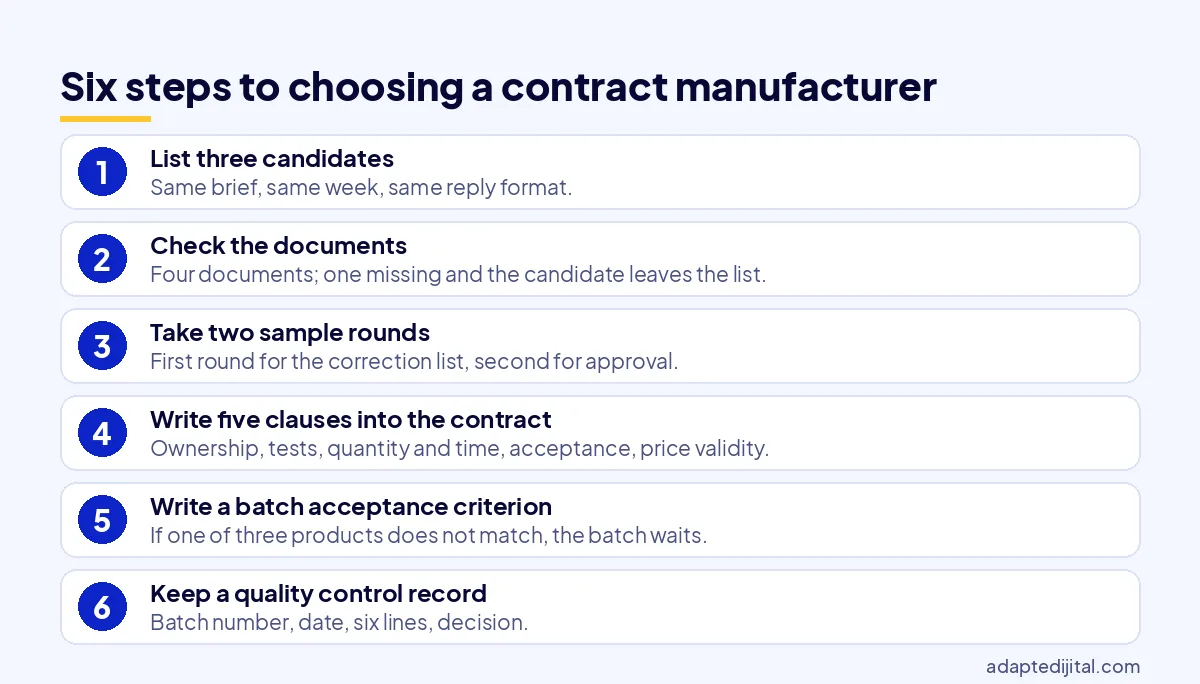
A contract manufacturer for a baby product is chosen in six steps: list at least three candidates, check their documents, take two rounds of samples, sign a five-clause contract, write a batch acceptance criterion and set up a quality control routine. The thresholds are clear: no decision with fewer than three candidates, no approval after a single sample round, and no minimum order larger than three months of forecast sales.
This article gives the six steps in order; each step has a do-this instruction, a threshold and the most common mistake. At the end you will find a six-criterion comparison template; put your three candidates into it and the choice falls out on its own. No decoration, just steps.
Step 1: list at least three candidates
A brand that talks to one candidate loses both its bargaining power and its yardstick. Do this: find three contract manufacturers, send all three the same brief in the same week, and ask all three to reply in the same format. Threshold: with fewer than three candidates the decision is postponed until the list is complete.
The most common mistake
Starting sampling with the first manufacturer you find. The first candidate is usually the most visible one, not the most suitable. Choosing a manufacturer belongs to the set-up stage; confirm your stage with the four questions in the hub article, because switching manufacturers at the launch stage costs two months.
Step 2: check the documents before you look at the product
Ask for documents before you ask for samples: the manufacturing permit, the cosmetics production site registration, the quality management system and whether they have made a baby product before. No sample is ordered from a candidate with a document missing; a sample takes weeks, a document is one email. Threshold: if one of the four documents is missing, the candidate leaves the list.
The four documents
Production site permit, a responsible technical person registered with TİTCK (Turkish Medicines and Medical Devices Agency), good manufacturing practice compliance, and a reference baby product. The official framework is on the TİTCK pages; conditions change, so confirm the current version with a specialist.
The most common mistake
Leaving a document at verbal confirmation. If they say they have it, ask for a copy; if the copy does not arrive, the document does not exist. This step takes one email and two days; skipping it takes a year.
Step 3: take two rounds of samples
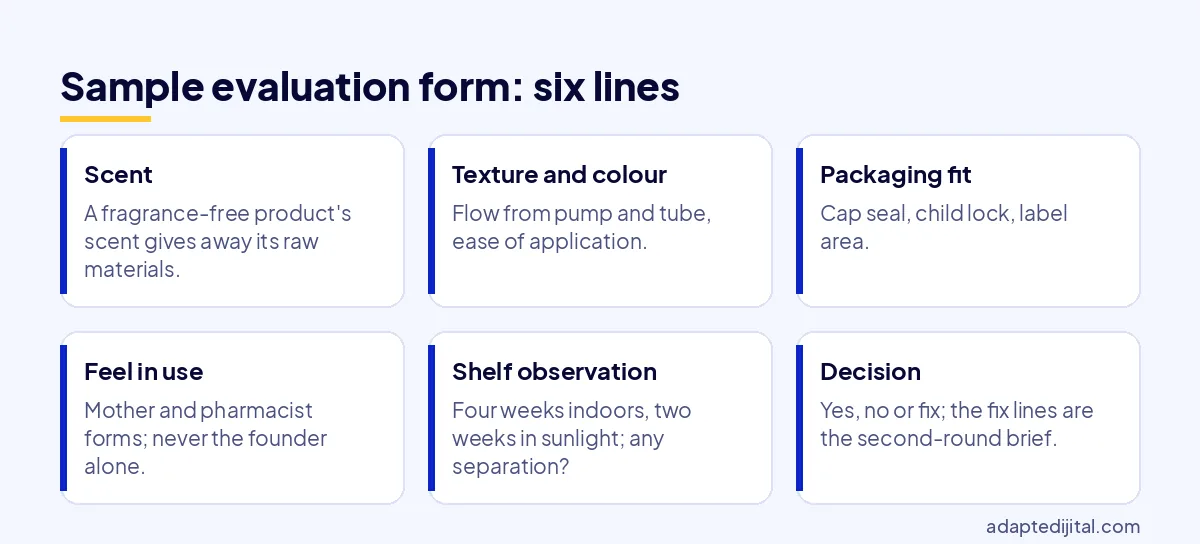
The first sample is never approved; the first sample exists to produce a correction list. Do this: fill in a written evaluation form in each round (scent, texture, packaging fit, shelf test), and in the second round tick whether each correction has been made. Threshold: series production is not discussed until both rounds are complete.
The evaluation form
Six lines: scent, texture, colour, packaging fit, feel in use, four-week shelf observation. Each line gets yes, no or fix. The lines marked fix become the brief for the second round.
The most common mistake
Testing the sample only in your own hands. A baby product is judged by the target mother, not by the founder. The full set-up sequence is in the nine-step guide.
Step 4: write five clauses into the contract
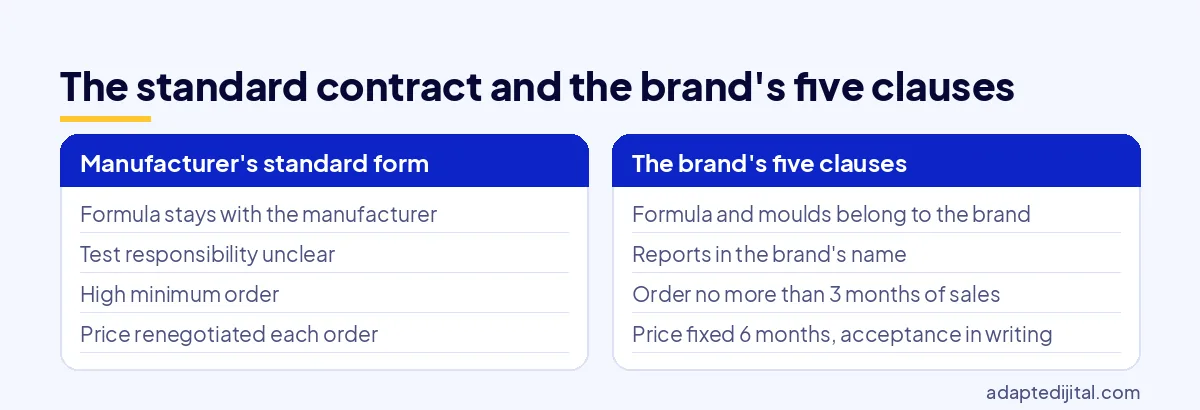
No contract manufacturing agreement is signed without five clauses: ownership of the formula and moulds, responsibility for tests and documents, minimum order and delivery time, batch acceptance criterion, and price validity period. Do this: write the five clauses in your own words and have them added to the manufacturer’s contract. Threshold: if one of the five is missing from the contract, it is not signed.
The five clauses
- The formula and packaging moulds belong to the brand owner and can be used even if the manufacturer changes
- Test reports are issued in the brand’s name; the documents needed for notification are supplied by the manufacturer
- The minimum order does not exceed three months of forecast sales; delivery time is written in days
- Batch acceptance criterion: a quality control record and exact match with the approved sample; a non-matching batch is returned
- The price is valid for at least six months; raw material increases are passed on only with written notice and mutual approval
The most common mistake
Signing the manufacturer’s standard printed contract. The standard form protects the manufacturer; the five clauses protect the brand.
Steps 5–6: batch acceptance criterion and quality control
Every batch is compared with the approved sample on delivery and a quality control record is kept; a batch with no record is not accepted. Do this: take three products at random from every batch, fill in the six-line form, and write the batch number on the record. Threshold: if one of the three products does not match the sample, the batch is held and the whole of it is inspected.
The six-criterion comparison template
Put the three candidates into the same table; score each criterion from 1 to 3, and the highest total wins. If the totals tie, the documents and reference criteria decide, not the price. The template is below; it takes an hour to fill in, while the time lost with the wrong manufacturer is a year.
The template
| Criterion | Candidate 1 | Candidate 2 | Candidate 3 | Weight |
|---|---|---|---|---|
| Documents and permits (4/4) | Decisive | |||
| Baby product reference | Decisive | |||
| Second-round sample match | High | |||
| Minimum order ≤ 3 months of sales | High | |||
| Accepts the five contract clauses | High | |||
| Price and validity period | Medium |
Frequently Asked Questions
Quick Summary
- Six steps: three candidates, document check, two sample rounds, a five-clause contract, a batch acceptance criterion, quality control.
- Documents are checked before samples; no sample is ordered from a candidate with a document missing.
- The first sample is not approved; it exists to produce a correction list.
- If formula ownership and test responsibility are not in the contract, the brand stays dependent on the manufacturer.
- Every batch is accepted with a record; the record is traceability itself.
Short Glossary
- Contract manufacturing: having a product made under your own brand name by another manufacturer, without a facility of your own
- Batch acceptance criterion: a written measure of how closely a delivered batch matches the approved sample and the condition for returning it
- Minimum order: the lowest production quantity a manufacturer will accept in a single run
- Quality control record: the document in which samples from each batch are assessed on six criteria and recorded against the batch number
Next Step
To place your three candidates in the template together, write to us through the consult your expert form; the scope is on the brand consultancy page. Next article: pharmacy, baby store or your own site for a baby brand.
Updated: October 2026
Sık Sorulan Sorular
One page: product type, target age, ingredients you do not want, packaging type, forecast three-month volume, documents required. The brief contains no abstract words; instead of hypoallergenic it says fragrance-free and colourant-free. The concepts are in the article on dermatologically tested and hypoallergenic.
Trade fairs, cosmetics manufacturers’ associations, a pharmacist’s recommendation and the manufacturer line on the labels of existing brands. The label line is the most honest source; it shows who makes what for whom.
Ask which brand’s baby product the manufacturer makes, look at that brand’s label and check its notification record. A reference is something shown, not something described.
The founder, one pharmacist and two mothers. Four people, the same form. The line where the four forms disagree is the product’s weak point, and it is solved before series production.
If your formula stays with the manufacturer when you change manufacturer, your brand starts again from zero. We described the same problem as pattern ownership in the underwear brand guide; the principle is identical.
Batch number, delivery date, the person who checked, the six-line result and the decision. This record is the traceability the pharmacist asks about; in a batch complaint it is the first document opened. We saw the questions at the pharmacy counter in the case article.
The founder or someone they appoint; a manufacturer cannot accept its own batch. In a small brand this is a one-hour routine, and when skipped it becomes a one-year problem.
Choosing a manufacturer is a technical job, but its sequence and its contract are brand work; brand consultancy places the three candidates in this template and carries the five clauses into the contract. The next job is the budget: the article on start-up cost; the general framework is in the pillar article.
At least three. All three get the same brief and reply in the same format; with one candidate there is no yardstick and no bargaining power.
Formula and mould ownership, responsibility for tests and documents, minimum order and delivery time, batch acceptance criterion and price validity period; without all five, no signature.
No larger than three months of forecast sales; a bigger minimum locks up stock and pushes you to add product lines you do not need.