
Cost of Starting a Baby Care Brand: Seven Line Items, Unit Economics and Three Thresholds
The cost of starting a baby care brand is made up of seven line items: raw materials and production, testing and notification, packaging and labels, samples and trials, channel share, returns and wastage, and promotion. We do not give a single total figure; the items vary with the manufacturer, the quantity and the product type. In place of that figure there are three things that do not change: the order of the items, the unit economics formula and three thresholds.
This article opens the seven items in order, says what gets forgotten in each, then gives the unit economics formula for a single product. At the end come a budget template and three thresholds: the document share sits inside the product cost, a returns rate above five percent is an alarm, and the first batch does not exceed three months of forecast sales.
What are the seven line items, and which one gets forgotten?
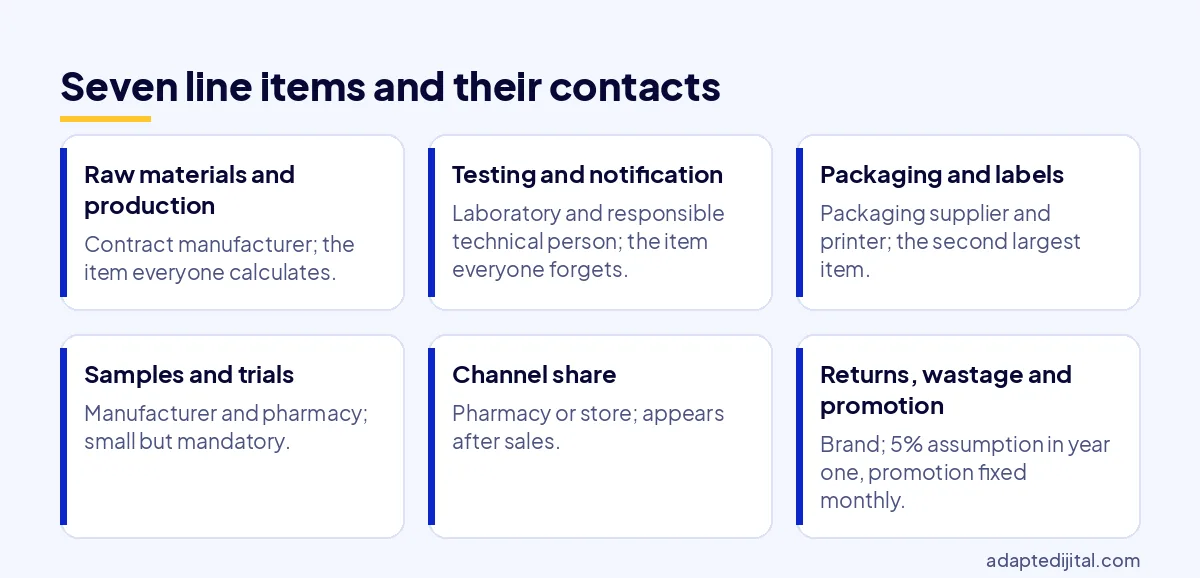
Raw materials and production is the item everyone calculates; testing and notification is the item everyone forgets. Packaging and labels is the second largest item, samples and trials small but mandatory, channel share and returns appear only after sales, and promotion is the last money spent. Do this: write the seven items into an empty table, and next to each write who will quote the price.
The three forgotten items
Testing and notification, returns and wastage, samples and trials. None of the three appears in a production quote, because none is the manufacturer’s job. Together they are the part of the first-year budget that slips out of view.
Why do testing and notification belong inside the product cost?
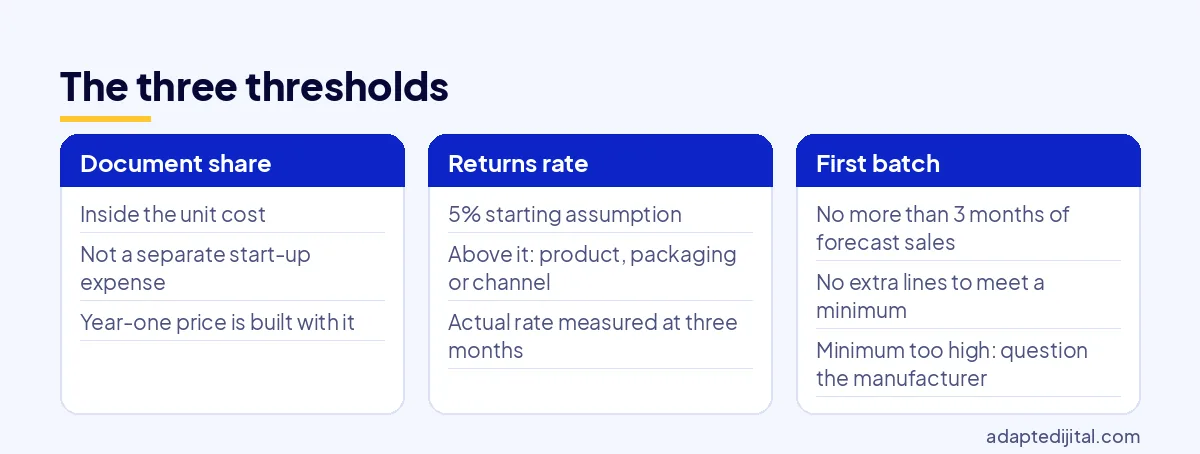
Because a product without documents cannot be sold, and the cost of a product that cannot be sold is not zero but infinite. Threshold one: testing and notification costs are spread across the units and added to the unit cost, not written as a separate start-up expense. Written this way, the unit cost of the first batch rises; that is the correct picture, because the first batch really does cost that much.
The spreading logic
The total cost of testing and notification is divided by the units expected to sell in the first twelve months and added to the unit cost. In year two that share falls; the year-one price is built with it in. What the concepts mean is in the article on dermatological testing.
The most common mistake
Treating the test as a one-off expense and pricing on the pre-test unit cost. The price comes out low, year one runs at a loss, and when the price rises in year two the mother is lost.
How do you build the unit economics formula?
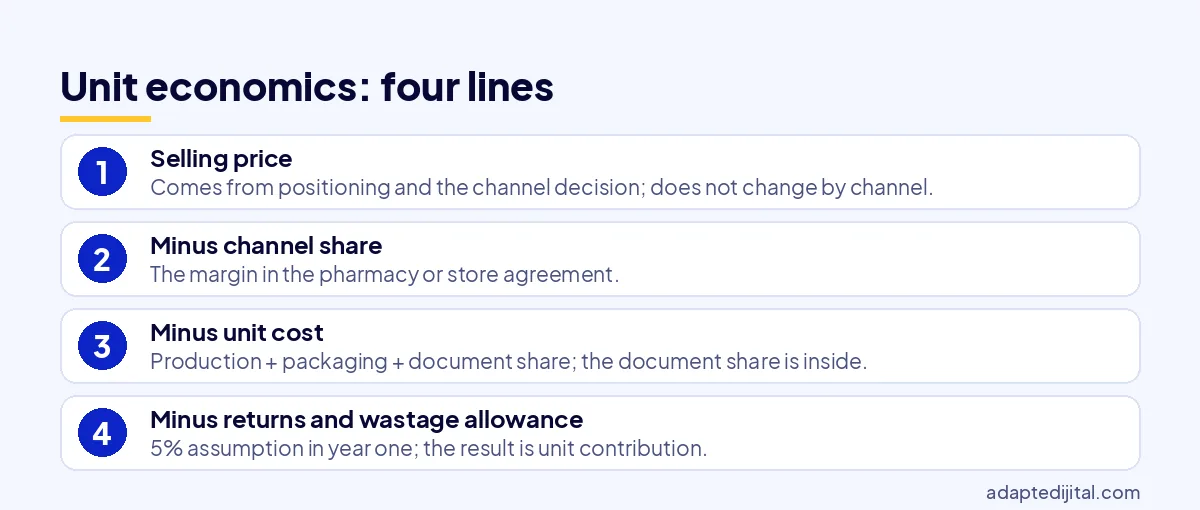
For a single product the formula is four lines: selling price minus channel share minus unit cost minus returns and wastage allowance equals unit contribution. Unit cost is production plus packaging plus the document share; channel share is the pharmacy or store margin; the returns allowance is taken as five percent in year one. Do this: fill in the formula for your hero product; if the result is zero or negative, the price or the channel is wrong.
The formula
| Line | What | Where it comes from |
|---|---|---|
| A | Selling price | Positioning and channel decision |
| B | Channel share | Pharmacy or store agreement |
| C | Unit cost | Production + packaging + document share |
| D | Returns and wastage allowance | 5% assumption in year one, then the actual rate |
| E | Unit contribution | A − B − C − D |
Threshold two: the returns rate
If the actual returns and wastage rate goes above five percent, that is an alarm: the product, the packaging or the channel has a problem. Below five percent is normal; above it calls for a diagnosis. This rate is a starting assumption for a baby care product, not a sector average.
How large should the first batch be?
Threshold three: the first batch does not exceed three months of forecast sales. If the manufacturer’s minimum order is above this threshold, either the manufacturer changes or the forecast is questioned again; you do not add product lines to meet a minimum. Do this: write down the pharmacies or stores you are talking to, put a weekly sales estimate against each, and multiply by thirteen weeks.
A worked example
Five pharmacies, two products a week in each, thirteen weeks: one hundred and thirty units. The first batch is built around that figure; if the manufacturer says a thousand, the manufacturer is wrong, not the sums. Manufacturer choice is in the article on contract manufacturers.
The most common mistake
Producing a large batch to bring the unit price down. The unit price falls, stock locks up, shelf life starts ticking, and no money is left for the second product.
The budget template and support sources
The template is seven rows and four columns: line item, contact, one-off or recurring, first-year share. It takes a day to fill in, and every manufacturer quote goes into it. Public funding exists for new entrepreneurs; conditions change, so confirm the current version at the official source.
The template
| Line item | Contact | Type | First-year share |
|---|---|---|---|
| Raw materials and production | Contract manufacturer | Recurring | |
| Testing and notification | Laboratory, responsible technical person | One-off, spread per unit | |
| Packaging and labels | Packaging supplier, printer | Recurring | |
| Samples and trials | Manufacturer, pharmacy | One-off | |
| Channel share | Pharmacy, store | Recurring | |
| Returns and wastage | Brand | Recurring, 5% assumption | |
| Promotion | Brand, agency | Fixed monthly |
Public support
KOSGEB (Turkey’s small business development agency) runs entrepreneur support programmes for new founders; scope and conditions change by period, so confirm them on the official KOSGEB page before applying. Support does not build the budget; it closes a gap.
The three thresholds on one page
The document share sits inside the unit cost; a returns rate above five percent is an alarm; the first batch does not exceed three months of forecast sales. The three thresholds let a baby care brand run its first year from its own sums, not the manufacturer’s quote. Every decision that crosses a threshold breaks next month’s cash flow.
To do today
Open the seven-row template, write in the contacts, note the three thresholds at the top of the page. The figures fill in as quotes arrive; the order and the thresholds are fixed from today.
Next step
What must be complete before launch: the twelve-point checklist; for your stage, the hub article; for the sums, consult your expert.
Frequently Asked Questions
Quick Summary
- Seven line items: production, testing and notification, packaging, samples, channel share, returns and wastage, promotion.
- The three forgotten items are testing and notification, returns and wastage, and samples; none appears in a production quote.
- Unit contribution = selling price − channel share − unit cost − returns allowance.
- Threshold one: the document share sits inside the unit cost. Threshold two: returns above 5% is an alarm. Threshold three: the first batch does not exceed three months of sales.
- The template is seven rows and four columns; every quote is placed into it.
Short Glossary
- Unit economics: the comparison of the revenue from selling a single product with all the costs attached to that product
- Unit contribution: the amount left to cover fixed costs after channel share, unit cost and returns allowance are deducted from the selling price
- Document share: the portion of testing and notification costs loaded onto each unit by dividing them by the expected sales volume
- Wastage: product lost to breakage, spoilage and expired shelf life that cannot be sold
Next Step
To fill in the template together with your own quotes, write to us through the consult your expert form; the scope is on the brand consultancy page. Next article: the twelve-point checklist before a baby product launch.
Updated: October 2026
Sık Sorulan Sorular
The contract manufacturer quotes raw materials and production, the laboratory testing, the responsible technical person notification. Packaging is priced by the printer and packaging supplier, the channel share by the pharmacy or store. Seven items, at least five contacts; a budget is not built from a single quote.
Promotion sits outside unit economics as a fixed monthly cost; if total unit contribution covers promotion and the other fixed costs, the brand is standing. How the channel share changes by channel is set out in the three-channel comparison.
Putting the budget in order and placing quotes into the template is the job of brand consultancy; the same line items on the cosmetics side are in the cosmetics brand guide. The general order is in the pillar article.
There is no single figure; the seven line items vary with the manufacturer, the quantity and the product type. What does not change is the order of the items, the unit economics formula and the three thresholds.
The total cost is divided by the number of units expected to sell in the first twelve months and added to the unit cost; it is not written as a separate start-up expense.
As many as three months of forecast sales: the number of outlets you are talking to, a weekly estimate per outlet, thirteen weeks. If the manufacturer’s minimum exceeds that, you do not add product lines; you question the manufacturer.