
Makeup Brand Sales Channels: Own Site, Marketplace or Beauty Retailer Compared
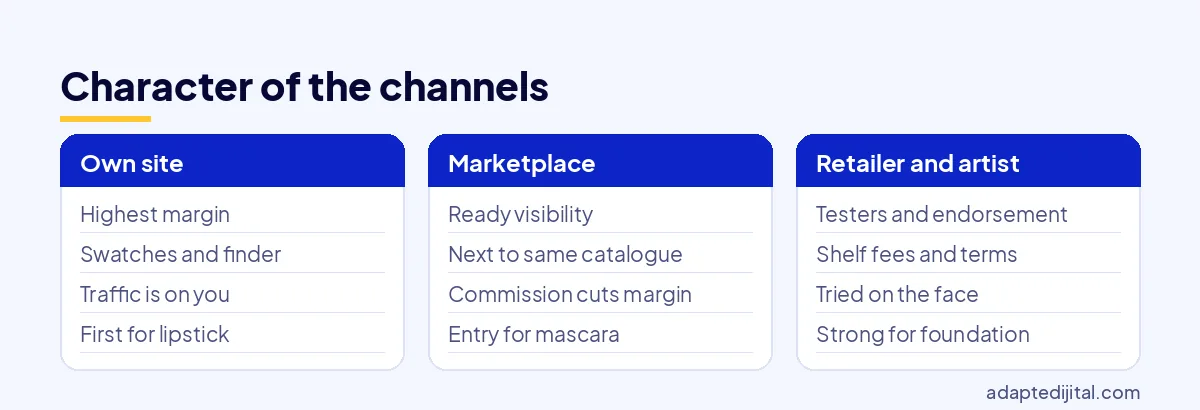
In one sentence: shade-led products like a lipstick family are strongest on your own site, compare-and-buy products like mascara and brushes on marketplaces, foundation and concealer through artists, and wide shelf presence comes from beauty retailer chains in year two. Your own site carries a shade finder and swatch gallery best, but the brand must bring the traffic. A marketplace gives visibility but lines you up with ten lipsticks from the same catalogue; retailers give shelf and touch, artists give endorsement.
This article compares four channels on six criteria and ends with a decision rule by product group. No figures, no ad copy, just criteria.
Which six criteria drive the comparison?
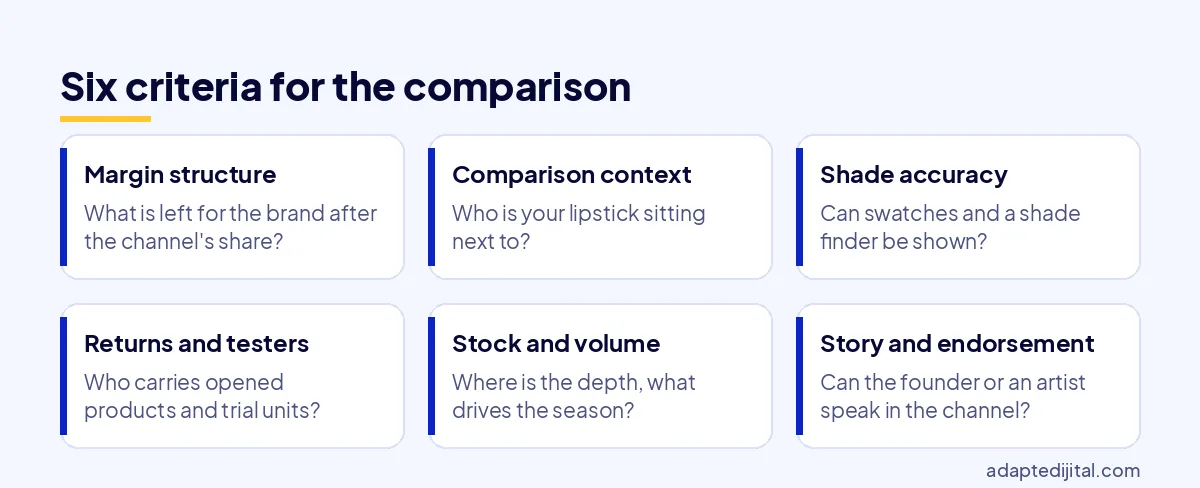
Margin structure, comparison context, showing shade accuracy, returns and tester load, stock and volume, story and endorsement. These six shape a makeup brand’s first two years; price is left out on purpose, because price is the brand’s decision, not the channel’s. Each criterion is rated low, medium or high; there is no total, as weights change by product group.
Own site: the home of the shade family and swatch gallery
Your own site has the highest margin and fullest control; a shade finder, three-skin-tone swatches, the founder’s voice and gift bundles only work fully here. The price is traffic, which the brand brings through content, short video and ads. Shipping and returns are yours too.
Pros
Highest margin, your own comparison context, visible shade accuracy, customer data in your hands. We set out the swatch standard in the article on shade-led positioning.
Cons
Slow early traffic, trust built from zero, returns on you. Building and converting the site is its own job, covered by e-commerce consulting.
Marketplace: volume for mascara, a price war for lipstick
A marketplace gives ready visibility; for compare-and-buy items like mascara, brushes, sponges and lip liner, the first sales come here. The trade-off cuts both ways: commission and campaign pressure squeeze margin, and the listing view puts your lipstick next to rivals from the same catalogue. One review saying the colour looked different rises to the top of the page.
Pros
Ready traffic, fast first sales, volume on entry products. The Trendyol seller page is the primary source for seller rules and commission; terms change, so read the current version there.
Cons
Lipstick is compared on price, the shade finder and story do not carry over, and you sell a product, not a brand. For store setup, see real profit after commission on Trendyol.
Beauty retailer chains: shelf, testers and the listing file
A beauty retailer lets customers try the product; the sales adviser hands over the tester and plays the endorser. The cost is heavy: the listing file, shelf fees, tester and sample share, payment terms and the order calendar all sit with the retailer. For a small brand it is usually a year-two channel.
Pros
Trial, adviser endorsement, visibility; the site address on the box brings the customer home.
Cons
Shelf fees, tester load, payment terms and returns come back to the brand; shades that do not sell come off the shelf. Shops and districts are in starting a makeup brand in Istanbul, buying seasons in the article on launch timing.
Salons and artists: the endorsement channel
Makeup artists, hairdressers and beauty salons use the product on the customer’s face; endorsement is born here in its strongest form. Foundation, concealer and brushes are strong in this channel, because the right shade and texture show in the artist’s hands. It is less a channel than a relationship: an artist kit, a pro price and product training.
Pros
Artist endorsement, bridal clients, natural visibility; a lipstick in an artist’s kit is the strongest proof.
Cons
Small volume, slow relationships, a pro price on margin. The kit needs a hero product.
Four channels on six criteria: the comparison table
The table rates the six criteria for four channels in relative terms: no figures, just high, medium and low. There is deliberately no total, because for a lipstick family shade accuracy and comparison context weigh most, while for mascara it is visibility and stock turn. The last row tells you which product the channel carries.
Table
| Criterion | Own site | Marketplace | Beauty retailer chain | Salon and artist |
|---|---|---|---|---|
| Margin structure | Highest | Tightest | Tight; shelf and terms | Medium; pro price |
| Comparison context | Yours | Next to the same catalogue | Same shelf as big brands | The artist’s kit |
| Shade accuracy | Full: swatch and finder | Low: one photo | High with testers | Shown on the face |
| Returns and testers | On the brand | High | High tester share | Low |
| Stock and volume | Controlled | Campaign depth | Depth per store | Small, steady |
| Story and endorsement | Full | Does not carry | With the adviser | Strongest endorsement |
Decision rule: first and second channel by product group
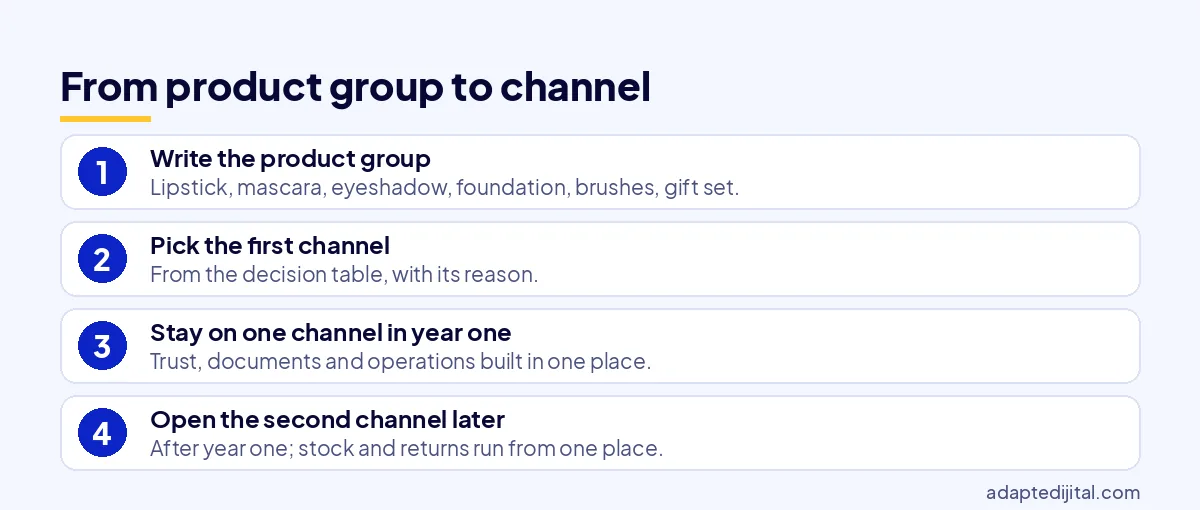
The decision comes from the product group, not preference. The lipstick family goes to your own site, mascara and brushes to the marketplace, foundation and concealer to artists, gift sets to the site and retailers at year end. The second channel opens once the first year is over; a brand that enters all four at once ends up half-done in all four.
Decision table
| Product group | First channel | Second channel | Reason |
|---|---|---|---|
| Lipstick family | Own site | Salon and artist network | Shade accuracy and swatches live here |
| Mascara and eyeliner | Marketplace | Own site, in sets | Price is compared, volume is there |
| Eyeshadow palette | Own site | Marketplace, with a set page | The colour story gets told |
| Foundation and concealer | Salon and artist network | Own site, with shade finder | Shade matching needs an expert |
| Brushes and sponges | Marketplace | Artist kit | Entry product, a bridge |
| Gift set | Own site | Retailer chain, year end | Seasonal, sold as a bundle |
The exception
The exception is a founder with a ready community, such as an artist or beauty creator. The community endorses, but brings single-channel dependence.
Frequently Asked Questions
Quick Summary
- Six criteria: margin, comparison context, shade accuracy, returns and testers, stock and volume, story and endorsement.
- Own site: highest margin, home of the shade finder and swatch gallery; traffic is the brand’s job.
- Marketplace: the entry for mascara and brushes; lipstick sits next to the same catalogue on a thin margin.
- Beauty retailer chain: shelf, testers and adviser endorsement; a year-two channel.
- Salon and artist network: strongest endorsement for foundation, concealer and lipstick; small volume.
- One main channel in year one; the second opens after the first year.
Short Glossary
- Swatch gallery: a set of photos showing a product’s swatch on different skin tones in the same light
- Shade finder: a site tool that suggests a product shade from the customer’s skin tone and undertone
- Tester: an open, unsold unit left in a shop for customers to try
- Comparison context: the products and prices placed next to yours in the customer’s eye
Next Step
To set your channel order by product group together, write to us via the consult your expert form; the scope is on the brand consultancy page. Next up: the cost of starting a makeup brand: items, three thresholds and the first batch.
Updated: October 2026
Sık Sorulan Sorular
Because the most common return reason in makeup is that the colour does not match the photo. Does the channel make room for a swatch gallery, three-skin-tone images and a shade finder, or one pack shot? The concepts are in the article on pigment, shade, undertone and wear time.
A makeup product’s risk is what sits next to it. Among ten nude lipsticks from the same catalogue, yours looks no different; we told that case in why a makeup brand stalls at its first collection.
After the hero product, documents and swatches are ready; choose earlier and you cheapen pigment to hit marketplace prices. See the four-doors hub by stage.
A brand launching with a lipstick family that can produce short video and swatches. Instagram and TikTok bring discovery; the sale closes on the site.
A brand entering with mascara and accessories. For a shade family, it is a visibility channel, not a margin one.
Export is the fifth door, open once the document file is ready. The process framework is on the foreign trade consultancy page.
The channel match comes from the buyer card; brand consultancy ties each product group to a channel with this table. The overall order is in the pillar on starting a makeup brand, the cost effect of channel share in the cost article; to decide, consult your expert.
It depends on the product group: lipstick family on your own site, mascara and brushes on a marketplace, foundation and concealer through artists, gift sets on the site and in retailers at year end.
Yes, but it is compared on price with rivals from the same catalogue, and the shade finder and swatch gallery do not carry over. For lipstick, a marketplace is a visibility channel, not a margin channel.
Usually in year two, once the shade family is proven, the document file is ready and the margin can carry testers and shelf share.