
I Want to Start a Makeup Brand: Catalogue Lipstick Is Easy, Standing Out Is Hard
Picking a lipstick from a stock shade card and printing a logo takes weeks; standing out takes years. The same catalogue lipstick sits in ten brands’ boxes on a marketplace, and buyers cannot tell them apart. The difference lives in custom shades, texture, packaging, shade range, honest swatches and a makeup artist’s approval.
This article sets out the founder’s decision order, from why makeup to when to hire a consultant; seventeen support articles open each step. The industry side sits in the industry guide to starting a makeup brand; here we stay on decisions.
I write as a brand consultant, not a manufacturer. The manufacturer opens the shade card; I ask about your buyer and your promise. Founders who see this early do not leave their first batch in a warehouse.
Why is a makeup brand a business worth starting?
BU BÖLÜMÜN ÖZETİ
- Fast consumption, repeat purchase
- A visual product
- Contract manufacturing base
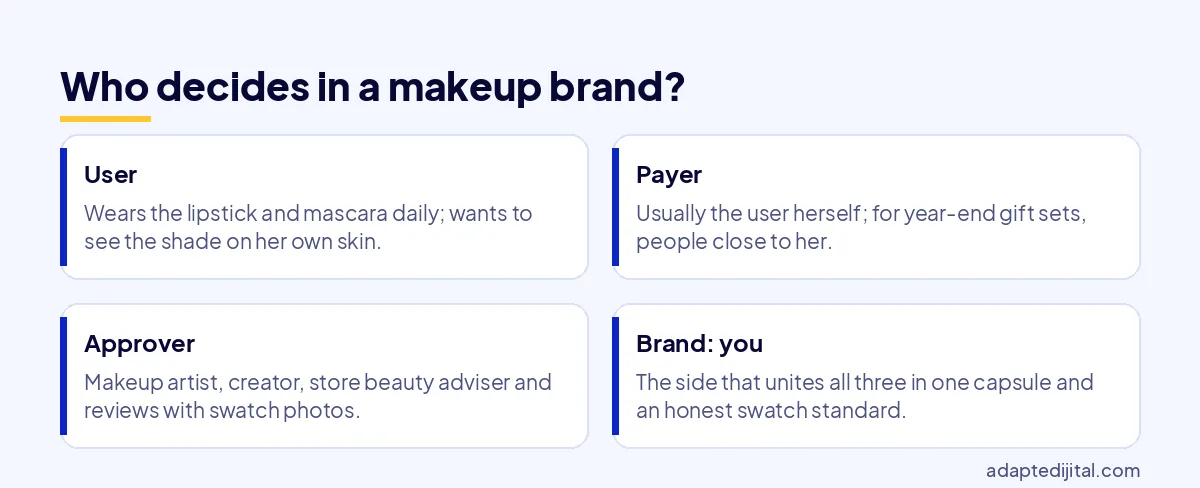
- A three-part buyer chain
Makeup is consumed fast, sold visually and renewed often: lipstick runs out, mascara dries, colours change with the season. It shows itself in photos and video, so a small brand can be seen without a big ad budget. Contract manufacturing of cosmetics in Turkey is also widespread and experienced. Together these open a real door for a small founder.
Fast consumption, repeat purchase
Lipstick, mascara and eyeliner have a limited life once opened, and buyers return for a shade they love. The first sale is a trial; the second sale is the brand itself.
A visual product
Makeup sells through an arm swatch, colour on the lips and a short video. Discovery happens on social media, but discovery is not a sale. Honest visuals, where the photo colour is the real colour, are a brand’s capital of trust.
Contract manufacturing base
Colour cosmetics makers operate along Istanbul’s western belt and the Anatolian side, and private label is common. You can read the direction of cosmetics exports in TİM (Turkish Exporters Assembly) data. Finding a manufacturer will not be your real problem.
A three-part buyer chain
User and payer are often the same person; with gift sets the payer changes. Approvers are makeup artists, beauty creators, store advisers and swatch-photo reviews. You cannot choose a product until you know which of the three to win first.
We explain with a case why people switch in why people switch to small makeup brands.
Ten brands from one catalogue: where exactly is the problem?
The problem is that a catalogue product is not yours. The same shade card, formula and stock packaging serve ten other founders. The founder prints a logo on the box and then cannot tell their lipstick from a neighbour’s on the marketplace. Private label is a convenience, but on its own it builds no part of the brand.
Do this
Before seeing a manufacturer, write one sentence: my lipstick differs from its rival in these three ways. If you cannot write it, the visit is premature.
We show why a twelve-shade catalogue launch stalls in why a makeup brand stalls at its first collection.
Where does a makeup brand stand out? The differentiation map
Differentiation happens at seven points, and only some depend on the manufacturer. Custom shade and texture are developed with the manufacturer; packaging is solved with a supplier; shade range, swatch honesty, artist approval and story belong to the brand alone. Catalogue shades are open to everyone. The map orders the seven points by who controls them.
Differentiation map
Seven points, three hands. The points hardest to copy are in the last column.
| Point | Who controls it | Where decided | Copyability |
|---|---|---|---|
| Catalogue shade | Manufacturer | Stock shade card | Easy; everyone has it |
| Custom shade | Founder, manufacturer | Shade development | Medium; own the formula |
| Texture and finish | Founder, manufacturer | Wear test | Medium; good texture is rare |
| Packaging | Founder, supplier | Stock, print or mould | Medium; a custom mould helps |
| Shade range | Founder | Product plan | Hard; needs patience |
| Swatch honesty | Founder | Shooting standard | Hard; needs discipline |
| Artist and story | Founder | Network, content | Hardest; nobody takes your artist |
Differentiating in the wrong place
Most new brands compete in the catalogue row: more shades, a shinier box. That fills a shelf but makes no brand. We correct myths such as 24-hour lipstick in 6 things people get wrong about makeup brands.
Which product group first: lips, eyes, face or nails?
BU BÖLÜMÜN ÖZETİ
- Lips
- Eyes
- Face
- Nails and accessories
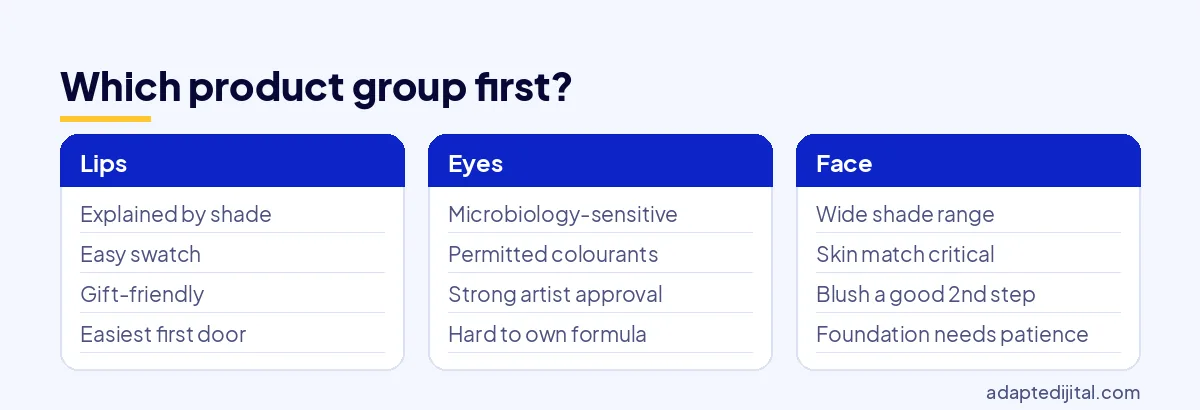
Start with a single group, and for most founders lips are the easiest door. Lipstick is explained through shade, shown fast with a swatch, and buyers like trying shades. Eye products demand microbiological care; foundation demands a wide shade range; nail polish is a world of its own. A brand opening all four stays half-finished in all four.
Lips
Lipstick, liquid lipstick, gloss and lip liner suit the brand’s backbone best: a clear shade decision, easy swatches, gift appeal. We explain pigment, undertone and finish in pigment, shade, undertone and wear time explained.
Eyes
Palettes, mascara, eyeliner and brow products sit near the eyes, so microbiology and permitted colourant rules are stricter. Owning a mascara formula is hard; artist approval sells well here.
Face
Foundation, concealer, powder, blush, highlighter. A foundation launched with few shades never reaches many buyers. Blush and highlighter are a good second step after lips.
Nails and accessories
Nail polish has its own formulas and rules, so it is a poor first group. Brushes and sponges do not carry identity; add both once the main group settles.
We lay out cost items as structure, not figures, in cost of starting a makeup brand.
How do you build the first product and capsule: one product, five or six shades?
The first collection is not a twelve-shade lipstick wall but one product in a five or six shade capsule. The hero product carries the brand; the shade family shares one texture and packaging language; a second product comes only after the capsule proves itself. Fewer shades mean deeper testing and content per shade, not fewer sales.
Capsule architecture
A hero product; a shade family from nudes to a deep red; then lip liner or blush, all in one texture and packaging language. We set this out with a swatch standard in how Adapte Dijital positions a makeup brand.
The shade is found on the customer’s skin
Shades are chosen on real skin, not by the founder’s taste; the same lipstick changes on light, medium and deep tones. Read an artist’s path in from makeup artist to makeup brand.
Manufacturer and paperwork: when to look, what to ask?
BU BÖLÜMÜN ÖZETİ
- Three candidates, one sample
- The paperwork rule
- Claims need proof
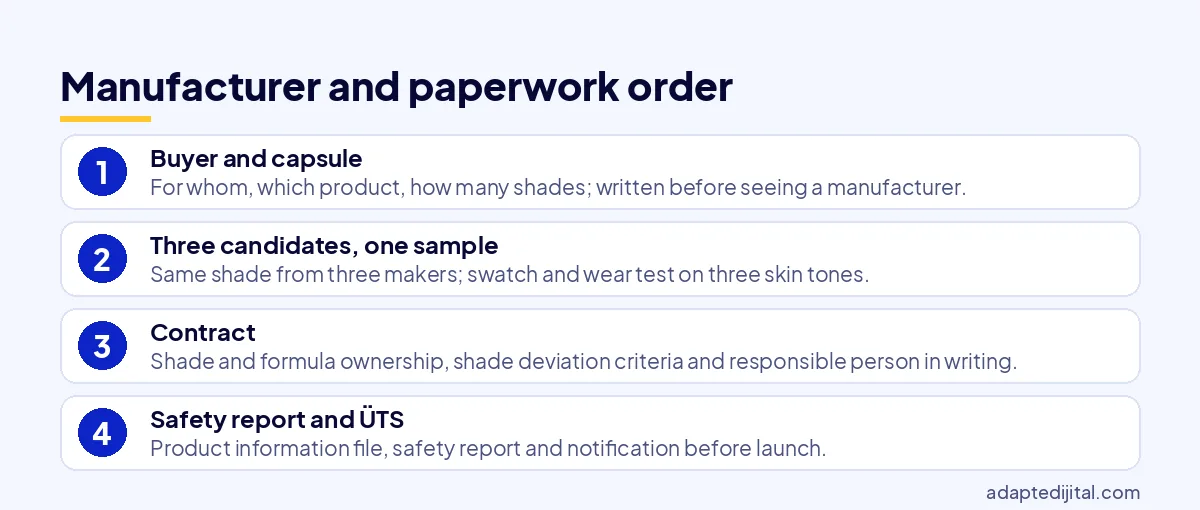
Look for a manufacturer after the buyer and capsule are set; meet three and decide by sample and swatch test. Paperwork is a rule, not a negotiation: the Cosmetics Regulation puts the product information file, cosmetic product safety report and product notification (ÜTS) on the responsible person. Market surveillance catches unsafe makeup too. An undocumented lipstick is a risk, not a brand.
Three candidates, one sample
Ask three makers for the same shade and test it yourself: three skin tones, wear after a meal, transfer, drying. Contract shade ownership, shade deviation and the responsible person; the twelve questions are in how to choose a contract manufacturer for makeup.
The paperwork rule
Cosmetics are overseen by TİTCK (Turkish Medicines and Medical Devices Agency) under a regulation aligned with EU 1223/2009. Colourants follow a permitted list; eye products need microbiology tests. Documents are gathered in cosmetics notification and inspection rules for makeup brands.
Claims need proof
Every claim on the box rests on a test; long-wearing or transfer-proof needs a wear test. The label carries ingredients, nominal quantity, PAO, batch number and the responsible person.
The nine steps from shade card to collection are in how to start a makeup brand in 9 steps.
How do you set the channel order: own site, marketplace, store, salon?
BU BÖLÜMÜN ÖZETİ
- Own site
- Marketplace
- Salon, artist and store
Channels follow product group and promise, and year one runs on one main channel. A custom-shade capsule starts on its own site with a swatch gallery; artists and salons carry approval; marketplaces bring volume but price wars; chain beauty retailers, with files and shelf fees, are year-two work. The right order puts the right shade in the right window.
Own site
Shade finder, swatch gallery, ingredients and returns are explained fully here; the build is a job for website consulting. Instagram and TikTok are for discovery; the product page is for decision.
Marketplace
Volume, but price wars against same-catalogue rivals. Enter with a product that survives comparison, not the hero shade. Four channels meet six criteria in own site, marketplace or beauty store.
Salon, artist and store
Artists and salons show the product on real faces; chain retailers want files and shelf fees. We map makers and points of sale in starting a makeup brand in Istanbul.
What does the first-year calendar of a makeup brand look like?
BU BÖLÜMÜN ÖZETİ
- Testing and paperwork calendar
- Season calendar
- Channel calendar
- Pre-launch check
Year one is where three calendars meet: testing and paperwork, season, and channel. Sample to batch takes weeks for stability, microbiology and the safety report, and often runs over; the season leans on spring colours, weddings and year-end gift sets; stores and marketplaces plan campaigns early. Overlay the three and launch at their intersection.
Testing and paperwork calendar
Capsule, maker, sample, wear test, stability, microbiology, safety report, ÜTS, packaging, batch. Each step waits for the last, and a shade deviation delays the batch. Count back from launch.
Season calendar
Valentine’s lipstick, spring colours, weddings, November sales, gift sets and party makeup. Entry weeks are tabled in when should a makeup brand launch.
Channel calendar
Retailers close buying before the season; marketplaces publish campaigns early. Without a ready swatch gallery and artist kit, the channel slips a season.
Pre-launch check
Twelve items in four groups, with a countdown, in 12-point checklist before a makeup launch.
When does a makeup brand need a consultant?
BU BÖLÜMÜN ÖZETİ
- Next reads
- Looking ahead
- If you want help
You need a consultant before you find the manufacturer, not after. Once a maker is chosen, every decision takes the shape of its shade card and formula. A brand consultant sets buyer, differentiation, capsule and channel order independently. The only decision today: which product group, which buyer, which channel.
Next reads
Which consulting fits which stage is in which consulting for a makeup brand; sourced market data is in Turkey’s makeup and colour cosmetics market in numbers.
Looking ahead
Shade inclusivity, refills and virtual try-on are coming; makeup brands towards 2027 gives today’s task for each. For skincare, see the guide to starting a cosmetics brand.
If you want help
Write via the consult your expert form. The scope is on the brand consultancy page; we stand with the brand, not the manufacturer.
Frequently Asked Questions
Quick Summary
- A catalogue lipstick is easy; a makeup brand is hard, as one shade card appears in ten brands.
- Catalogue shades get copied; shade range, swatch and artist approval stay yours.
- Start with one product group; lips are usually the easiest door.
- The first collection is one product in a five or six shade capsule.
- Product file, safety report and ÜTS notification belong to the responsible person; claims need tests.
- Today’s decision: product group, buyer, channel; the manufacturer comes last.
Short Glossary
- Private label: a maker’s ready formula and shade sold under another brand’s name and packaging
- Differentiation map: a table showing who controls each of seven differentiation points and where the founder should spend energy
- Swatch: the mark a makeup product leaves on the skin, showing how the shade really looks
- Responsible person: the person or company placing a cosmetic on the market, answerable for its file, safety report and notification
Next Step
Start with the consult your expert form; the scope is on the brand consultancy page. Next read: which consulting for a makeup brand.
Updated: October 2026
Sık Sorulan Sorular
Ready formulas, ready shades and filling into stock packaging, with your logo or your neighbour’s. That is their job; there is nothing to resent, only something to plan.
Many founders believe the brand exists once twelve shades are ordered. Yet they picked a card anyone can pick. The brand is built by the shade, texture, packaging and content decisions made after it.
The catalogue row is open to your rival; shade range, swatch, artist and story are yours alone. Spend most budget and time on these hard rows.
Each shade needs its own swatch, photo and stock risk. Buyers cannot see which shade represents the brand, and the founder cannot measure which sells. So start with five or six shades tested on three skin tones.
No. Private label makers are easy to find; standing out among same-catalogue products is the hard part. The responsible person owns the product file, safety report and notification.
For most founders, lips: lipstick is explained through shade and shown easily with a swatch. Eye products need microbiological care and foundation a wide shade range.
One product, five or six shades, tested on three skin tones. Add a second product once sales prove the capsule.
The logo is yours, but the shade exists in other brands too. You differ through custom shade, texture, packaging, range, swatch honesty and artist approval.
Yes, but not with the hero shade. Marketplaces set same-catalogue products side by side; a custom-shade capsule starts on its own site.
Sets buyer, differentiation, capsule and channel order independently of the manufacturer, orders the paperwork and picks the launch date from three calendars.