
6 Things People Get Wrong About Makeup Brands: Is 24-Hour Lipstick a Myth?
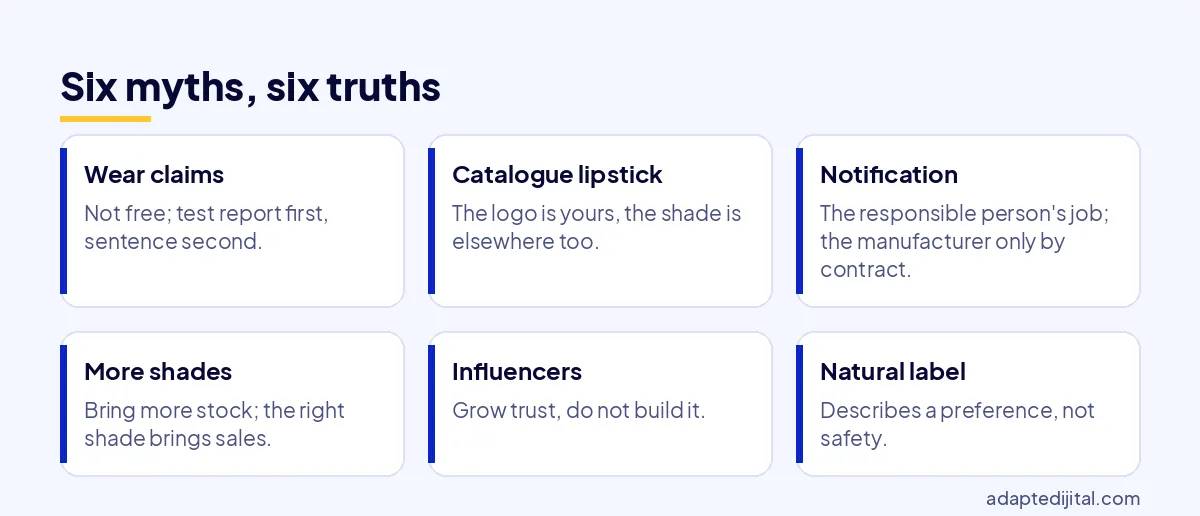
The six things most often misunderstood when starting a makeup brand are these: wear claims can be written freely, a lipstick picked from a catalogue is your own, the manufacturer handles notification, more shades bring more sales, influencers build trust, and a natural or vegan label is automatically safe. All six sound right, and all six cost money in the first collection. The correction sits under each one, short and reasoned.
You may not know this: a 24-hour lipstick claim is not banned, but it cannot be written without proof; in cosmetics, every claim must be backed by a test or document. So a lipstick may or may not last 24 hours; what matters is whether the evidence holds. This article corrects the six myths one by one and says what each correction means for brand decisions.
Myth 1: wear claims can be written freely
BU BÖLÜMÜN ÖZETİ
- Why people believe it
- A light comparison
- Brand decision
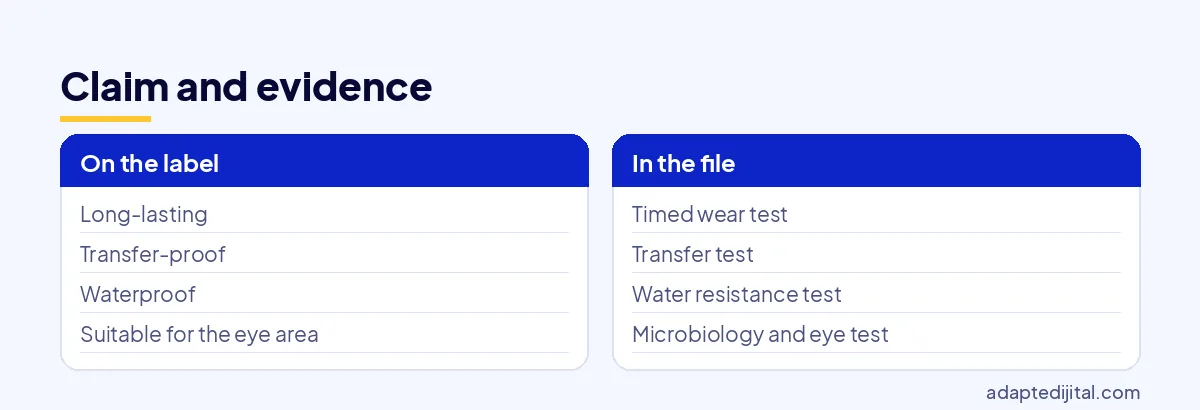
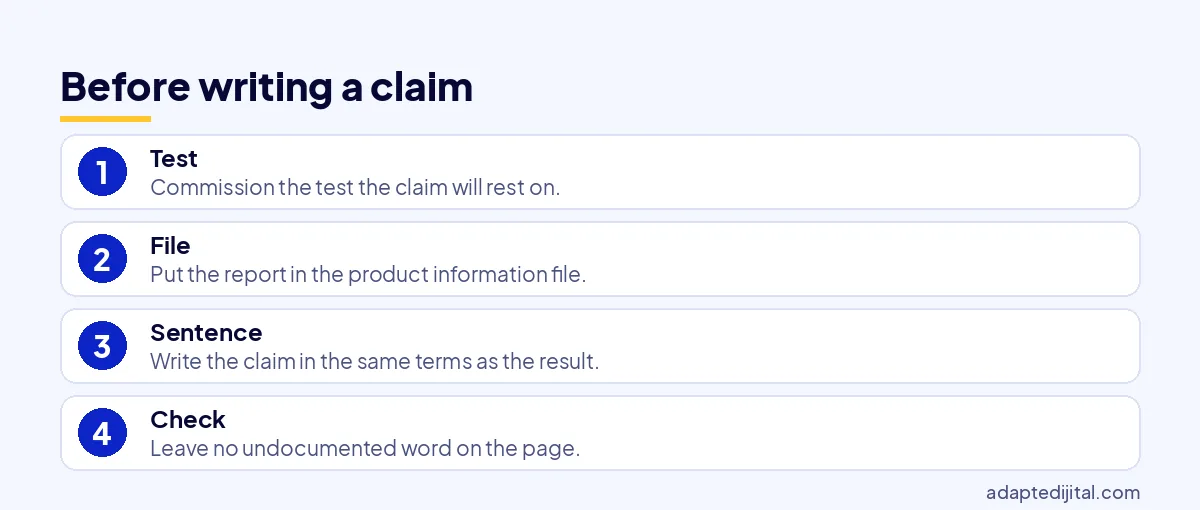
The truth: every claim on a cosmetic product must be substantiated; phrases like 24-hour wear, transfer-proof or waterproof need tests and documents. The evidence sits in the product information file and is asked for at inspection. A claim can be made, but the test comes first and the sentence second, never the reverse.
Why people believe it
Because every lipstick on the shelf claims something and buyers are used to it. But seeing claims on a shelf does not mean claims are free; the same shelf holds claims corrected after inspection. The official text is EU Cosmetics Regulation 1223/2009.
A light comparison
A wear claim is a bit like saying “I’m never late” on a first date. Easy to say, proven on the first meeting; for a lipstick, the proof is the test report in the product information file.
Brand decision
Write the claim in the same terms as the test result: claim only as long as the test lasted. What wear time actually means is in the article on pigment, shade and wear time.
Myth 2: a lipstick picked from a catalogue is your own
The truth: a catalogue shade is sold under your logo, but the same shade exists in other brands. Private label is fast and can make sense for a first product, but it is not differentiation. A buyer who sees the same shade cheaper in another box remembers the price, not the brand.
Why people believe it
Because holding a box printed with your logo makes it feel like your product. Yet the formula and shade belong to the manufacturer; unless the contract says otherwise, the brand does not own the shade. The shade ownership clause is in the manufacturer selection article.
Brand decision
Even if you start from a catalogue, have the shade made exclusive with a small change and put it in the contract. A custom shade costs more than a catalogue one but never appears on a competitor’s shelf.
Myth 3: the manufacturer handles notification and documents
The truth: a brand placing a product on the market must have a responsible person, and the product information file, safety assessment and ÜTS notification are that person’s responsibility. The manufacturer can take this on, but only if the contract says so. If it does not, you are the named contact at inspection.
Why people believe it
Because the manufacturer handles samples, filling and boxes, people assume it handles the paperwork too. You may not know this: the responsible person is not a title but a name, and that name is on the label. Current rules and notices are on the TİTCK (Turkish Medicines and Medical Devices Agency) site.
Brand decision
Ask in the first meeting: who is the responsible person, whose name is on the report, where is the file kept? The documents inspections ask for are in the article on notification and inspection rules.
Myth 4: more shades bring more sales
The truth: more shades bring more stock, more swatch photos and more undecided buyers; the right shades are what sell. A twelve-shade first collection means little depth per shade; the two bestsellers run out and the other ten wait in the warehouse. Few shades, deep stock and honest swatches are the safer path in year one.
Why people believe it
Because big brands carry dozens of shades and small brands take that as the target. But big brands built that range over years; a first collection builds a capsule, not a range. How a capsule is built at the empty ends is in the small makeup brand trend article.
A light comparison
A twelve-shade first collection is like cooking twenty dishes for your first dinner party. Guests remember three plates, and the other seventeen sit in the fridge the next day.
Myth 5: influencers build trust
The truth: content creators grow trust, they do not build it. Trust is built in the product itself: the shade matching the photo, wear time matching the promise, returns being easy. A creator promoting a product without that trust livens up the first week, then amplifies the returns too.
Why people believe it
Because follower purchases really do arrive on launch day, and the founder mistakes that for trust. If sales stall in month two, the cause is usually not promotion but the gap between screen colour and real colour; this scene is in the case of a makeup brand stuck at its first collection.
Brand decision
Makeup artist first, content creator second. Artists test products on different skin every day and drop bad shades from their kit; their approval comes before a creator’s promotion.
Myth 6: a natural or vegan label is automatically safe
The truth: natural, plant-based or vegan describes an ingredient preference, not safety. Safety is assessed for each product separately; a colourant of natural origin must still be on the permitted list and used at the right level. Whatever word is on the label, the report is prepared with the same rigour.
Why people believe it
Because natural reads as harmless. Yet nature also has substances that cause allergies, smell strongly or do not suit the eye area; an ingredient’s cosmetic restrictions can be checked in the EU CosIng database.
Brand decision
If you write natural or vegan, state what it rests on with a document, and write the safety sentence separately. Keeping these two words apart is the most honest line on a product page.
Claim-to-evidence table
The table below brings together the six most common claims on makeup products, the evidence each needs and what to write if there is none. Open it before writing the product page; one row per claim, one document per row. A claim without a document does not go on the page.
Evidence table
| Claim | Evidence needed | If there is none, write |
|---|---|---|
| Long-lasting | Timed wear test report | Describe finish and texture, give no duration |
| Transfer-proof | Transfer test | Say it sets once dry, do not guarantee |
| Waterproof | Water resistance test | Make no water resistance claim |
| Suitable for sensitive skin | Dermatological test | Do not use this phrase |
| Suitable for the eye area | Eye-area test and microbiology | Do not sell it as an eye product |
| Vegan | Supply chain document | Show the ingredient list, add no label |
Frequently Asked Questions
Quick Summary
- Wear claims are not free; test first, sentence second.
- A catalogue lipstick sells under your logo, but others have the shade too.
- Notification and documents belong to the responsible person; the manufacturer takes them on only by contract.
- More shades bring more stock; the right shades bring sales.
- Influencers grow trust, they do not build it; artist approval comes first.
- Natural or vegan does not mean safe; the claim-to-evidence table needs a document for every row.
Short Glossary
- Claim: a statement about a product’s effect or property on the label, page or in advertising
- Product information file: the file held by the responsible person containing the formula, safety report and claim evidence
- Responsible person: the natural or legal person legally accountable for a cosmetic product’s compliance
- Transfer: lipstick rubbing off onto a cup, mask or clothing
Next Step
To match your product’s claims to documents, write via the consult an expert form; scope is on the brand consultancy page. Next up: when a makeup brand should launch.
Updated: October 2026
Sık Sorulan Sorular
Matching claims to documents is brand consultancy work; the overall sequence is in the pillar article and your stage in the hub article. For product page copy and store setup, see e-commerce consulting; to match your own product’s claims together, consult an expert.
Yes, but only with a test report showing that duration; the evidence sits in the product information file and is asked for at inspection. Without a test, give no duration and describe finish and texture.
It sells under your logo, but unless the contract says otherwise, the shade and formula belong to the manufacturer and may appear in other brands.
Not automatically; natural describes an ingredient preference, and safety is shown separately for each product through its safety report.