
Makeup Brand Basics: Pigment, Shade, Undertone and Wear Time on a Label
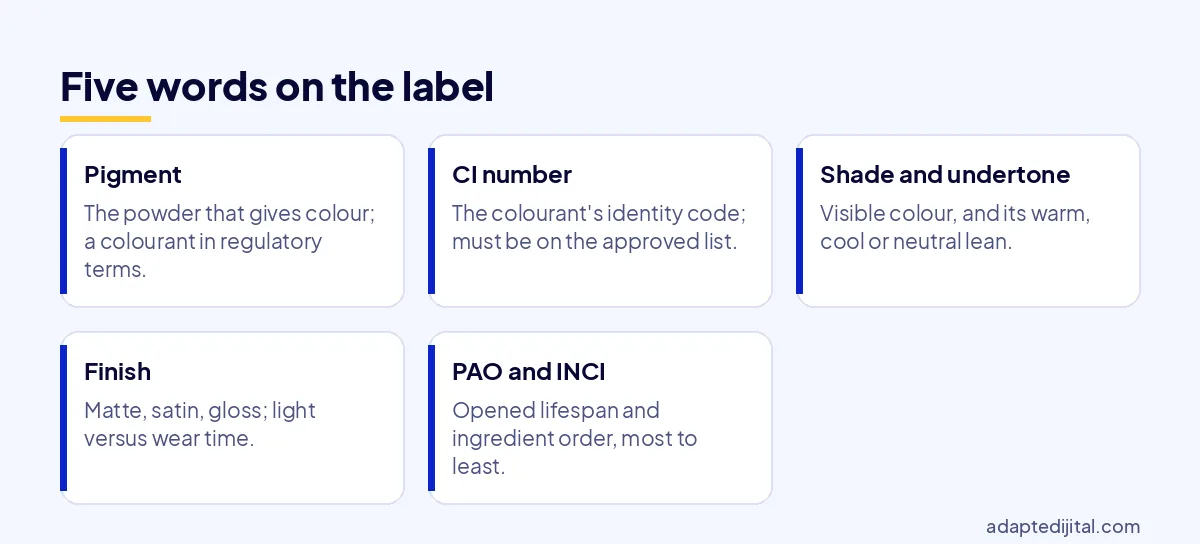
Pigment is the powder that gives colour, and the label lists it with a number starting with CI. Shade is the colour you see; undertone is the warm, cool or neutral lean beneath it. Wear time is how long the product stays on skin, and every wear-time claim needs proof. In short: the shade name on the front sells a feeling, the small print on the back tells you what is inside.
A lipstick’s real identity sits in the tiny text under the box, not on the cap. This article explains each term in everyday language and ends with a 30-second label check you can run quietly in any shop.
Are pigment and colourant the same thing?
Almost: colourant is the regulatory name for anything that gives a product colour, and pigments are its insoluble, powdered part. In lipstick, eyeshadow and foundation, pigments do most of the work. Every colourant has a CI number, and only those on the approved list may be used. A line such as CI 77491 is that colour’s identity card.
In plain words
A crayon says dusty rose, but the factory knows that colour by a code. The CI number is the code; the shade name is the romance.
What it means for your brand
Ask the manufacturer for each shade’s CI list in writing, next to the shade card. We listed the questions to ask in the article on choosing a contract manufacturer; the colourant question is second.
Why are shade and undertone separate words?
BU BÖLÜMÜN ÖZETİ
- In plain words
- Skin has an undertone too
- What it means for your brand
Two identical-looking lipsticks can sit differently on skin. Shade is the visible colour: rose, brick, nude, burgundy. Undertone is the lean underneath: warm tips toward yellow and orange, cool toward blue and pink, neutral sits between. Customers usually reject the undertone, not the shade.
In plain words
Two white paints match on the chart, yet on the wall one looks yellow, the other ice blue. The undertone speaks on skin.
Skin has an undertone too
The customer’s skin also has an undertone. Put a cool nude on warm-toned skin and the lipstick turns grey, and the customer says the colour is not what the photo showed. We covered a case of this gap in why a makeup brand stalls at its first collection.
What it means for your brand
Write warm, cool or neutral next to every shade name. One word cuts the most common return reason.
What do matte, satin and gloss finishes tell you?
BU BÖLÜMÜN ÖZETİ
- In plain words
- Shimmer and metallic
- What it means for your brand
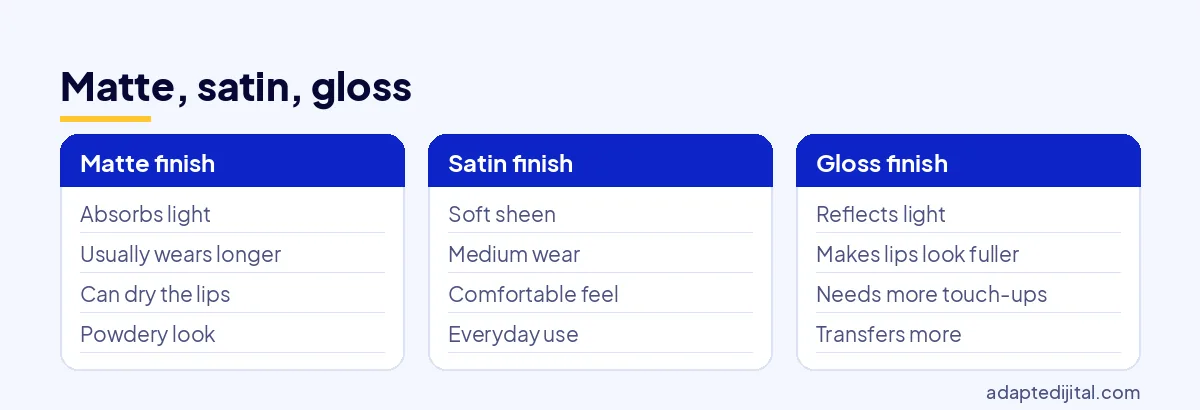
Finish is how the product reflects light once it is on the skin. Matte absorbs light and looks flat and powdery; satin gives a soft sheen; gloss throws light back and makes lips look fuller. Finish is not a mood but a formula choice: matte products usually wear longer, yet they can dry the lips more.
In plain words
Like wall paint: matt hides marks, gloss wipes clean but shows every flaw. Each finish has its price.
Shimmer and metallic
Shimmer and metallic finishes use fine reflective particles. These count as colourants too, with their own CI line.
What it means for your brand
Launch the capsule with one finish. Matte and gloss in the same shade family means two formulas, two sets of tests and two stock lines; we show the budget effect in the cost of starting a makeup brand.
Can you just write 24-hour wear on the pack?
No: wear time is a claim, and every cosmetic claim needs evidence. A brand that prints 24-hour wear must keep a use test on file. Transfer-proof is the same: a test must show it does not mark a cup, a mask or a collar. The sentence is easy to write; the proof is hard to gather.
In plain words
Write never sinks on a cake recipe and one sunken cake costs you your word. One bad wear experience rises to the top of the reviews.
What it means for your brand
Write the claim after the test, never before. We unpack this confusion with a claim-and-proof table in six myths about makeup brands.
How do you read the PAO symbol and the INCI list?
PAO is the open-jar icon with 12M or 6M inside; it tells you how many months the product lasts once opened. INCI is the international language of ingredient lists, and ingredients run from most to least. Colourants sit at the end with their CI numbers. Together these two lines give you both the product’s lifespan and its recipe.
In plain words
INCI is a recipe list without quantities: flour first, salt last. In lipstick, oils and waxes lead and colour codes close.
The 30-second lipstick label check
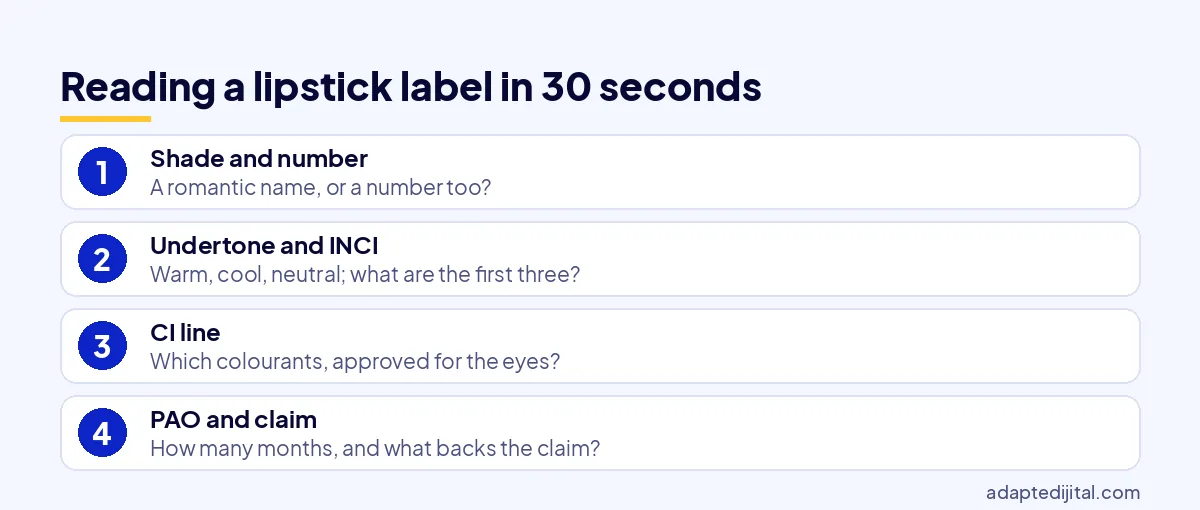
Read five lines: shade name and number, undertone, INCI order, the CI line and the PAO symbol, then check the wear claim last. If the shade name is lovely, note its number; if no undertone is given, ask; look at the first three INCI ingredients; for eye products, make sure the colourants are approved for the eye area. Nobody in the shop will ask why you are turning the box over.
Check: 30 seconds
- Shade name and number: just a romantic name, or a number too?
- Undertone: does it say warm, cool or neutral?
- First three INCI: oil, wax or silicone?
- CI line: which colourants, and how many?
- PAO and claim: how many months, and what does the wear claim say?
On your own product
Run it on your own sample first. A blank line is either a document to request or a sentence to print; the order is in the nine-step guide to starting a makeup brand.
Now you know
Pigment is colour in powder form, the CI number is its identity card, shade is the visible colour, undertone is the lean on skin, finish is the relationship with light, and wear time is a promise that needs proof. PAO gives the opened lifespan, INCI the recipe’s order. A founder who knows these words speaks the manufacturer’s language, writes the label correctly and reads a shelf in 30 seconds.
Do this today
Run the check on three lipsticks from your bag, then swatch each on your arm in daylight. If label and arm agree, that maker is a manufacturer candidate.
Frequently Asked Questions
Quick Summary
- Pigment is the powder that gives colour; every colourant has a CI number and must be on the approved list.
- Shade is the visible colour; undertone is the warm, cool or neutral lean beneath it.
- Matte, satin and gloss describe how the product meets light; matte wears longer but can dry more.
- Wear-time and transfer-proof claims need proof: test first, claim second.
- PAO gives the opened lifespan; INCI lists ingredients from most to least.
- The 30-second label check: shade and number, undertone, INCI, CI line, PAO and claim.
Short Glossary
- CI number: the colourant’s identity code in the international Colour Index
- Undertone: the warm, cool or neutral lean beneath a colour or a skin tone
- PAO: the open-jar symbol showing how many months a product can be used after opening
- INCI: the international naming system for cosmetic ingredient lists, ordered from most to least
Next Step
To match every line on your label to the manufacturer’s language, write to us via the consult your expert form; the scope is on the brand consultancy page. Next up: how to choose a contract manufacturer for makeup.
Updated: October 2026
Sık Sorulan Sorular
Approved colourants sit in a separate annex of the EU rules, and Turkish regulation is aligned with the EU cosmetics regulation 1223/2009. The list says which product and which body area each substance may be used in; some colourants are not allowed around the eyes.
A lab runs a use test with volunteers, stating how many people, hours and conditions. The label says what the test says, no more.
Eye products are more sensitive microbiologically, because the brush goes in and out near the eye every day. That is why mascara has a shorter PAO than lipstick. We boxed the full labelling rules in the article on product notification and inspection rules.
You can search any INCI name and its function in the EU CosIng database. For a founder, it is the quietest way to understand the list a manufacturer sends.
The manufacturer supplies the formula words; the brand sets their order and tone, and brand consultancy matches every label line to a document. The sector overview is in the makeup brand industry guide, the full route in the pillar on starting a makeup brand, your stage in the four-doors hub by stage; to read your label together, consult your expert.
The CI number is the colourant’s international identity code. Cosmetics may only use colourants on the approved list, and they appear with these codes at the end of the INCI list.
Undertone is the lean beneath a colour: warm toward yellow and orange, cool toward blue and pink, neutral in between. The easiest way is to look at a swatch on your arm in daylight.
Not without proof. Wear-time and transfer-proof claims must be backed by a use test, kept in the product information file.