
Makeup Brand Manufacturer: How to Choose Catalogue, Custom Shade or Custom Formula
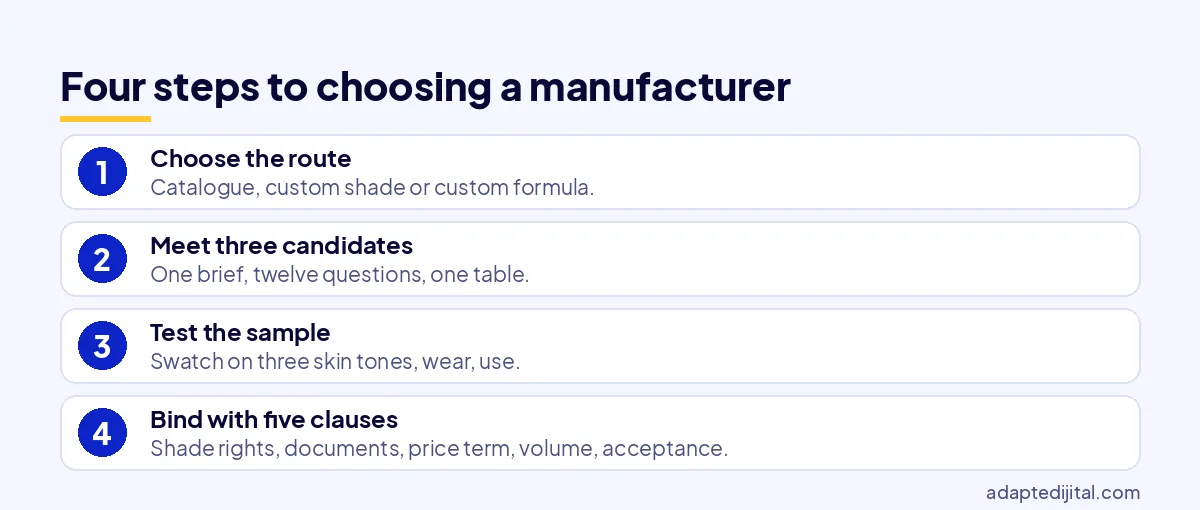
Choosing a makeup contract manufacturer starts with a route: catalogue shade, custom shade on a catalogue formula, or custom formula. Then you meet three candidates, ask twelve questions, test samples on several skin tones and sign a five-clause contract. The thresholds are clear: no decision with fewer than three candidates, no signature until the responsible person is named in writing, no batch accepted until shade deviation is in the acceptance criteria.
This article runs the process in order, from routes to contract. Read the same list to all three candidates, write the answers side by side, and the choice makes itself.
Catalogue, custom shade or custom formula: which suits whom?
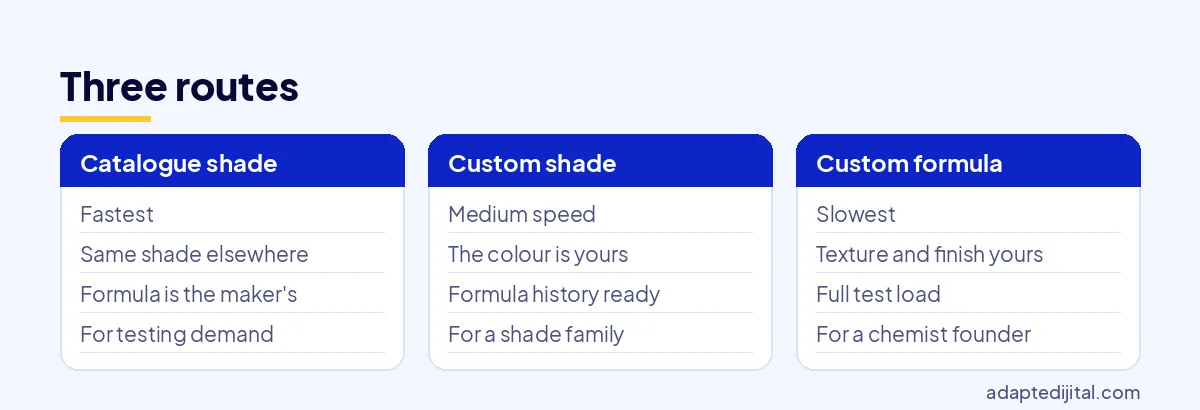
Catalogue is fastest: pick a ready shade, print your logo, done in weeks, but other brands sell the same lipstick. A custom shade keeps the catalogue formula and tunes the colour; it is the sensible start for standing apart. A custom formula makes texture and finish yours, with the heaviest time and test load. Threshold: if your difference is shade, catalogue only tests demand.
Decision table
| Route | Speed | Differentiation | Document and test load | Best for |
|---|---|---|---|---|
| Catalogue shade | Fastest | Lowest; same shade elsewhere | Manufacturer’s existing file, brand checks | Creator testing demand |
| Custom shade | Medium | High; the colour is yours | Updated safety assessment for new shade | Brand building a shade family |
| Custom formula | Slowest | Highest; texture and finish yours | Stability, microbiology and safety report from scratch | Cosmetic chemist founder |
Why three candidates, and where do you find them?
One quote is no measure, two is a haggle, three is a comparison. Send one brief to three manufacturers in the same week and ask for one answer format. Colour cosmetics makers cluster in industrial zones on Istanbul’s western and Anatolian sides. Threshold: no samples until all three answer.
Most common mistake
Sampling with the fastest replier. Speed shows spare capacity, good or bad; wait for three answers.
Who owns the shade and the formula?
With a catalogue shade, formula and shade belong to the manufacturer. With a custom shade, the contract states the colour recipe is the brand’s and goes to no other brand. With a custom formula, usage rights and confidentiality are the core clause. Threshold: no sample approval until recipe ownership is in writing.
Why ownership matters
If the manufacturer keeps the shade, your best seller leaves when you switch, and the recipe can reach a rival’s shelf overnight.
The colourant question
Ask in writing for each shade’s CI list and approved body areas. A lip-safe colourant may not be eye-safe, so this is vital for eyeshadow and eyeliner.
Who prepares the safety report, and who is the responsible person?
A qualified safety assessor prepares the cosmetic product safety report, often supplied by the manufacturer as a service. The responsible person places the product on the market and makes its product notification; under your own brand, that is usually you. Threshold: no first batch until it is written who holds the report, the file and the notification.
The framework
In Turkey, cosmetics regulation and product notification run through TİTCK (Turkish Medicines and Medical Devices Agency), aligned with the EU regulation. We boxed the documents inspectors ask for in the article on product notification and inspection rules.
The manufacturer-notifies myth
The notification is made in the responsible person’s name, not automatically the manufacturer’s. Selling under your brand means keeping a copy of the file.
How do you run sample and swatch tests?
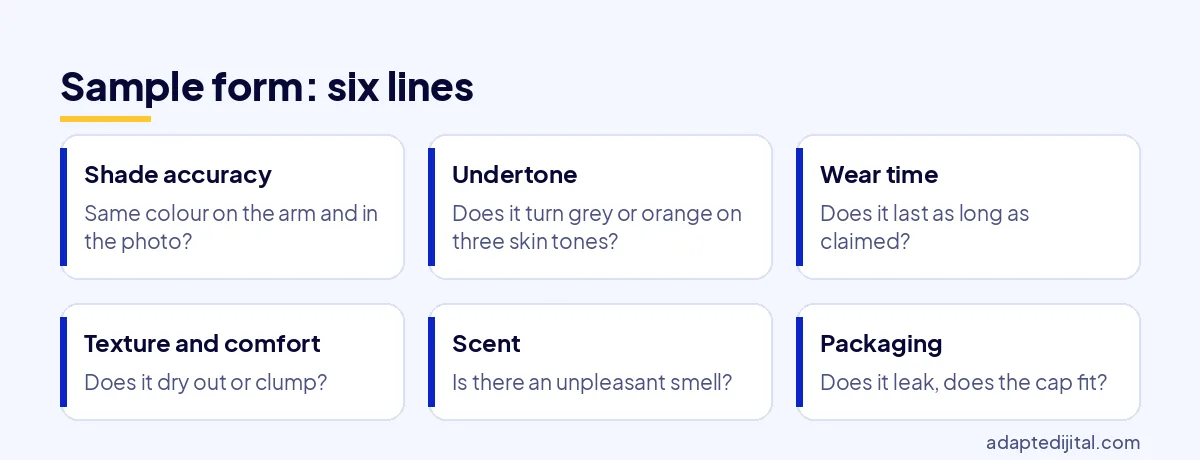
One sample round sits three exams: shade, wear time and use. Swatch every shade on light, medium and deep skin in the same light and photograph it; then three target customers use it for a week. Threshold: if shades blur, wear misses the claim or the pack leaks, request a correction.
Assessment form
Six lines, each pass, fail or fix. The fix lines become your second brief to the manufacturer.
Twelve questions for the manufacturer interview
Read the same list, in the same order, to all three candidates and record answers in one table. It covers shade, formula, colourants, documents, responsible person, samples, volume, packaging, contract and delivery. A candidate vague on two questions drops out.
Twelve questions
- Who owns the shade recipe, and will it be given to another brand?
- Will you give each shade’s CI list and area approval in writing?
- Are the catalogue formula’s stability and microbiology tests current?
- Who prepares the safety report?
- Will the brand receive a copy of the product information file?
- How long does a sample take, what does it cost, and is it credited on order?
- What is the minimum order per shade?
- Do you source packaging, stock or custom-printed?
- How long is the price valid, and how are raw material rises notified?
- Do you print the label and box, and who owns INCI and PAO?
- What is the lead time, and what happens if you are late?
- Will you write acceptance criteria against the approved sample and shade deviation?
Which five clauses go into the contract?
Shade and formula rights, document handover, price validity, minimum order with lead time, and acceptance criteria. Five clauses protect the brand; a verbal deal protects the manufacturer. Threshold: no signature until all five are in.
Five clauses
- The custom shade recipe and any formula belong to the brand and go to no other brand
- Safety assessment, test reports and product information file are handed over and kept current
- Price holds for a set period; rises need written notice and mutual approval
- Minimum order is stated per shade, lead time in days
- Acceptance means a match with the approved sample in shade, texture and packaging; failing batches are remade
How do you write acceptance criteria and shade deviation?
One sentence: the delivered batch matches the approved sample in shade, undertone, texture, scent and packaging. Check shade deviation by swatching beside the approved sample in the same light; a visible difference means rejection. Spot-check random units and log each batch number.
Decision table
| Criterion | Candidate A | Candidate B | Candidate C | Weight |
|---|---|---|---|---|
| Shade recipe rights | Decisive | |||
| Safety report and file | Decisive | |||
| CI list and area approval | High | |||
| Swatch passed on three skin tones | High | |||
| Packaging options | Medium | |||
| Price and validity | Medium |
Frequently Asked Questions
Quick Summary
- Three routes: catalogue is fast but generic, custom shade is the middle road, custom formula is heaviest but most distinct.
- Three candidates, one brief, one week; no samples until all three reply.
- The shade recipe stays with the brand; ask for each shade’s CI list and area approval in writing.
- An assessor prepares the safety report; the responsible person is usually the brand.
- Samples pass swatch, wear and use tests on three skin tones; shade deviation goes into the acceptance criteria.
- Read twelve questions to three candidates in the same order; fewest zeros wins.
Short Glossary
- Contract manufacturer: a company that makes another brand’s product under that brand’s name
- Custom shade: a product that keeps the catalogue formula but has its colour tuned for the brand
- Responsible person: the party that places a cosmetic on the market, makes its notification and answers for its file
- Shade deviation: a visible difference between a delivered batch’s colour and the approved sample
Next Step
To place your three candidates in the decision table together, write to us via the consult your expert form; the scope is on the brand consultancy page. Next up: own site, marketplace or beauty retailer for a makeup brand.
Updated: October 2026
Sık Sorulan Sorular
Customers notice colour first, and the catalogue formula brings its safety history; see the pillar on starting a makeup brand.
Product group, shades and undertones, finish, wear time, packaging, three-month volume and documents. The brief needs the concepts, so the article on pigment, shade, undertone and wear time comes first.
Trade fairs, packaging suppliers and the maker line on products you like. Districts are in starting a makeup brand in Istanbul.
The owner, an artist and three users of different skin tones; the customer’s skin is the measure.
Samples precede the safety assessment and packaging order; see the nine-step guide.
A clear, documented answer scores one; it depends scores zero. Fewest zeros wins.
When a raw material supplier changes, reports may change too; only a brand that asks will notice. Cost impact: cost of starting a makeup brand.
Brief and contract are brand work; brand consultancy places the three candidates in this table. For skincare, see the guide to starting a cosmetics brand; for your stage, the four-doors hub by stage; before the interview, consult your expert.
At least three. The same brief goes to all three in the same week and answers come back in one format; with one candidate there is nothing to compare.
Catalogue is quick for testing demand; to stand apart on colour you need a custom shade, because the same catalogue shade is sold by other brands.
The party that places the product on the market under its own brand; the notification is made in its name and the product information file is tied to it. A manufacturer can take this on as a service, but it must be in writing.