
How to Start a Makeup Brand in 9 Steps: From Shade Card to First Collection
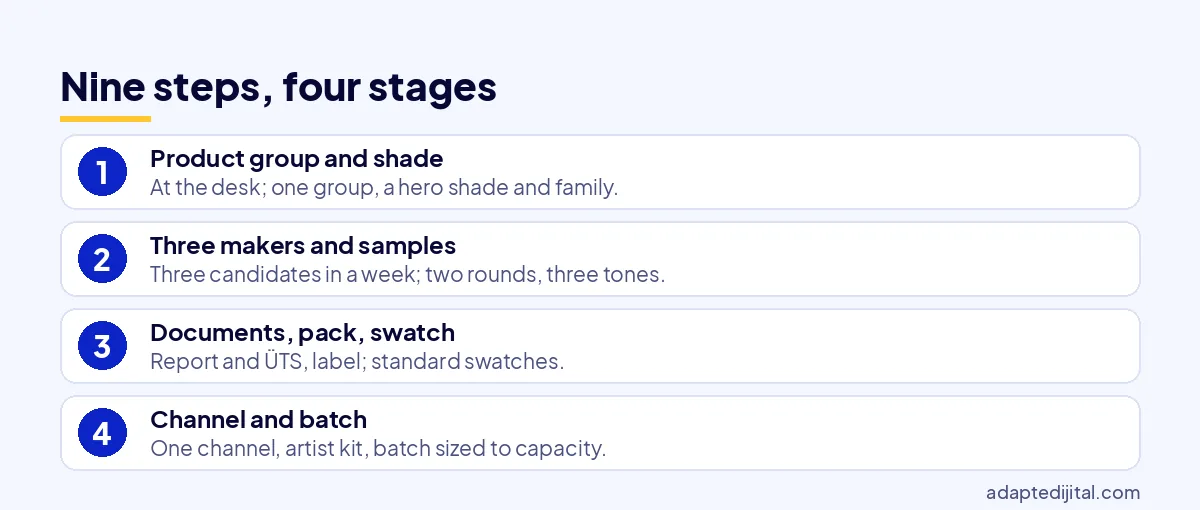
A makeup brand is built in nine steps: choose the product group, decide shade and texture, find three manufacturers, test samples on different skin tones, complete the safety report and ÜTS notification, prepare packaging and label, shoot swatches and build the page, open the first channel and produce the first batch. Shade comes before manufacturer, documents before batch. Because printing a logo is easy, most steps happen at the desk, not the factory.
At each step this guide gives what you hold at the end and the most common mistake. No prices, because cost varies; outputs and mistakes do not. A nine-row table closes the piece.
Steps 1–2: product group, shade and texture
The first two steps happen at the desk. Choose one product group: lips, eyes, face or nails. Then choose shade and texture: how many shades, which undertone, matte, satin or gloss. Skip these and the manufacturer meeting becomes browsing a shade card, and samples run twice.
1. Choose the product group
Output: a one-sentence product definition and a buyer card for user, payer and approver. Mistake: launching lipstick, palette and foundation at once. Lips are the simplest start; the framework is in the I want to start a makeup brand pillar.
2. Decide shade and texture
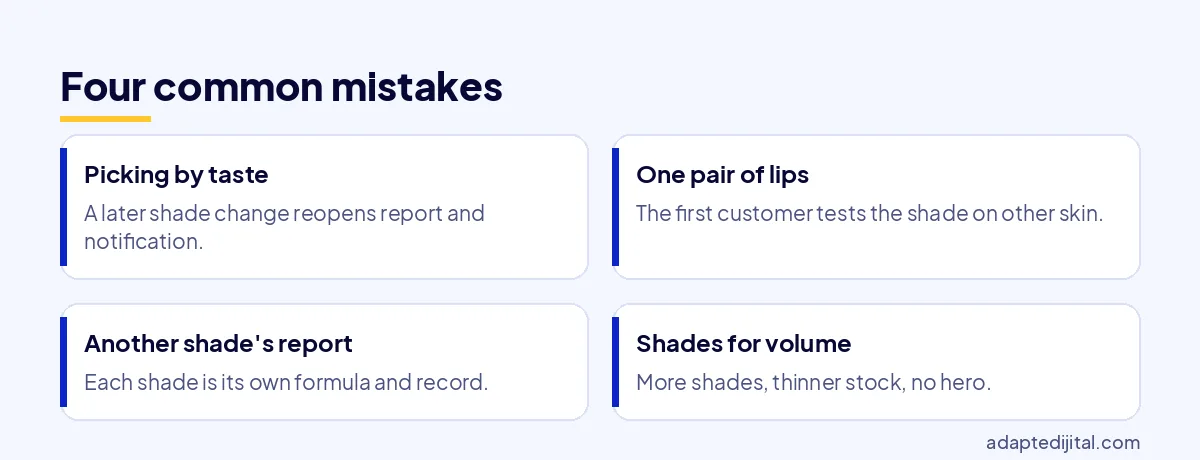
Output: a hero shade, a family of five or six, a finish and a target skin tone range on one page. Mistake: picking from the manufacturer’s card by taste. Undertone and finish are in pigment, shade, undertone and wear time in makeup.
Step 3: three candidate manufacturers
Once shade is set, ask three manufacturers for samples in the same week. Istanbul’s western belt of Beylikdüzü, Hadımköy, Esenyurt and İkitelli, and Tuzla, Gebze and Dilovası on the Asian side, are the first places to look. Starting with one candidate kills comparison from day one.
3. Compare three candidates in one table
Output: minimum order, catalogue or custom shade, formula and shade ownership, who commissions the safety report and the responsible person offer, side by side. Mistake: taking the first manufacturer found. Questions are in how to choose a contract manufacturer for makeup.
Step 4: samples, swatches and wear tests
Samples are tested on skin, not in a mirror: swatches on fair, medium and deep skin, colour in daylight and indoor light, wear after food and drink, transfer and drying. The first sample is never approved; a second round is mandatory. Notes are written and shared with the manufacturer.
4. Put the sample through three tests
Output: a signed approved sample and written notes. Swatch, wear and texture tests show colour on different skin, behaviour through the day, and drying or clumping. Mistake: approving only on the founder’s own lips.
Steps 5–6: safety report, notification, packaging and label
Step five is paperwork: stability and microbiology tests, the cosmetic product safety report, the product file and ÜTS notification, all on the approved sample. Step six is packaging and label. Packaging comes before the documents, because the report assesses packaging compatibility; the label is printed after.
5. Complete the safety report and notification
Output: a report and file per shade, a written responsible person and an ÜTS record. Mistake: accepting a report held for another shade. The rules are in cosmetics notification and inspection rules; the framework is on the TİTCK website.
6. Prepare packaging and label
Output: packaging that passes leak and shipping tests, and a label with INCI, quantity, PAO or expiry, batch number and responsible person. Mistake: a custom mould in the first batch; printed stock packaging is the middle route.
Steps 7–8: swatch photos, product page and first channel
Swatches and video are shot before the first batch, because makeup sells on screen by colour: same light, three skin tones, a colour card, no filter. The page carries shade name, undertone, finish, wear time, ingredients and return policy. The first channel follows the product group and opens alone.
7. Shoot swatches and build the product page
Output: swatches on three skin tones per shade, a short application video, a shade guide and a return policy for opened cosmetics. Mistake: using the catalogue image. The swatch standard is in how Adapte Dijital positions a makeup brand; page setup falls under website consulting.
8. Open the first channel
Output: one channel with its setup: own site, salon and artist kit, or marketplace store. Mistake: opening everything on one day. The comparison is in own site, marketplace or beauty retailer.
Step 9: the first batch
BU BÖLÜMÜN ÖZETİ
- 9. Produce the first batch
- Shade drift check
- The second batch rule
The first batch is sized to channel capacity, not a forecast. Makeup is small but its shelf life is limited; an unsold shade ages in the warehouse. Few shades, deep stock: a hero shade and its family. Testers get their own line, and the second batch follows first-channel turnover.
9. Produce the first batch
Output: a batch matching the approved sample, batch number linked to the notification, a shade drift note and testers set aside. Mistake: adding shades to reach the minimum order; the result is in why a makeup brand stalls after its first collection.
Shade drift check
In every batch the first unit is swatched beside the approved sample. If the shade drifts, the batch is rejected under the contract.
The second batch rule
Fast shades grow, slow ones stay flat. Cost items and thresholds are listed without prices in the cost of starting a makeup brand.
The step-output-mistake table
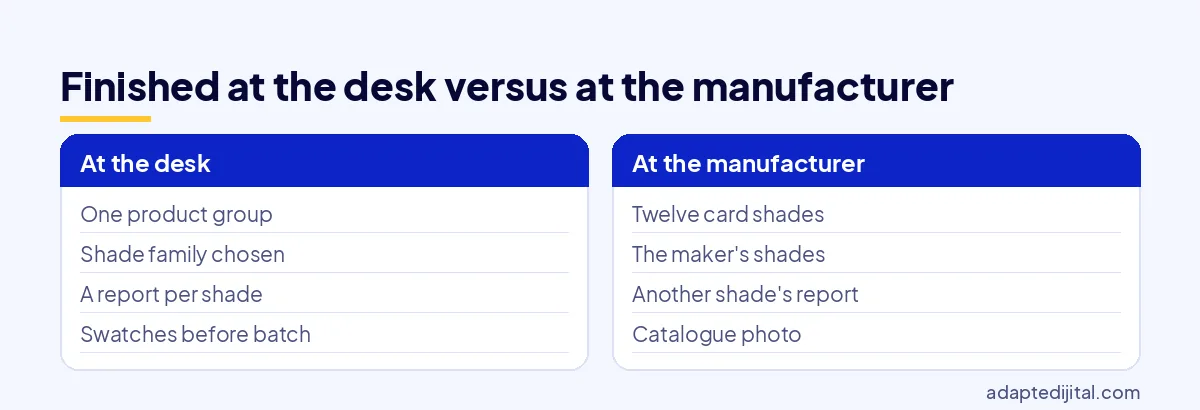
The table below shows the output and most common mistake for each of the nine steps at a glance. No output means the step is not done; a mistake means it repeats. Print it, take it to the manufacturer meeting and tick each row you hold.
Table
| Step | Output | Common mistake |
|---|---|---|
| 1 Product group | Definition, buyer card | Three groups at once |
| 2 Shade and texture | Hero shade, family, finish | Picking by taste |
| 3 Three makers | Minimums, ownership, report | Taking the first found |
| 4 Sample and tests | Three-tone swatches, wear notes | Own lips only |
| 5 Report and notification | Report, file, ÜTS per shade | Another shade’s report |
| 6 Pack and label | Leak-proof pack, INCI, PAO | Custom mould too early |
| 7 Swatches and page | Standard swatches, returns | Catalogue image |
| 8 First channel | One channel, artist kit | Three channels at once |
| 9 First batch | Sized to capacity, testers | Shades for volume |
Nine steps on one page
Five steps at the desk, two at the manufacturer, two in the market: group, shade, documents, packaging and swatches at the desk; sample and batch at the plant; channel and artist kit outside. A brand whose work ends at the manufacturer becomes one of many sharing the same shade card.
Do this today
Print the nine rows and tick each output you hold. The first empty row is today’s job.
Next step
To fit the steps to your calendar, use the ask an expert form; the final check is in the twelve-point makeup pre-launch checklist.
Frequently Asked Questions
Quick Summary
- Nine steps from product group to first batch, in a fixed order.
- Shade before manufacturer, documents before batch.
- Samples go through two rounds with swatches on three skin tones.
- The safety report and ÜTS record are separate for every shade.
- The first batch follows channel capacity; shade drift is checked every time.
Short Glossary
- Wear test: checking how long a product stays through food, drink and contact
- Shade drift: a batch shade visibly different from the approved sample
- Minimum order: the lowest quantity a manufacturer accepts
- Artist kit: shades and testers sent to makeup artists to try
Next Step
To fit the nine steps to your calendar, write via the ask an expert form; scope is on the brand consultancy page. Next read: how Adapte Dijital positions a makeup brand.
Updated: October 2026
Sık Sorulan Sorular
Shade decides the manufacturer: card-based plants rarely develop custom shades. A later shade change reopens formula, report and notification.
Catalogue is fast but shared; custom is slow but yours. A common middle route: catalogue formula, brand-specific shade. A district map is in starting a makeup brand in Istanbul.
The brand runs the use test; a makeup artist and people with different skin tones test best. Lab testing comes in step five; neither replaces the other.
The first shows shade and texture, the second that the fix holds. Skip it and the second round happens in the first batch, costing a batch, not a sample.
The brand owner, not the manufacturer. For order and calendar, see brand consultancy; for your stage, which consultancy a makeup brand needs.
Nine: product group, shade and texture, three manufacturers, sample tests, report and notification, packaging and label, swatches and page, first channel, first batch.
On fair, medium and deep skin in two rounds: colour in different lights, wear through the day, transfer and drying, all in written notes.
As many as the channel can handle, with depth: a hero shade and its family, plus testers.