
Cosmetics Notification and Inspection Rules: What Should a Makeup Brand Do?
Cosmetics notification and inspection rules tell a makeup brand one thing: before a lipstick, mascara or foundation reaches the market, its safety must be assessed, filed and notified, and the brand’s responsible person answers for it. In Türkiye the Cosmetics Regulation is aligned with EU Regulation 1223/2009 and enforced by TİTCK (Turkish Medicines and Medical Devices Agency). Notification goes through ÜTS, and the Ministry of Trade and TİTCK periodically announce unsafe products.
First the development, then the rule, then five steps. Sources are official announcements and current law. At the centre: the three documents asked for at inspection.
What is happening: the Ministry publishes unsafe product results
BU BÖLÜMÜN ÖZETİ
- Official source
- Reasons that concern makeup
- Timing
The Ministry of Trade publishes market surveillance results for the first half of the year and announces sales bans, recalls and public notices for unsafe products. The reasons are published openly. Cosmetics fall within this surveillance; for makeup, TİTCK also runs the technical side.
Official source
The full statement is in the Ministry of Trade unsafe products announcement; figures are there, and this piece explains the rule.
Reasons that concern makeup
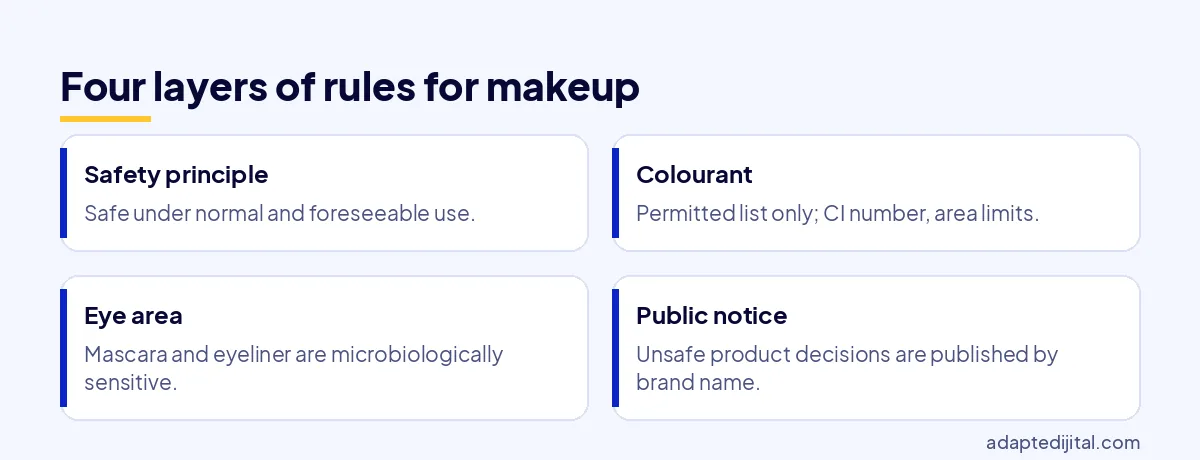
Three stand out: a substance not permitted or over its limit, missing label information and no notification. Colourants in lipstick, microbiology in mascara and preservatives in foundation are faces of the same problem.
Timing
Marketplace products are checked closely before gift set season. A brand preparing a year-end collection gathers documents before printing and the batch; the calendar is in when should a makeup brand launch.
Which legislation covers a makeup product?
Two texts are read side by side: Türkiye’s Cosmetics Regulation, enforced by TİTCK, and EU Regulation 1223/2009. Both say a cosmetic product must be safe under normal and reasonably foreseeable use. Lipstick, eyeshadow, mascara, foundation and nail polish all fall within it; colour adds rules, not exemptions.
The Turkish side
The regulation and guidelines are on the TİTCK website. It follows the EU framework, so a brand that knows both needs no second system to export.
The EU side
The text is in EU Cosmetics Regulation 1223/2009. Banned and restricted substances, permitted colourants and preservatives sit in its annexes, which are updated over time.
What are the responsible person, product file and safety report?
BU BÖLÜMÜN ÖZETİ
- Responsible person
- Product information file
- Cosmetic product safety report
The responsible person is the individual or company that takes on the product’s compliance; the brand owner can do it or hand it to the manufacturer in writing. The product information file is the product’s identity card and holds the cosmetic product safety report, prepared by a qualified assessor from formula, ingredients and test results.
Responsible person
Their name and address are on the label and they are the named contact at inspection. The role can go to the manufacturer in writing, but the brand must know what happens if the manufacturer changes. This question is in how to choose a contract manufacturer for makeup.
Product information file
It holds the description, safety report, manufacturing method, GMP statement and proof of claims. It stays accessible while the product is on sale.
Cosmetic product safety report
It assesses each ingredient, exposure, stability, microbiology and packaging compatibility. Eye products are more sensitive, so mascara and eyeliner reports need extra care.
ÜTS notification and permitted colourants
Before reaching the market, the product is notified in ÜTS, recording its identity, formula, responsible person and label. The second check in colour cosmetics is the colourant: only permitted colourants may be used, and some are banned around the eyes or on the lips. Colourants are identified by CI number.
ÜTS notification
Each product is notified separately; a different shade is a different formula. Twelve shades mean twelve records, the paperwork reason to keep shade count small.
CI numbers and CosIng
Each colourant has a CI number shown on the label. Permitted conditions can be searched in the EU CosIng database. Pigments are explained in pigment, shade, undertone and wear time in makeup.
Label: INCI, PAO, batch number and responsible person
BU BÖLÜMÜN ÖZETİ
- The PAO symbol
- Batch number
- Shade names and claims
A makeup label carries INCI ingredient names, nominal quantity, period after opening or expiry date, batch number, warnings and the responsible person’s name and address. On small packs this can move to the outer box or a card. The label must match the notification; design cannot change the information.
The PAO symbol
The open jar symbol shows how many months the product lasts after opening. Short-lived products carry an expiry date instead; the safety report decides.
Batch number
It links the product to its production record and shows which batch a complaint or recall affects. The manufacturer prints it; the brand matches it to sales records.
Shade names and claims
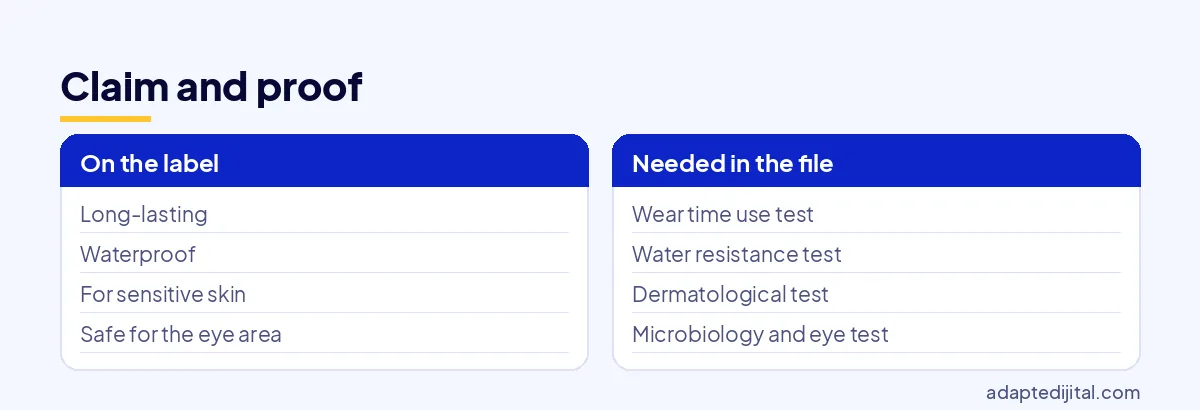
Shade names are free, claims are not: long-lasting, waterproof or for sensitive skin need proof in the product file.
The three documents asked for at inspection
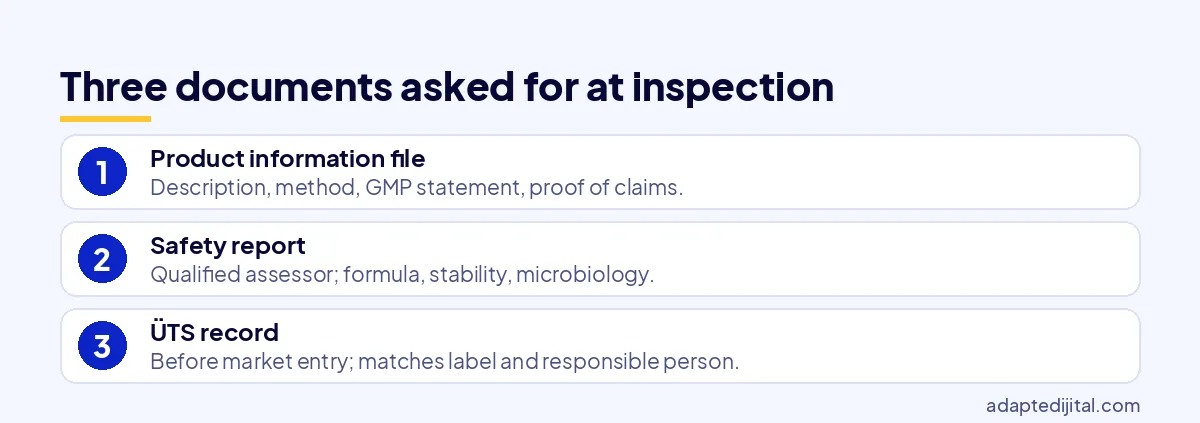
An inspector does not look at the lipstick’s colour; they ask for three things: the product information file, the cosmetic product safety report and the ÜTS notification record. All three must be within the responsible person’s reach, not just the manufacturer’s. Print this box for your manufacturer meeting and responsible person contract.
The three-document box
Three documents that reach the table at inspection:
- Product information file: description, method, GMP statement, proof of claims; current for every shade
- Safety report: from a qualified assessor, with formula, stability and microbiology; extra care for eye products
- ÜTS record: made before market entry, identical to label and responsible person
If one stays with the manufacturer, it does not exist for the brand.
The contract line
Access to these three documents and updates with every formula change go into the manufacturer and responsible person contract. Otherwise, on inspection day nobody can find them.
Five steps for a makeup brand
BU BÖLÜMÜN ÖZETİ
- Five steps in order
- Pre-launch check
- The skincare side
Five steps come before production: name the responsible person in writing, complete the report and file for every shade, check colourants against the permitted list, notify ÜTS before market entry, and limit claims to the proof in the file. All five are decisions; none can wait for the sales stage.
Five steps in order
- Name the responsible person in writing: you, the manufacturer or a separate firm
- Complete the safety report and file for every shade; ask for microbiology on eye products
- Check colourants by CI number; ask about lip and eye limits
- Notify ÜTS before market entry and match it to the label
- Limit wear time or sensitivity claims to the proof in the file
Pre-launch check
These form the documents and label group of the twelve-point makeup pre-launch checklist; tick them before the batch.
The skincare side
The same rules apply to skincare; for a skincare start see the cosmetics brand guide.
Summary and what to do today
A makeup product must be safety-assessed, filed and notified before it reaches the market; the named contact is the responsible person. Today, check that the product file, safety report and ÜTS record for every shade on sale or on order are within your reach. If even one is missing, the batch stops.
One check
Open your product page and write the file’s proof next to every claim. A claim you cannot back comes off; you protect your reputation.
Next reads
For the full setup, see how to start a makeup brand in nine steps; for your stage, which consultancy a makeup brand needs; for the decision order, the makeup brand pillar. To read the documents against your product, ask an expert; scope is on the brand consultancy page.
Frequently Asked Questions
Quick Summary
- A makeup product must be safety-assessed, filed and notified in ÜTS before sale.
- Türkiye’s Cosmetics Regulation and EU Regulation 1223/2009 are aligned; TİTCK enforces them.
- Colourants come from the permitted list by CI number; some are banned near eyes or lips.
- Inspection asks for three documents: product file, safety report, ÜTS record.
- Five steps come before production; the named contact is the responsible person.
Short Glossary
- Responsible person: the individual or company answering for a cosmetic’s compliance, named on the label
- Product information file: the file holding description, safety report, manufacturing data and proof of claims
- ÜTS: Türkiye’s Product Tracking System, where cosmetics are notified before sale
- CI number: the international number identifying a colourant on the label
Next Step
To read your documents with the three-document box, write via the ask an expert form; scope is on the brand consultancy page. Next read: how to start a makeup brand in nine steps.
Updated: October 2026
Sık Sorulan Sorular
Whoever places the product on the market under their own brand. With a catalogue lipstick the formula is the manufacturer’s, but responsibility sits with the owner of the logo.
It changes the colourant ratio, so the safety report and notification are updated. Tweaking a shade later reopens the documents.
The product information file, its safety report and the ÜTS record, plus responsible person details on the label, all within the responsible person’s reach.
The individual or company taking on the product’s compliance: the brand owner or the manufacturer by written agreement. Their name and address are on the label.
Yes; a different shade is a different formula, assessed and notified separately. Changing a shade means updating report and notification.