
Why People Are Switching to Small Makeup Brands: Four Reasons and a Shade Gap Case
People switch to small makeup brands for four reasons: finding a shade that matches their skin, seeing clearly what is in the product, reaching the founder or artist directly, and trusting an honest swatch community. Price is not one of the four; a small brand is often dearer than a catalogue lipstick on a marketplace, and buyers know it.
This article follows an anonymous brand developing difficult shades: who buys, why they pay, why they return. What grows the brand is not a new collection but the two end shades shelves leave empty.
Say you are looking for a foundation and your shade does not exist
BU BÖLÜMÜN ÖZETİ
- What happens
- Unexpected finding
- Why it works
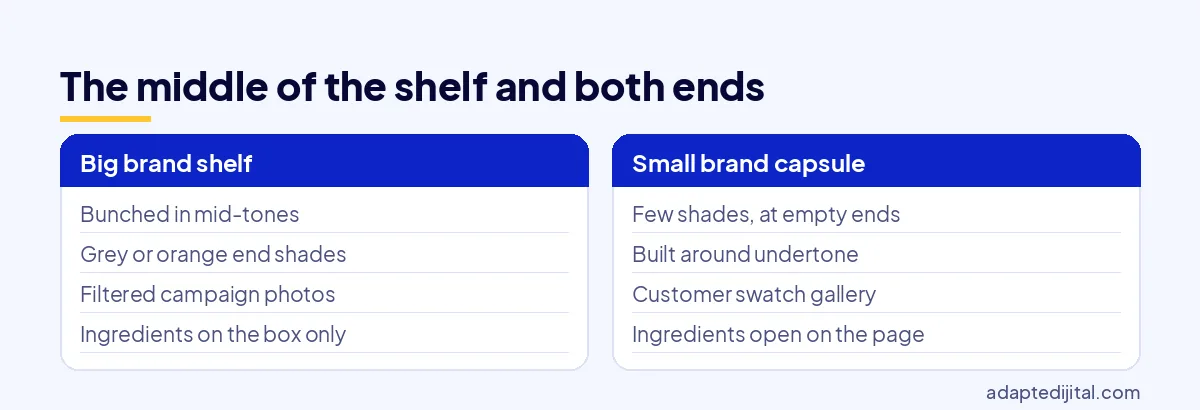
Say your skin is very deep or very fair and you are looking for a foundation at a beauty retailer. The shelf is full, but the shades are bunched in the middle: light-medium, medium, medium-beige. There are one or two shades at the ends, and they look either grey or orange. The founder in this case lives exactly this moment and builds the brand on that gap.
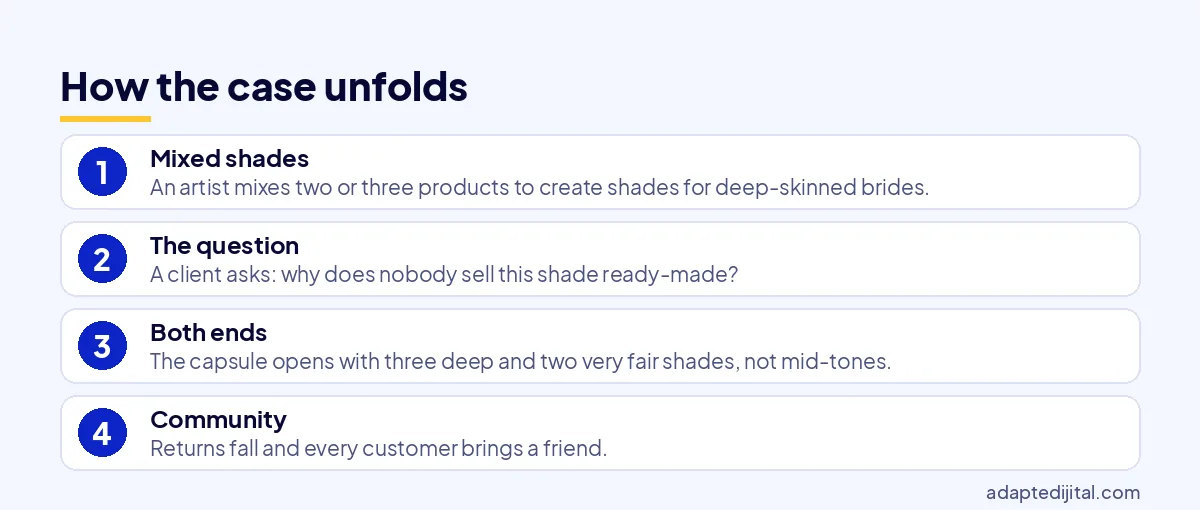
What happens
The founder is a makeup artist who mixes two or three products every day to create shades for brides with deep skin. One day a client asks why nobody sells this ready-made. The founder knows the answer but says it out loud for the first time: because the volume is in the middle.
Unexpected finding
The founder opens the capsule not with mid-tones but with the two ends: three deep and two very fair shades. Early sales start slower than expected, but returns are close to zero and every customer brings a friend. We call this the shade gap: the middle of big shelves is full, both ends are empty.
Why it works
The story of stuck brands is in the case of a makeup brand stuck at its first collection: twelve shades, all mid-tone, all from a catalogue. The founder here does the opposite; fewer shades, but in empty space.
Reason one: finding a shade that matches your skin
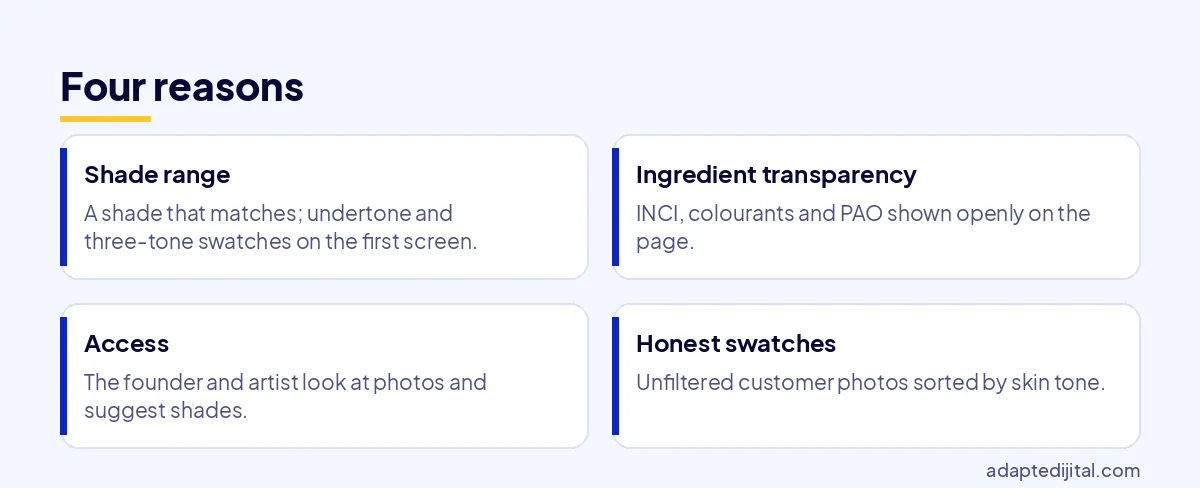
Buyers now look for their shade first and the brand second. A buyer who cannot find their shade either mixes two products or gives up on makeup; the day they find it, they stay with that brand. A small brand cannot build a full shade range, but it can enter the empty ends with a few right shades. Shade inclusivity is where a small brand competes most clearly with a big one.
What the buyer thinks
Is there a shade for me, is my undertone warm or cool, will the colour in the photo look the same on me? The founder answers these three questions on the product page’s first screen: shade name, undertone and swatches on three skin tones.
A principle for you
Aim at the shade gap, not the shade count. Map the competitor’s shelf shade by shade, find the empty spot and build the capsule there; undertone and finish are explained in the article on pigment, shade and undertone.
Reason two: seeing clearly what is inside
BU BÖLÜMÜN ÖZETİ
- Check the source
- Unexpected finding
- A principle for you
Buyers turn the lipstick over and read the ingredient list; even if they cannot read it, they want to know they could. A small brand can show the INCI list, colourants and PAO openly on the product page; a big brand often leaves them on the box only. Transparency is a cheap differentiator, and it works as long as people ask about ingredients.
Check the source
You can look up an ingredient’s function and restrictions in cosmetics in the EU CosIng database. The founder lists each shade’s colourants by CI number on the page and links to CosIng.
Unexpected finding
The most-read page is not the product page but the ingredients page. Buyers check the ingredient list first, then their shade; the order looks backwards, but that is how trust is built.
A principle for you
Put the ingredient list on the page, but add no claims. Words like clean, natural or harmless need proof; a word without proof is challenged in the first review.
Reason three: reaching the founder and the artist
With a big brand the buyer writes to a customer service form; with a small brand they write to a person, and that person answers: this is your shade, this is your undertone, do not mix it with that product. The founder in this case looks at the photos sent in and recommends shades. The buyer tests the promise not on the day it is made but on the day they find the right shade.
What it looks like
| Promise | When the buyer tests it | What the brand gains | What it costs |
|---|---|---|---|
| Shade advice from a photo | Before ordering | Fewer colour returns | A few messages a day |
| Live trial with an artist | At a salon visit | Referrals and bridal clients | Kits and testers |
| The founder’s reply | At the first question | Better reviews | The founder’s time |
Reason four: honest swatches and community
Buyers trust a swatch from someone with skin like theirs, not a filtered campaign photo. A small brand’s community is made of customers’ own photos, and the founder shares them unedited. It answers what no ad budget can: how will this shade look on my skin?
What the case shows
The founder builds a gallery that sorts customer swatches by skin tone for every shade. A buyer with deep skin looks at the photo closest to theirs and picks a shade from it; the return rate falls after this gallery.
Unexpected finding
The biggest contributors to the gallery are not the first customers but buyers who searched for their shade for years and finally found it. The joy of finding it drives sharing; as the shade gap closes, the community grows by itself.
What do the user, the payer and the endorser look at?
In makeup, the user and the payer are usually the same person, but they split with year-end gift sets. The endorser is a third person: a makeup artist, content creator, reviewer or store adviser. All three look at the same lipstick from different angles, and the brand must speak to each separately; a brand with one sentence misses either the first sale or the second.
Three-person table
| Who | Looks at | Decides when | Brand says |
|---|---|---|---|
| User | Shade, undertone, wear time | First trial | Your shade is here, see its swatch |
| Payer (gift) | Box, shade set, returns | At checkout | A shade guide is ready |
| Endorser | Swatches, ingredients, artist view | When recommending | Unfiltered photos, open ingredients |
Unexpected finding
The brand’s most-shared image is not a product shot but a side-by-side swatch of the two end shades. Where shade inclusivity is heading is in the article on makeup brands towards 2027.
One principle
People pay a small makeup brand for shade, transparency, access and honest swatches. A brand that offers all four sells at a premium and lasts; one that offers only packaging and price gets plenty of likes and no second order. The founder in this case learns this from a bride’s question: where is this shade sold?
To do today
Map the competitor’s shelf shade by shade, mark both ends and find the empty spot. Then ask your manufacturer: can we develop a custom shade at this end? If yes, the capsule goes there; questions for manufacturers are in the manufacturer selection article.
Next step
The overall sequence is in the pillar article, your stage in the hub article, scope on the brand consultancy page, and the first step is to consult an expert.
Frequently Asked Questions
Quick Summary
- In this case, what grows the brand is not a new collection but the two end shades shelves leave empty.
- Reason one is shade range; reason two is ingredient transparency.
- Reason three is access to the founder and artist; reason four is an honest swatch community.
- User, payer and endorser see the same lipstick from three angles; the page needs three sentences.
- One principle: aim at the shade gap, not the shade count.
Short Glossary
- Shade gap: the space where shelves bunch mid-tones and leave very deep and very fair skin unserved
- Shade range: the full set of shades a product offers for different skin colours
- Undertone: the warm, cool or neutral tendency beneath the skin’s surface colour
- Honest swatch: a shade photo shared unfiltered, in fixed light and true colour
Next Step
To find your shade gap together, write via the consult an expert form; scope is on the brand consultancy page. Next up: six things people get wrong about makeup brands.
Updated: October 2026
Sık Sorulan Sorular
Messaging and live streams are a shop window, not a till; how the window and the site divide the work is in the digital media roadmap.
For four reasons: finding a shade that matches their skin, seeing clearly what is inside, reaching the founder and artist, and trusting an honest swatch community. Price is not the reason.
Big brands cluster their shelves in mid-tones, leaving very deep and very fair skin empty at both ends; a small brand can enter that gap with a few right shades.
Choose the spot before the number: entering an empty end of the competitor’s shelf with a few shades brings fewer returns and more referrals than twelve shades in the middle.