
New dry cleaner first clients: a 90-day plan for a premium tailor, trust before experience
A new dry cleaner wins its first clients from the streets around its door, from a phone screen and with a single trial piece. The plan has three rungs: one shirt first, then a few pieces, then the season’s wardrobe. Each rung is climbed on the trust of the one before. The first 90 days exist to build the first two rungs of that ladder.
Look, in an affluent district a client buys trust before experience. The covered hanger, the jacket with no chemical smell, the neatly folded shirt are noticed only on the second visit. On the first visit the worry is one: “Will I get my things back?” The plan starts there.
Where does a new dry cleaner find its first clients?
BU BÖLÜMÜN ÖZETİ
- Say you are opening in Moda
- The decision is made on the phone
- The trust ladder
The first client is usually close by: someone on the same street, in the office across the road, passing the door every morning. What brings them in is usually the phone. They see your name on the map, look at the photos, then call or ask for directions. Finding the first client happens on the pavement and the screen at once.
Say you are opening in Moda
You raise the shutters on the first morning. A woman passing looks at the sign and walks on. That evening she searches your name at home. If she finds an empty profile, she goes back to her old dry cleaner.
The decision is made on the phone
On our own site, between 14 June and 13 September 2026, 1,267 of 1,699 clicks came from mobile, about three quarters. Mobile click-through rate: 1.86 percent; desktop: 0.57 percent. A dry cleaning client also decides on the sofa, phone in hand; if your page opens badly on a phone, someone else gets the decision.
The trust ladder
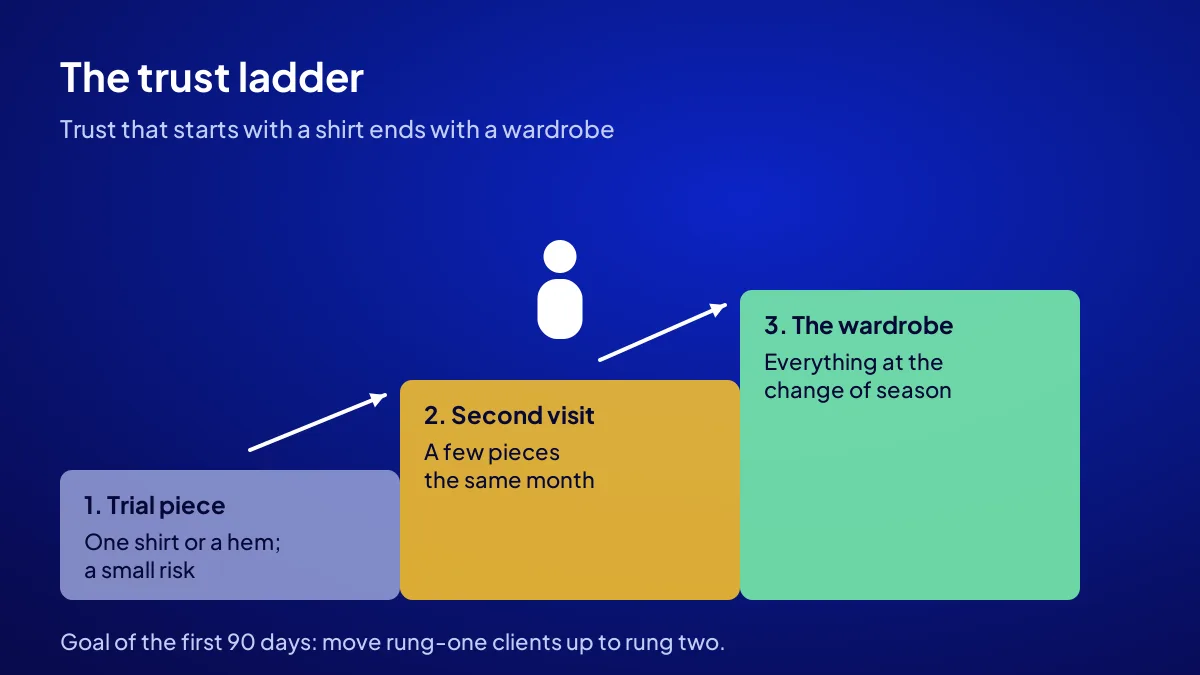
Rung one: a single trial piece. Rung two: a second visit with a few pieces the same month. Rung three: the wardrobe at the change of season. The first 90 days aim to move rung-one clients up to rung two.
Why should the 90 days before opening not be wasted?
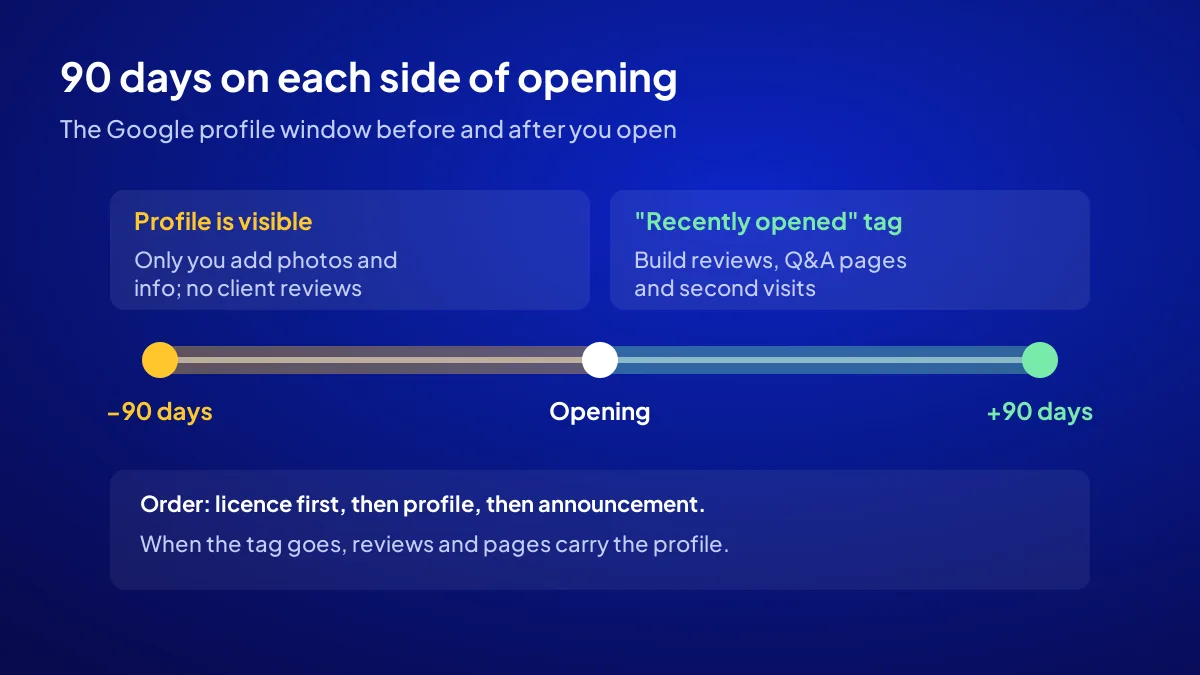
Google can show a verified profile with an opening date 90 days before opening. That is a free shop window, with one limit: until the business officially opens, users cannot post reviews or photos or suggest edits. So before opening, only you fill that window.
Profile and opening date
Once the date is fixed, create the profile with the right address and category. The steps are in adding an opening date on Google. Here only the order matters: licence, then profile, then announcement.
The phone and the first sentence
Answer the profile number during working hours, with the first sentence ready: “Hello, turnaround is two working days, pickup is Tuesdays and Fridays.” A caller who gets the answer before asking decides to come before hanging up.
In the first 30 days, how does a trial piece become a second visit?
BU BÖLÜMÜN ÖZETİ
- The intake counter
- Two minutes at pickup
- The limit of the opening announcement
- The tailor’s fitting
The trial piece is the client weighing you with a small risk. Intake, pickup and the week after decide the second visit. In all three the client should see care, order and a kept promise. This month the intake counter is fixed before any ad.
The intake counter
Open the piece in front of the client, check the pockets, write any stain or tear on the ticket and take an intake photo. Two minutes that say: “your things are on record.”
Two minutes at pickup
At pickup, show the piece out of its cover and say how much of the stain came out. Leave one sentence: “Bring your winter clothes before the season turns and we will have them ready without a queue.” A reminder, not a pitch.
The limit of the opening announcement
The announcement gives the district, address, turnaround time and pickup days; it makes no certain promise such as “we remove every stain”. We collected compliant examples in dry cleaner opening announcement.
The tailor’s fitting
For an alterations client, the fitting is trust’s second test. Measure and pin in front of the client, and write the fitting day on the ticket. A hem a centimetre short is blamed on you, not the fabric.
Why doesn’t the client come back?
BU BÖLÜMÜN ÖZETİ
- The silent loss
- Promises and delays
- The trust threshold
A first-time client who does not return is rarely about price. A one-day delay, a piece squeezed into plastic or an unanswered phone is enough. A premium client does not complain; they quietly go elsewhere. A shop that does not track second visits notices only when the till stops ringing.
The silent loss
The client never says “I wasn’t happy”. They take the next jacket elsewhere, and only the ticket book shows it. Write the name and first visit day on each ticket, and mark anyone not back within four weeks.
Promises and delays
For a premium client, the delivery promise is the service itself. If you will be late, call a day ahead and give a new time. A delay announced in advance is forgiven; one that is not, is not.
The trust threshold
We break down why clients do not walk in and the parts of the trust threshold in why clients don’t come to a new dry cleaner.
Days 31 to 90: what to do before the “recently opened” tag ends?
BU BÖLÜMÜN ÖZETİ
- Reviews, with no incentive
- Three questions, three answers a month
- Allow for the season
After opening, Google shows a “Recently opened” tag on the profile for 90 days. It sparks curiosity, but it does not last. Before it ends, build up unincentivised reviews, question-and-answer pages and second visits. When the tag goes, these carry the profile.
Reviews, with no incentive
Ask politely at pickup: “If you were happy, two lines from you would help us a lot.” Do not give a discount or gift in return. Incentivised reviews break Google’s policies, and a selective client spots them anyway.
Three questions, three answers a month
Note the most common phone questions: how many days for a wedding dress, can cashmere be cleaned, are hems done the same day. Turn three into short site pages each month. Clients find answers there, and AI assistants read you there.
Allow for the season
Dry cleaning gets busy at the change of season and before weddings and holidays. If you open in a quiet month, do not lose heart over month-one numbers. You learn your district’s calendar by writing it down.
How do you keep a weekly trust table?
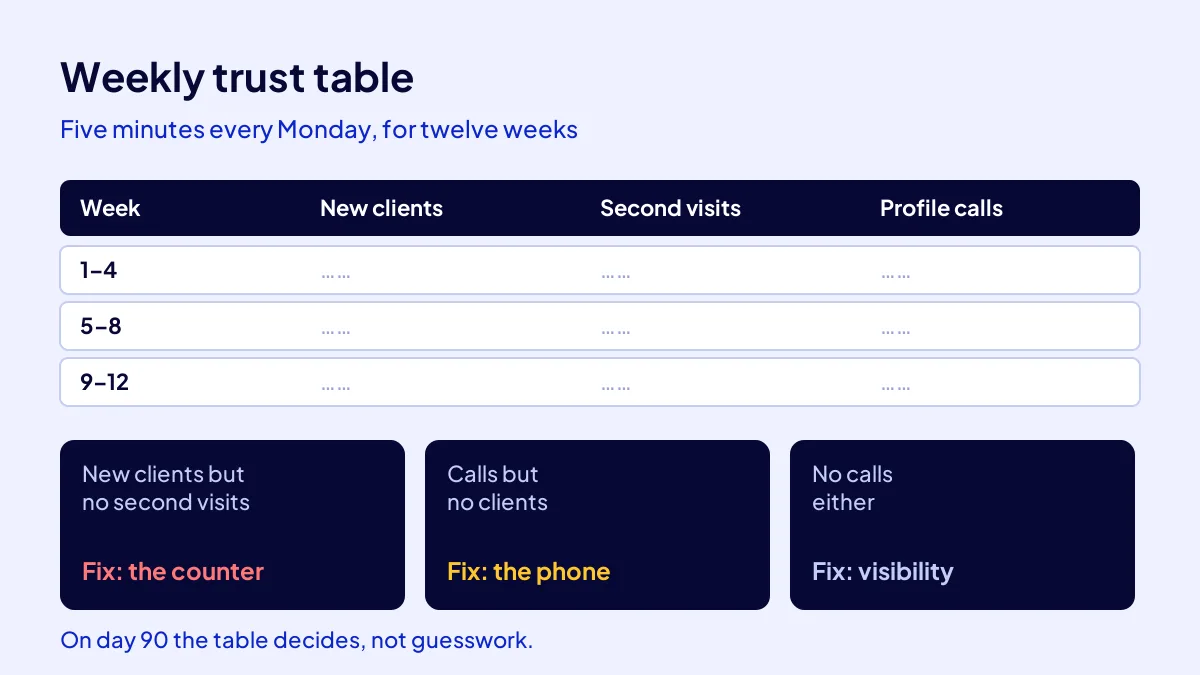
Four columns: week, new clients, returning clients and profile calls. Five minutes every Monday. The numbers may be small; the direction matters. After twelve weeks, the table tells you whether to fix promotion or the intake and delivery routine at the counter.
| Week | New clients | Second visits | Profile calls |
|---|---|---|---|
| 1–4 | …… | …… | …… |
| 5–8 | …… | …… | …… |
| 9–12 | …… | …… | …… |
Here is what I see
With a keyword domain, it is possible to reach the top in one month for a word I could not crack for years. But if the client who clicks never comes back, the ranking is worth nothing. Now I say it plainly: the ticket book first, ads second.
What decision is made on day 90?
On day 90 you choose one of three: keep the routine and be patient, fix intake and delivery, or invest in visibility. The table decides. Without it you guess, and guesswork usually picks the most expensive option: rushing into ads.
One team for the foundation
The Website Recipe in the Get Visible Online campaign sets up the profile, mobile page and visitor tracking together. TRY 36,000 + VAT, upfront and fixed, for 3 months; results are reviewed together after month one. Details on the campaign page.
Let me ask you one thing
How many of last week’s first-time clients can you name? If you cannot, start the book. The decision: in the first 90 days, grow second visits, not ads.
Quick Summary
- The first client is nearby and usually decides on the phone.
- The trust ladder: trial piece, second visit, seasonal wardrobe.
- Google can show the profile 90 days before opening; no reviews can be posted until you open.
- For 90 days after opening a “Recently opened” tag shows; build reviews and Q&A pages meanwhile.
- Weekly table: new clients, second visits, profile calls.
- On day 90 the decision comes from the table, not from guesswork.
Short Glossary
Trial piece: A trial piece is the first garment a new client leaves to test a shop with a small risk.
Return rate: The return rate is the ratio used to measure how many first-time clients come back.
Recently opened tag: The Recently opened tag is the label Google uses on a Business Profile for 90 days after opening to show that the business is new.
Next Step
To make the most of the 90 days before opening, set up your profile, mobile page and visitor tracking with a ready recipe: apply for the Get Visible Online campaign.
Frequently Asked Questions
Source: Google Business Profile Help — Add a business opening date
Sık Sorulan Sorular
The counter in daylight, covered hangers, the tailor’s worktable and the door from the street. With these four shots the client asks “is this place careful?” Show the finished garment, not the inside of the machine.
New clients but no second visits: the problem is at the counter. Calls but no clients: the problem is the first sentence on the phone. No calls either: the problem is visibility, and then you go back to promotion.
If the foundation is ready and the return rate is good but new clients are few, ads make sense. You will find step-by-step thresholds in how a new dry cleaner finds clients, and the full promotion plan in the new dry cleaner promotion guide.
Google can show a verified profile with an opening date 90 days before opening. After opening, a “Recently opened” tag shows on the profile for 90 days.
No. According to Google, users cannot post reviews or photos on the profile until the business officially opens. Before opening, fill the profile with your own photos and information.
Results are reviewed together at the end of the first month. The package is TRY 36,000 + VAT, paid upfront at a fixed price for 3 months; with 20 percent VAT that is TRY 43,200, so check the current rate on the invoice.
Updated: October 2026