
Deli website: the 9 pages a new gourmet deli needs and a pre-launch checklist
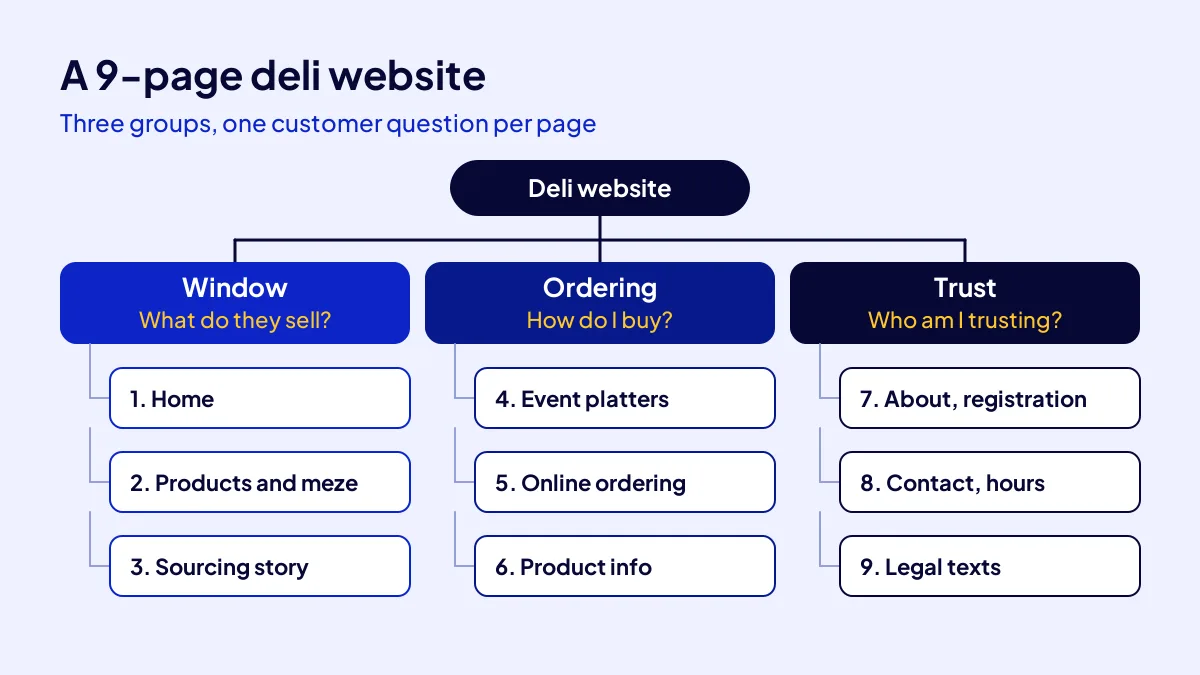
A deli website is built from 9 pages in three groups: shop window, ordering and trust. Together they answer a selective customer’s “where do I buy this” without a phone call.
What sets a deli apart is food information. If you take orders online, Turkey’s food labelling regulation requires mandatory information to be visible before the purchase is completed. And a registered retailer’s business QR code is the strongest proof on a trust page. Each step lists its time and what you need.
Which 9 pages does a deli website need?
Each page answers one customer question. Add no page without a question, and leave no question without a page.
| Group | Pages | Question answered |
|---|---|---|
| Window | 1. Home · 2. Products and meze menu · 3. Sourcing story | What do they sell, where is it from? |
| Ordering | 4. Event platters · 5. Online ordering and delivery · 6. Product information | How do I buy, what is in it? |
| Trust | 7. About and registration · 8. Contact and hours · 9. Legal texts | Who am I trusting? |
How are the window pages prepared?
BU BÖLÜMÜN ÖZETİ
- Step 1. Home page (half a day)
- Step 2. Products and meze menu (1 day)
- Step 3. Sourcing story (1 day)
The window pages take about three working days and need real photos, a product list and suppliers’ names. In an affluent district, a gourmet customer’s first question is often source, not price.
Step 1. Home page (half a day)
Needed: shop photo, one-line description, address, hours and a WhatsApp button. On a phone, “what, where, open when” should fit the first screen.
Step 2. Products and meze menu (1 day)
Needed: each product’s name, short description and weight or portion. Keep cheeses, cured meats, meze and dry goods under separate headings, written as text, not images.
Step 3. Sourcing story (1 day)
Needed: supplier regions and producer names you have permission to use. Gruyère from Kars, olive oil from Ayvalık: concrete sources justify the shelf price.
What must ordering pages show before purchase?
BU BÖLÜMÜN ÖZETİ
- Step 4. Event platters and baskets (1 day)
- Step 5. Online ordering and delivery zone (2–3 days)
- Step 6. Product information: ingredients and allergens (1–2 days)
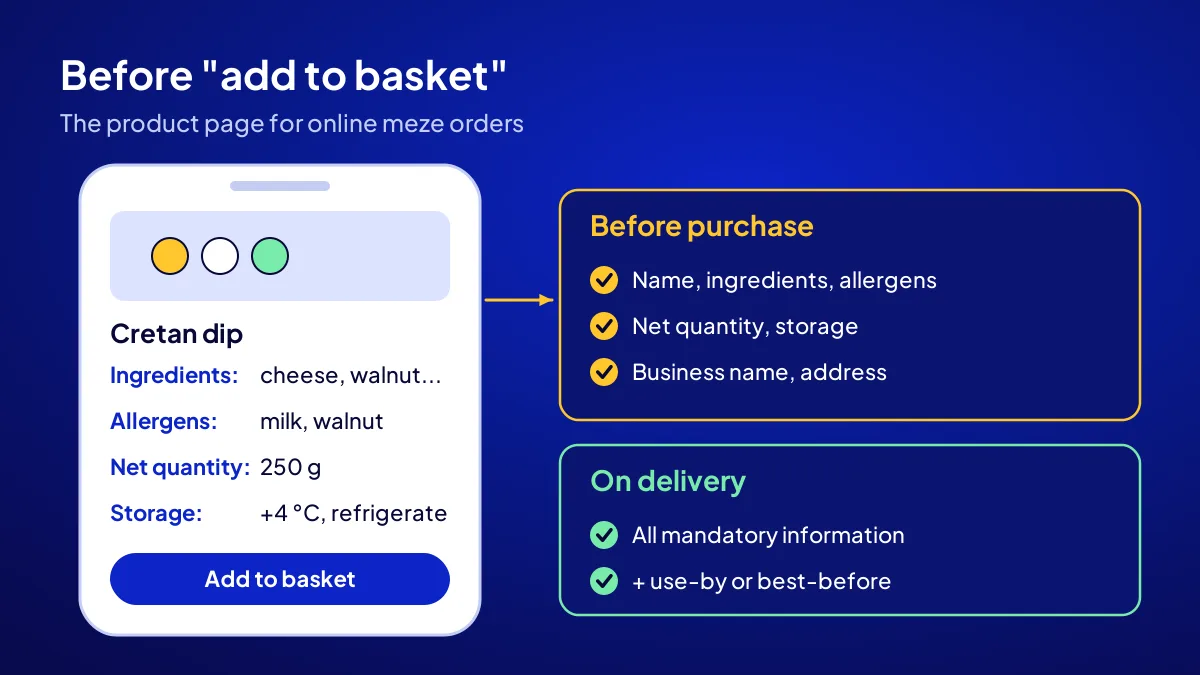
For food sold remotely, mandatory information must be available on the sales page before the purchase is completed; the use-by or best-before date is the exception. Everything is also provided on delivery, at no extra cost (Article 17).
Step 4. Event platters and baskets (1 day)
Needed: three platter sizes by guest count, contents and an order cut-off time.
Step 5. Online ordering and delivery zone (2–3 days)
Needed: delivered neighbourhoods, time slots and a cold-chain note. Keep the list identical to the service area in your Google profile.
Step 6. Product information: ingredients and allergens (1–2 days)
Needed: name, ingredients, allergens, net quantity and storage conditions for each product. In meze you make yourself, state allergens such as milk, sesame, walnuts and gluten clearly.
| Information | Before purchase | On delivery |
|---|---|---|
| Food name, ingredients, allergens | On the sales page | Yes |
| Net quantity, storage, business name | On the sales page | Yes |
| Use-by or best-before date | Not required | Yes |
What do trust pages prove to a selective customer?
BU BÖLÜMÜN ÖZETİ
- Step 7. About and registration (half a day)
- Step 8. Contact and hours (2 hours)
- Step 9. Legal texts (1 day)
Trust pages show documents. Since 28 July 2025, the Ministry of Agriculture and Forestry has required registered or approved food retailers and catering venues to display their business QR code where customers can see it. The same proof can sit on your site.
Step 7. About and registration (half a day)
Needed: business registration number, QR code image and a short founding story. The code is generated on the Ministry’s website with your registration number.
Step 8. Contact and hours (2 hours)
Needed: address, map, phone, WhatsApp and weekend hours, matching your Google profile letter for letter.
Step 9. Legal texts (1 day)
Needed: privacy notice under Turkey’s data protection law (KVKK), cookie information and, if you sell online, a distance sales contract and pre-information form. Have a lawyer check them.
How should “organic”, “homemade” and “best” be used?
Only as far as you can document. Food information must not mislead about production method, and Organic Agriculture Law No. 5262 bans selling uncertified products under the organic name. The Ministry’s labelling guide does not accept superlatives such as “best” or “super” unless proven by production records.
Common mistake: copying “organic” and “natural” from a supplier catalogue onto your site without asking for documents. If you say organic, keep a copy of the certificate on file; otherwise just say where the product comes from.
Menu note for meze shops with table service
A provincial agriculture directorate notice says catering venues must show ingredient and energy information. Outside chains, the deadlines are 31 December 2026 and 31 December 2027, via menu, board, screen or QR code. Your website’s menu page can be where that QR code points; confirm your status with your local directorate.
How can the 9 pages be set up in one go?
For TRY 36,000 + VAT, fixed, the Build Your Digital Brand campaign delivers a domain, one year of hosting, a 6-page brand site, 108 AI SEO-ready articles in 6 keyword groups and structured data. The domain is registered in your name. Details on the campaign page.
Places and deadline
There are 12 brand places and the deadline is 1 November 2026. Mention the 10% coupon code when you apply.
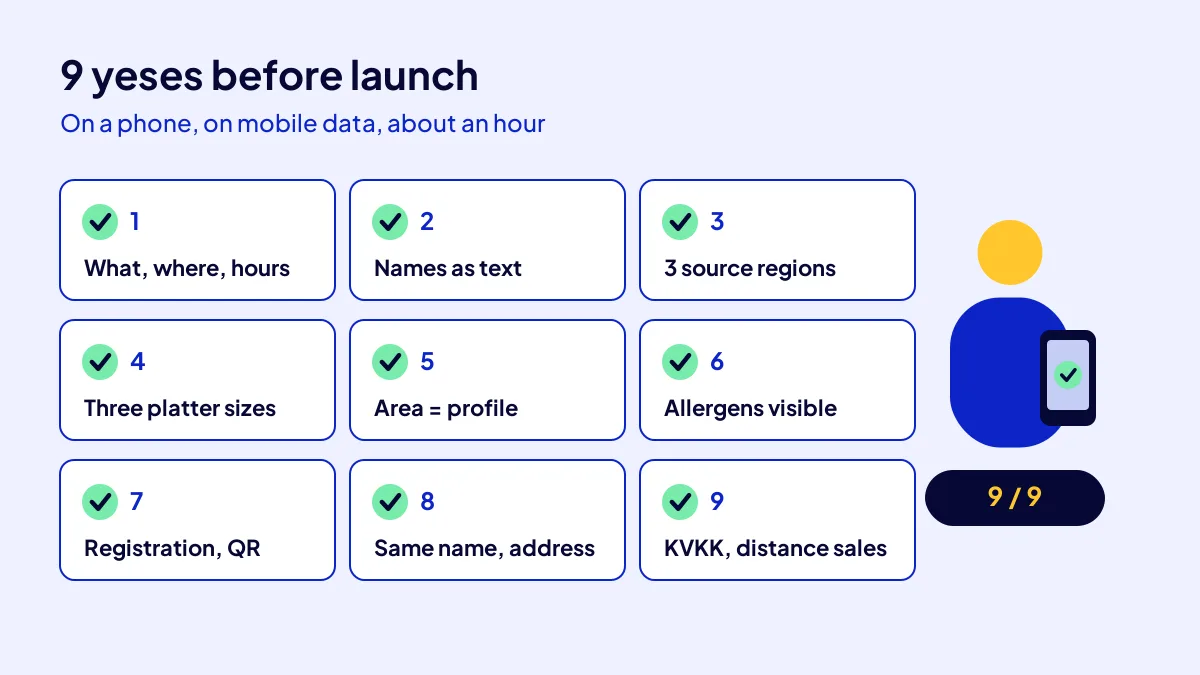
Which 9 items do you tick before launch?
One yes-or-no question per page; announce nothing until all nine are “yes”. It takes about an hour on a phone. The site’s place in the plan is in the new deli promotion guide, its timing in the first 90 days plan.
| Item | Check question | Yes / No |
|---|---|---|
| 1. Home | What, where, hours and WhatsApp on first screen? | …… |
| 2. Products | Product names written as text? | …… |
| 3. Sourcing | At least 3 concrete source regions? | …… |
| 4. Event platters | Three sizes and order cut-off shown? | …… |
| 5. Delivery | Neighbourhoods match the profile’s service area? | …… |
| 6. Product information | Allergens visible before adding to basket? | …… |
| 7. Registration | Registration number and QR code visible? | …… |
| 8. Contact | Name, address, phone match the profile? | …… |
| 9. Legal texts | Privacy and distance sales texts live? | …… |
After launch
Review one product page a week in month one.
Quick Summary
- A deli site has 9 pages: window, ordering and trust groups.
- For online orders, mandatory food information shows before purchase, except the date.
- Allergens are stated on every product page.
- Registration number and business QR code sit on the trust page.
- “Organic” only for certified products, “best” only with proof.
- Tick the 9-item list on a phone before launch.
Short Glossary
Allergen declaration: An allergen declaration is the mandatory information used to show ingredients that may cause allergies.
Business QR code: A business QR code is the Ministry code used to show a registered food business’s identity and inspection status.
Pre-information form: A pre-information form is the document used in online sales to tell the consumer the terms before the contract is made.
Next Step
To have your deli’s site, domain and 108 articles set up in one go, apply to the Build Your Digital Brand campaign. Fill in the form and mention your coupon code.
Frequently Asked Questions
Source: Ministry of Agriculture and Forestry — Food business QR code procedures published
Sık Sorulan Sorular
A single menu image tells Google and customers very little. Someone searching cheese by name should find that name as text.
Whether to take orders on your own site or through a marketplace or delivery app is a separate decision, weighed in own site or marketplace.
A verifiable sentence such as “prepared in our shop every morning” convinces more than a claim.
Home, products, sourcing story, event platters, about and contact fit the 6-page site. Product detail can become article topics. Online ordering and e-commerce are an extra, separate offer.
Instagram whets the appetite, the site answers questions. See is Instagram enough for a deli, and the latest sector rules in deli latest rules and market.
Someone who did not build the site. Hand a friend your phone and say “order a meze platter for 6 tonight”.
Nine: home, products and meze menu, sourcing story, event platters, online ordering and delivery, product information, about and registration, contact and hours, legal texts.
Mandatory information such as name, ingredients, allergens, net quantity, storage and business details must be visible before purchase. The date is not required beforehand, but everything is provided on delivery.
Yours. One year of hosting is included in TRY 36,000 + VAT; renewal from year two is yours. At 20% VAT the total is TRY 43,200; check the current rate on your invoice.
Updated: October 2026