
New deli, no customers? The 6 parts of the trust threshold at a gourmet meze shop
Say you have opened a gourmet deli and meze shop in Bakırköy, two streets from the market. The window shines and the meze is fresh, yet your new deli has no customers. The reason is rarely price. Before trusting an unfamiliar counter with food for their table, a selective customer looks for six things: inspection, freshness, ingredients, the person behind the counter, price and what others say.
We call these six parts the trust threshold. If one is missing, the customer goes back to their usual deli. A new shop’s real rival is not the business on the next street but the customer’s habit. In 2026, in Istanbul or Çankaya, habit only breaks with visible trust.
Why does the window shopper not come in?
Because risk in food is invisible. Through the glass you cannot see when a meze was made, whose hands it passed through or what is in it. A selective customer covers that gap with a familiar place, and a new shop is not familiar yet. So the decision is usually made on the phone before the door: the map, the photos, the reviews.
Risk comes before price
In an affluent district a small price gap turns nobody away. What does is the chance of a problem on a plate set before guests. An opening discount does not fix that.
Customers look, they do not ask
A selective customer does not phone to ask whether the meze contains walnuts. If they cannot see the answer, they leave quietly. The day the till stops turning is the sum of those silent decisions.
What are the 6 parts of the trust threshold?
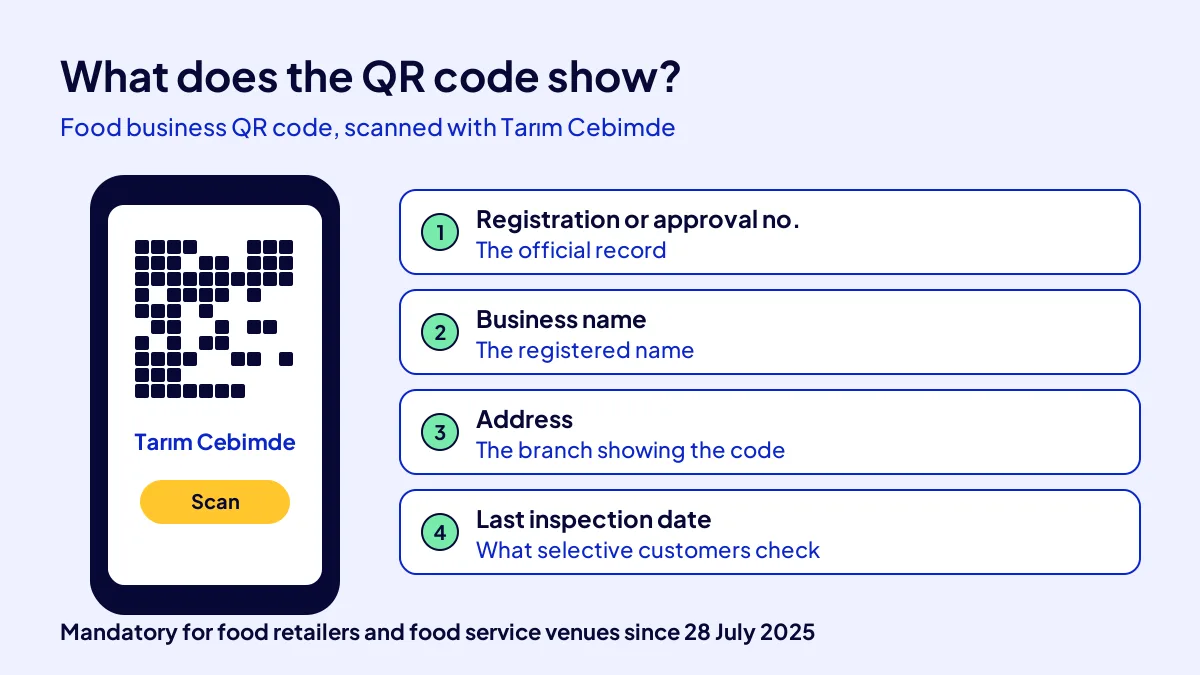
The six parts are six questions in the customer’s mind: is this place inspected, how fresh is it, what is in it, who makes it, will the price surprise me, and what have others said. Each answer must be visible somewhere specific. The table shows where.
| Part | Customer’s question | Where the answer sits |
|---|---|---|
| 1. Inspection | Is this place inspected? | Food business QR code at the door |
| 2. Freshness | When was it made? | Preparation time on the counter |
| 3. Ingredients | What is in it? | Allergen card and menu |
| 4. Person | Who makes it? | The maker’s name and face, on profile and site |
| 5. Price | Any surprises? | Per-kilo and tray price list |
| 6. Others’ word | Who tried it, what did they say? | Google reviews and replies |
The threshold is a chain
The weakest link sets its height. Even with a perfect price list, if there is no answer on allergens, a mother whose child is allergic to walnuts stops at the door.
Why is the QR code at the door the first part?
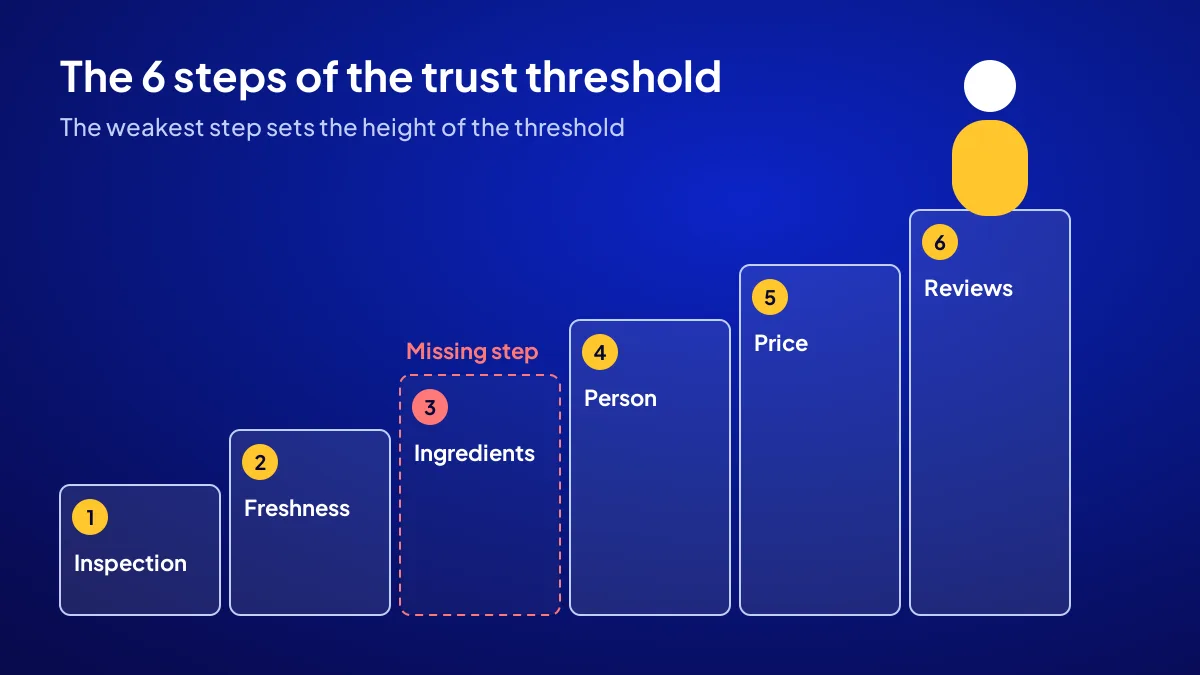
Because since 28 July 2025, food retailers and food service venues holding a registration or approval certificate in Türkiye must display the Ministry of Agriculture and Forestry’s business QR code where customers can see it. A customer who scans it sees the date of the last inspection on their phone. Hiding it in a corner wastes your strongest proof of trust.
Do not leave it on the wall
The code is printed at A5 or A4 and placed where it is easy to see. Takeaway businesses and food service venues may also put a smaller version on packaging, menus or table cards.
No registration, no opening
The code is generated with your registration or approval number on the ministry’s safe food site. Complete registration at your provincial or district agriculture directorate before opening.
How do you show freshness and allergens at the counter?
In writing. The preparation day and time sit next to each meze, the ingredients on its card. Food service venues must give information on a food’s components when a customer asks, including allergen, alcohol and pork-derived ingredients where present. Answering when asked is the rule; showing before anyone asks is trust.
Preparation time
A small card is enough: “Made today at 9.30.” The word “daily” is only for food with a 24-hour shelf life and a stated production date. We list the conditional words in the deli opening announcement guide.
The allergen card
Write common allergens such as walnut, sesame, dairy and gluten on each plate’s card. Seeing walnuts in muhammara on a card is easier than asking.
Why should the person and the price be visible?
BU BÖLÜMÜN ÖZETİ
- The maker’s name
- The cheese’s journey
- The tray price
Because in food, trust attaches to a name. If the name and face of whoever chooses the cheese and makes the meze appear on your profile, site and counter, the customer trusts a person, not a shop. Price works the same way: fear of a surprise on a tray order makes a selective customer give up before calling.
The maker’s name
Who makes the meze, who chooses the cheese? Two photos and two sentences are enough; a neighbourhood shop is known by its face.
The cheese’s journey
Emphasis like “genuine” is banned on food. The producer’s name and region are allowed and persuasive.
The tray price
The real uncertainty is a meze tray for ten. List a per-person price range.
Why are first reviews the last part?
Because a new shop starts from zero. On a profile with an opening date, Google does not let customers post reviews or photos before you open. First reviews only come from first customers, so the other five parts are built before them. When reviews arrive, reply to each one briefly and calmly.
Bought reviews break the threshold
An amendment published in the Official Gazette on 1 July 2026 bans publishing reviews from people whose purchase cannot be verified. Reviews from friends break both rule and trust. Honest ways are in getting first reviews for a new business.
A reply to a bad review is a shop window
Answer a negative review calmly, briefly and with a solution. The next customer reads your reply more than the review.
Which part do you build first in 30 days?
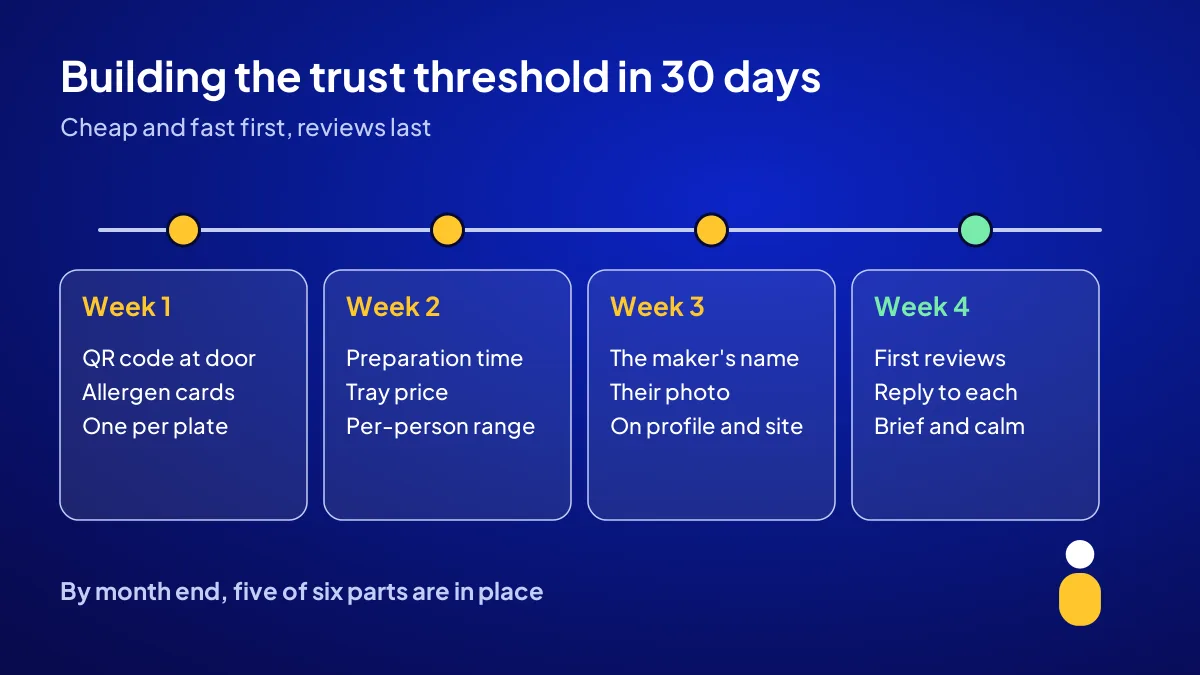
The cheap and fast parts first. Week one: the QR code and allergen cards; week two: preparation-time cards and the tray price list. Week three: the maker’s name and face on profile and site; week four: replies to first reviews. By month end, five of six parts are in place.
Build the threshold as a brand
The Build Your Digital Brand campaign includes brand consulting, a digital identity, a 6-page brand website and 108 AI SEO-ready articles; the domain is registered in your name. TRY 36,000 + VAT at a fixed price, a 10% coupon, 12 brand places and a deadline of 1 November 2026. Details are on the campaign page.
The full picture
The first three months are in the new deli’s first 90 days, and the whole promotion in the new deli promotion guide. One principle: a selective customer does not choose a shop, they choose the person they trust with their table.
Quick Summary
- A selective customer weighs the risk on the plate more than the price.
- A new shop’s real rival is the customer’s habit.
- The trust threshold has six parts; the weakest sets its height.
- The food business QR code is mandatory since 28 July 2025.
- Freshness and allergens are shown in writing, before anyone asks.
- Reviews come last, and each one gets a reply.
Short Glossary
Trust threshold: The trust threshold is the concept used to describe all the information a customer wants to see before trying a new business.
Business QR code: A business QR code is the two-dimensional code used to reach a food business’s registration number, address and last inspection date by phone.
Allergen: An allergen is the term used for ingredients, such as walnut or sesame, that can trigger allergic reactions.
Next Step
To build the person, website and brand voice parts of your trust threshold together, apply for the Build Your Digital Brand campaign. Mention the coupon code when you apply.
Frequently Asked Questions
Source: Ministry of Agriculture and Forestry — Food business QR code procedures
Sık Sorulan Sorular
A premium customer buys a table they can set before guests with peace of mind, as covered in what deli customers really buy.
Scanned with the ministry’s Tarım Cebimde app, the code shows four facts: registration or approval number, business name, address and the latest inspection date. If the details do not match reality, customers can report it to the 174 food hotline.
Usually the reason is risk, not price. Before buying from an unfamiliar counter, a selective customer wants to see inspection, freshness, ingredients, maker, price and review information. If one is missing, they return to their usual deli.
Yes. Since 28 July 2025, food retailers and food service venues with a registration or approval certificate must display the code where customers can see it. For food production sites it is voluntary.
The domain is registered in the customer’s name; the first year of hosting is included and second-year renewal is the customer’s. The package is TRY 36,000 + VAT at a fixed price, the 10% coupon code is given when applying, there are 12 brand places and the deadline is 1 November 2026.
Updated: October 2026