
KOSGEB Global Competitiveness Program backs loans up to TL 75M, which exporters qualify?
KOSGEB’s Global Competitiveness Support Program backs loans between TL 30 million and TL 75 million for growing exporters with a non-repayable financing support of 20 points, and the 2026/1 project call closed on 30 September 2026 (KOSGEB program page and 2026/1 call text, accessed 13 October 2026). KOSGEB is Türkiye’s Small and Medium Enterprises Development Organization. Its program page still lists this call as the one “in force”, but the deadline in the call text has passed.
Here is what it means for you: there is no application window today, but there is a preparation window. The program runs on calls, and each new call is announced on KOSGEB’s website. A firm that meets one of the four criteria and keeps three years of export and R&D data in order is ready when the next call opens.
How much loan does KOSGEB’s Global Competitiveness Program support?
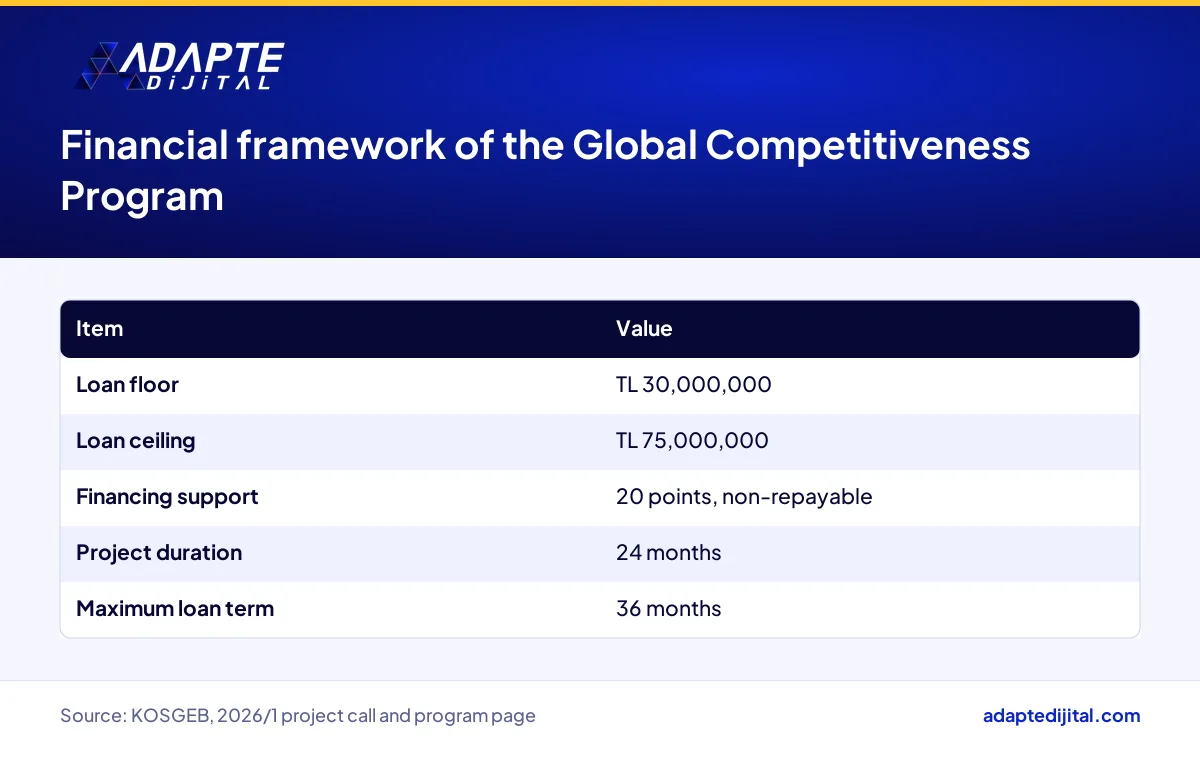
Each business can take a loan of at least TL 30,000,000 and at most TL 75,000,000 (2026/1 call text). For the loan used, KOSGEB provides a non-repayable financing support of 20 points, and a guarantee is available through KGF, Türkiye’s Credit Guarantee Fund. The project runs for 24 months, and the maximum loan term is 36 months.
Is the Global Competitiveness Program’s 2026/1 call still open?
No. The 2026/1 project call lists 7 September 2026 as the opening date and 30 September 2026 as the deadline, so the application period has closed. The program page still shows it as current on 13 October 2026, and says nothing about a second 2026 call.
Which businesses does Global Competitiveness support affect, and how?
BU BÖLÜMÜN ÖZETİ
- Who gains: the manufacturer with steadily rising exports and R&D
- The alternative route: the HAMLE list and Turcorn 100
- Who struggles, and who feels it indirectly
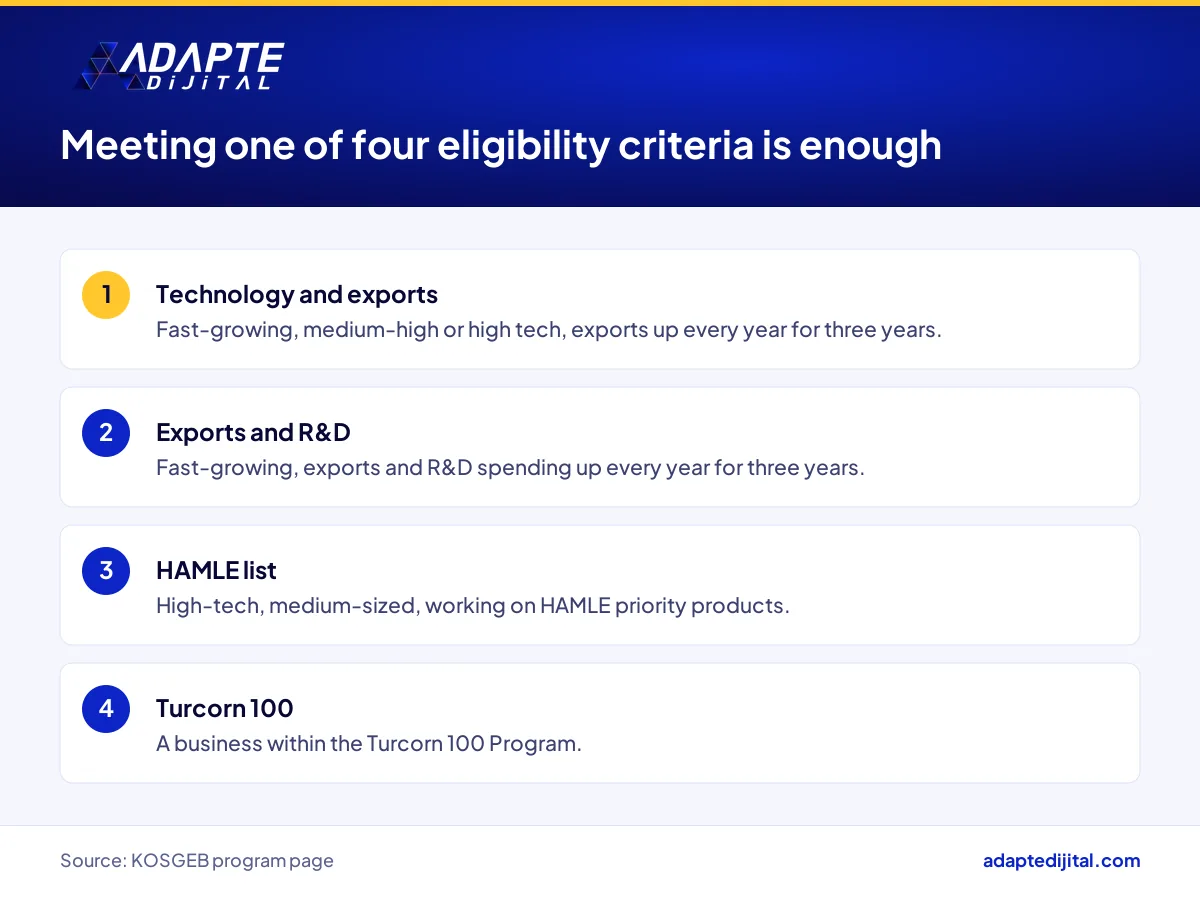
The program favours high-tech manufacturers with three years of steady export growth. Base conditions apply to everyone. You must be registered and active in the KOSGEB database, keep your İşletme Beyanı (the SME declaration that sets your size class) up to date, and be a natural or legal person defined in the Turkish Commercial Code. On top of that comes one of four criteria, which splits exporting manufacturing SMEs in Türkiye into three groups this autumn of 2026.
Who gains: the manufacturer with steadily rising exports and R&D
The first two criteria hinge on three years of export growth. A fast-growing firm at a medium-high or high technology level that has grown exports every single year meets the first one. A fast-growing firm that has raised both exports and R&D spending every year meets the second. The “fast-growing” condition is checked automatically by KBS, the KOSGEB SME Information System used for applications.
The alternative route: the HAMLE list and Turcorn 100
Two doors remain if exports did not rise every year. The third criterion covers medium-sized, high-technology firms working on products in the priority list of the Technology-Focused Industry Move, known in Turkish as HAMLE. The fourth covers businesses within the Turcorn 100 Program.
Who struggles, and who feels it indirectly
Let’s say a textile subcontractor or a furniture maker sees exports rise one year and dip the next. Without a product on the HAMLE list, that firm stays outside the program. Indirectly, machinery and mould suppliers, software firms, testing labs, certification bodies and design studios sit on the other side of these budget lines.
What can a Global Competitiveness loan be spent on?
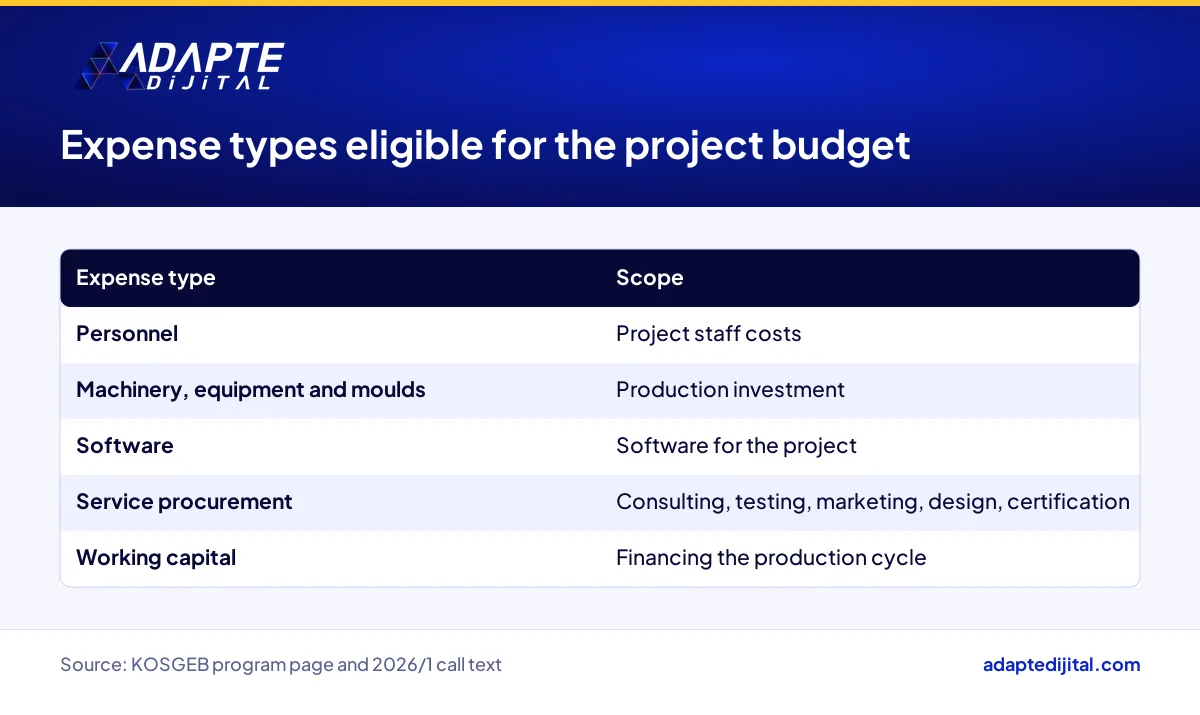
On five expense types: personnel; machinery, equipment and moulds; software; service procurement; and working capital (KOSGEB program page and 2026/1 call text). Supported projects range from innovative product development and process optimisation to supply chains, global partnerships and market entry.
How does the Global Competitiveness Program show up on an exporter’s digital side?
Because marketing services can be written into the project budget, digital work in foreign markets becomes a defined line inside the program. A multilingual site, local search visibility, a B2B marketplace storefront and ads can all serve the “market entry” goal.
What should an exporting business owner do this week to prepare for the next Global Competitiveness call?
Four things: check your registration status, document your fit with the criteria, hold a preliminary meeting with a partner bank and split your project budget by expense type. With the 2026/1 call closed, this is preparation, not an application.
Quick Summary
- The program gives a non-repayable financing support of 20 points on loans of TL 30-75 million (2026/1 call text).
- The 2026/1 call’s deadline was 30 September 2026, and the application period has closed.
- Applicants must meet one of four eligibility criteria, two of which depend on three years of export growth.
- The project runs 24 months, the maximum loan term is 36 months and instalments are equal and quarterly (KOSGEB).
- Loans can be used only from Ziraat Bankası, Halkbank, VakıfBank and Ziraat Katılım.
Short Glossary
- KOBİ Bilgi Sistemi (KBS)
- KBS is the online system used to apply for KOSGEB programs and to track projects.
- Project call
- A project call is the official notice used in call-based programs to announce the application calendar and conditions.
- KGF guarantee
- A KGF guarantee is the security provided by Türkiye’s Credit Guarantee Fund, used to help a business with limited collateral access a loan.
Frequently Asked Questions
Next Step
If you want to pin down your criteria fit and project budget before the next call, fill in the consult your expert form, and we will map out the gaps in your file together.
Support amounts and conditions can change; check the current terms on the institution’s official page before applying. This article is not financial or legal advice.
Sources: KOSGEB, Global Competitiveness Support Program page (accessed 13 October 2026) · KOSGEB, 2026 First Project Call
Updated: October 2026
Sık Sorulan Sorular
A TL 30 million floor makes the program meaningful for a firm that builds a new line or enters a new market with production capacity. A workshop whose turnover cannot carry that loan stays outside it.
The call text defines it as “a non-repayable financing support of 20 points for the loans used”. How those points translate into interest relief sits in a separate Support Calculation Table, and the page gives no TL equivalent. Compare that table with your bank’s offer before budgeting a TL figure.
According to KOSGEB’s FAQ, instalments are equal and paid every three months, and a project can borrow from only one financial institution. After the jury accepts the project, the first loan drawdown must happen within 9 months of the project start. If cash flow is not planned around that calendar, cash stops turning over fast.
The program page carries no publication date, and its “call in force” field still points to the first period of 2026. The call text is clear about the dates, so trust its timetable.
According to KOSGEB’s program page, the program is call-based: each project call takes effect with an approval by the KOSGEB President and is announced on the agency’s website. The next call’s date and budget are not known today. New calls also appear in our grants and incentives news archive.
Yes. The FAQ on the program page says a rejected applicant can apply again. For a firm turned down with an incomplete file, the next call is a real second chance.
According to the program page, service procurement covers training, consulting and mentoring, certification, testing and analysis, marketing, design, and industrial property rights. Target-market certification, testing and trademark registration fit here. For an assessment and roadmap alone, the KOSGEB YÖNDE advisory support may be the closer fit.
In a new market, orders arrive but cash for raw materials and extra shifts runs short. Working capital and personnel lines keep production running in those first months.
For a pure machinery and software investment without the export criteria, the KOSGEB SME Digital Transformation interest support subsidises interest on machinery and software loans of up to TL 20 million for manufacturing SMEs.
The criteria look at export and R&D figures, and the demand behind those figures often shows up online first. Quote requests by country, converting product pages and post-fair enquiries tie the project’s rationale to numbers.
Leaving the website in Turkish only while writing an export target into the plan is like building a shopfront where foreign buyers walk straight back out the door. Without product pages, documents and contact in the buyer’s language, the plan loses credibility.
Confirm your KOSGEB record is active and your SME declaration current. If your size class or turnover has changed, renew it now.
Put three years of annual exports and R&D spending, from accounting and customs records, into one table. If any year shows a decline, the first two criteria do not fit. In that case, check whether your product appears on the HAMLE priority list.
Loan applications go only to banks that have signed a protocol with KOSGEB: Ziraat Bankası, Halkbank, VakıfBank and Ziraat Katılım. Settle collateral, any KGF guarantee and the quarterly instalment calendar now, so the 9-month drawdown period after the jury decision holds no surprises.
Divide the investment into personnel, machinery and moulds, software, service procurement and working capital, and tie each line to a project goal. On export strategy and market entry planning, we build this file with clients through our foreign trade consultancy service.
The 2026/1 call’s deadline was 30 September 2026, and the application period has closed. Applications become possible again when KOSGEB announces a new call on its website.
The first two criteria require export growth. If the firm is a medium-sized, high-technology business working on HAMLE priority products, or falls within Turcorn 100, it can apply under one of the other two criteria.
No. The loan can only be used from banks that have signed a protocol with KOSGEB, and a project can borrow from only one financial institution.