
Is a digital company a new legal entity type, what does Law 7582 say about LLCs and JSCs?
No, a digital company (dijital şirket) is not a new legal entity type; Law 7582 only gives companies that meet a definition still to be set by the Ministry of Industry and Technology an exemption of up to 3 years from chamber and exchange fees and dues (TÜRMOB circular, 4 June 2026). The text says “companies”, names no company type and does not cite the Turkish Commercial Code. You still incorporate as an existing type; “digital company” reads as a status on top.
What this means for you: the LLC or JSC question is still on the table, and the digital company does not replace it. As of 14 October 2026 the Ministry has not published the definition, so nobody can register as a “digital company” today.
Is a digital company a separate legal entity type from an LLC or a JSC?
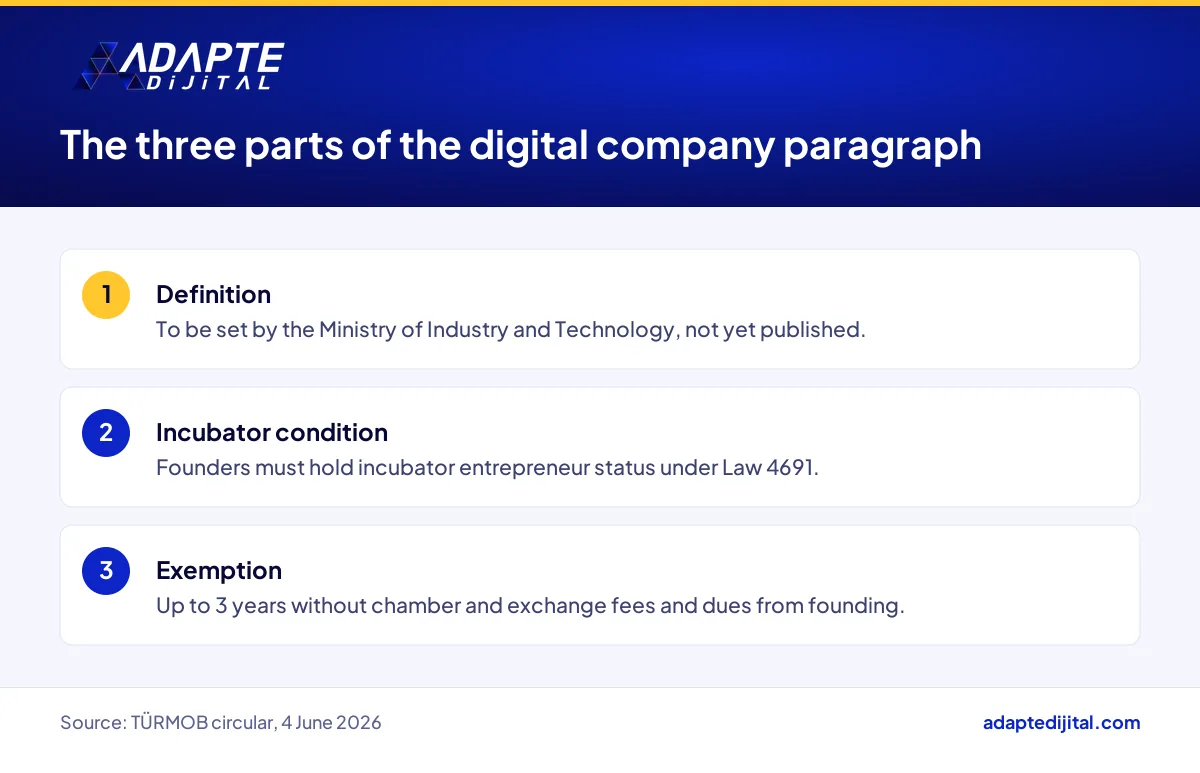
No, the official text creates no such type. Article 11 of Law 7582 adds paragraph 16 to Article 3 of Law 5746, the Turkish law on supporting R&D and design activities. According to the TÜRMOB circular on Law 7582, the clause covers companies “founded and operated in line with the digital company definition to be set by the Ministry”. It attaches a consequence to a company; it does not create a form.
Where does the claim that a digital company is a new type under an amended Commercial Code come from?
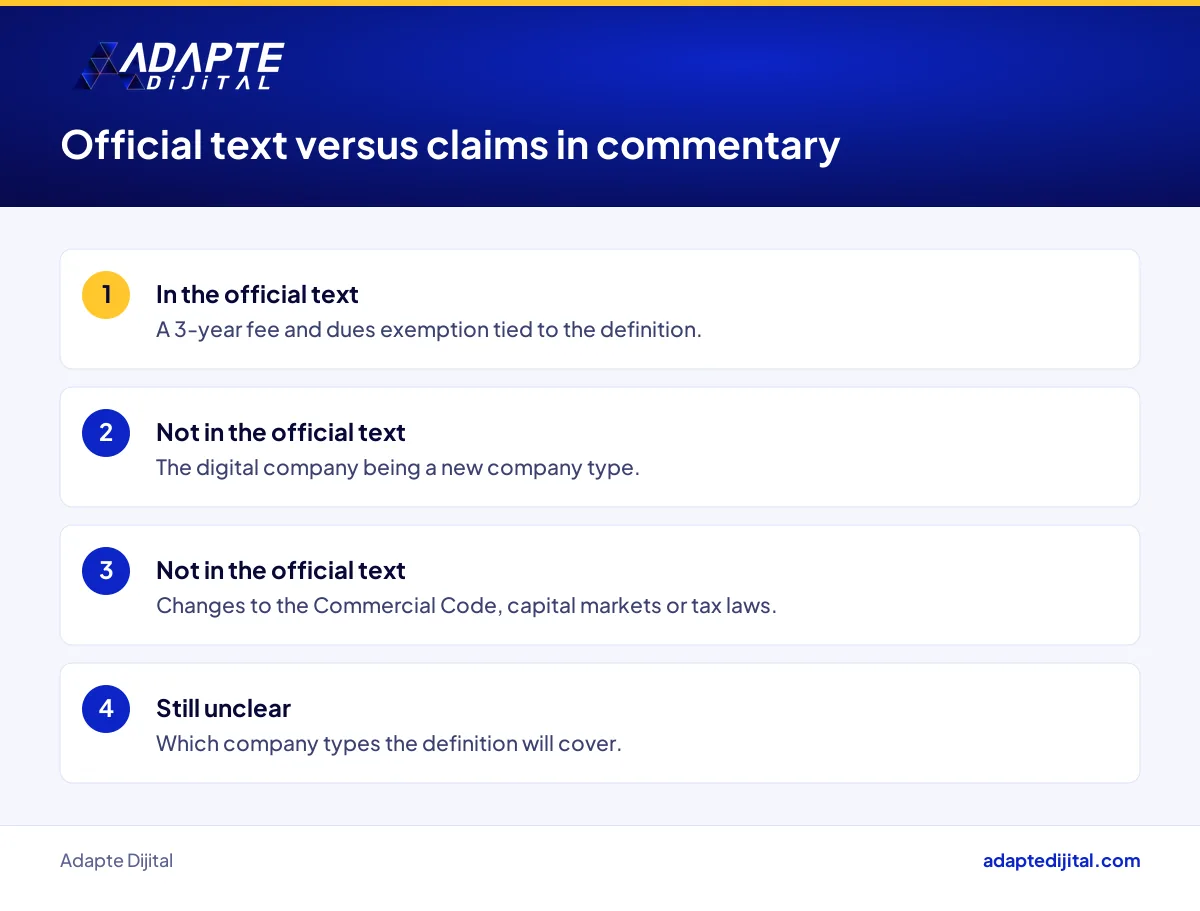
Some commentary says so, but it is not in the official text. Some write-ups claim that the Commercial Code, capital markets rules and tax laws will be amended, or that a new entrepreneurship package has been issued. The law in the Official Gazette, the TÜRMOB circular and the KOSGEB announcement contain no provision on any of these changes. No Commercial Code bill mentioning digital companies was found in parliament’s records either.
Who can benefit from the digital company exemption, and who is left out?
Nobody can benefit today, because the definition has not been published. Once it is, the eligible profile will be a company that meets two conditions together. It must be founded and operated in line with the Ministry’s definition. It must also be founded by entrepreneurs with incubator entrepreneur status under Law 4691, Türkiye’s Technology Development Zones Law, which keeps the group narrow.
What does the digital company change when you choose between an LLC and a JSC?
For now, nothing. You still choose between the existing types based on your partner structure, capital plan and investor expectations. The winner is whichever existing type fits your business plan today, because the digital company paragraph favours none.
What can a digital company founder prepare on the web and digital side before the definition appears?
Since the definition is not out, nobody knows which digital criteria will apply. According to an AA report based on the Ministry’s 2025 report, the scheme aims to run incorporation through a single window and fully digitally. Preparation can therefore focus on records and visibility.
What should a founder considering digital company status do this week?
Three concrete tasks fit into this week. Settle the company type with your accountant, confirm whether you hold incubator entrepreneur status, and check official sources for the definition. Our digital company page, where we collect every question on the topic, is a good starting point.
Quick Summary
- The official text does not set up the digital company as a new company type.
- Law 7582 gives qualifying companies up to 3 years of exemption from chamber and exchange fees and dues (TÜRMOB, 4 June 2026).
- The exemption depends on the Ministry’s definition and on the incubator entrepreneur condition.
- As of 14 October 2026, no published Ministry definition could be found.
- The choice between an LLC and a JSC is still made on today’s rules and your business plan.
Short Glossary
- Digital company
- Digital company is the legal term used to describe a company founded and operated in line with the definition the Ministry of Industry and Technology will set.
- Incubator entrepreneur
- Incubator entrepreneur is the status used under Law 4691 for founders who qualify to operate in incubators within technology development zones.
- Dues exemption
- Dues exemption is the legal carve-out used to relieve a company from chamber and exchange fees and dues for a set period.
Frequently Asked Questions
Next Step
If you want to review your company type and your readiness for digital company status together, fill in the consult your expert form.
The definition and conditions of the digital company scheme are not final yet; check the latest information with the Ministry of Industry and Technology, KOSGEB and the Official Gazette before deciding. This is not legal or financial advice.
Support amounts and conditions can change; check the current terms on the institution’s official page before applying. This article is not financial or legal advice.
Sources: TÜRMOB Special Circular, Law 7582 (4 June 2026) · Official Gazette issue 33270 (4 June 2026) · KOSGEB, Entrepreneur Support Programme renewed (12 October 2026)
Updated: October 2026
Sık Sorulan Sorular
No. The paragraph says only “companies”. The paragraph right before it, on techno-startup badge holders, cites the Commercial Code; the digital company paragraph does not.
It grants an exemption. A qualifying company is exempt for up to 3 years from its founding date from the fees and dues covered by Article 24 of Law 5174, the law governing TOBB, Türkiye’s Union of Chambers and Commodity Exchanges. No tax exemption is part of this provision.
The power sits with the Ministry of Industry and Technology. The definition itself is not in the law, and no published definition could be found on the Ministry’s site. Until it appears, the exemption stays on paper.
The law was published on 4 June 2026, and the words “digital company” appeared in it. Some readers took this to mean “the digital company is now in force”. In fact, the only provision in force is the dues exemption, and applying it depends on the definition.
KOSGEB, Türkiye’s Small and Medium Enterprises Development Organization, renewed its Entrepreneur Support Programme on 12 October 2026. It refers to “businesses that fit the Digital Company definition to be set by the Ministry”. That is eligibility language, not entity-type language.
Look for a law number, an article and an Official Gazette date behind it. A source that says “this will change soon” without showing a text gives you nothing to stand on at the contract table. When in doubt, open the current text of the law on mevzuat.gov.tr, Türkiye’s official legislation database.
A software or technology startup coming out of an incubator in a technopark is the closest candidate. The incubator condition in the law points straight at that ecosystem. If the definition fits its business model, the chamber and exchange costs of the first 3 years get lighter.
Under today’s text, a traditional SME that has not been through incubation falls outside the exemption. So does a retailer moving its shop online or a freelancer setting up an agency without incubator status. Because the provision says “founded and operated”, it is unclear whether an existing company can gain the status later.
Accountants and law firms that handle incorporations are the first to face this question. Technopark managers and incubators may also get questions because of the incubator condition.
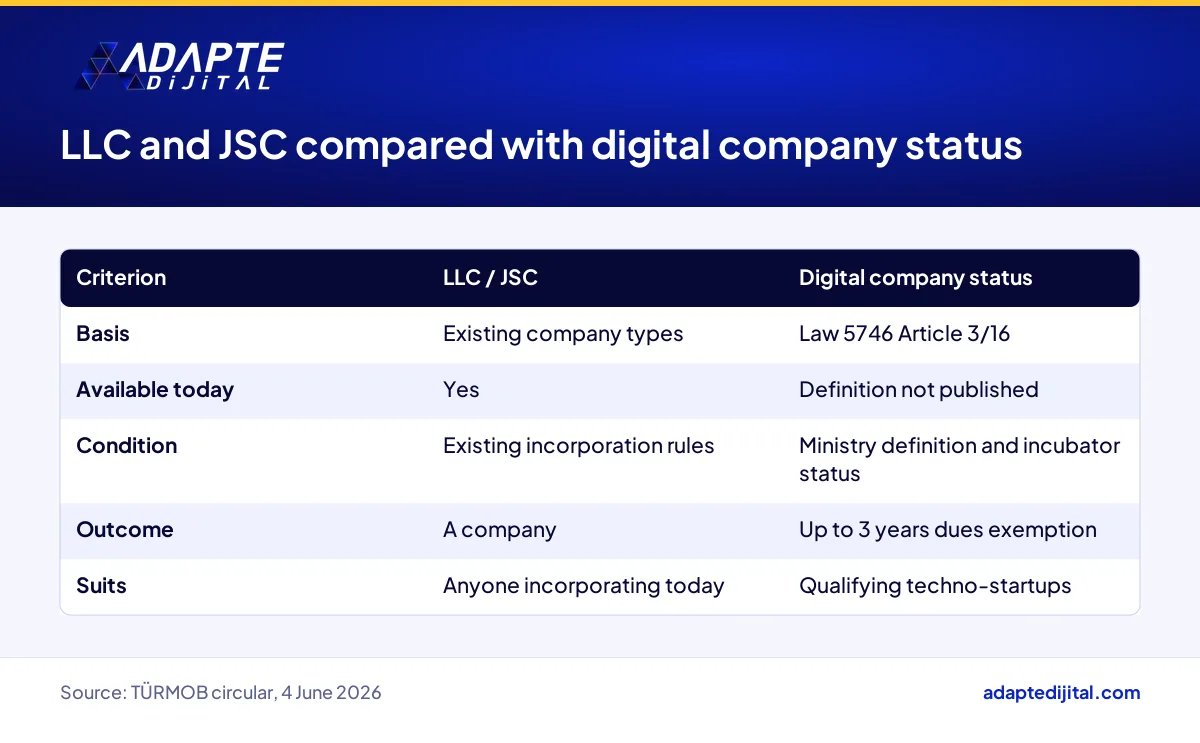
Five criteria are enough: legal basis, whether you can set it up today, conditions, outcome and who it suits. For an LLC or JSC, you can incorporate today and the outcome is a company. For the digital company, the basis is the paragraph added to Law 5746 and the outcome is a 3-year fee and dues exemption.
For anyone who needs a company today, the right route is one of the existing types. Digital company status could become an extra advantage for a qualifying techno-startup once the definition appears. The two are layers, not rivals.
If you need to start trading, weigh the cost of waiting against what the exemption could bring. A startup that cannot issue invoices has no cash coming in. For foreign partners, our article on remote setup for foreign founders walks through today’s incorporation steps.
A domain that matches your trade name keeps incorporation papers and bank correspondence consistent.
A working product page, a clear value proposition and technical documentation make your business model easy to explain.
Keep shareholdings, capital movements and contracts in one digital folder. Tidy records help in every scenario.
Discuss “LLC or JSC?” together with the number of partners, the capital plan and the chance of raising investment later. Treat digital company status as a layer that may be added later, not as a parameter of this decision.
Ask the incubator at the technology development zone you belong to, or plan to join, in writing. File their written answer about your incubator entrepreneur status. Without it, keep the exemption out of your business plan.
Planning the website, domain and digital records in the same week as incorporation keeps things moving. We do digital consulting work; you can see the scope on our digital consulting page. For the basics, our article on what a digital company is in Türkiye explains where it sits in the law.
No. The official text contains no such type; a company is formed as one of the existing types, and the Ministry’s definition has not been published yet.
No. The provision introduced by Law 7582 exempts qualifying companies from chamber and exchange fees and dues for up to 3 years; it contains no tax exemption.
That is not clear yet. The provision refers to companies “founded and operated” in line with the definition; the position of existing companies will become clear with the definition.