
Virtual office and automated accounting in a digital company, what do e-ledger rules say?
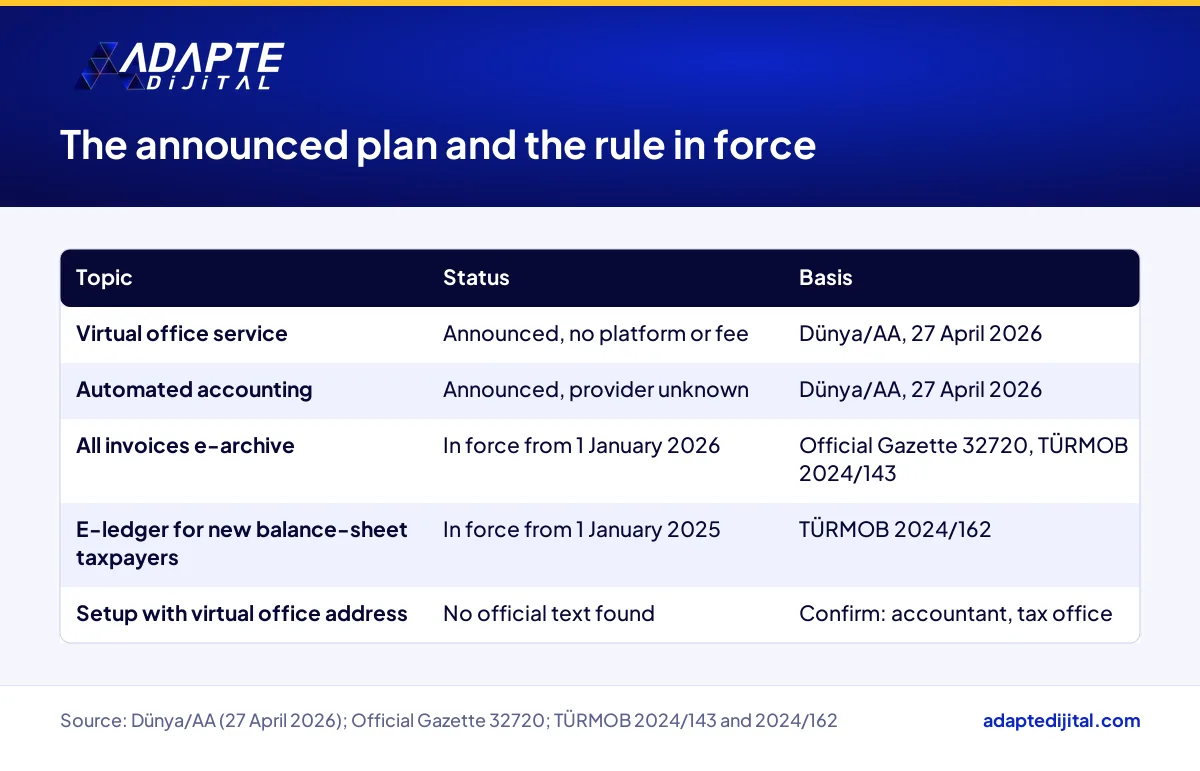
A virtual office and automated accounting are an announced plan for the digital company (dijital şirket), not a right in force today: Minister Kacır said entrepreneurs will have access to this infrastructure from day one, but no platform, provider or fee has been announced (Dünya/AA, 27 April 2026). The rules in force today sit on the e-document side. From 1 January 2026, every invoice of a taxpayer outside the e-invoice system is issued as an e-archive invoice, and balance-sheet-basis taxpayers starting business from 1 January 2025 must keep an e-ledger.
What this means for you: if you set up a digital company today, build your bookkeeping on the communiqués in force, not on the announced platform. No official text was found that clearly allows or bans incorporating with a virtual office address, so there is no definitive answer on that point. Our digital company page applies the same split to every other topic.
What does Minister Kacır’s virtual office and automated accounting plan mean for a digital company today?
It points to a goal, not to a working service. In his 27 April 2026 announcement, Minister of Industry and Technology Mehmet Fatih Kacır said entrepreneurs “will have access to virtual office services and automated accounting infrastructure” from day one. The digital company definition had not been published as of 14 October 2026.
Can a digital company be set up with a virtual office address?
There is no definitive answer. No Ministry of Trade or GİB text was found that clearly allows or bans using a virtual office address as a company’s head office. GİB is Türkiye’s Revenue Administration. So saying “it can” or “it cannot” would be wrong; confirm your address choice with your accountant and your tax office before incorporating.
Common mistake: treating the announcement as a rule in force
The most frequent mistake is reading “the state will provide virtual offices” as a current right and putting off address and bookkeeping decisions. The second is using e-invoice thresholds found online as official figures. Those thresholds could not be verified with GİB, so settle your own situation with your accountant.
How are the e-archive and e-ledger rules applied in a digital company step by step?
BU BÖLÜMÜN ÖZETİ
- Step 1: Settle the bookkeeping basis before incorporating
- Step 2: Issue e-archive invoices from day one
- Step 3: Keep the journal and general ledger electronically
- Step 4: Be ready for a GİB risk analysis notice
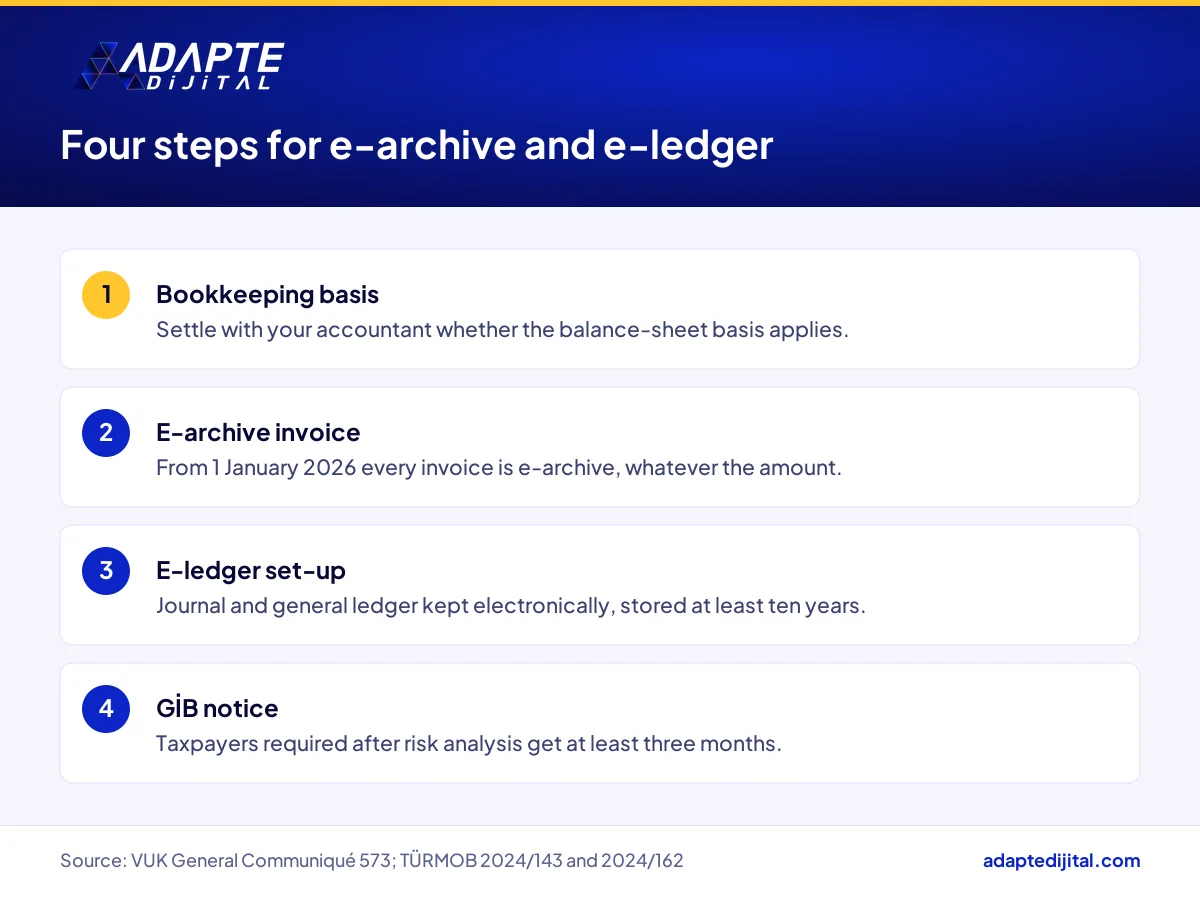
In four steps: the bookkeeping basis, the e-archive invoice, the e-ledger set-up and readiness for GİB notices. The rules rest on VUK General Communiqué 573 and TÜRMOB circulars 2024/143 and 2024/162. TÜRMOB is the Union of Chambers of Certified Public Accountants of Türkiye. Get your own quotes for software and service fees.
Step 1: Settle the bookkeeping basis before incorporating
Under TÜRMOB circular 2024/162, taxpayers starting business from 1 January 2025 who keep books on a balance-sheet basis must switch to the e-ledger (e-Defter). Agree with your accountant which basis applies to your company before you incorporate.
Step 2: Issue e-archive invoices from day one
Under Communiqué 573, from 1 January 2026 every invoice of a taxpayer outside the e-invoice and e-archive system is issued as an e-archive invoice, whatever the amount. Starting out with a paper invoice book is no longer an option for these taxpayers.
Step 3: Keep the journal and general ledger electronically
Taxpayers obliged to use e-invoices, those keeping books on a balance-sheet basis and companies subject to independent audit under Turkish Commercial Code Article 397/4 keep their journal and general ledger as e-ledgers. Since 1 January 2020, e-ledgers must be kept for at least ten years.
Step 4: Be ready for a GİB risk analysis notice
GİB can require taxpayers it selects through risk analysis to move to the e-ledger, regardless of turnover or sector. In that case, at least three months are given.
Which digital companies does the automated accounting plan affect, and how?
The effect depends on where the founder is and on current invoicing habits. Founders preparing software, e-commerce or digital service companies in Istanbul in autumn 2026 read the same announcement but end up in different places. If the plan goes live, remote founders gain most; today, paper-based businesses feel the most pressure. How automated accounting would affect accountants appears in no official source.
Ahead: foreign founders planning a remote setup
If passport-based identity checks, virtual offices and automated accounting go live together, setting up in Türkiye without a physical office gets easier. For now it is a plan with no date or platform. The pros and cons of waiting are weighed in our article on whether to wait or incorporate now.
Under pressure: small digital businesses running on paper
A business that issues invoices in bulk at month-end and piles receipts into folders finds the 2026 rule hard. Once every invoice is e-archive, paperwork left for later turns into a mountain on the accountant’s desk.
What does the digital side of a digital company’s bookkeeping mean for invoices, data and the website?
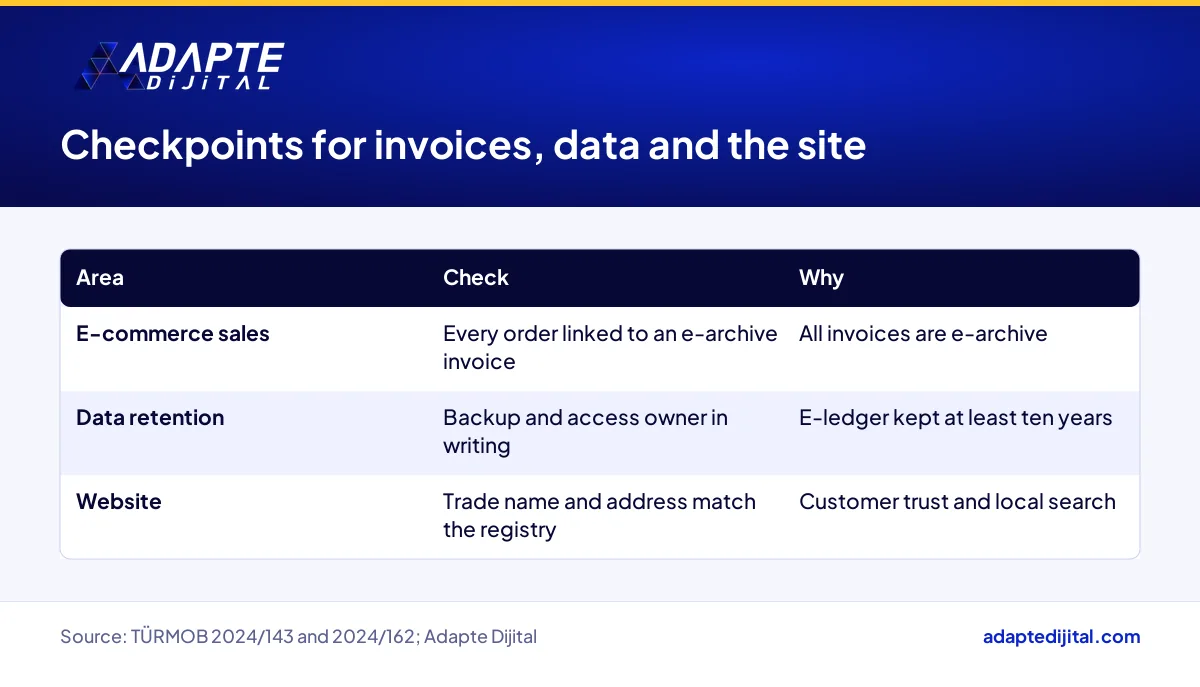
It shows up in three places: the e-archive invoice in the sales flow, ten-year data retention, and a website whose company details match the registry. None of the three waits for the announced platform; all can be set up under current rules.
What should a founder preparing a digital company do this week?
BU BÖLÜMÜN ÖZETİ
- Monday: address and bookkeeping basis with your accountant
- Wednesday: e-signature and MERSIS preparation
- Friday: the checklist
Do three things this week: discuss the address and bookkeeping basis with your accountant, set up your signing tools and close the checklist. All three are independent of the announced platform.
Monday: address and bookkeeping basis with your accountant
Ask in writing whether a virtual office address can serve as your head office and which bookkeeping basis applies. Confirm it with the tax office.
Wednesday: e-signature and MERSIS preparation
According to the Ministry of Trade’s MERSIS page, the articles of association can be drafted in MERSIS, Türkiye’s central registry system, and signed with an e-signature or mobile signature. Get your own quote from an e-signature provider for timing and fees.
Friday: the checklist
The list: (1) address decision confirmed, (2) bookkeeping basis settled, (3) e-archive invoicing ready from day one, (4) e-ledger and ten-year retention plan, (5) the same trade name on the site, invoices and registry. We set up the business model and digital processes with founders through our digital transformation management service.
Quick Summary
- A virtual office and automated accounting were announced on 27 April 2026; the platform and fee are unknown (Dünya/AA).
- From 1 January 2026, every invoice of a taxpayer outside the e-invoice system is an e-archive invoice (Official Gazette 32720, TÜRMOB 2024/143).
- Balance-sheet-basis taxpayers starting business from 1 January 2025 must keep an e-ledger (TÜRMOB 2024/162).
- E-ledgers must be kept for at least ten years (TÜRMOB 2024/162).
- No official text clearly governs incorporating with a virtual office address, so confirm with your accountant and tax office.
Short Glossary
- E-archive invoice
- An e-archive invoice is the invoice type used to bill buyers outside the e-invoice system electronically and store the record.
- E-ledger
- The e-ledger (e-Defter) is the record system used to keep and store the journal and general ledger electronically.
- Balance-sheet basis
- Balance-sheet basis is the bookkeeping method used to track a business’s assets and liabilities with double-entry records.
Frequently Asked Questions
Next Step
If you would like to plan your company address and bookkeeping around the rules in force, fill in the consult your expert form.
The definition and conditions of the digital company scheme are not final yet; check the latest information with the Ministry of Industry and Technology, KOSGEB and the Official Gazette before deciding. This is not legal or financial advice.
Support amounts and conditions can change; check the current terms on the institution’s official page before applying. This article is not financial or legal advice.
Sources: Dünya (AA), Minister Kacır: foreign investors will be able to set up companies remotely in Türkiye (27 April 2026) · TÜRMOB circular 2024/143, VUK General Communiqué 573 (Official Gazette, 12 November 2024) · TÜRMOB special circular 2024/162, e-ledger (27 December 2024) · Ministry of Trade, MERSIS page (12 May 2026)
Updated: October 2026
Sık Sorulan Sorular
It says foreign investors will be able to set up a company fully remotely with passport-based identity verification (KYC), while the virtual office sentence refers to entrepreneurs; who exactly is covered is unclear. The gap between what is certain and what is only announced is covered in our article on digital company tax and chamber fee relief.
The news report does not say who will provide the virtual office and automated accounting, on which platform or at what fee. No Ministry regulation on this infrastructure was found either.
The Communiqué took effect on 1 February 2023. For certain transactions registered with the trade registry, no separate notice to the tax office is needed, because the Ministry of Trade reports them electronically. Branch openings, closures and address changes also run through registry entries. The Communiqué says nothing about virtual offices.
Take three questions to your accountant and the tax office: is the address accepted as a head office, how do official notices reach it, and which document goes to the registry with the contract.
Every order from the site has to turn into an e-archive invoice. If payment, order and invoice steps are not linked, invoices fall behind even while the till keeps ringing.
E-ledgers must be kept for at least ten years. Records must stay accessible even if the cloud service changes or the software provider closes. Put in writing who is responsible for backups.
The same trade name and address should appear on the site, on invoices and in the registry. A different address in local search or map listings raises trust questions for customers. If you use a virtual office address, keep it consistent on every channel.
No official text was found that clearly allows or bans it. Confirm that the address is suitable with your accountant and the tax office before incorporating.
No. The infrastructure was announced on 27 April 2026, but the platform, the provider and the fee have not been announced.
According to TÜRMOB circular 2024/143, from 1 January 2026 every invoice of a taxpayer outside the e-invoice system is issued as an e-archive invoice, whatever the amount.