
When is KOSGEB’s TL 2.25 million support repaid, what does the 24+12 month schedule say?
KOSGEB (Türkiye’s SME development agency) published the schedule of its Business Development Support (İş Geliştirme Desteği) in the Entrepreneur Support Programme it renewed on 12 October 2026: the programme period is 24 months, and repayment starts 12 months after the programme ends. The support is interest-free and repayable; the ceiling is TL 2.25 million and the support rate is 80 percent. Applications for the third 2026 period are open from 12 to 31 October 2026 (KOSGEB, 12 October 2026).
What this means for you: there is a 36-month window between the month you receive the support and the month of the first repayment. Your cash flow plan should be built around this three-year span.
When is KOSGEB’s TL 2.25 million support repaid?
Repayment starts 12 months after the 24-month programme period ends. KOSGEB’s announcement of 12 October 2026 states both periods clearly. The number of instalments, the payment interval and any early repayment rule are not in the announcement; they will be in the contract.
Who gets TL 2.25 million and who gets TL 2.5 million in KOSGEB Business Development Support?
The ceiling for everyone is TL 2.25 million. For businesses whose founder is young, a woman, disabled, a veteran or a first-degree relative of a martyr, the ceiling rises by TL 250,000 to TL 2.5 million. In both cases the support rate is 80 percent.
The sector condition: five fields, everyone else outside
The support is open to five fields: manufacturing; telecommunications; computer programming, consultancy and related activities; information service activities; scientific R&D. A business outside these fields cannot apply for Business Development Support. The non-repayable Business Setup Support (İş Kurma Desteği), on the other hand, is open to all KOSGEB-supported sectors. Our article on KOSGEB-supported sectors and the activity code covers the sector scope in detail.
How does the KOSGEB repayment schedule affect cash flow over 36 months?
BU BÖLÜMÜN ÖZETİ
- Months 1 to 24: spending and documentation
- Months 25 to 36: revenue has to settle
- From month 37: repayment collides with capital needs
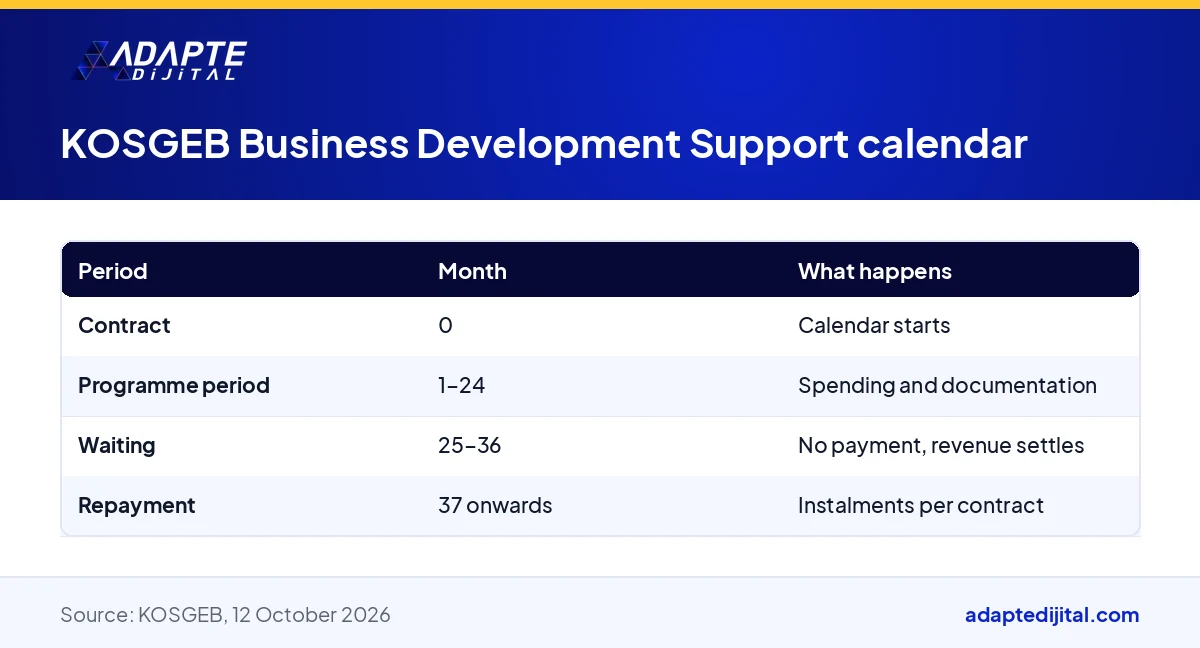
Reading the calendar by month number is enough: the contract month is zero, months 1 to 24 are the programme, months 25 to 36 are the waiting period, and repayment runs from month 37. We use month numbers instead of dates because the contract day is different for every business.
Months 1 to 24: spending and documentation
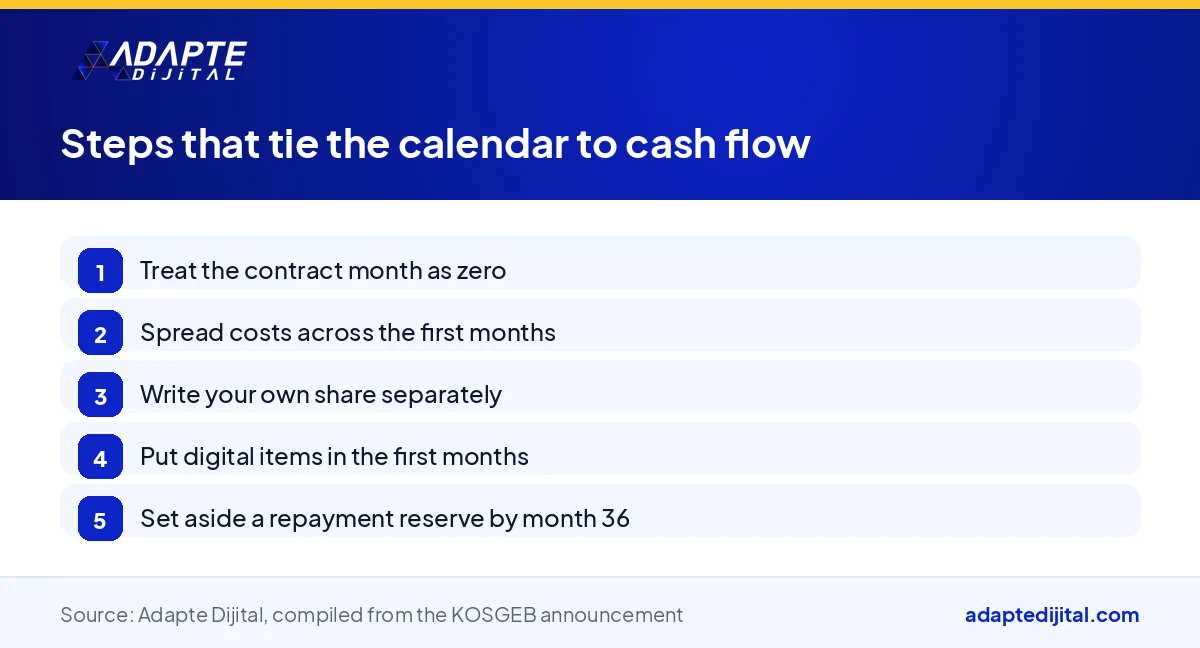
Two flows run side by side in this period: support payments and the business’s own share. Every cost is documented, and if KOSGEB accepts it, the support share is paid. That is why making every item in the business plan match the cost list in the announcement one to one is the first measure that protects cash flow.
Months 25 to 36: revenue has to settle
In the 12 payment-free months there is no new support and no repayment. The business runs on its own revenue alone. If the sales channel, the website and customer measurement do not enter this period ready, the till is empty when the repayment month arrives.
From month 37: repayment collides with capital needs
When repayment starts, the business pays for growth and pays instalments at the same time. To stop the two loads clashing, a repayment reserve should be set aside by month 36. Because the instalment plan is written in the contract, the reserve should also be calculated from the contract.
Which costs go into the calendar under KOSGEB support?
BU BÖLÜMÜN ÖZETİ
- Staff and machinery costs
- Software and mould costs
- Service procurement: marketing, design, consulting
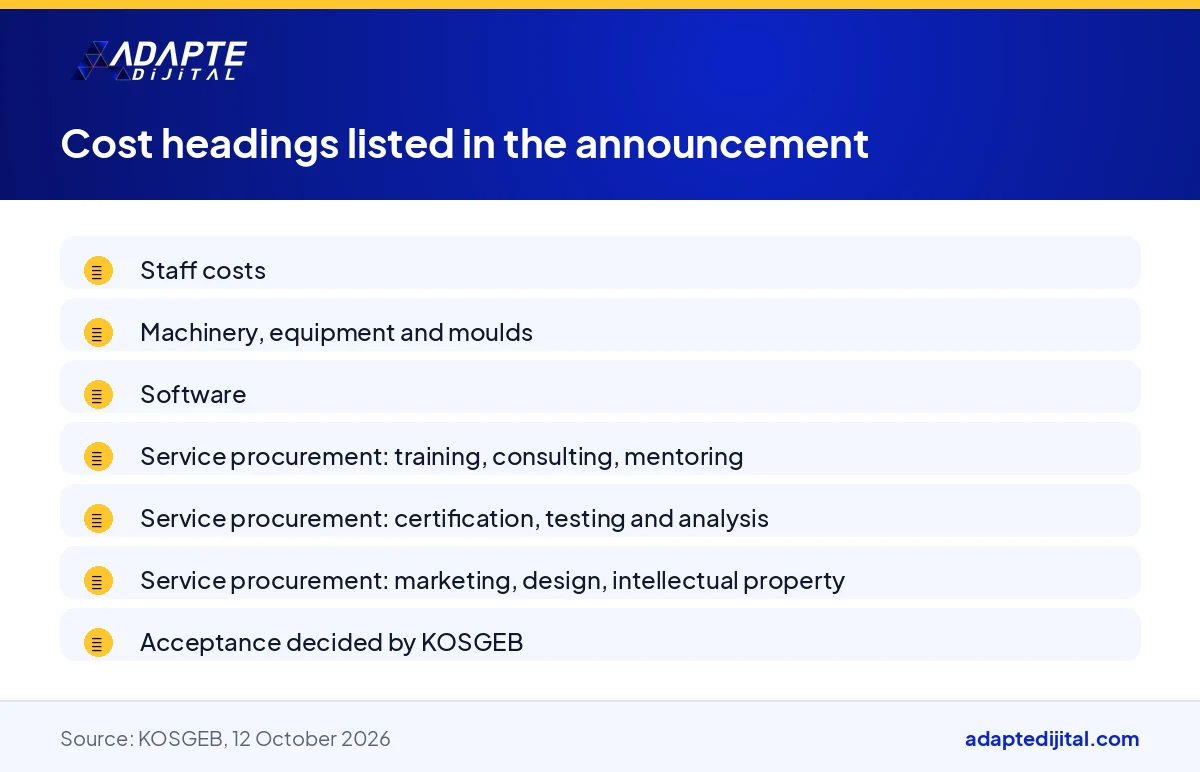
KOSGEB’s announcement lists the cost headings: staff, machinery and equipment, moulds, software and service procurement. Under service procurement it names training, consulting, mentoring, certification, testing and analysis, marketing, design and intellectual property. KOSGEB decides which costs are accepted.
Staff and machinery costs
Staff costs recur every month for 24 months, so they form the backbone of the calendar. Machinery and equipment are one-off and high-value; the month they are bought directly affects cash flow. For both, the documentation routine should be set up from month one.
Software and mould costs
Software appears in the announcement as a separate cost heading. For businesses in programming and information services, this item is the equivalent of machinery in manufacturing. Moulds are a manufacturing-specific item; for a software or service-focused tech startup it usually stays empty.
Service procurement: marketing, design, consulting
The service procurement heading is where the digital section of the business plan is written. Marketing, design and consulting are listed under it; cost items for the website, content and AI SEO work are defined here. We explained how to write the digital section in our article on the digital section of a KOSGEB business plan.
When do you apply for KOSGEB Business Development Support, and how does selection work?
BU BÖLÜMÜN ÖZETİ
- 12 to 31 October 2026: the third period
- Board, jury, top 500 and top 3 in every province
- 4,476 projects and TL 6.4 billion since 2024
Applications for the third 2026 period are open from 12 to 31 October 2026. Applications are ranked by a sector board score and a jury assessment. The repayment schedule only starts for a business that makes the ranking and signs a contract.
12 to 31 October 2026: the third period
The period closes on 31 October 2026. Applications go through e-Devlet, Türkiye’s e-government gateway, and the business must already be incorporated. Because the contract date comes after the application date, month zero of the calendar is the contract day, not the application day. Miss this difference and you land on the wrong repayment month.
Board, jury, top 500 and top 3 in every province
Sector boards score the projects; the top 1,000 nationwide and the top 6 in every province go to the jury. By the average of jury and board scores, the top 500 nationwide and the top 3 in every province receive support. The score depends on how measurable the plan is.
4,476 projects and TL 6.4 billion since 2024
KOSGEB reports that TL 6.4 billion has been approved for 4,476 projects since the programme began. The figure shows the repayment schedule is not just the text of an announcement but a routine running in thousands of businesses. The same announcement also shows that not every approved amount is paid at the same speed.
How does the KOSGEB calendar fit with a digital company plan?
The digital company (dijital şirket) scheme does not change the calendar of Business Development Support. As of October 2026, when this article was updated, the Ministry of Industry and Technology had not published its digital company definition. We gathered the whole concept in our article what is a digital company.
The definition is pending, the support calendar is not
Platform Costs Support for digital companies sits inside Business Setup Support and depends on the definition. The 24 plus 12 month calendar of Business Development Support is running today. Whether you can afford to wait for the definition is discussed in our article wait or incorporate now; the scope of the platform support is explained in our article on KOSGEB platform support.
Digital items go into the first months of the calendar
The domain name, the website and AI SEO-ready content should be placed in the first months of the 24-month programme. The earlier the site goes live, the more measurement data accumulates by month 36. We handle the work of putting incorporation and digital transformation steps on a single calendar in our digital transformation management service.
Quick Summary
- Business Development Support goes up to TL 2.25 million, interest-free and repayable; the support rate is 80 percent (KOSGEB, 12 October 2026).
- For young, women, disabled, veteran or martyr-relative founders, the ceiling rises by TL 250,000 to TL 2.5 million.
- The programme period is 24 months; repayment starts 12 months after the programme ends, that is from month 37.
- Applications for the third 2026 period run from 12 to 31 October 2026; the top 500 nationwide and the top 3 in every province receive support.
- TL 6.4 billion has been approved for 4,476 projects since the programme began; the Ministry’s digital company definition had not been published as of October 2026.
Short Glossary
- Programme period
- Programme period is the term used for the 24-month period in which supported costs are incurred and documented.
- Support rate
- Support rate is the percentage used to show how much of an accepted cost is covered by the support.
- Repayable support
- Repayable support is the term used for support that is returned in the same amount after a set period.
Frequently Asked Questions
Next Step
If you want to plan the digital side of your company together with incorporation, book a discovery call on our digital company page and review the My Digital Company (Dijital Şirketim Olsun) delivery list; we stay your friendly adviser throughout your digitalisation.
The definition and conditions of the digital company scheme are not final yet; support amounts and conditions may change. Check the latest information with the Ministry of Industry and Technology, KOSGEB and the Official Gazette before deciding. This is not legal or financial advice.
Sources: KOSGEB, Entrepreneur Support Programme renewed (12 October 2026) · Bigpara/DHA-AA, Ministry report and KOSGEB figures (8 September 2025) · AA, Medium-Term Programme report (10 September 2026)
Updated: October 2026
Sık Sorulan Sorular
The programme period is the time in which the costs written in your project are incurred and documented to KOSGEB. Staff, machinery, software and service purchases all happen within these 24 months. When the period ends, no new cost can be added; only reporting and closure remain. So tie the spending plan to the calendar from the first months.
Once the programme ends, no repayment is made for 12 months. You can read this as breathing room for the business built in the project to start generating revenue. The business should settle its sales and collections in these 12 months.
Interest-free means you pay back the amount of support you received with no interest added. The announcement does not mention indexation, revaluation or a collateral requirement. Those details are in the contract. Reading the repayment amount, the instalment plan and the late-payment rule line by line before you sign is the only safe answer to this question.
The support rate means 80 percent of an accepted cost is covered by the support and the rest comes from the business’s own resources. The ceiling is the support amount, not the project budget. In a project that reaches the ceiling, the business’s own share must also be written into the calendar. That share is paid at the moment of spending and sets the cash need of the first 24 months.
The extra amount depends on the founder: in businesses founded by a young person, a woman, a disabled person, a veteran or a first-degree relative of a martyr, the ceiling is TL 2.5 million. Women and young entrepreneurs who make the ranking can choose Interest/Profit Share Support instead if they wish. The difference between the two options is explained in our article on the TL 1 million business loan for women and young entrepreneurs.
What fills the till when the repayment month arrives is the sales channel built during the programme. Regional and demand measurement with Search Console and GA4 shows from the first month whether that channel is working. We collect every question about the digital company on our digital company page and update developments there every week.
Repayment starts 12 months after the 24-month programme period ends. If you count the contract month as zero, the first payment falls in month 37; the instalment plan is set by the contract.
Yes. KOSGEB’s announcement defines Business Development Support as interest-free and repayable. Indexation, collateral and late-payment rules are not in the announcement; those details are written in the support contract.
The announcement lists marketing, design and consulting under service procurement; software is a separate item. KOSGEB decides which costs are accepted, so the items must be written clearly in the business plan.