
Once-only data and a company passport: how would 7 proposals shape the digital company?
Ertan Barut, a columnist at the Turkish business daily Dünya, listed seven proposals for Türkiye’s digital company (dijital şirket) model in his Software Desk column of 28 September 2026. Two ideas sit at the centre: a company gives its information to the state once, and verified company information is shared with banks, investors and public bodies through a company passport. The column is an opinion piece. As of October 2026, when this article was last updated, the Ministry of Industry and Technology had not published its digital company definition.
What this means for you: some of the proposals already exist, and some are waiting for the definition. Keeping your company information identical in every record is in your hands right now and waits for no definition.
What is the once-only data principle, and what was proposed on 28 September 2026?
The principle is simple: a company gives its trade name, address, shareholders and activity code to the state once, and no other institution asks for the same data again. Barut made it the third of his seven proposals; the other six complete it.
Which of Barut’s seven proposals already exist today?
BU BÖLÜMÜN ÖZETİ
- MERSİS and the TOBB registry network: a backbone exists, but not a single one
- Electronic notification and e-signature exist, automatic opening does not
- Status criteria and the company passport: neither exists
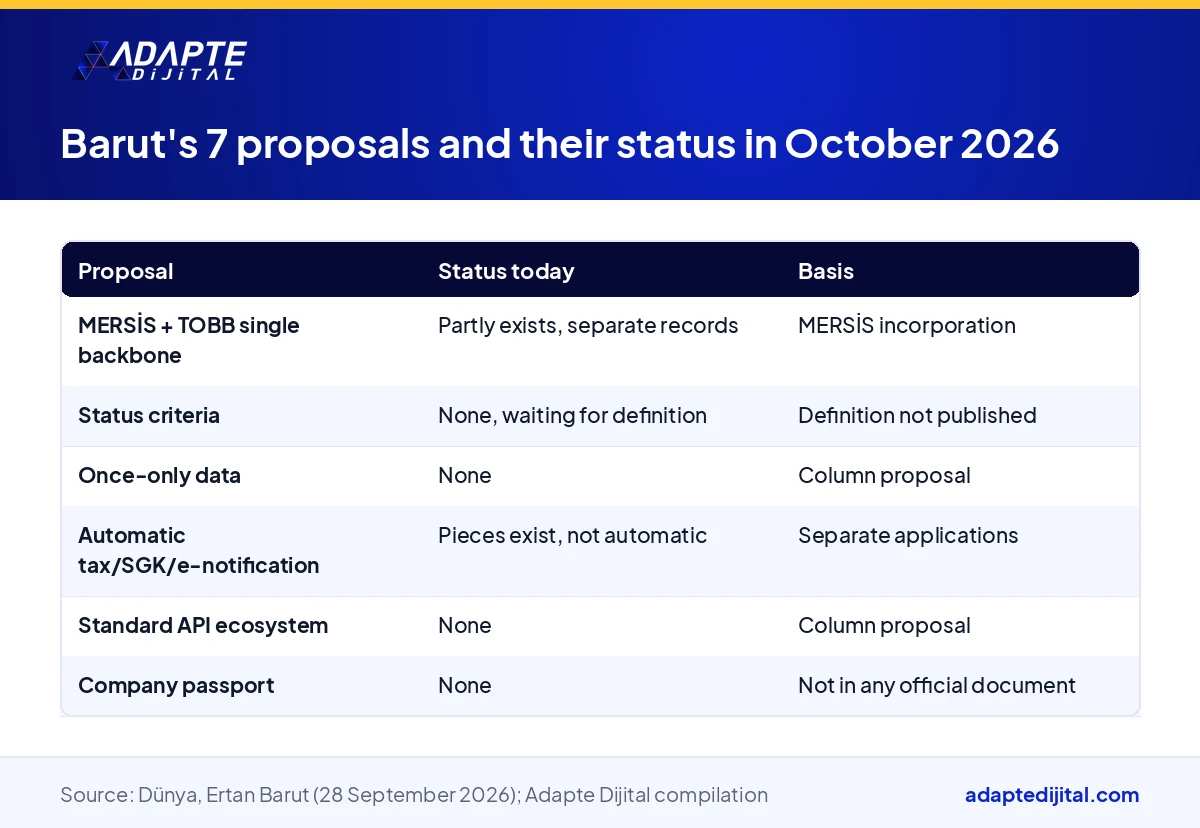
Three exist in part, four do not. MERSİS, e-signature and electronic notification work today; the company passport, status criteria, standard API and profile-linked support do not. The difference is not whether the pieces exist, but whether they are connected.
MERSİS and the TOBB registry network: a backbone exists, but not a single one
Companies are incorporated through MERSİS today, and the registry record is kept at the trade registry offices. Barut’s proposal is to treat these two as one backbone and connect every other institution to it. Today the tax office, SGK and the banks each ask for company information separately. Which steps are online today is in our guide to setting up with MERSİS, e-signature and KEP.
Electronic notification and e-signature exist, automatic opening does not
An e-signature and a KEP (registered e-mail) address are obtained at incorporation, and electronic notification is running. What Barut asks for is that these open by themselves at incorporation. Today each needs a separate application, fee and timetable. Tax and SGK registration are also separate steps. The proposal reduces existing steps to a single transaction.
Status criteria and the company passport: neither exists
As of October 2026 the Ministry has not published the digital company definition, so there are no status criteria either. The Technostartup Badge and the incubator link exist, but not as digital company conditions. The company passport, the newest and least defined of the seven, appears in no official document.
What is a company passport, and what does it give banks and investors?
A company passport presents verified company information to banks, investors and public bodies as a single identity. That is Barut’s description. Today the same information goes to each institution on a separate document.
The bank account and the beneficial owner question
Vircon Legal’s assessment of 18 June 2026 left open how a remotely incorporated company would open a bank account and file its beneficial owner declaration. The company passport proposal answers exactly that question: if the shareholder structure is verified in the registry, the bank can use the same data. Today the bank asks for the document again.
A verified profile for investors
Investors spend time verifying a company’s shareholders, capital and activity. The passport would present that information verified by the registry. The package announced on 27 April 2026 also included employee stock option plans and venture-capital-friendly instruments; a verified profile is a precondition for them.
What do the local software ecosystem and standard API proposals tell a founder?
BU BÖLÜMÜN ÖZETİ
- Five software areas, one standard
- Linking growth support to the profile
- Overlap with the one-stop office in the Medium-Term Programme
The fifth proposal wants the software a company uses to talk to the state record. If accounting, ERP, CRM, cloud and cybersecurity connect through one standard, data is entered once. This proposal lands directly on a founder’s desk.
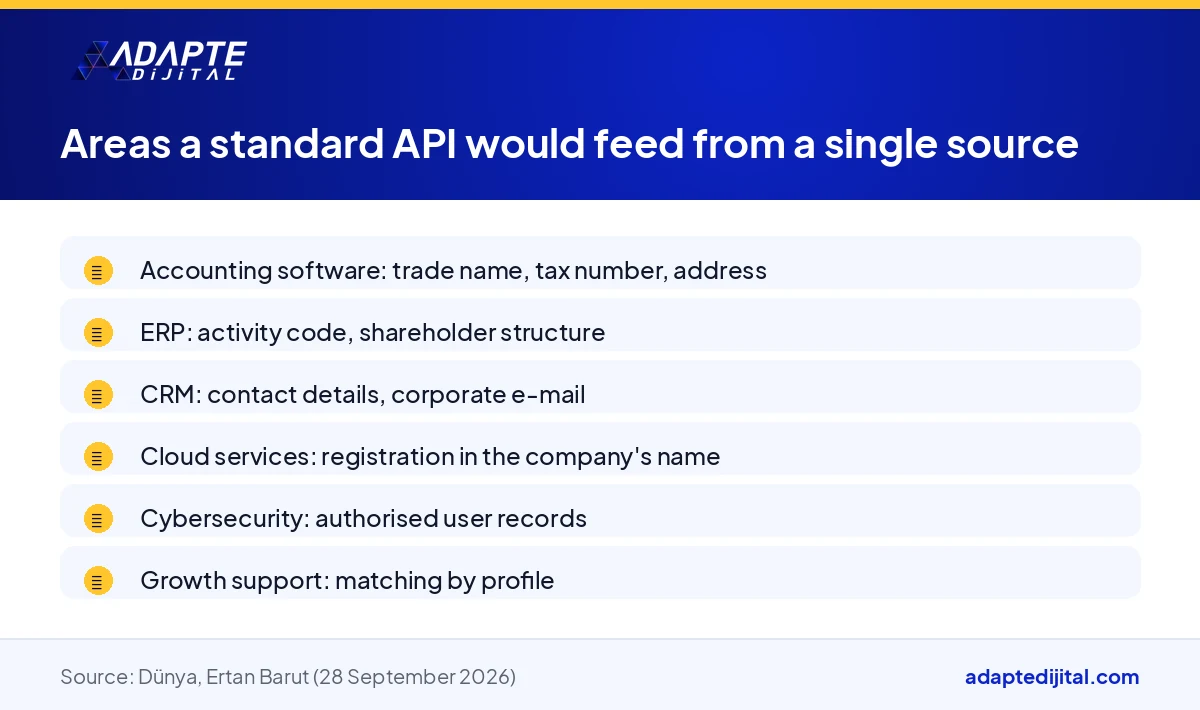
Five software areas, one standard
Barut lists accounting, ERP, CRM, cloud and cybersecurity software. Today each enters company information into its own database separately. With a standard API, the trade name, address and tax number in the registry would flow into the software from a single source.
Linking growth support to the profile
The seventh proposal is for KOSGEB and similar support to match a company profile automatically. Today an application to the KOSGEB Business Development Support (İş Geliştirme Desteği) needs a separate file, and a sector board scores the project. Profile-linked support would show the call to an eligible company automatically; it is not in any official document either.
Overlap with the one-stop office in the Medium-Term Programme
The Medium-Term Programme set the one-stop office as a target; Barut’s proposals describe the data structure behind that office. What the programme promises is in our guide to the digital company scheme and the one-stop office in the 2027-2029 programme.
How does the once-only data principle affect a founder’s digital record today?
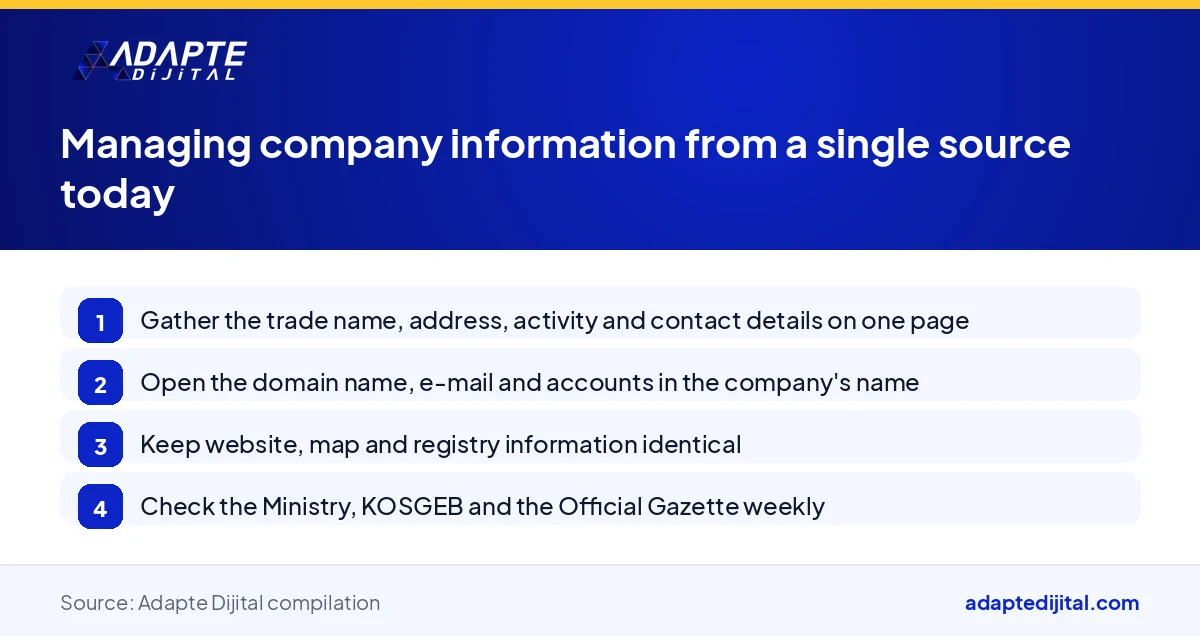
The principle does not exist in the public sector yet, but its logic can be applied to a company’s own records today. The trade name, address, phone number and activity description should be the same in the registry, on the website, on the map and on social accounts. AI tools and search engines recognise a company through this consistency.
Organization information in structured data
Organization structured data on the website gives the company’s name, address and contact details in machine-readable form. When the definition is published, these fields can be updated in a day; a site that does not exist cannot be updated. Our guide to what should change on your website when the digital company definition is published explains which fields will change.
If the digital company scheme is shaped by these proposals, what should a founder do?
There are three jobs: gather your company information in one list today, follow the definition and the secondary legislation, and build the digital record together with incorporation. The three jobs hold whichever proposals are adopted.
A one-page company information sheet
Trade name, MERSİS number, tax number, address, activity code, shareholders, domain name, corporate e-mail and account names belong on a single page that every new record copies. If a public passport is built, your data is ready; if not, consistency still pays off.
Building the digital record together with incorporation
The domain name, website, AI-SEO-ready content, accounts and measurement should be planned on the same calendar as incorporation. We run single-source management of company information and alignment of digital records in our digital consulting service. When the definition arrives, only the update of ready records remains.
Quick Summary
- On 28 September 2026 Ertan Barut listed seven proposals for the digital company model in Dünya.
- Three proposals (MERSİS backbone, electronic notification, e-signature) exist in part today; the company passport appears in no official document.
- Vircon Legal left the bank account and beneficial owner declaration as open questions on 18 June 2026.
- The Medium-Term Programme set the one-stop office as a target on 6 September 2026; KOSGEB announced platform support on 12 October 2026.
- The Ministry’s digital company definition had not been published as of October 2026; consistency of company information is in the founder’s hands today.
Short Glossary
- Once-only data principle
- Once-only data principle is the governance principle used so that a company gives its information to the state once and institutions do not ask for the same data again.
- Company passport
- Company passport is the proposed structure used to share verified company information with banks, investors and public bodies as a single identity.
- Standard API
- Standard API is the shared connection interface used so that different software exchanges the same data under a single rule.
Frequently Asked Questions
Next Step
If you want to plan your company’s digital side together with incorporation, book a discovery call on our digital company page and review the My Digital Company (Dijital Şirketim Olsun) delivery list; we stay your friendly adviser throughout your digitalisation journey.
The definition and conditions of the digital company scheme are not final yet; support amounts and conditions may change. Check the latest information with the Ministry of Industry and Technology, KOSGEB and the Official Gazette before deciding. This is not legal or financial advice.
Sources: Dünya, Ertan Barut, How should Türkiye’s digital company model look (28 September 2026) · Vircon Legal, Is the digital company coming to Türkiye (18 June 2026) · AA, Medium-Term Programme report (10 September 2026) · KOSGEB, Entrepreneur Support Programme renewed (12 October 2026)
Updated: October 2026
Sık Sorulan Sorular
The column opens seven headings. First, MERSİS (Türkiye’s Central Registry System) and the TOBB (Union of Chambers and Commodity Exchanges of Türkiye) registry network become a single backbone. Second, the Ministry defines status criteria through the Technostartup Badge, incubator and technopark links. Third, the company gives its data once. Fourth, tax, social security (SGK), electronic notification and e-signature open automatically at incorporation. Fifth, accounting, ERP, CRM, cloud and cybersecurity software connect through a standard API. Sixth is the company passport, seventh is linking growth support to the company profile.
The piece is a column, not a programme of the Ministry or of KOSGEB (Türkiye’s Small and Medium Enterprises Development Organization). Official documents give the digital company two anchors: the dues exemption provision of Law No. 7582, dated 4 June 2026, and the implementation target in the Medium-Term Programme of 6 September 2026. Barut’s proposals fill the space those two documents leave empty. The official framework is in our guide to what a digital company is.
The column came out three weeks after the Medium-Term Programme, which set the digital company scheme and a one-stop office as targets, but did not describe the method. KOSGEB’s programme renewed on 12 October 2026 announced a Platform Costs Support for digital companies, without a fee amount.
Barut cites Estonia’s e-Residency, the UK’s Companies House and Singapore’s ACRA BizFile. In all three, company information is queried from a single record. Türkiye has the Trade Registry Gazette and MERSİS queries, but no automatic flow to banks and investors. The details are in our guide to how many days company setup takes in Estonia, the UK and Singapore.
If the trade name in the registry and the name on the website differ, a search engine sees two entities. The domain name, corporate e-mail and social accounts should be opened in the company’s name, not the founder’s personal account. The notification address and the service area can be written separately, but must not contradict each other.
AI answers verify a company from several sources: website, map listing, registry, social accounts. If the information is inconsistent, the company does not appear in the answers. The 108 articles and an AI-SEO-ready website are built on this consistency. Data entered wrongly attaches the content to the wrong entity.
Check the Ministry website, KOSGEB announcements and the Official Gazette weekly. We gathered the technopark incentive debate from the same column in our article on whether the technopark withholding incentive ends on 31 December 2028. Developments are on our digital company page, where we collect every question on the topic.
No. Companies are incorporated through MERSİS, but the tax office, SGK and the banks each ask for company information separately. The principle is a proposal in a column of 28 September 2026; it is not in any official document.
There is no date. The company passport is Ertan Barut’s proposal; the Medium-Term Programme and Law No. 7582 do not contain the concept. The Ministry’s digital company definition had also not been published as of October 2026.
Keep the trade name, address, activity and contact details the same in the registry, on the website, on the map and in accounts. Open the domain name and accounts in the company’s name. This consistency pays off without waiting for the definition.