
Does the technopark withholding incentive end in 2028, does the digital company plan help?
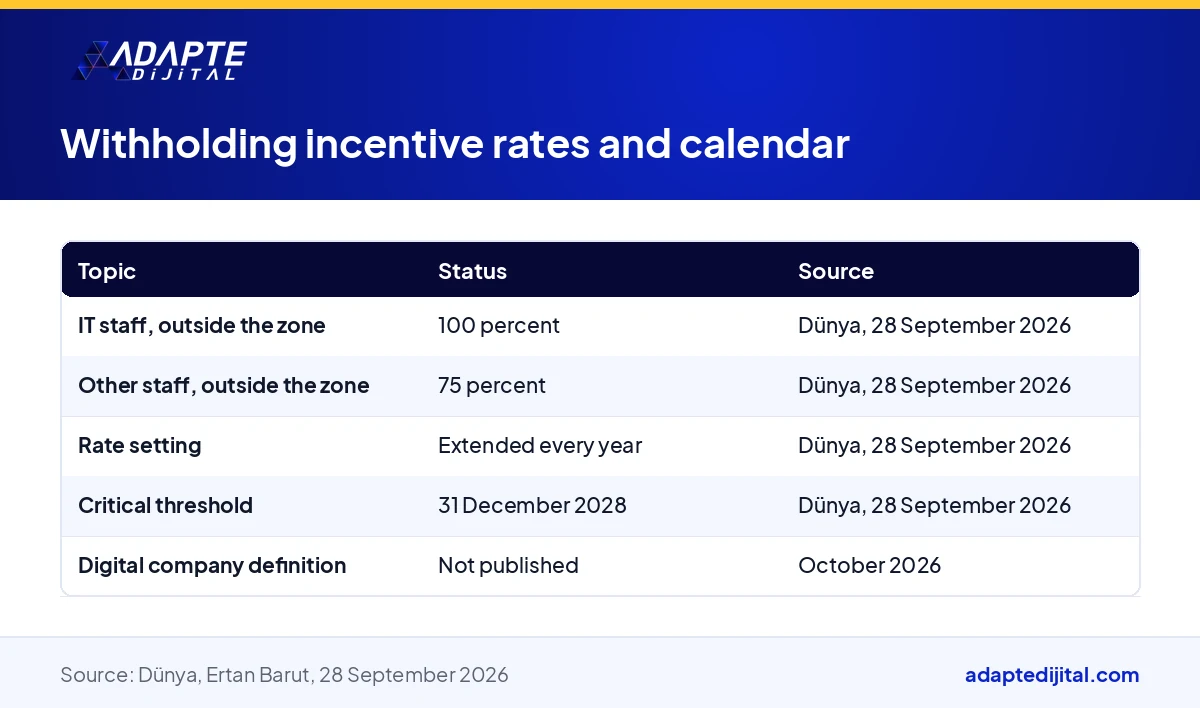
The calendar of the income tax withholding incentive in technoparks and R&D centres is back on the agenda: in his Software Desk column in the Turkish daily Dünya on 28 September 2026, Ertan Barut wrote that the rates for time spent outside the zone, 100 percent for IT staff and 75 percent for other staff, are extended every year and that this creates uncertainty. According to the author, 31 December 2028 is the critical threshold; he calls for a regulation that covers the period after 2028 (Dünya, 28 September 2026).
What this means for you: the staff cost of the company you set up in a technopark or an incubator depends on a decision renewed every year. The digital company (dijital şirket) scheme does not change this calendar today; the Ministry of Industry and Technology had not published its definition as of October 2026.
Does the technopark withholding incentive end in 2028, what is known today?
BU BÖLÜMÜN ÖZETİ
- Rates are set yearly, so plans are made yearly
- 31 December 2028: the threshold of the current framework
- The call is an opinion, not an official calendar
No definite end date has been announced; what is known is that the rates are set again every year and that 31 December 2028 is the critical threshold in the current regulation. Barut’s column takes these two points together and proposes a permanent framework covering the period after 2028.
Rates are set yearly, so plans are made yearly
The column’s real criticism is about the method, not the duration: the rates are extended every year. That means a team drawing a two-year product roadmap does not know its staff cost for the second year. A yearly extension may look like a guarantee, but it shrinks the planning horizon to twelve months.
31 December 2028: the threshold of the current framework
Barut cites 31 December 2028 as the critical threshold. There is no written rule for the period after that date today. A company founded in a technopark with a three-year growth plan spends the last year of its plan in a period without rules.
The call is an opinion, not an official calendar
The piece is a column; no new statement on the subject has come from the Ministry or the Treasury. The 2027-2029 Medium-Term Programme lists the digital company scheme and a one-stop office as goals and does not touch the withholding calendar. Read the column as a warning, not as a basis for decisions.
Who do the 100 percent and 75 percent withholding incentive rates cover?
BU BÖLÜMÜN ÖZETİ
- IT staff: 100 percent for time outside the zone
- Other staff: 75 percent
- The rates rest on a decision, the incentive on a law
The two rates separate two groups of staff. According to Barut’s account, for time spent outside the zone the rate is 100 percent for IT staff and 75 percent for other staff. The debate is not about the rates themselves but about their being set again every year.
IT staff: 100 percent for time outside the zone
Time that staff who develop software, process data and build systems spend outside the technopark is kept within the incentive at a rate of 100 percent. In a sector where remote work has become common, this rate gives a cost advantage regardless of where the team sits.
Other staff: 75 percent
For staff in roles such as sales, operations and support, the rate for time outside the zone is 75 percent. As a technology company grows, this group gets larger and the gap between the two rates becomes visible in the budget. When planning staffing, which role falls into which group should be cleared with the technopark management before payroll.
The rates rest on a decision, the incentive on a law
The incentive is based on Laws No. 4691 and 5746; the rates are set by yearly decisions. This two-layer structure means a founder has to follow two separate calendars. That is why the accountant of a technopark company checks the rate decision at every year end and updates the budget accordingly.
Does the digital company plan resolve the withholding uncertainty?
BU BÖLÜMÜN ÖZETİ
- The only provision in force: up to three years of dues exemption
- No definition, no link
- Barut’s proposal: tie the status criteria to the technopark relationship
Not today. The only provision of the digital company scheme in force is the dues exemption; there is no article on the withholding incentive. We gathered the whole concept in our article what is a digital company.
The only provision in force: up to three years of dues exemption
Article 11 of Law No. 7582 took effect on 4 June 2026 and added an exemption from TOBB, chamber and exchange dues for digital companies to Law No. 5746; TOBB is the Union of Chambers and Commodity Exchanges of Türkiye. The provision requires founders who fit the Ministry’s definition and have gained incubator entrepreneur status. What is happening on the tax side is set out in our article will digital companies get a tax exemption.
No definition, no link
As of October 2026, when this article was updated, the Ministry had not published its digital company definition. Without a definition, no relationship can be drawn between a digital company and technopark staff, the withholding rate or the 2028 threshold. In April 2026, Minister Kacır spoke of a tax exemption up to a certain scale; the scale and scope were not announced.
Barut’s proposal: tie the status criteria to the technopark relationship
One of the column’s seven proposals is to tie the Ministry’s status criteria to the Tech Startup Badge (Teknogirişim Rozeti), incubation and the technopark relationship. If this proposal is accepted, the digital company and the technopark meet in the same definition and the withholding debate also attaches to the status. We covered all the proposals in our article on the once-only data principle and the company passport.
When does the 2028 uncertainty force a decision for a technopark startup?
BU BÖLÜMÜN ÖZETİ
- Staffing plan: a yearly budget, a multi-year product
- Work outside the zone: the rate gap depends on team structure
- Incubation status: the key to the exemption and the possible link
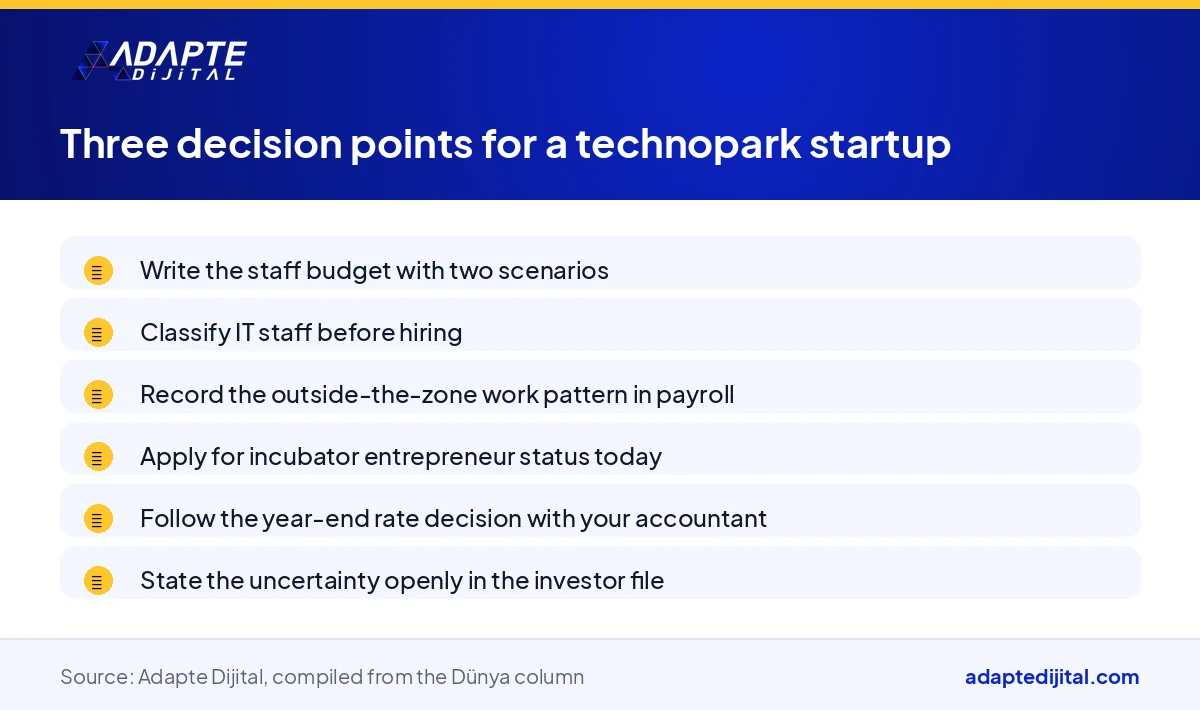
There are three decision points: when planning staffing, when the team will work outside the zone, and when applying for incubation status. The uncertainty is the same in all three, but the cost of waiting differs.
Staffing plan: a yearly budget, a multi-year product
The product roadmap runs two or three years while the staff cost depends on a yearly decision. The solution is to write the budget with two scenarios: the rate is extended, and it is not. Having these two lines in the investor file sends a stronger message than hiding the uncertainty.
Work outside the zone: the rate gap depends on team structure
Remote IT staff benefit from the 100 percent rate, other staff from 75 percent. As the team grows, which roles count as IT staff shapes the payroll structure. This classification should be done together with the technopark management and your accountant, before hiring.
Incubation status: the key to the exemption and the possible link
Incubator entrepreneur status is the condition for the dues exemption in force today; tomorrow it may also be part of the status criteria. How to obtain it is explained in our article on how incubator entrepreneur status is obtained. The company whose status is ready on the day the definition appears reaches the exemption first.
What role should technoparks evolve into, according to Barut?
BU BÖLÜMÜN ÖZETİ
- Laboratory and shared R&D infrastructure
- Mentoring and investor relations
- The technopark’s place among the seven proposals
The column proposes taking the technopark beyond being an address that only provides a tax advantage. Four roles, defined as laboratory, shared R&D infrastructure, mentoring and investor relations centre, push the withholding debate into the background.
Laboratory and shared R&D infrastructure
The proposal is to open test environments, equipment and data infrastructure that a small team could not set up alone to shared use in the technopark. The difference between technoparks, incubators and TEKMER is explained in our article on technoparks, incubators and TEKMER.
Mentoring and investor relations
Barut wants the technopark to be a centre that brings founders together with investors and passes on the knowledge of experienced founders. In this role, what stands out is not the incentive rate but the network and visibility. The first place an investor looks when assessing a startup is the company’s digital footprint: website, content and consistent company information.
The technopark’s place among the seven proposals
Among the seven proposals, the technopark appears in two places: in the status criteria and in tying growth supports to the company profile. The second proposal aims to open supports and incentives not through individual applications but according to the verified profile in the company passport.
What should a founder do on the digital side while the uncertainty continues?
BU BÖLÜMÜN ÖZETİ
- Watch three sources at year end and every week
- Keep company information identical everywhere
- Build the digital presence independently of the incentive calendar
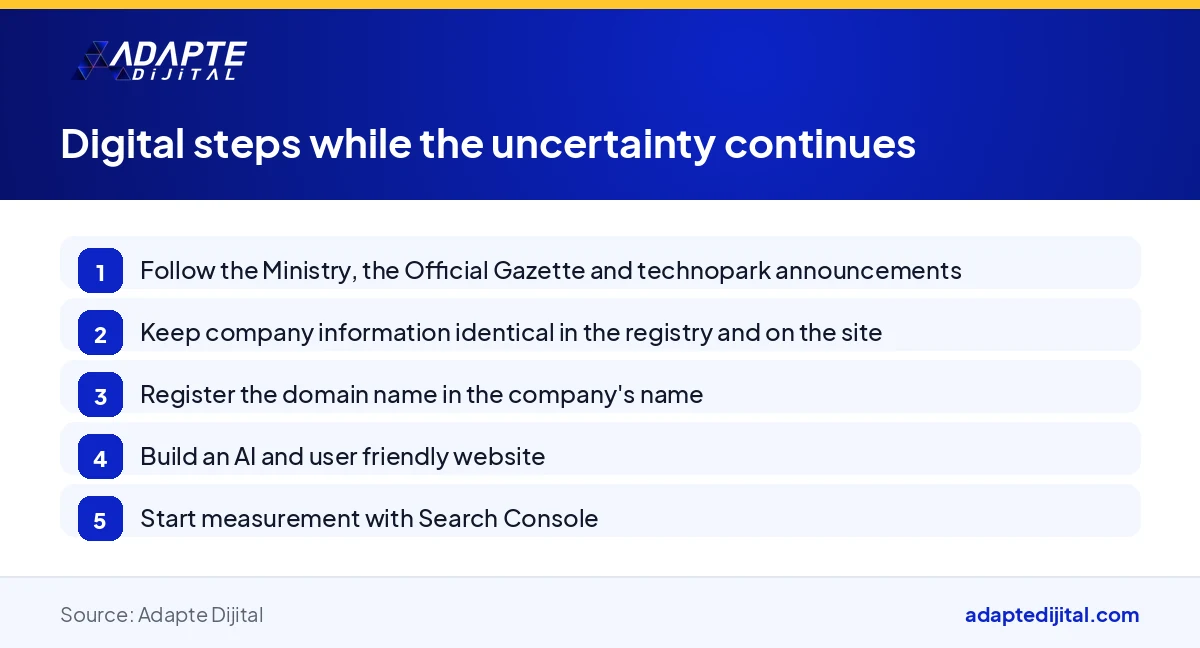
The withholding calendar is not in the founder’s hands; the company’s digital presence is entirely in them. While the definition and rate decisions are pending, the work to do should be work that does not depend on any decision.
Watch three sources at year end and every week
The yearly rate decision comes out towards the end of the year; the digital company definition can be published on any day. The Ministry of Industry and Technology website, the Official Gazette and the technopark management’s announcements should be followed together. We collect developments on our digital company page and update it weekly.
Keep company information identical everywhere
Trade name, address, activity and founder information should be identical in the registry, on the website and in structured data. When the definition is published, a ready website is adapted the same day; a site that does not exist cannot be adapted. We explained what will change in our article on what should change on your website when the definition is published.
Build the digital presence independently of the incentive calendar
The domain name, an AI and user friendly website, AI-ready content and measurement wait for no rate decision. We handle the work of running incorporation, the incentive calendar and the digital setup as one plan in our digital transformation management service.
Quick Summary
- On 28 September 2026, Barut wrote that the yearly extension of withholding incentive rates creates uncertainty (Dünya).
- For time outside the zone, a rate of 100 percent applies to IT staff and 75 percent to other staff.
- 31 December 2028 is the critical threshold; the author calls for a regulation covering the period after 2028, and there is no official statement.
- The digital company scheme’s only provision in force is the dues exemption of 4 June 2026; it has no defined link to withholding.
- The Ministry’s digital company definition had not been published as of October 2026; four new roles are proposed for technoparks.
Short Glossary
- Withholding incentive
- Withholding incentive is the regulation used to waive, at a set rate, the income tax deducted from staff wages.
- Time outside the zone
- Time outside the zone is the term used for the time staff spend working outside the boundaries of the technopark.
- Tech Startup Badge
- Tech Startup Badge, Teknogirişim Rozeti in Turkish, is the identity mark proposed to officially define a technology startup.
Frequently Asked Questions
Next Step
If you want to plan the digital side of your company together with incorporation, book a discovery call on our digital company page and review the My Digital Company (Dijital Şirketim Olsun) delivery list; we stay your friendly adviser throughout your digitalisation.
The definition and conditions of the digital company scheme are not final yet; support amounts and conditions may change. Check the latest information with the Ministry of Industry and Technology, KOSGEB and the Official Gazette before deciding. This is not legal or financial advice.
Sources: Dünya, Ertan Barut, how Türkiye’s digital company model should look (28 September 2026) · Official Gazette, Issue No. 33270, Law No. 7582 (4 June 2026) · Dünya/AA, Minister Kacır’s statement (27 April 2026) · AA, Medium-Term Programme report (10 September 2026)
Updated: October 2026
Sık Sorulan Sorular
There is no official end announcement. The rates are set again every year and 31 December 2028 is cited as the threshold of the current framework. There is no written rule for the period after 2028 today.
Unknown. The Ministry’s digital company definition had not been published as of October 2026; the only provision in force is the dues exemption. There is no defined link between withholding and the status yet.
According to Barut’s account, for time spent outside the zone the rate is 100 percent for IT staff and 75 percent for other staff. Because the rates are set yearly, verify the current decision with your accountant.