
An Agent-Run Company at Three Months: Moving From One Agent to a Three-Desk Team
An agent-run company at three months is the stage at which a single agent job becomes a line. In the first month one job is handed over; by the end of three months two or three agents should be passing work to each other. The difference is not the number. One agent does a task; a line carries a job from start to finish. 🔗
This page is the second step of our horizon series. It explains what can be built in a quarter, how the handover between agents is written and which signs say “you are not ready yet”. Statements about today come from our own work; every forward-looking statement is labelled as a forecast and will be re-read when it falls due.
What is realistic in three months?
BU BÖLÜMÜN ÖZETİ
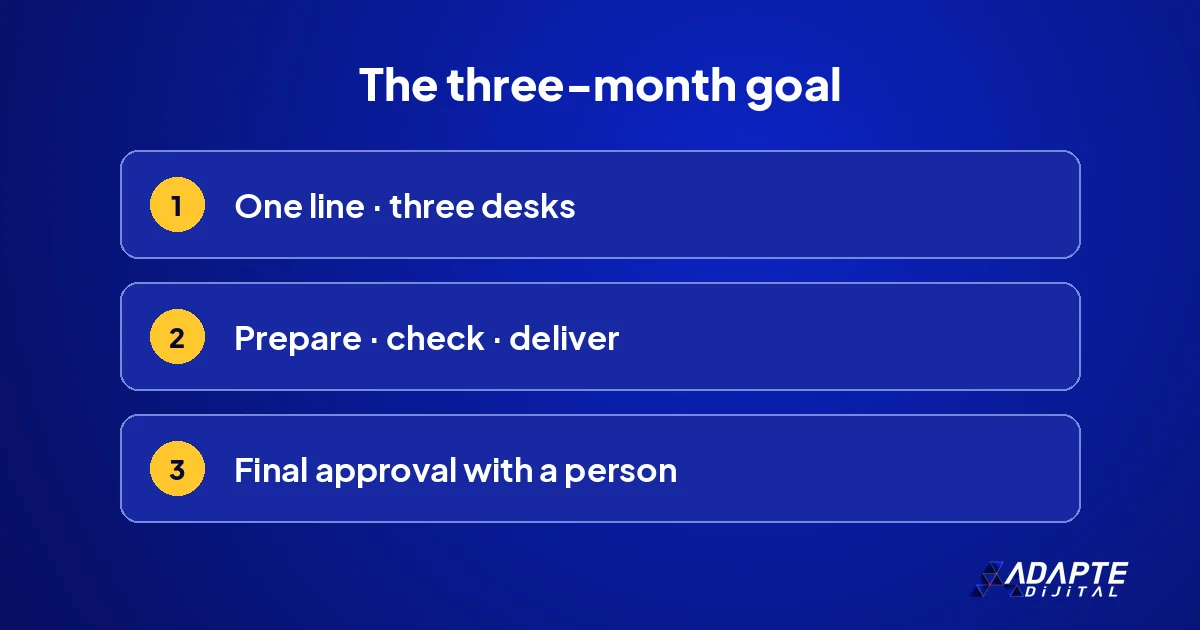
- One line, three desks
- A person is still at the gate
- What you hold at quarter end
A quarter is enough to build a line and watch it for two months. It is not enough to hand over a department. Kept at the scale of one line, the three months are productive.
One line, three desks
The realistic target is a three-desk line: one agent prepares, one checks, one delivers. The preparing agent produces the work, the checking agent measures it against the rule, the delivering agent moves the output to where it will be used. The three are kept separate, because an agent that checks its own work does not see its own mistakes. Separation also makes it obvious which desk to fix when something goes wrong. 🧱
A person is still at the gate
At the end of month three the final approval still sits with a person. What changes is how much that person looks at: not every output, only what the checking agent has passed. That lowers the approval load without handing over responsibility. Responsibility stays with one named person along the whole line. Their name should appear on the rules page.
What you hold at quarter end
After ninety days four things should have built up: three rules pages, one handover definition, a weekly error log and the time spent per run of the line. Adding a fourth agent without these means growing a system that has never been measured. With them, the decision to expand becomes a simple reading of the numbers. 📂
How do you move from one agent to a line?
BU BÖLÜMÜN ÖZETİ
- Add the checker first
- Write the handover definition
- Then add the deliverer
The move starts by writing down whose input the first agent’s output becomes. The order matters: an agent added in the wrong order lengthens the line without strengthening it.
Add the checker first
The second agent should not be one that does new work but one that checks the first. During month one, the corrections people made have turned into a list; that list is the checking agent’s rules page. We explain how the first month goes in the one-month horizon. Starting with the checker protects everything you add later. ✅
Write the handover definition
Every pass between two agents is written down: in what form work is delivered, which unmet condition sends it back, how many times it may go back. A line without a handover definition is a line that loses work. Put a limit on returns; if the limit is exceeded, the work drops to a person, so nothing loops forever unseen.
Then add the deliverer
The third agent moves approved output to where it will be used: it writes to a spreadsheet, uploads a draft, notifies the right person. This agent has the narrowest permissions; it only carries and never changes. Steps that cannot be undone, such as publishing, sending and deleting, stay with a person. That one rule removes most of the risk of a line. 📤
Where do the gates go?
BU BÖLÜMÜN ÖZETİ
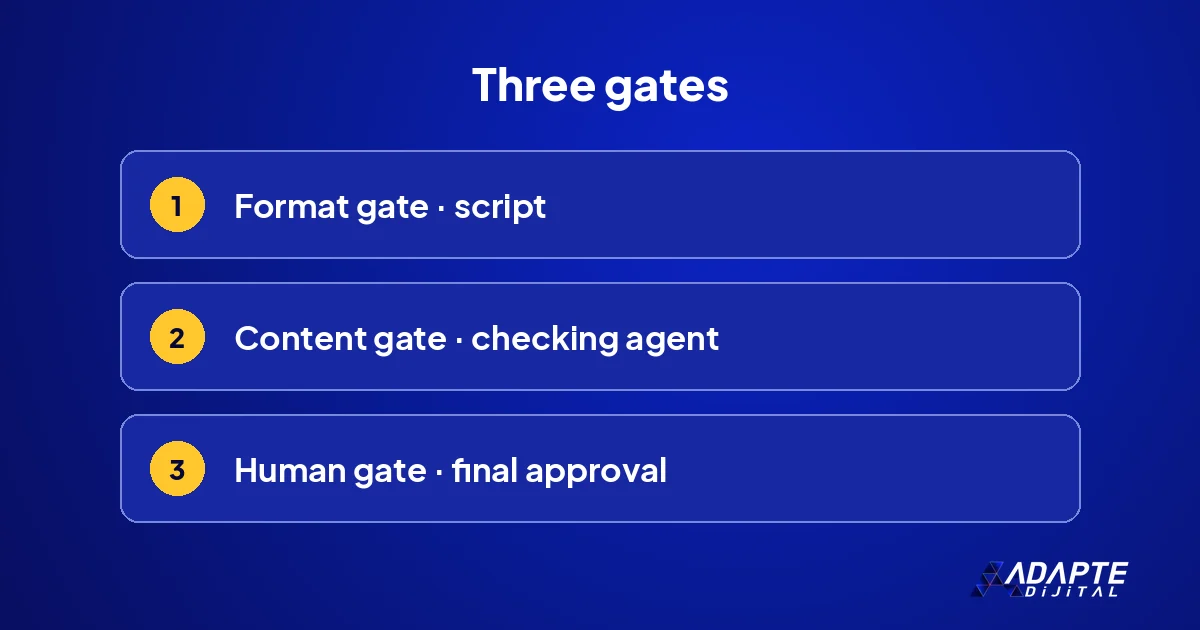
- The format gate
- The content gate
- The human gate
As a line grows longer, a mistake can travel from desk to desk. A gate is a check that stops work which fails the condition. Three gates are enough for most lines.
The format gate
The first gate looks at countable things: length, required fields, working links, file format. This gate does not even need an agent; a simple script will do. Everything countable goes to the script, because a script does not get tired and does not interpret. Scripts are also cheaper and faster than any model. 🔢
The content gate
The second gate checks whether the work follows the rule: is a source cited, is there a forbidden phrase, are the figures consistent? The checking agent works here. The checking agent does not fix; it only sends back; fixing is the preparer’s job. Keeping that boundary stops the checker from quietly becoming a second, unmeasured producer. The methods are covered in how to verify what AI produces.
The human gate
The third gate is a person and comes last. The person sees work that has already passed the first two gates, so their attention goes not to counting errors but to whether this is the right work at all. Human time is the most expensive resource, and the line exists to protect it. A good line hands people fewer, better questions. 👤
Which signs say you are not ready?
BU BÖLÜMÜN ÖZETİ
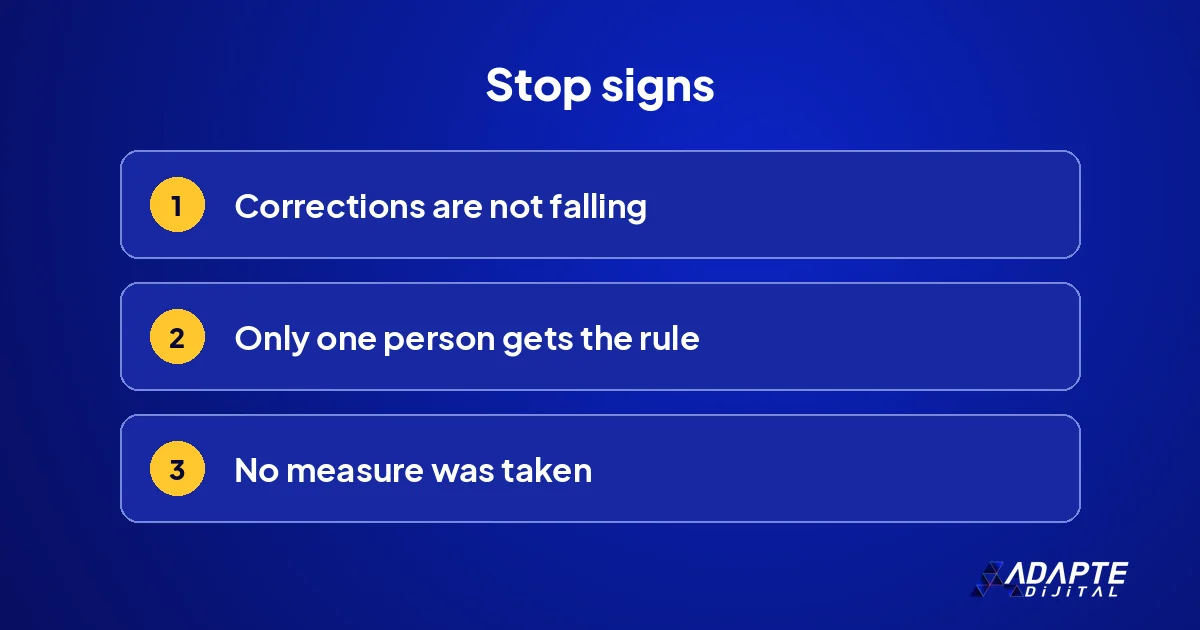
- Corrections are not falling
- Only one person understands the job
- No measure was taken
Rushing to build a line puts the gains of the first month at risk. Three signs tell you to stop before adding a second agent.
Corrections are not falling
If a person makes the same number of corrections to the first agent’s output every week, the rules page is incomplete. Adding a checker on top of an agent working from an incomplete rule doubles the incomplete rule. Complete the rule first, then build on it. 🛑
Only one person understands the job
If only one person can follow the rules page, the line depends on that person. The page should be clear enough for someone who has never done the job to read and apply it. The same test applies to the agent; a rule a person cannot follow will be misread by an agent too.
No measure was taken
Without before and after figures from the first month, you will not know whether the line works either. A measure cannot be taken retroactively. If necessary, work one week the old way, record the time, then continue. That one week is a small price for a clear decision. 📏
What is rising on this horizon?
BU BÖLÜMÜN ÖZETİ
- Today: memory and skills
- Forecast: ready-made lines will multiply
- Forecast and log
The three-month horizon looks at the first quarter of 2027. The first item below is today’s observation; the other two are forecasts.
Today: memory and skills
The leading open-source agent frameworks of 2026 advanced on two fronts: persistent memory across sessions and reusable skills. That means a rules page can be written once and used across many jobs. The frameworks change quickly, so it is worth following their release notes. 🧠
Forecast: ready-made lines will multiply
Forecast: in the coming quarter, ready-made line templates for specific jobs will spread: quote preparation, request sorting, report compiling. A template speeds up setup but does not write your rule. A business that has not written its own rule gets a line that runs on someone else’s.
Forecast and log
Forecast: in small businesses using agents, the first complaints will come not from cost but from unchecked output. Those who build gates from the start will not face it. Update log. 12 November 2026: first publication. The forecasts on this page are re-read when they fall due; a forecast that turns out wrong is not deleted but corrected here. The next step is the six-month horizon. 🔭
How do three months go with Adapte Digital?
BU BÖLÜMÜN ÖZETİ
- A single delivery package
- What is delivered
- Seeing a real line
Our own content line grew in exactly this order: first the producer, then the measurer, then the uploader. We recommend the same order.
A single delivery package
Adapte Digital does not charge a monthly management fee. Work starts with a single delivery package whose scope is written down in advance: 36,000 TRY + VAT. If the work grows, the new need is defined as a separate add-on package, priced by what will be delivered rather than by the hours spent. 📦
What is delivered
In line work, the deliverables are the rules pages and the handover definition. Even if the tool changes, these documents stay valid. We decide together which job is suitable to become a line, usually starting from the job that went best in month one.
Seeing a real line
If you want to see what a working three-desk line looks like, we describe ours step by step in how an agent content line works, including the gates and where people stand. 🧭
We cover the earning-gate side of this topic in our article on agent maintenance subscriptions.
Quick Summary
- The three-month goal is a three-desk line: preparer, checker, deliverer.
- The second agent is always the checker.
- Every handover has a written definition and a return limit.
- Three gates are enough: format, content, human.
- Forecasts are re-read and corrected when they fall due.
Short Glossary
- Line
- A sequence of agents passing work to each other to carry one job end to end.
- Handover definition
- A written rule describing the delivery format and return conditions between two agents.
- Gate
- A checkpoint that stops work which fails the condition.
Frequently Asked Questions
Next Step
Gather the first month’s correction notes into a single list; that list is the rules page for your second agent.
Sources: DeepLearning.AI — Hermes Agent Challenges OpenClaw · Five Minute AI Brief — Open Source Agentic AI: A Practical Brief
Updated: November 2026
Sık Sorulan Sorular
Two or three. The number matters less than agents passing work through a written rule. No fourth agent is added without measurement.
Check the first one. The corrections people made in the first month form the checking agent’s rules page.
Not for irreversible steps. Publishing, sending and deleting stay with a person; what shrinks is the amount of output the person reviews.