
How to Write ChatGPT Ad Copy: Building an Offer Around the Question
How to write ChatGPT ad copy comes down to one idea: the text answers a question, not a keyword. The user has described a problem to the assistant and received an answer; the ad has to offer something that reads like the next step after that answer. The short, keyword-driven language of search ads does not always work here. ✍️
This guide explains why copy should be written around the question, how to write context hints, the parts of an ad, the phrases that cause trouble and how to test copy. The technical details of the ads manager may change; the principles come from the logic of the surface itself. Every claim must be backed up on the landing page.
Why write around the question?
In in-answer advertising, the user’s situation is far clearer than in search advertising. The copy should use that clarity rather than ignore it.
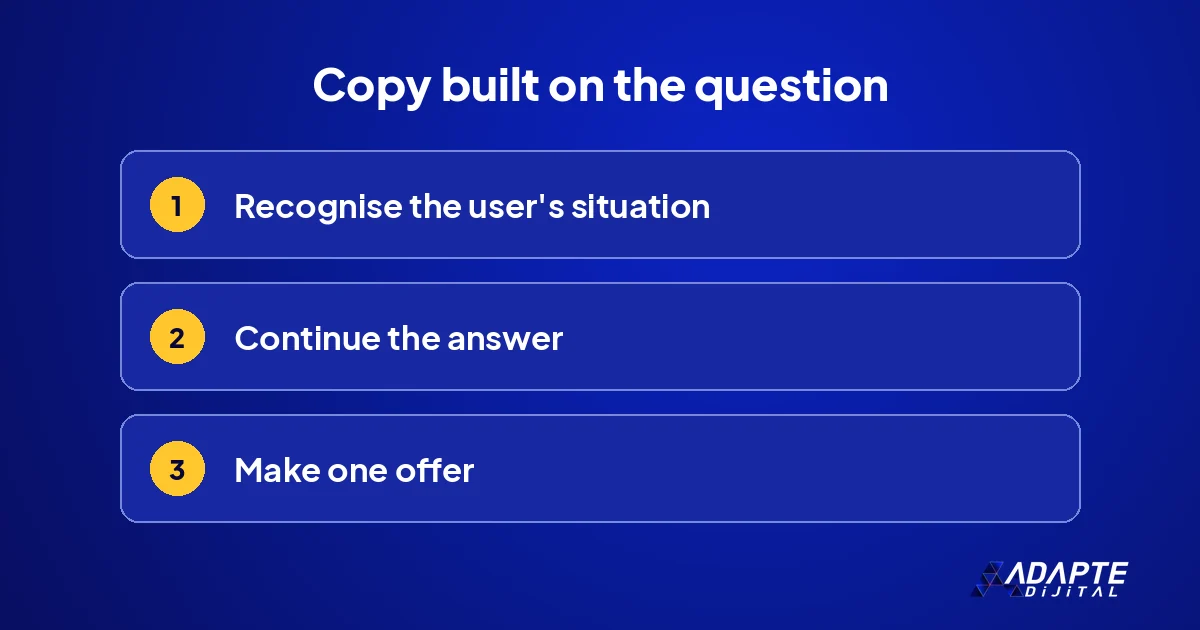
The next step after the answer
The user has read the assistant’s answer; the ad should not repeat that answer but offer the next step. If the answer explained several options, for example, the ad offers one of those options in concrete form. The ad is the continuation of the answer, not its repetition, and that difference sets the tone of the copy from the start. Ask what the user would want to do once they understand their options, and make that action the ad.
One offer
Offering more than one thing in an ad makes the user’s decision harder. Each ad contains one offer and one next step. Different offers are tested in different ad groups, with different contexts, which also shows which one works. If an offer cannot be explained in one sentence, it is probably two offers and should be split before it reaches the ad. Clarity beats coverage on this surface, where the user has already read a full answer and has little patience for a crowded card. 🎯
How do you write a context hint?
The context hint is the description that tells the system in which conversations the ad makes sense. Half of the copy lives here.
Plain sentences, not word piles
OpenAI states that context hints are not exact-match keywords and do not guarantee delivery in a particular conversation. So a hint is not a comma-separated word list but a plain description of the customer’s situation: who, with what problem, at what stage. Write it the way you would brief a new colleague about a typical customer. The more natural the description, the easier it is for the system to recognise similar conversations. 🧠
Who it is not for
Think about situations in which the offer is not suitable: a user in another city, someone looking with a very different budget, a problem the product does not solve. Even if these are not explicitly excluded, the language of the hint is built so as not to attract them. An ad shown to the wrong person is a paid misunderstanding, and on a surface where users expect relevance, it also costs a little trust. 🚫
The parts of an ad
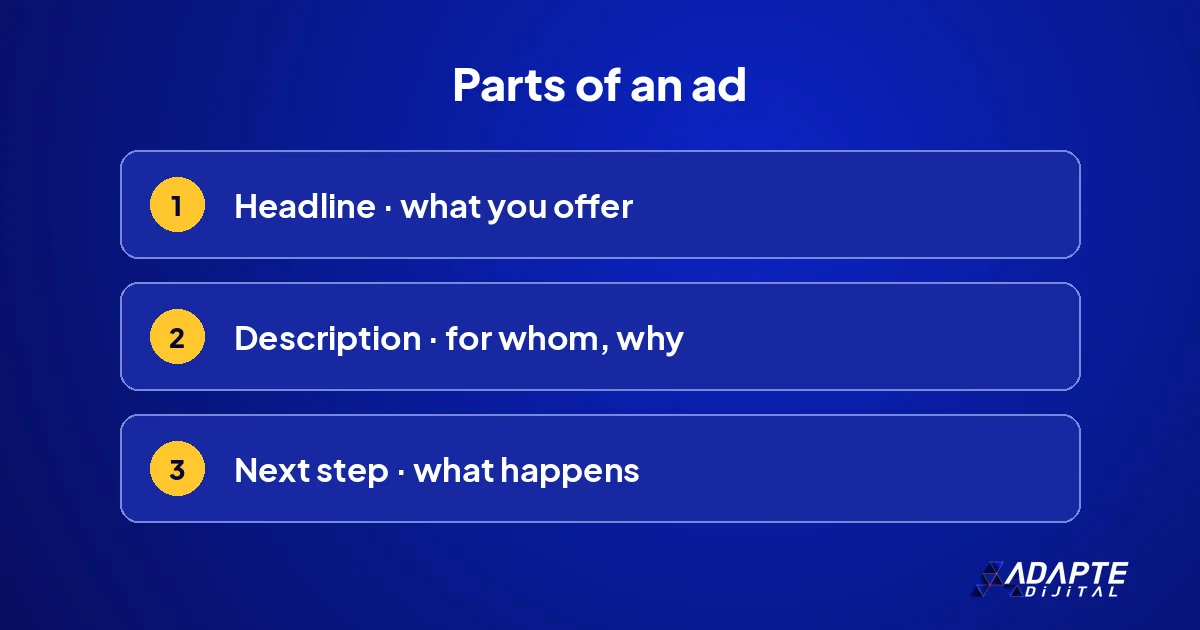
The text is short, but it has three parts, and each answers a different question the user has. Read together, they should tell the user what they get, who it is for and what to do next.
The next step
What happens when the user clicks must be clear: does an offer page open, a booking form, a product page? An unclear next step leaves the person who clicked lost on the page. The text and the first screen of the page should repeat the same promise, so the user feels they have arrived where the ad said they would. One click, one expected action is the standard to aim for. 👉
Which phrases cause trouble?
BU BÖLÜMÜN ÖZETİ
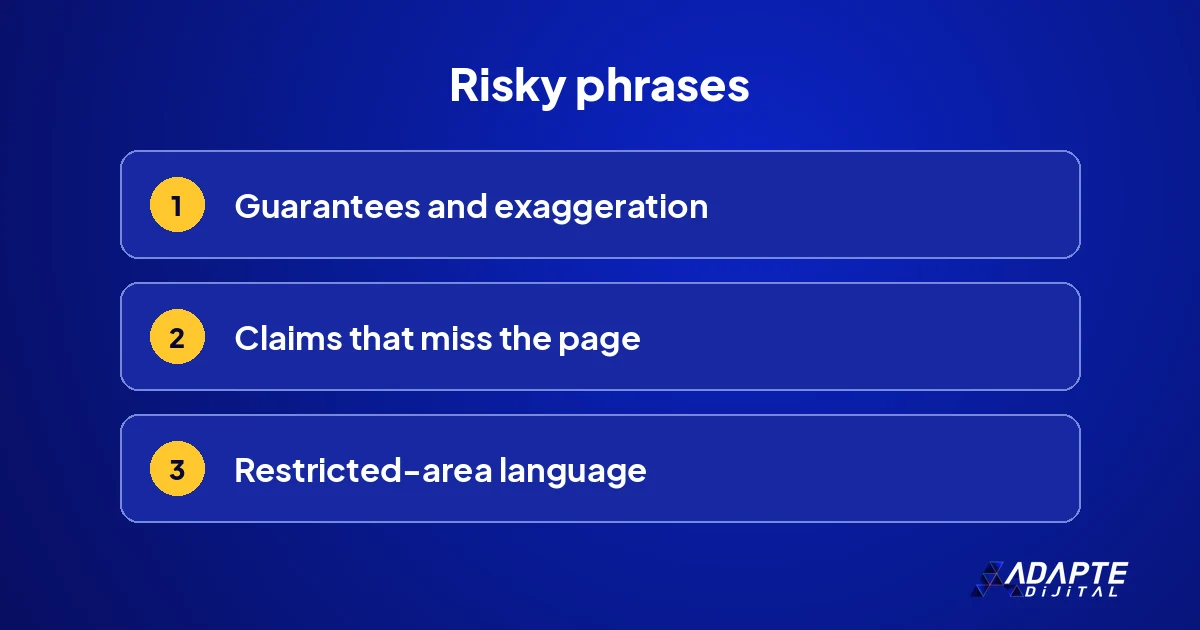
- Guarantees and exaggeration
- Claims that do not match the page
- Language that enters restricted areas
Some phrases cause problems in review and damage user trust at the same time. Three kinds need particular care.
Guarantees and exaggeration
Phrases like “guaranteed results” or “double your sales in a week” break both ad rules and honesty if they cannot be proven. An exaggerated ad stands out even more next to an assistant’s balanced answer. Promise the work that will be delivered, not the outcome. If you do have real results, describe them precisely and make sure the page shows where they come from. Precision reads as confidence; exaggeration reads as doubt. ⚠️
Claims that do not match the page
If the price, stock, timeframe or promotion in the ad differs on the page, the ad may be rejected; even if approved, user trust is lost. OpenAI expects claims in the ad to match the landing page. When a promotion ends, the ad text is updated on the same day. Put a reminder in the calendar for every time-limited claim, because outdated ads are one of the most common causes of rejection and of confused customers.
Language that enters restricted areas
In areas such as health, finance and law, the rules are stricter and in some countries open only to approved advertisers. A business in these areas should read the current policy before writing copy. A well-written ad in a restricted area is an ad that never runs. For legal obligations, consult a qualified professional; this article is not legal advice. Check the policy first, then write. 🔒
How do you test copy?
BU BÖLÜMÜN ÖZETİ
- Two variations
- One variable
- Enough data
No text is the best on the first try. A regular, measured test improves copy over time.
Two variations
At least two texts run in each ad group. One states the offer directly; the other starts from the user’s situation. The difference between the two shows which language works on this surface. A group with a single text cannot compare anything. Variations run with the same budget and in the same period, so that the comparison is fair and the result reflects the words rather than the timing. 🔁
One variable
Only one thing changes between the two texts: the headline, the description or the next step. If several things change together, you cannot tell where the difference came from. One change per test is slower, but it is the only way to learn. Account setup is covered in how to open a ChatGPT ads account. Keep a simple log of each change and its date, so that results can be traced back to decisions.
Enough data
Decisions between texts wait until enough impressions and clicks have been collected. A decision made on a handful of clicks is luck. What you learn is the winning language, not the winning ad, and that language is carried into later ad groups. Measurement for these decisions is covered in Google Ads performance measurement. Patience with data is what turns tests into knowledge. 📊
How does Adapte Digital prepare ad copy?
BU BÖLÜMÜN ÖZETİ
- A single delivery package
- What is delivered
- Where to start
We write copy starting from customers’ real questions and match every claim to the landing page.
A single delivery package
Adapte Digital does not charge a monthly management fee. Work starts with a single delivery package whose scope is written down in advance: 36,000 TRY + VAT. If the work grows, the new need is defined as a separate add-on package, priced by what will be delivered rather than by the hours spent. 📦
What is delivered
The output is context hints for the ad groups, two texts for each group and a page consistency check. We choose together which offer to test first, usually the one customers ask about most often.
Where to start
Which packages are open, and at what price, is shown on our campaign pages, item by item. 🧭
Quick Summary
- In-answer ad copy answers a question, not a keyword.
- A context hint is a plain description of the customer’s situation, not a word list.
- The three parts of an ad: headline, description, next step.
- Guarantees, claims that miss the page and restricted-area language cause trouble.
- Copy is tested with two variations and one variable.
Short Glossary
- Context hint
- A description of the conversations in which an ad makes sense.
- Variation
- A second text in the same ad group that differs in one element.
- Next step
- The action a user is expected to take after clicking.
Frequently Asked Questions
Next Step
Write down the three questions customers ask you most often; for each, set one offer and one next step. Our campaign pages list the packages that cover advertising foundations.
Sources: OpenAI Help Center — ChatGPT Ads: Frequently Asked Questions · OpenAI Help Center — Create campaigns for ChatGPT Ads
Updated: November 2026
Sık Sorulan Sorular
Someone asking an assistant a question usually describes a situation: “I have a small café; how do I get more customer reviews?” An ad that speaks in language that recognises that situation draws attention. A general brand slogan, on the other hand, gets lost next to the same answer. Before writing copy, list the real questions customers ask, in their own words, from emails, calls and sales conversations. Those questions are the raw material for both the hints and the ads. 💬
The hint describes the kinds of conversation the ad suits: a user comparing options, asking about prices or trying to solve a problem. The more concrete it is, the more accurately the system matches. A vague hint leads to irrelevant impressions and wasted budget. After writing a hint, ask a colleague to read it and say which customer it describes; if they cannot, the system probably cannot either. Specific beats broad every time.
The headline says at first glance what the offer is. A brand name alone is not a headline; if the user does not know the brand, it says nothing. A concrete headline such as “Review collection package for cafés” always says more than a general one such as “the solution of the future”. Name the thing the customer gets, in the words the customer uses. On Google’s AI surfaces, by contrast, the system assembles headlines from your assets, as described in Google AI Mode latest. 🏷️
The description explains in one or two sentences who the offer suits and why it helps this user. If a number or a timeframe is given, the page must say exactly the same. A description that matches the page passes review more easily and earns more trust. How to prepare the page is covered in the landing page for in-answer ads. Read the description aloud: if it would sound odd said to a customer, rewrite it in plainer words.
Yes. On Google the text mostly answers a keyword; on ChatGPT it sits next to a situation the user described and the answer the assistant gave.
Clarity matters more than length. A few plain sentences about who the customer is, what problem they bring and what stage they are at are enough.
The most common reasons are claims that do not match the page and restricted areas. Read the reason and fix the copy or the page before resubmitting.