
How to Set Up Measurement for In-Answer Ads: Pixel, Server Reporting and Reading Reports
Measuring in-answer ads means counting the conversions an ad brings correctly and crediting them to the right ad. Without measurement, an ad produces only impressions and clicks, and those numbers do not say whether the channel works. Measurement is the one piece that is built before the ad. 📏
This guide explains why measurement comes first, how to set up the pixel and server-side reporting on ChatGPT, what to check on Google, how to read reports and which mistakes are common. The technical facts were checked against OpenAI’s help pages on 12 November 2026. Do the setup together with your developer.
Why does measurement come first?
BU BÖLÜMÜN ÖZETİ
- The basis of the objective
- The basis of the budget
- Proof of the channel
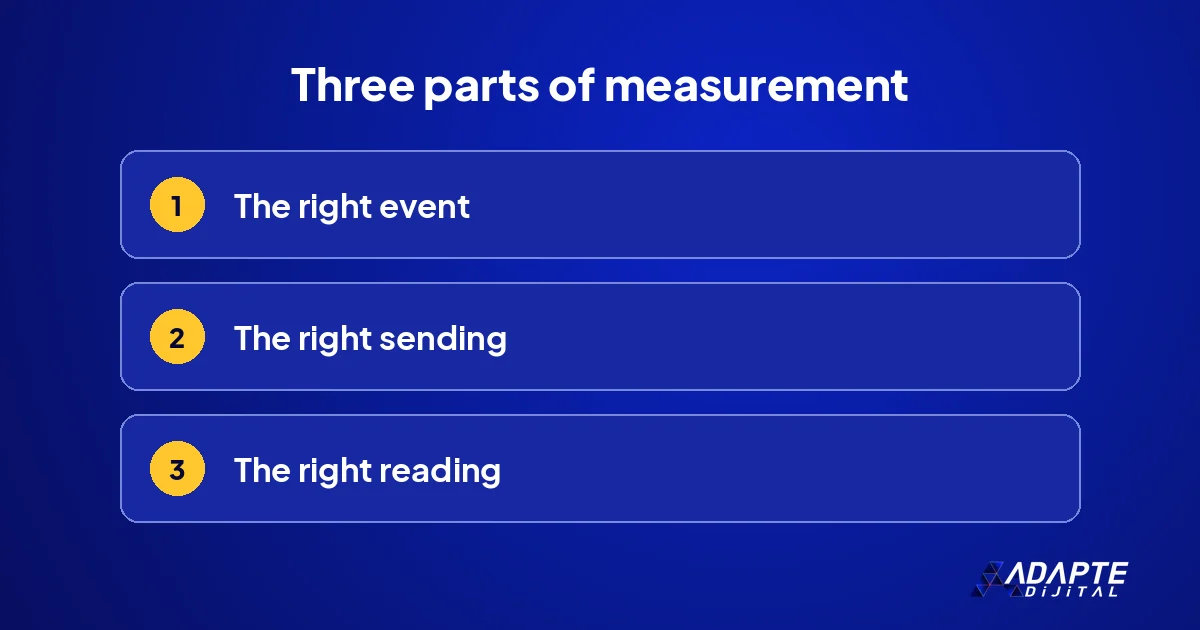
Measurement underpins every other decision about an ad. Three decisions depend on it directly.
The basis of the objective
Campaigns with a conversions objective learn from reported conversions. OpenAI’s help pages also note that higher-quality conversion signals give campaigns better context for optimisation. If measurement is weak, the system optimises for the wrong result. The right objective starts with the right measurement, which is why measurement is set up and tested before the objective is chosen. 🎯
The basis of the budget
Decisions to raise, cut or move budget are made on cost per conversion. If conversions are not counted, that cost cannot be calculated and budget decisions are left to guesswork. A budget decision without measurement is flying blind. How budget is planned is covered in in-answer ads budget. Measurement turns the budget conversation into arithmetic.
Proof of the channel
Whether a surface adds value to the business can only be shown with measurement. It moves the discussion about the channel, within the team and with management, from opinion to data. A contribution that cannot be proven is the first to be cut when budgets tighten. Good measurement protects a channel that works well. 🛡️
How do you set up measurement on ChatGPT?
BU BÖLÜMÜN ÖZETİ
- The data source
- The pixel
- The Conversions API
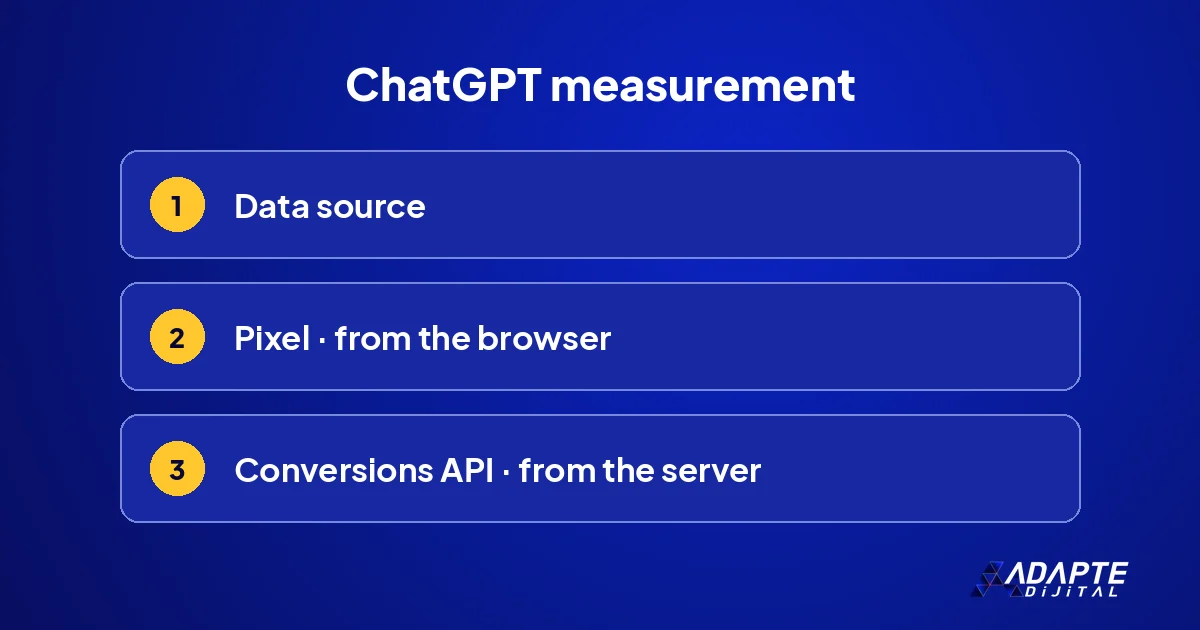
According to OpenAI’s help pages, measurement rests on a data source, a pixel and the Conversions API. Using both sending methods together gives the soundest result. Account setup itself is covered in how to open a ChatGPT ads account.
The data source
In the ads manager, you first create a data source; conversion events are sent to it through the pixel, the Conversions API or both. Which event counts as a conversion is selected separately in the campaign. If the event and the campaign setting do not match, no conversion is reported. That match is the first thing to check after setup. 🗂️
The pixel
The pixel sends events from the visitor’s browser. According to OpenAI, the pixel can capture the click reference carried by an ad click and store it in a first-party cookie. The pixel is quick to install, but it can miss some events because of browser blocking and consent settings. That is why it is best used together with server-side reporting rather than alone.
The Conversions API
The Conversions API sends events from the business’s own server, with the keys kept on that server. If the same conversion is sent through both the pixel and the server, OpenAI’s guidance is to give it the same event ID so that it is counted once. For businesses whose forms and sales are recorded on a server, this is the most reliable path. 🖥️
What do you do on Google?
BU BÖLÜMÜN ÖZETİ
- Conversion tracking
- Primary and secondary conversions
- Value and double counting
Because Google’s ads in AI answers draw on existing campaigns, measurement runs through existing conversion tracking as well.
Conversion tracking
In Google Ads, correctly configured conversion tracking is a precondition for automated campaigns to learn properly. Check which action counts as a conversion, what value it carries and in which window it is counted. The reporting side is covered in Google Ads performance measurement. 📈
Primary and secondary conversions
Google Ads separates primary conversions, used in bidding decisions, from secondary conversions, kept for observation only. Counting everything as primary leads the system to treat minor actions as goals. Keep the business’s real goal as primary and supporting steps as secondary, so the system optimises for what actually matters.
Value and double counting
If a conversion carries a value, that value should be close to the real sale or lead value. Counting the same action twice inflates the report and misleads the system. A monthly comparison with the sales record catches double counting early. An inflated report looks good but leads to wrong decisions. ⚠️
How do you read the report?
BU BÖLÜMÜN ÖZETİ
- Click-through and view-through conversions
- Modelled conversions
- Differences between tools
The reported number changes with the measurement settings. Three details keep the reading accurate.
Click-through and view-through conversions
According to OpenAI’s help pages, when the view-through window is set to one day, the conversions figure combines click-through and eligible view-through conversions; with a zero-day window, only click-through conversions are counted. Use the same setting when comparing periods. Note the setting in the report, so later readers know which measure they are looking at. 👁️
Modelled conversions
OpenAI says that, where available, it may estimate some conversions from aggregated patterns in observed conversions, and that reported totals may include them. These numbers are useful, but they are estimates. Comparing with the sales record shows how accurate the estimate is. Do not treat an estimate as a certainty.
Differences between tools
According to OpenAI, totals can differ between the ads manager, analytics providers and other ad platforms because of attribution methods and windows, time zones, browser and consent conditions, deduplication and modelled reporting. A difference does not necessarily indicate an error. Choose the report that counts at the start; reading results across rounds is covered in in-answer ads: three months. 🧮
Common measurement mistakes
BU BÖLÜMÜN ÖZETİ
- A click reference lost in a redirect
- Double sending
- Counting the wrong event
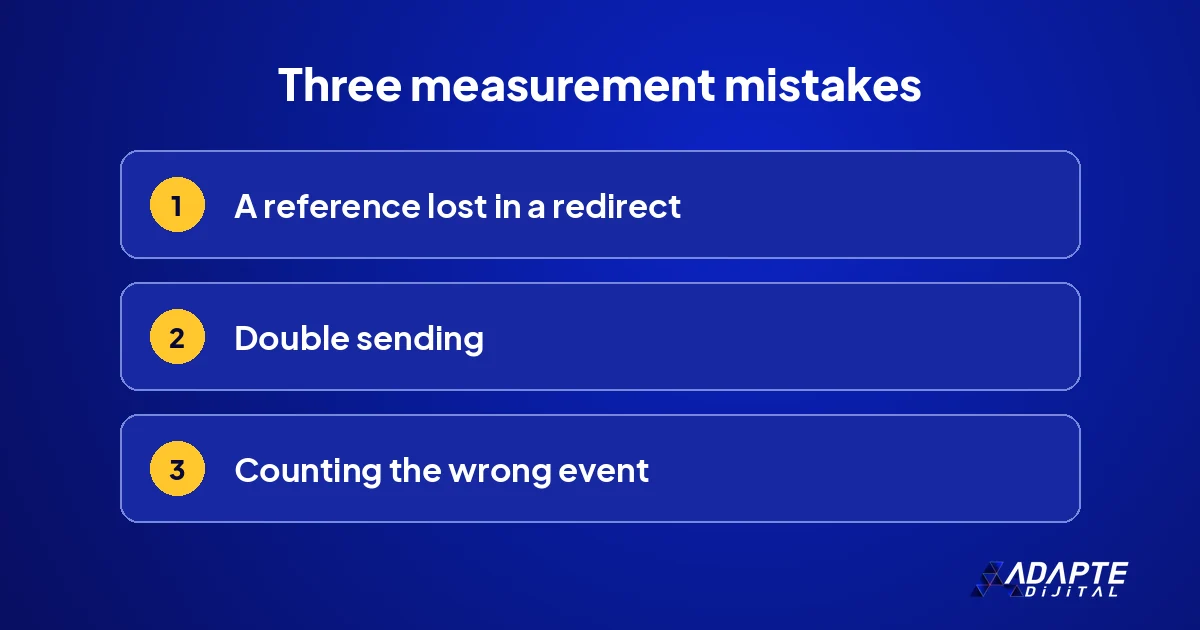
Most measurement mistakes come from a lack of attention rather than technical difficulty. Three are especially common.
A click reference lost in a redirect
If the address an ad leads to redirects to another address, the click reference carried by the click can be lost on the way. The conversion may then happen but cannot be credited to the ad. Test that redirects keep URL parameters after setup. A lost reference means a lost conversion, and it is invisible unless you check for it. 🔗
Double sending
If the pixel and server-side reporting are used together but give the same conversion different event IDs, the conversion is counted twice. The report inflates and the cost looks lower than it is. The same ID for the same event is the most important detail of the setup. Test it with trial conversions in the first week.
Counting the wrong event
Counting intermediate steps such as page views or add-to-cart as conversions leads the system to target actions that have no value for the business. A conversion is the action the business actually wants: a sale, a form, a call or a booking. Intermediate steps can be tracked separately, but they are not made the goal. 🎯
How does Adapte Digital set up measurement?
BU BÖLÜMÜN ÖZETİ
- A single delivery package
- What is delivered
- Where to start
We set up measurement before the ads, test it with trial conversions and hand it over with documentation.
A single delivery package
Adapte Digital does not charge a monthly management fee. Work starts with a single delivery package whose scope is written down in advance: 36,000 TRY + VAT. If the work grows, the new need is defined as a separate add-on package, priced by what will be delivered rather than by the hours spent. 📦
What is delivered
The output is a working pixel and Conversions API setup, matching campaign settings and a measurement document. We put Google-side conversion tracking in order at the same time, so both surfaces are measured the same way.
Where to start
Our current packages and capacity are listed on our campaign pages; scope and price are written there before any work starts. 🧭
Thinking of building a business in this area? Our article on in-answer ads measurement setup looks at that door separately.
Quick Summary
- Measurement underpins decisions on objective, budget and the channel itself.
- On ChatGPT, a data source, the pixel and the Conversions API are set up together.
- On Google, check conversion tracking and the primary/secondary split.
- The view-through window and modelled conversions affect the report.
- Redirects, double sending and the wrong event are the commonest mistakes.
Short Glossary
- Data source
- The record area in the ads manager where conversion events are collected.
- Conversions API
- Sending conversion events from the business’s own server rather than from the visitor’s browser.
- Primary conversion
- In Google Ads, the conversion used for bidding decisions; the business’s real goal.
Frequently Asked Questions
Next Step
This week, send a trial conversion and confirm that it appears both in the ads manager and in your sales record. Our campaign pages list the packages that cover measurement setup.
Sources: OpenAI Help Center — Conversion measurement · OpenAI Help Center — Troubleshooting conversion tracking for ChatGPT Ads
Updated: November 2026
Sık Sorulan Sorular
It can be enough to start, but browser blocking misses some events. Using it together with the Conversions API, with shared event IDs, is more reliable.
Attribution methods, time zones, consent settings, deduplication and modelled reporting create differences. According to OpenAI, a difference is not necessarily an error.
Send a trial conversion and check that it appears in the ads manager. Then compare the ads manager figure with your sales record once a month.