
What Are C2PA Content Credentials? How to Prove Where an Image or Video Comes From
C2PA content credentials are an open standard that carries, in signed form inside the file, where an image, video or audio file comes from, which tool produced it and how it was changed. In the AI era, it is the way to answer “is this image real?” with a record rather than a guess. 🧾
This guide explains what C2PA is, the difference between metadata, watermarks and fingerprints, its relation to European rules, how a business can start and the limits of the standard. The technical facts were compiled from the standards body and industry sources on 12 November 2026. This article is for information only and is not legal advice; consult a lawyer about your own situation.
What is C2PA?
C2PA is an open standard developed jointly by major technology and media companies to record content provenance. Users see it under the name content credentials.
An open standard
C2PA stands for the Coalition for Content Provenance and Authenticity. The standard it developed is an open specification anyone can use; it is not one company’s product. An open standard lets different tools read the same record. A photo signed on one phone can be verified in another company’s software, which is what makes the record useful outside its origin. 🌐
Metadata, watermarks and fingerprints
BU BÖLÜMÜN ÖZETİ
- Signed metadata
- Invisible watermarks
- Durable content credentials
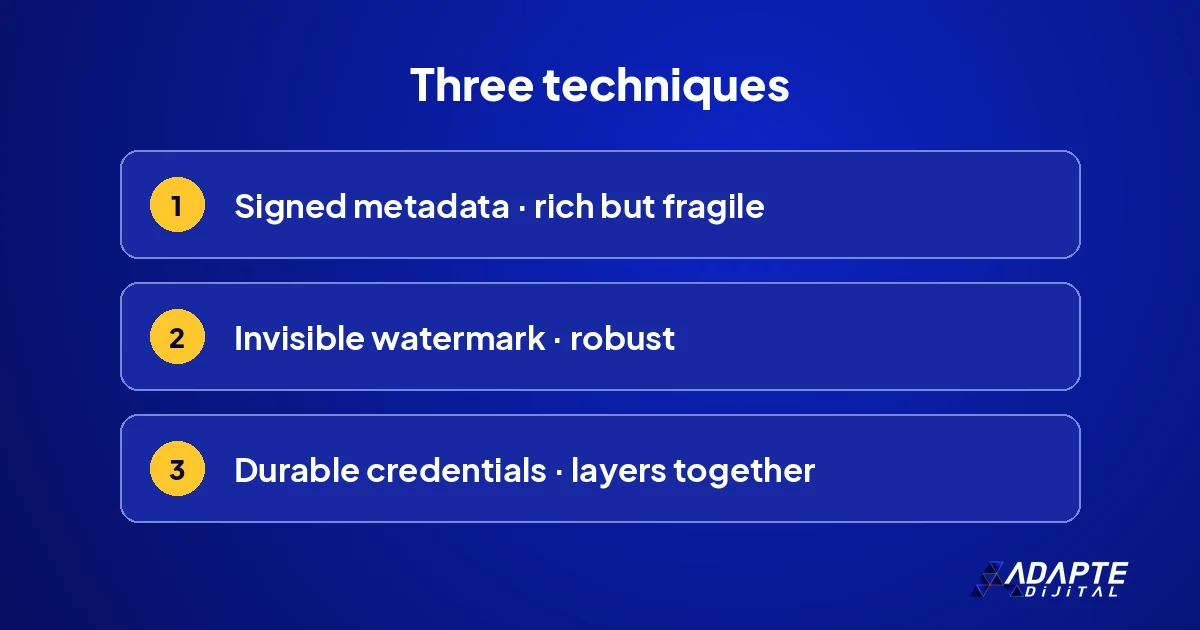
Provenance can be carried by three different techniques. Each has strengths and weaknesses.
Signed metadata
The C2PA record sits in the file’s metadata and is signed; it carries rich information about the content. But some platforms and tools strip metadata when processing a file. Metadata is the most informative but most fragile layer. When it is stripped, the record is lost, so it is not treated as sufficient on its own. 📄
Invisible watermarks
A watermark is a marker embedded invisibly in the content itself; it can survive operations such as compression or resizing better than metadata. A watermark is more robust but carries less information. It usually shows that content was produced by a particular tool; it does not show a detailed history of edits.
Durable content credentials
The standard describes durable content credentials, which make it possible to find a content’s record again even after metadata is stripped: the signed record, a watermark and a content fingerprint are used together. The layers complement each other. Even if one layer is lost, another can link the content back to its record. 🔗
How does it relate to European rules?
BU BÖLÜMÜN ÖZETİ
- Machine-readable marking
- From the deploying business’s side
- Proof of your own content
C2PA is not a law, but it has become an important tool for applying Europe’s transparency rules.
Machine-readable marking
Article 50 asks providers of content-generating systems to mark outputs in a machine-readable way, and the code of practice expects at least two layers of marking. Combining a C2PA record with a watermark is a common approach that fits that expectation. The code’s details are explained in the AI content code of practice. ⚖️
From the deploying business’s side
A deploying business’s job is usually to put a visible label in front of readers. The C2PA record is the proof behind that label. The label tells the reader; the provenance record proves it to the machine. Used together, people and machines reach the same information, and the label is harder to dispute.
Proof of your own content
C2PA is used not only to mark AI content but also to prove that real content is real. A brand that signs its own product photos can stand apart from fake images. This is one of the most concrete defences against deepfakes. The topic is covered further in protecting your brand from deepfakes. 🛡️
How does a business start?
BU BÖLÜMÜN ÖZETİ
- Checking the tools
- Keeping the record
- Signing your own content
C2PA does not require a large investment. Three steps show where a business stands.
Checking the tools
The first step is finding out whether the camera, phone, design software and AI tools in use add content credentials. Many tools offer this as a setting that can be switched on or off. Knowing which tool adds a record should be part of the AI inventory, and it helps explain later why some files carry credentials and others do not. 🔍
Keeping the record
The second step is testing whether the publishing chain keeps the record. A content management system, image compression plugin or content delivery network may strip metadata. A simple test with one file shows whether the record reaches publication. If a step strips it, its settings are changed. A brand’s wider digital footprint is reviewed in brand digital audit.
Signing your own content
The third step is producing the brand’s important content, such as product photos and promotional videos, with tools that add content credentials. A signed original becomes evidence for comparison if a fake image ever appears. Proof is produced today, not at the moment it is needed. ✍️
Limits
BU BÖLÜMÜN ÖZETİ
- Provenance is not truth
- Platforms can strip it
- Adoption is uneven
C2PA is a powerful tool, but it does not answer every question. Knowing three limits prevents false expectations.
Provenance is not truth
Content credentials show where content came from and how it changed; they do not show that the content is true. A signed image can still be used in a misleading context. A provenance record is evidence, not a verdict. Interpretation still falls to people, and a labelling routine is still needed, as covered in setting up an AI content labelling system. ⚖️
Platforms can strip it
According to industry sources, many social platforms still strip metadata from uploaded files; this is seen as the weakest link in the standard. Durable content credentials were developed to ease this problem, but implementation varies by platform, so a brand cannot assume its records survive every channel.
Adoption is uneven
Camera makers and AI tools are adopting the standard quickly, while some platforms where content circulates lag behind. That is why C2PA makes sense today together with labels and logs rather than on its own. As adoption grows, so will its value, and early adopters will have their archive ready. 📊
What does Adapte Digital do for content credentials?
BU BÖLÜMÜN ÖZETİ
- A single delivery package
- What is delivered
- Where to start
We test whether your tools and publishing chain keep content credentials, fix what breaks and hand it over.
A single delivery package
Adapte Digital does not charge a monthly management fee. Work starts with a single delivery package whose scope is written down in advance: 36,000 TRY + VAT. If the work grows, the new need is defined as a separate add-on package, priced by what will be delivered rather than by the hours spent. 📦
What is delivered
The output is a tool list, a publishing chain test note and a roadmap for signing your own content. The roadmap starts with the content most likely to be copied or faked.
Where to start
The written scope of each package, with current pricing and capacity, is on our campaign pages. 🧭
To turn this topic into a business of your own, start with our article on content provenance records.
Quick Summary
- C2PA is an open standard that carries content provenance with the file.
- Major companies such as OpenAI and Google are adopting it.
- Metadata is informative but can be stripped; watermarks are more robust.
- Europe’s code of practice expects at least two layers of marking.
- Provenance is not proof of truth; this article is not legal advice.
Short Glossary
- Content credentials
- A signed record added to content under the C2PA standard, showing its provenance.
- Watermark
- A recognition marker embedded invisibly in content.
- Fingerprint
- A unique digest derived from the content itself and used to recognise it.
Frequently Asked Questions
Next Step
Check with a free verification tool whether an image you uploaded to your site still carries its content credentials after publication. Our campaign pages list the delivery packages that cover this work.
Sources: C2PA — Coalition for Content Provenance and Authenticity · Content Authenticity Initiative — The State of Content Authenticity in 2026 · Freshfields — The final Code of Practice on transparency of AI-generated content
Updated: November 2026
Sık Sorulan Sorular
When content is created or edited, the tool adds a signed record to the file: who or which tool produced it, when, and what changes were made. Because the record is cryptographically signed, it cannot be altered later without detection. As the file is edited, new records are added, and the content’s history can be seen as a chain.
In May 2026, OpenAI joined the C2PA steering committee and announced that images generated with ChatGPT carry Google’s invisible watermark alongside the C2PA record. According to industry sources, photos taken with the Google Pixel 10 camera are signed by default, and Google announced it would bring C2PA verification to Search and Chrome. The Content Authenticity Initiative passed 6,000 members in early 2026. 📈
C2PA records provenance. If the AI tool added a record, you can see that the content was AI-generated; without a record, C2PA does not detect anything on its own.
Some platforms strip metadata. Durable content credentials and watermarks were developed to reduce that loss.
First check whether its tools add records and whether its publishing chain keeps them; then produce important content with tools that sign it.