
Agent-Ready Website at 6 Months: Access Decisions, Agent Identity and a Tool Trial
Month six of an agent-ready website is when the order built in the first quarter starts producing decisions. Forms have been fixed and the machine layer has grown; now it is time to write down which agent may do what. 🧭
This page is the third step in the agent-ready web horizon series. It covers where preparation stands at six months, which decisions are made, how access is organised, the mistakes of this period and what is rising over this time frame. Forecasts are marked as forecasts.
Where does preparation stand at six months?
BU BÖLÜMÜN ÖZETİ
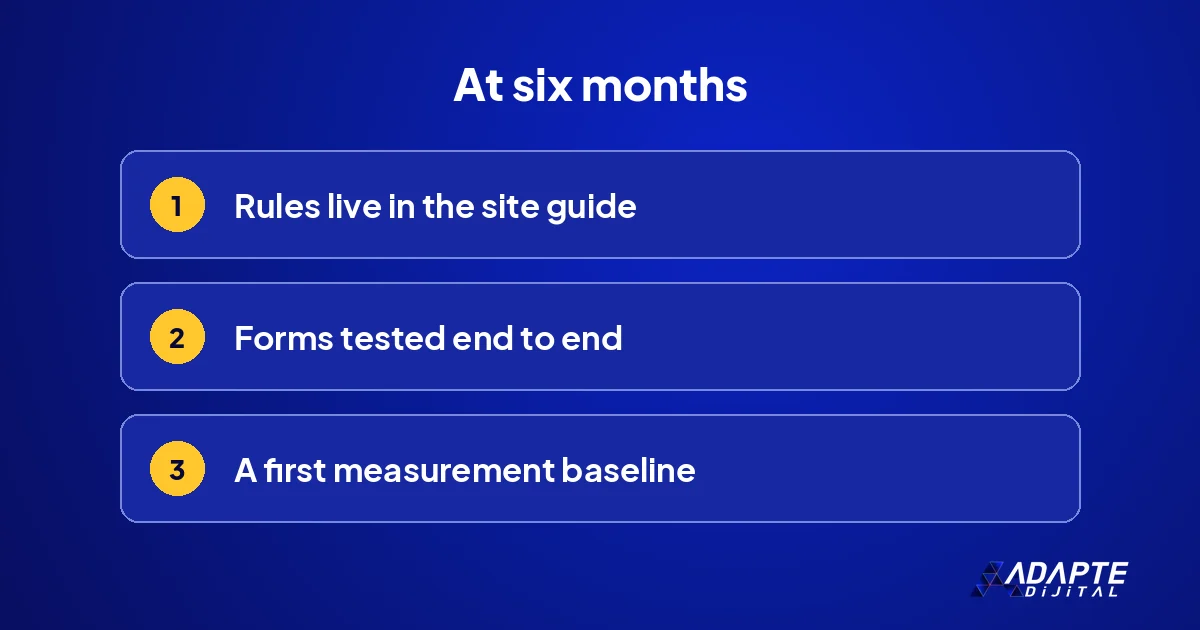
- Rules live in the site guide
- Forms tested end to end
- A first measurement baseline
Six months is long enough for agent readiness to stop being a separate project and blend into the site’s ordinary routine. By now, three things should have settled.
Rules live in the site guide
Form labels, field types and the service page outline now sit in a written site guide. When a new form is added, the same rules are applied without anyone having to remind the team. A rule has settled when it is followed without opening the guide. The way to check is to open a few pages added last month at random and look at their labels and structured data. If something is missing, the guide is updated too. 📘
Forms tested end to end
Quote, booking and contact forms have each been tested from start to finish with an agent at least twice. If the agent finds the form, fills it in, submits it and understands the confirmation message, the form is ready. Sticking points are now rare, and new ones usually come from a theme or plugin update. That is why a short agent test after every update becomes part of the routine.
A first measurement baseline
Test notes and analytics data kept since the first month form a baseline that can be compared at six months. Visits from assistants, the form completion rate for those visits and the quality of incoming enquiries are read side by side. Without a baseline, progress cannot be read. The numbers may be small; what matters is that the same measurement is done the same way every month. 📊
Which decisions are made?
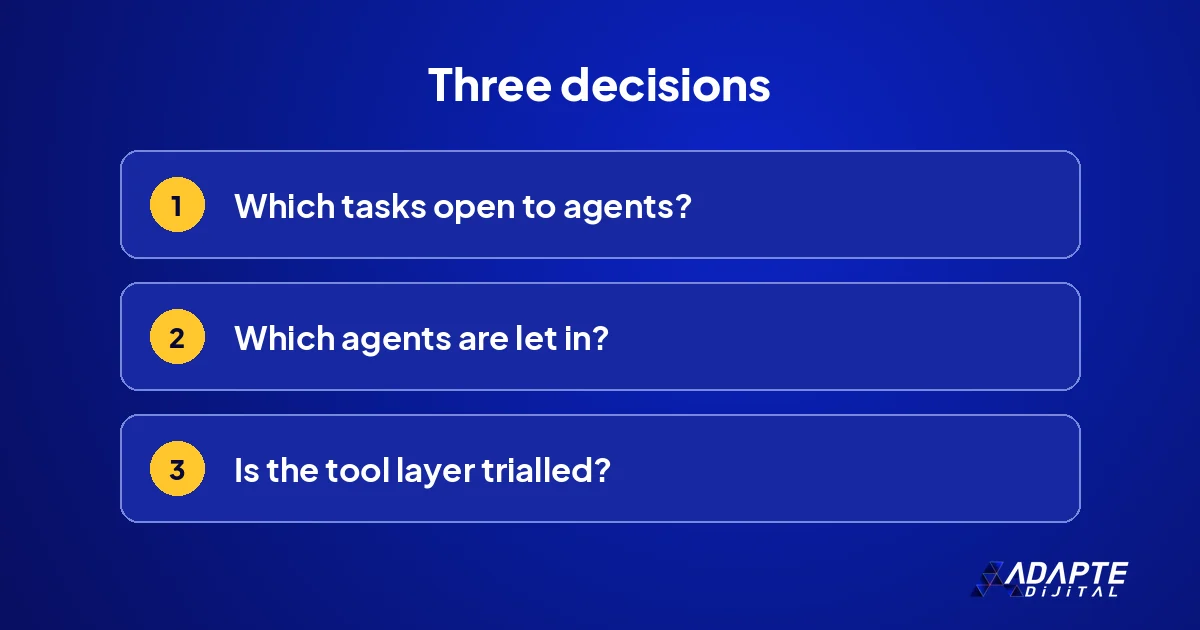
At six months, the data points in a direction, even if the numbers are small. Three decisions are made in this period and written into the site guide.
How is access organised?
BU BÖLÜMÜN ÖZETİ
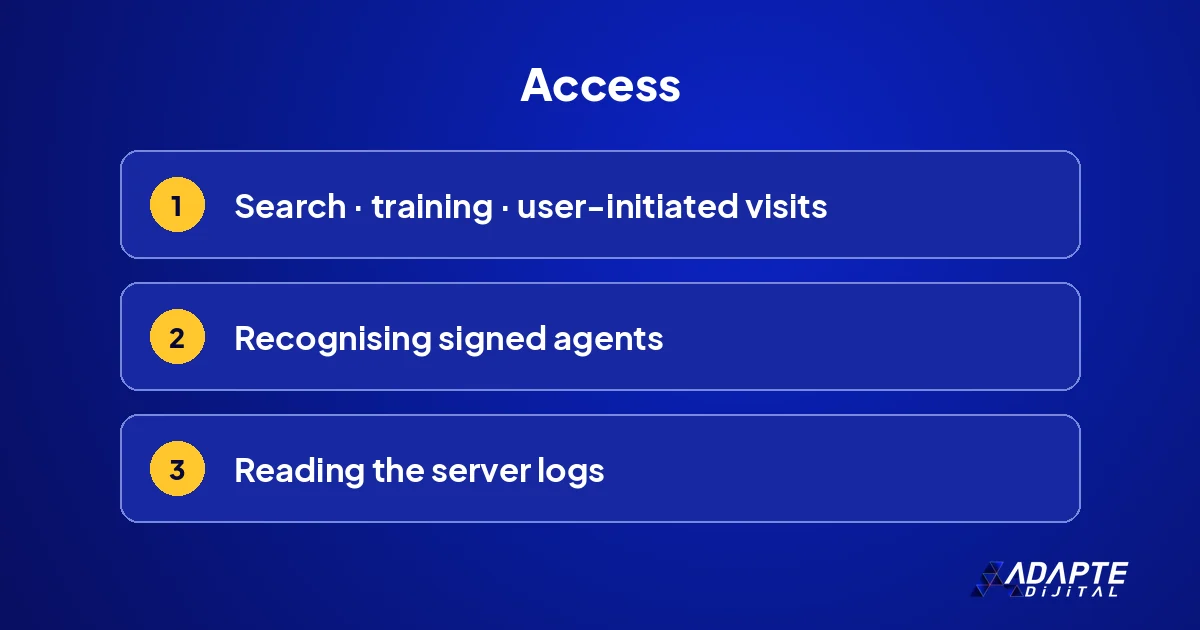
- Search, training and user-initiated visits
- Recognising signed agents
- Reading the server logs
Once the access decision is written, it is put into practice. The practice has three parts, and each needs regular checking.
Search, training and user-initiated visits
According to OpenAI’s documentation, OAI-SearchBot and GPTBot can be managed independently in robots.txt, while those rules may not apply to user-initiated ChatGPT-User visits. On Google’s side, the Google-Extended token controls use for AI training. Each type of visitor is handled on its own line, so one decision does not accidentally undo another. The lines in robots.txt mirror the sentences in the written policy. 🗂️
Recognising signed agents
An IETF draft called Web Bot Auth is being developed so agents can identify themselves verifiably; the method relies on HTTP message signatures. Cloudflare already treats signed agents as a separate class. A signature answers the question “is this agent really who it claims to be?” far more reliably than a user-agent string, which anyone can copy. Firewall rules can be set for this class, letting verified agents through while unknown automation is checked.
Reading the server logs
Server logs show which bots and agents visit the site, which pages they open and which requests are blocked. A short monthly read reveals wanted visitors that are being blocked by mistake. An access decision made without reading the logs is made blind. How often AI crawlers actually visit is discussed in how often AI crawlers read your site. The findings of each read are added to the site guide with a date. 🔎
Which mistakes happen at six months?
BU BÖLÜMÜN ÖZETİ
- Closing everything in one line
- Judging the numbers too early
- Breaking the rule with exceptions
The mistakes of this period come from the comfort of believing the arrangement has settled.
Closing everything in one line
After a news story or a moment of worry, it is tempting to block every AI bot with a single line. But that can mean the site disappears just when a customer asks an assistant to find a firm that does the job. A decision to close needs as much thought as a decision to open. According to Google, a site that switches off the Search Console setting receives no traffic or impressions from AI Overviews and AI Mode. 🚪
Judging the numbers too early
Six months of data forms a baseline but does not paint a definitive picture. A spike in one month may come from a campaign, a drop from a platform change. When the trend points the same way for several months in a row, a decision becomes solid. A hasty decision is reversed the next quarter, and it also wears down the team’s trust in measurement, which is harder to rebuild than any setting.
Breaking the rule with exceptions
In a busy campaign week, it is tempting to launch an unlabelled form “just this once” or to show a price only in an image. Every exception makes the next one easier. A rule is real if it can be followed in the busiest week too. If necessary, the rule is simplified rather than broken, and the simplification is written into the guide with its date, so everyone works from the same version. ✂️
What is rising over this time frame?
BU BÖLÜMÜN ÖZETİ
- Today: agents sign their identity
- Forecast: signatures spread
- Forecast and log
Over a six-month horizon, identity and access tools are maturing. The first item is today’s status; the next two are forecasts.
Today: agents sign their identity
The IETF’s Web Bot Auth work was published as a working group draft in September 2026, with authors from Cloudflare and Google. ChatGPT’s cloud browser signs its requests, and Cloudflare and AWS WAF can verify signed agents. Access is no longer simply open or closed; it can be graded by the agent’s identity. For site owners, that turns a blunt choice into a set of finer settings. 📅
Forecast: signatures spread
Forecast: over the next six months, the number of agents and browsers that sign their requests will grow, and firewall and CDN services will make ready-made settings for signed agents more visible. Sites that have written down their access decisions will be able to switch these settings on and off quickly, in line with their own policy.
Forecast and log
Forecast: within six months, part of the enquiries arriving through agents will start to appear as a separate source in businesses’ enquiry records. Update log. 12 November 2026: first publication. The forecasts on this page are re-read when they fall due; a forecast that turns out wrong is not deleted but corrected here. The next step in this series is agent-ready website at 9 months.
How does month six work with Adapte Digital?
BU BÖLÜMÜN ÖZETİ
- A single delivery package
- What is delivered
- Where to start
Month six is a decision job: access decisions are written for each task, access settings are checked, measurement is read and everything is handed over.
A single delivery package
Adapte Digital does not charge a monthly management fee. Work starts with a single delivery package whose scope is written down in advance: 36,000 TRY + VAT. If the work grows, the new need is defined as a separate add-on package, priced by what will be delivered rather than by the hours spent. 📦
What is delivered
The output is a task-by-task access decision table, a robots.txt and firewall check note, a six-month measurement reading and an updated site guide. How a wider site audit fits in is covered in website performance audit.
Where to start
Our current packages and capacity are listed on our campaign pages; scope and price are written there before any work starts. 🧭
We cover the earning-gate side of this topic in our article on WebMCP implementation services.
Quick Summary
- Month six is when rules settle in the site guide and access decisions are written down.
- Three decisions: which tasks open to agents, which agents are let in, whether the tool layer is trialled.
- Access rests on separating visitor types, verifying signatures and reading server logs.
- Closing everything in one line and breaking rules with exceptions are the mistakes of this period.
- Forecasts are re-read in the update log.
Short Glossary
- Access decision
- A written decision stating whether a task or visitor type is open, open with human approval or closed.
- Signed agent
- An AI agent that sends its requests with a cryptographic signature, so its identity can be verified.
- Server log
- A record of each request to a site, with its time, source and result.
Frequently Asked Questions
Next Step
Open your robots.txt file and list the lines written for AI bots; note which decision each line came from. Our campaign pages list the delivery packages that cover this work.
Sources: Google — New opportunities, control and insights for website owners · IETF Datatracker — draft-ietf-webbotauth-httpsig-protocol (Web Bot Auth) · OpenAI — Overview of OpenAI Crawlers
Updated: November 2026
Sık Sorulan Sorular
A decision is written for every task in the inventory: open to agents, open with human approval, or closed. Asking for information and requesting a quote usually stay open; steps such as payment or contract approval are tied to human approval. The decision follows the task’s risk, not technical convenience. The reason and the date of each decision are noted next to it, so the logic survives staff changes. 🎯
Crawlers that build search indexes, bots that collect data for model training and agents that open pages on a user’s behalf are different visitors. A separate stance is set for each. Opening or closing all of them in one line leads either to unwanted use or to lost visibility. How to write this distinction down is covered in the agent access policy, which turns it into a one-page document.
If the first two layers are solid, WebMCP’s declarative route can be tried with a single form in a test environment. The trial shows whether the agent recognises the form as a tool and whether the confirmation step works correctly. There is no rush to use it widely on the live site; the standard is still in trial, and its interface changed even within this year. The trial is written down with an owner and an end date. 🧪
Usually not. Separate decisions for search, training and user-initiated visits are more balanced; blocking everything in one line can cost visibility.
A signature makes the requesting agent’s identity verifiable, so a firewall can decide based on the signature rather than a user-agent string anyone can copy.
Trying it first with a single form in a test environment is safer. The standard is still in trial, and its interface changed during 2026.