
Structured Data for Agents: The Schema Markup AI Agents Actually Read

Structured data for agents is markup that presents a site’s business, service, product, price and contact information in a form AI agents can read without guessing. It goes one step beyond markup for search: the aim is not only rich results but the right answer and the right action. 🏷️
This article covers what structured data for agents is, which types stand out, how agents use the data, how to set it up correctly, and the mistakes and limits involved. The information was compiled from the schema.org vocabulary, Google’s structured data guidelines and Microsoft’s announcements.
What is structured data for agents?
Structured data has been used for search engines for years. With the arrival of agents, its role is widening.
Definition
Structured data is code that marks up the information on a page in a shared language such as the schema.org vocabulary. A service’s name, price and duration, or a business’s opening hours, are written into fields machines understand. For an agent, this means reading the page directly instead of interpreting it. Less interpretation means fewer errors, and the information the agent passes to the customer stays accurate. 🧩
How it differs from markup for search
Markup for search usually focuses on winning rich results: stars, prices, breadcrumbs. Markup for agents looks at the whole job: which service, for whom, when and on what terms. Even a type that produces no rich result can be valuable to an agent, because the agent uses the information to build an answer. That shifts the question from “what will Google display?” to “what does a machine need to know?”
Which types stand out?
BU BÖLÜMÜN ÖZETİ
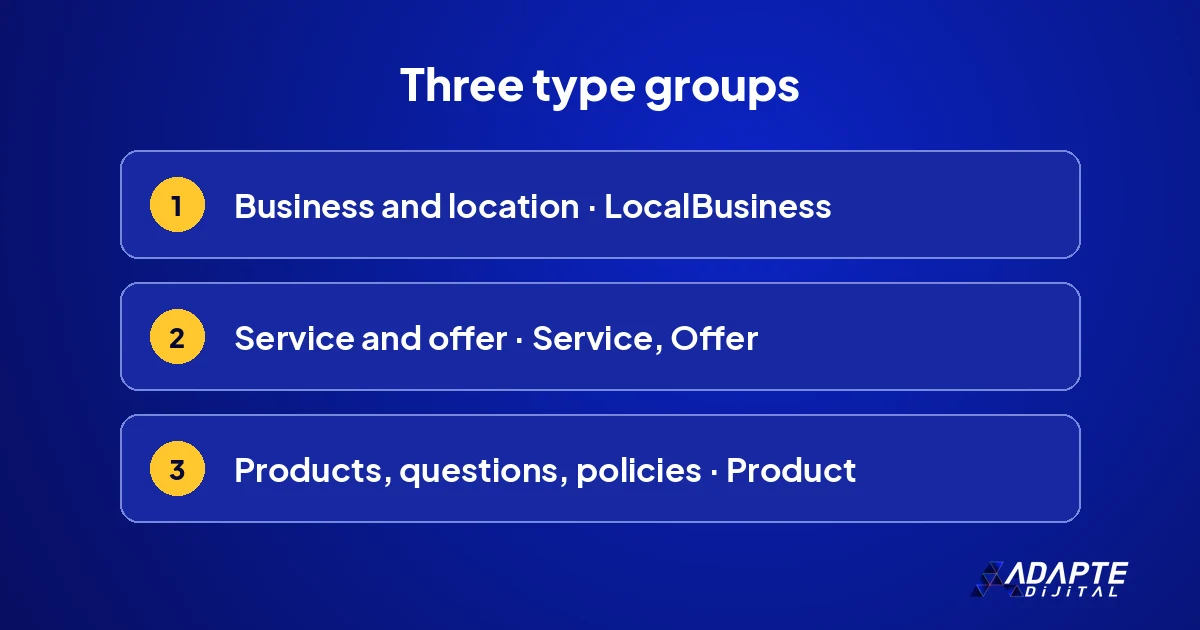
- Business and location
- Service and offer
- Products, questions and policies
Schema.org has hundreds of types, but the information agents need is gathered in a few. Three groups are enough for most sites.
Business and location
The Organization and LocalBusiness types describe a business’s name, address, phone number, opening hours and social profiles. This is where the answer to an agent’s question “who is this business, where is it and when is it open?” lives. Google’s local business guidelines explain in detail how fields such as opening hours and location should be marked up, including special hours for holidays. 📍
Service and offer
The Service type describes a service’s name, scope and the area it covers; the Offer type describes price, currency and terms of validity. Even a price range or a starting price lets the agent give the customer a frame of reference. The markup must match the text on the service page exactly, and both should be updated on the same day whenever something changes.
Products, questions and policies
For shops, the Product type carries the product name, price, stock status and images; how agents read product data is covered in product data agents read. FAQs and policies such as returns can be marked up too, though since August 2023 Google shows FAQ rich results only for well-known government and health sites. Without a rich result, the information still stays readable to agents. 🛒
How do agents use this data?
BU BÖLÜMÜN ÖZETİ
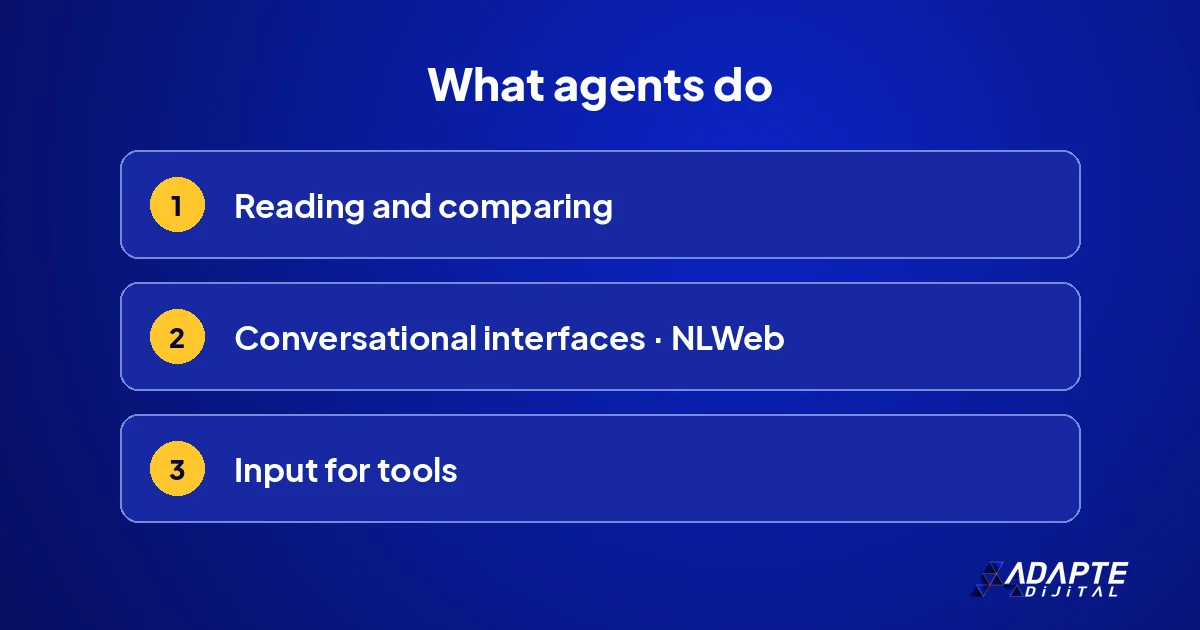
- Reading and comparing
- Conversational interfaces
- Input for tools
In an agent’s hands, structured data serves three different purposes. All three depend on the data being accurate and current.
Reading and comparing
When an agent compares several businesses, it lines up each site’s price, location and opening hours side by side. Marked-up data makes that comparison fast and error-free. A business whose data cannot be read appears incomplete or wrong in the comparison. That directly reduces its chances of being recommended, however good the service behind the page may be. ⚖️
Conversational interfaces
Microsoft’s open-source NLWeb project, announced in May 2025, aims to build natural-language interfaces from data sites already publish, such as schema.org markup and RSS. According to Microsoft, every NLWeb instance is also an MCP server. Structured data is the raw material of such interfaces; a site with weak data produces weak answers, whichever interface sits on top.
Input for tools
On sites that offer tools to agents, the answer a tool returns should also be structured: service name, price, available time. If the page markup and the tool’s answer use the same vocabulary, consistency is preserved. This is the core rule of a two-layer site, explained in the two-layer website, and it keeps people and machines hearing the same thing. 🧰
How is it set up correctly?
BU BÖLÜMÜN ÖZETİ
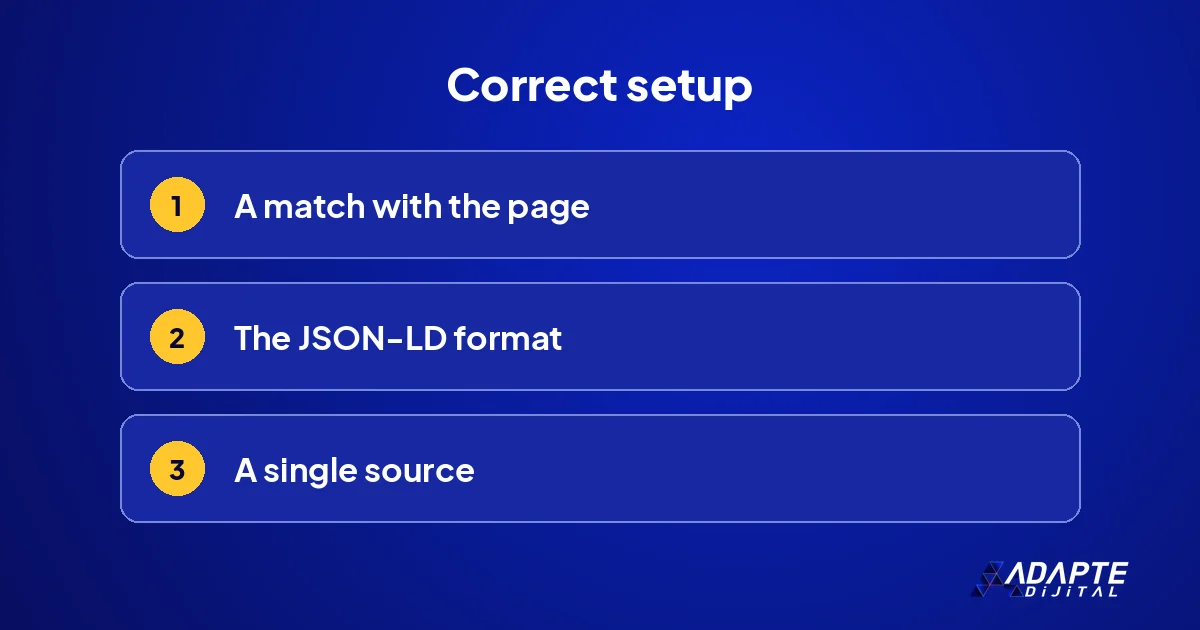
- A match with the page
- The JSON-LD format
- Generating from a single source
The value of structured data comes from its accuracy. A correct setup rests on three principles.
A match with the page
Google’s structured data guidelines require markup to reflect content visible to users on the page. Giving information only in the markup that does not appear on the page breaches the guidelines and undermines trust. To check, the text and markup of a few randomly chosen pages are read side by side, and any difference is closed the same day. 🔍
The JSON-LD format
Google recommends the JSON-LD format for structured data; it sits in a block separate from the page’s visible HTML and is easy to maintain. On WordPress sites, SEO plugins generate basic markup in this format. The data a plugin generates should still be checked, because default settings do not suit every business. How schema supports AI systems is covered in schema structured data and AI.
Generating from a single source
Prices, opening hours and service scope are kept in one place in the content management system and passed from there to both the page and the markup. Every field updated separately by hand will one day drift from the other layer. Every field that can be generated automatically is generated automatically; fields that stay manual are listed and checked monthly. 🔄
What are the mistakes and limits?
BU BÖLÜMÜN ÖZETİ
- Stale data
- Over-marking
- Limits
Set up wrongly, structured data does more harm than good. Three issues come up most often.
Stale data
A sale price left in the markup after a campaign ends, or opening hours that have changed, leads the agent to give the customer wrong information. Wrong data is more harmful than missing data, because the agent acts on it with confidence. When something changes, the page and the markup are updated at the same moment, ideally from the same source. ⏳
Over-marking
Adding every possible type to every page blurs the meaning of the data and increases the maintenance load. Each page marks up only what it genuinely describes. A service page describes the service, a product page the product; unrelated types are not added. Lean markup makes both validation and maintenance easier, and it keeps the signal clear for agents.
Limits
Structured data does not guarantee that an agent will recommend a site; content quality, trust signals and access settings also play a part. Structured data is a foundation, not enough on its own. As agents and platforms change, the fields they rely on most may shift too, so the setup is reviewed once a year against current guidelines. 🧭
What does Adapte Digital do with structured data?
BU BÖLÜMÜN ÖZETİ
- A single delivery package
- What is delivered
- Where to start
We rework your structured data around what agents need: types are chosen, alignment with the page is checked, and the data is set up to be generated from a single source, then handed over.
A single delivery package
Adapte Digital does not charge a monthly management fee. Work starts with a single delivery package whose scope is written down in advance: 36,000 TRY + VAT. If the work grows, the new need is defined as a separate add-on package, priced by what will be delivered rather than by the hours spent. 📦
What is delivered
The output is a markup plan by page type, corrected JSON-LD, an alignment checklist and a maintenance note. How a GEO audit looks at these signals is covered in how to run a GEO audit.
Where to start
The written scope of each package, with current pricing and capacity, is on our campaign pages. 🧭
We cover the earning-gate side of this topic in our article on sector knowledge packs.
Quick Summary
- Structured data for agents marks up business, service and price information so agents read it without guessing.
- Key types: LocalBusiness, Service and Offer, Product.
- Agents use the data for comparison, conversational interfaces and tool answers.
- Correct setup: an exact match with the page, the JSON-LD format and a single source.
- Stale data and over-marking are the most common mistakes.
Short Glossary
- Schema.org
- A shared vocabulary of types and fields used for structured data.
- JSON-LD
- A format that keeps structured data in a block separate from the page’s HTML.
- NLWeb
- An open-source Microsoft project that aims to give websites natural-language interfaces.
Frequently Asked Questions
Next Step
Open the structured data of your most important service page in a validation tool and check whether price, duration and contact details match the page. Our campaign pages list the delivery packages that cover this work.
Sources: Schema.org — Vocabulary for structured data · Google Search Central — General structured data guidelines · Microsoft — Introducing NLWeb: Bringing conversational interfaces directly to the web · Google Search Central — Local business structured data
Updated: November 2026
Sık Sorulan Sorular
Service businesses, local businesses, shops and corporate sites benefit most from structured data. Businesses whose information changes often, such as those whose prices or opening hours vary by season, gain the most from accurate data. Even a small brochure site can start with basic markup and grow it as the business adds services or locations. 🏢
They can, but they have to interpret the page, which raises the margin of error. Structured data presents the same information without leaving room for guesswork.
No need. Although Google shows FAQ rich results only on a limited set of sites, marking up questions and answers visible on the page causes no problem as long as it follows the guidelines.
It is a good start for basic markup. Business-specific fields such as services, prices and opening hours should still be checked to make sure they are filled in correctly.