
Token Waste in Agent Systems: How to Find It, Symptoms and Measurement
Token waste in an agent system means an AI agent reads and writes far more text than it needs to finish a job. The job ends correctly and the result looks fine. The excess shows only on the invoice. 🔁
This article shows that you do not need to be an engineer to find the waste. Three symptoms and one measure are enough. The scenario file is fiction. It does not describe a real company; it is written to show how the risk works.
Scenario file: why does an agent writing the same report cost more every week?
BU BÖLÜMÜN ÖZETİ
- The first set-up
- Quiet growth
- The day it is noticed
Picture a consultancy. An agent has been set up to gather client data every morning and write a summary report. In the first week the bill is small; by the third month it stands out.
The first set-up
Each morning the agent reads five sources, writes a summary and sends it by email. The task finishes in six steps. The person who built it likes the result and moves on to other work. Nobody notes how many tokens the task uses. The first day’s bill is too small to notice. 🌅
Quiet growth
Over time new instructions are added: include this client too, read that table as well, compare with last week. Every addition makes sense. The agent now reads fifteen sources and carries all the earlier ones along at every step. The task has grown to thirty steps. The report is still one page.
The day it is noticed
On the third month’s invoice this single flow accounts for half of the company’s entire AI spending. Nobody made a mistake. What was missing was one line showing consumption per task. A flow that is not measured does not announce that it has grown. 📈
Why does an agent cost more than a single question?
BU BÖLÜMÜN ÖZETİ
- The cost of the loop
- The provider’s own warning
- Tool results
An agent is not one question and one answer. The same model is called many times for a single task.
The cost of the loop
An agent thinks, calls a tool, reads the result and thinks again. On every turn the whole conversation so far is sent to the model again. An agent that reads a thousand tokens on the first turn may be reading ten thousand on the tenth. Cost grows not with the number of steps but with the total load of those steps. 🌀
The provider’s own warning
In a guide published in December 2024, Anthropic writes that agentic systems often trade latency and cost for better task performance. The same guide recommends trying the simplest solution first and adding complexity only when it is needed. Not every job needs an agent; some are finished by one well-built call.
Tool results
The tools an agent calls often return more than is needed: a whole page, a whole table, a whole file. The agent needs three lines but reads a thousand, then carries them along at every later step. The largest source of waste is often not the model but the surplus that tools return. 🧰
What are the symptoms of waste?
BU BÖLÜMÜN ÖZETİ
- The number of steps is rising
- The same tool is called again and again
- Caching is not working
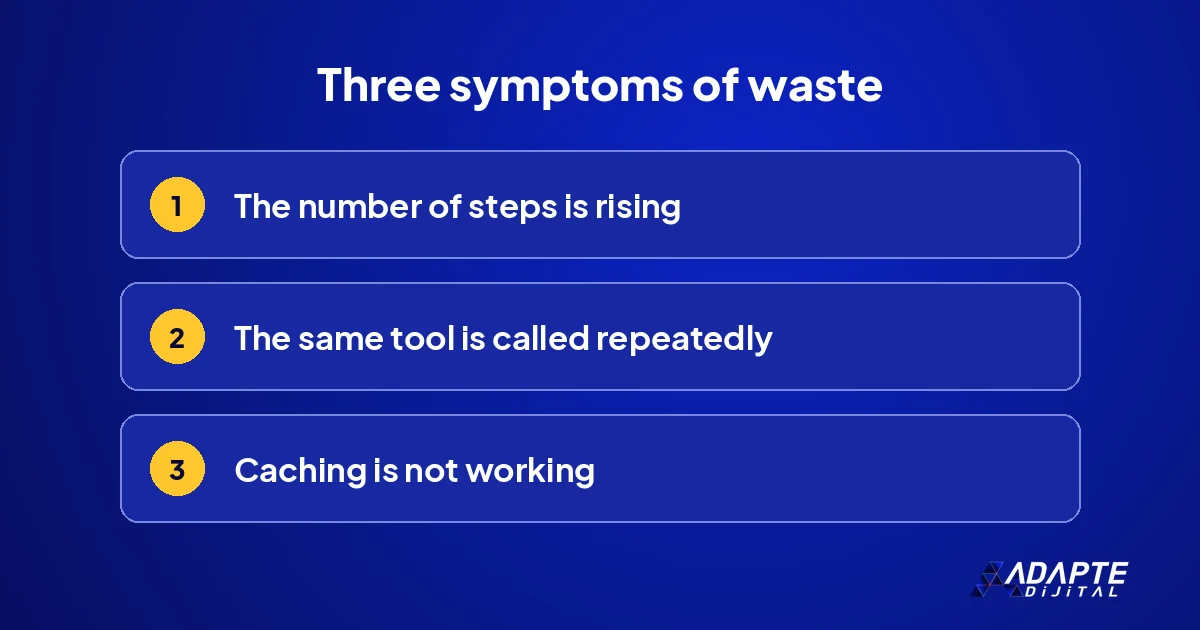
Waste shows itself in three places. All three can be seen in usage logs.
The number of steps is rising
The same task finished in ten steps last month and takes twenty this month. If the work has not changed, something has broken: an instruction has become vague, a tool is failing, or the agent is trying the same thing twice. Steps per task is the first indicator to watch. 👣
The same tool is called again and again
If the logs show the same file read three times, or the same search repeated, the agent cannot carry what it has learned. Sometimes a tool returns an error and the agent retries without changing anything. Without a stop condition, that retrying can go on for hours.
Caching is not working
If the same long instructions are sent with every task, caching brings a large saving. But if a changing date or name is placed at the start of the instructions each time, the cache never engages. If the tokens read from cache in your usage dashboard are close to zero, you are paying for a discount you never receive. 🧊
How is the cost measured?
BU BÖLÜMÜN ÖZETİ
- The cost formula
- The task log
- A measure for comparison
One number sees most of the problem: tokens per task. Whoever knows that number can ask about the rest.
The cost formula
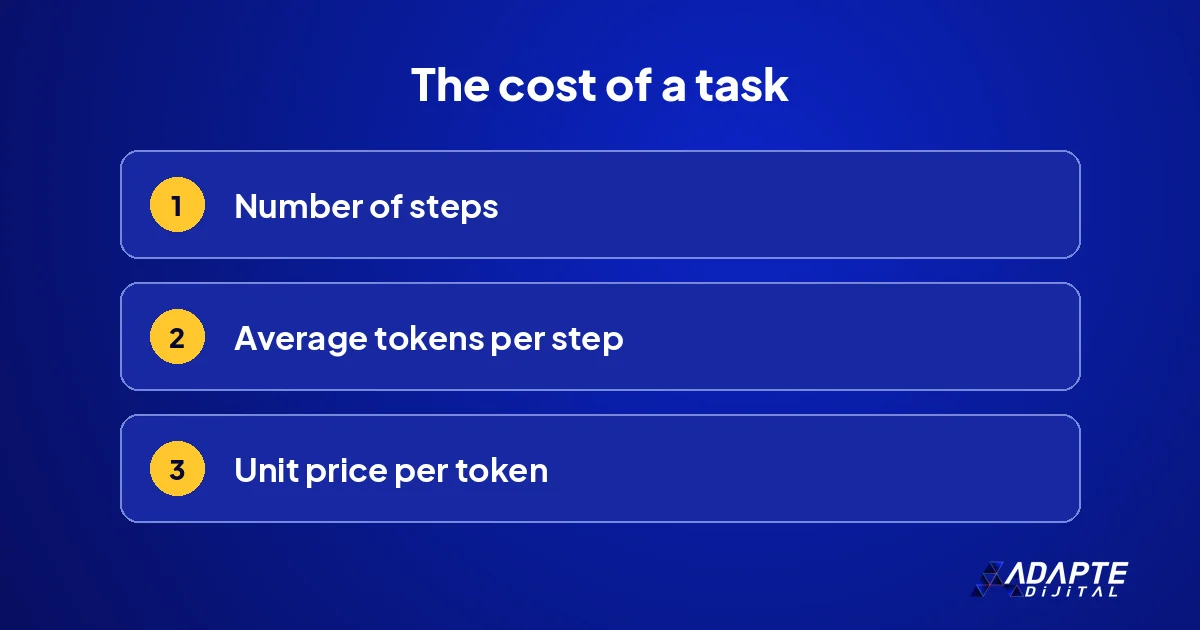
The cost of one task is: number of steps × average tokens per step × unit price per token. Tokens per step grow as the task proceeds, so the average has to come from the logs. The unit price is on the provider’s pricing page. We explain what a token is in what is a token in AI. 🧮
The task log
For measurement, four facts are recorded for every task: start and end time, number of steps, total input and output tokens, and whether the result succeeded. Most agent frameworks already keep this log; it only needs switching on. Without a log the audit is done by estimate, and an estimate shows the waste as smaller than it is.
A measure for comparison
Tokens per task says little alone. Compare it with the same task’s value last month and with a similar task. If there is a twofold gap, look for the reason. Count failed tasks separately; a task that produces no result is where the spending is wasted entirely. We work out the whole monthly bill in how to calculate AI agent costs.
How is waste reduced?
BU BÖLÜMÜN ÖZETİ
- Shorten the context
- Caps and stop conditions
- Five questions asked in an audit
Most fixes do not require changing the model. Changing what the agent is made to read is enough.
Shorten the context
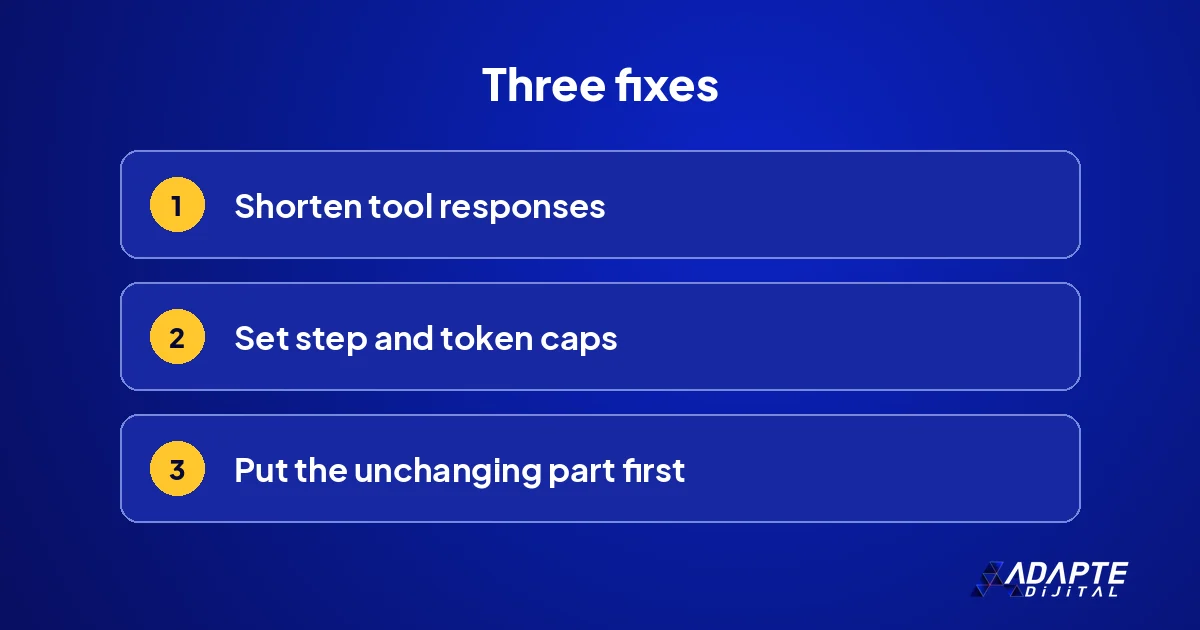
Shorten what tools return: the relevant section instead of the whole file, a summary instead of the whole table. In long tasks, summarise the agent’s interim notes and remove old steps from the context. Put unchanging instructions first and the changing part last, so that caching works. The same job can be done with half the load. ✂️
Caps and stop conditions
Give every task a step cap and a token cap. When a cap is passed, the agent should stop and alert a person. Add a rule that cuts off a task calling the same tool over and over. A cap sets the cost of a bad day in advance. The same discipline applies to automations, as the automation spend audit shows.
Five questions asked in an audit
One: are tokens per task measured? Two: is there a step cap? Three: have tool responses been shortened? Four: what share is read from cache? Five: is the cost of failed tasks tracked separately? Forecast: agent frameworks will start to present cost per task as a default indicator. Update log. 18 November 2026: first publication. Forecasts on this page are re-read when they fall due; one that proves wrong is corrected here, not deleted. How these costs add up at project level is in why AI projects go over budget.
How does Adapte Digital review agent efficiency?
BU BÖLÜMÜN ÖZETİ
- A single delivery package
- What comes out
- Where to start
In the efficiency file we open the three most expensive tasks step by step: which step read what, how much it used, and whether it was needed.
A single delivery package
Adapte Digital does not charge a monthly management fee. Work starts with a single delivery package whose scope is written down in advance: 36,000 TRY + VAT. If the work grows, the new need is defined as a separate add-on package, priced by what will be delivered rather than by the hours spent. 📦
What comes out
For each task we write down the step breakdown, the places that can be shortened and the caps we recommend, so the saving can be checked against next month’s bill.
Where to start
The written scope of each package, with current pricing and capacity, is on our campaign pages. 🧭
Quick Summary
- An agent re-reads its history at every step; cost grows with the total load of the steps.
- According to Anthropic, agentic systems often trade cost for performance; try the simple solution first.
- Three symptoms: more steps, repeated tool calls and caching that does not work.
- Task cost: number of steps × average tokens per step × unit price.
- A step cap and a stop condition limit the cost of a bad day.
Short Glossary
- Agent
- An agent is an AI system that uses a model and tools in sequence to complete a task.
- Stop condition
- A stop condition is a rule that makes an agent abandon a task at a set step or spending limit.
- Tokens per task
- Tokens per task is an indicator that measures the total text an agent processes to finish a single job.
Frequently Asked Questions
Next Step
Pick your most frequently run agent task and check how many steps and tokens a single run uses. That number is the starting point for every comparison from now on.
Sources: Anthropic — Building effective agents · Claude Docs — Prompt caching · Claude Docs — Pricing
Updated: November 2026
Sık Sorulan Sorular
It lowers the bill but does not solve the waste. The same needless steps are taken more cheaply. Reduce the load first, then choose the model.
No. Jobs with known steps are done more cheaply and predictably with a fixed workflow. An agent makes sense where the route is not known in advance.
In your agent framework’s task logs and in the provider’s usage dashboard. Matching the two task by task is enough.