
When Should You Run an AI Audit? Eight Moments That Call for One

An AI audit is not a ceremony held once a year. It is done at particular moments: when something is opened for the first time, when something changes, and when a question arrives from outside. If the right moment is missed, the audit turns into an incident review. ⏱️
This article lists eight moments in three groups: growth moments, change moments and outside moments. At the end is how to set a regular rhythm. The scenario file is fiction. It does not describe a real company; it is written to show how the risk works.
Scenario file: what did the company that audited after the invoice miss?
BU BÖLÜMÜN ÖZETİ
- Looking back
- Accumulation
- The lesson
Picture a logistics company. In two years it has acquired a chatbot, three automations and two model keys. The audit is carried out after an unexpected invoice.
Looking back
The auditor opens the records and finds eight different moments in the last two years. At each of them a short check could have prevented today’s problem. No cap was set when the first key was opened, and the key was not rotated when the founding developer left. None of them was a large mistake alone. 🧩
Accumulation
Small oversights piled up. The uncapped key was forgotten in an old plugin, and its setting was not deleted when the plugin was removed. The bill crept up for three months and each month was explained as ‘usage went up’. Nobody asked why it went up.
The lesson
Instead of auditing once and stopping, the company writes the eight moments on a list. From now on, when one of those moments occurs, a half-hour check will be made. The audit stops being a project and becomes a habit. 📋
Growth moments: when has a new door been opened?
BU BÖLÜMÜN ÖZETİ
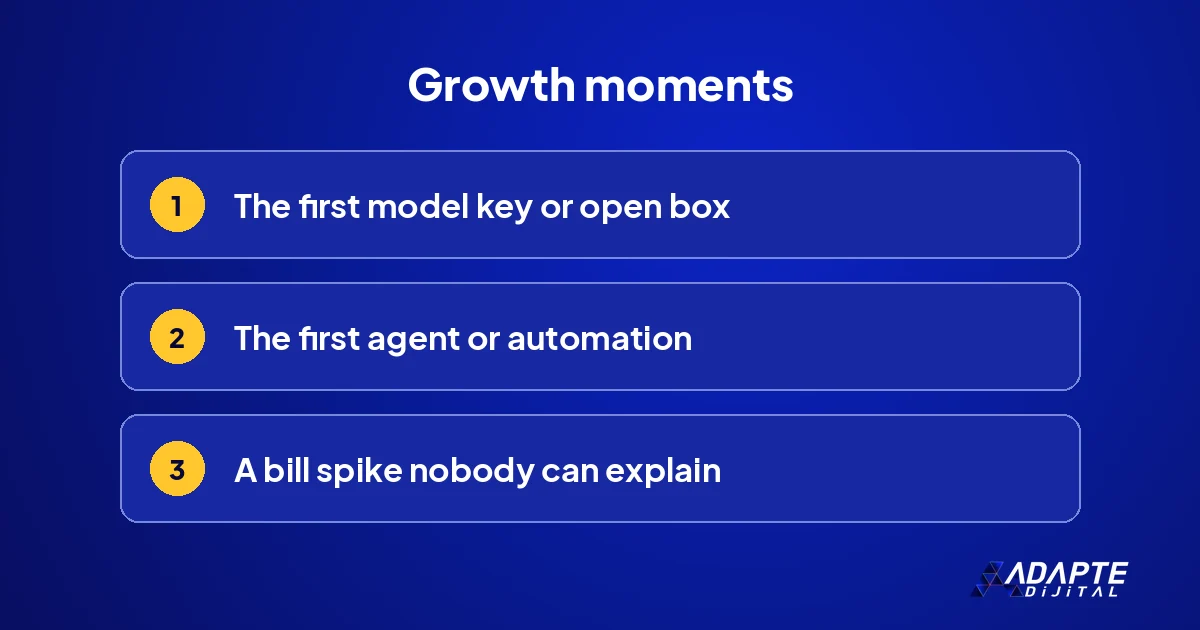
- One: the first model key or the first open box
- Two: the first agent or the first automation
- Three: a bill spike
The first three moments are when the company starts doing something new with AI. That is also when an audit is cheapest.
One: the first model key or the first open box
The day you move from a subscription to a model key, your spending becomes tied to usage. The day you put the first AI box on your site, others can trigger that spending too. Three things are done that day: a spending cap, a request limit and an owner. A cap set on opening day is far easier than one set later. 🔑
Two: the first agent or the first automation
When AI first does a job on your behalf, such as sending an email, changing a record or processing an order, the question of authority arises. What can it reach, what does a person approve, and what is logged? Those three questions are answered before going live. Narrowing the authority of a running flow is harder than granting it narrowly at the start.
Three: a bill spike
If the bill has risen noticeably on the month before and the reason cannot be given in one sentence, it is time to audit. ‘Usage went up’ is not an explanation; the question is which flow rose and why. Without finding the cause of the spike, you do not wait for the next month. The method is in how to audit an AI budget. 📈
Change moments: when does the old arrangement stop being valid?
BU BÖLÜMÜN ÖZETİ
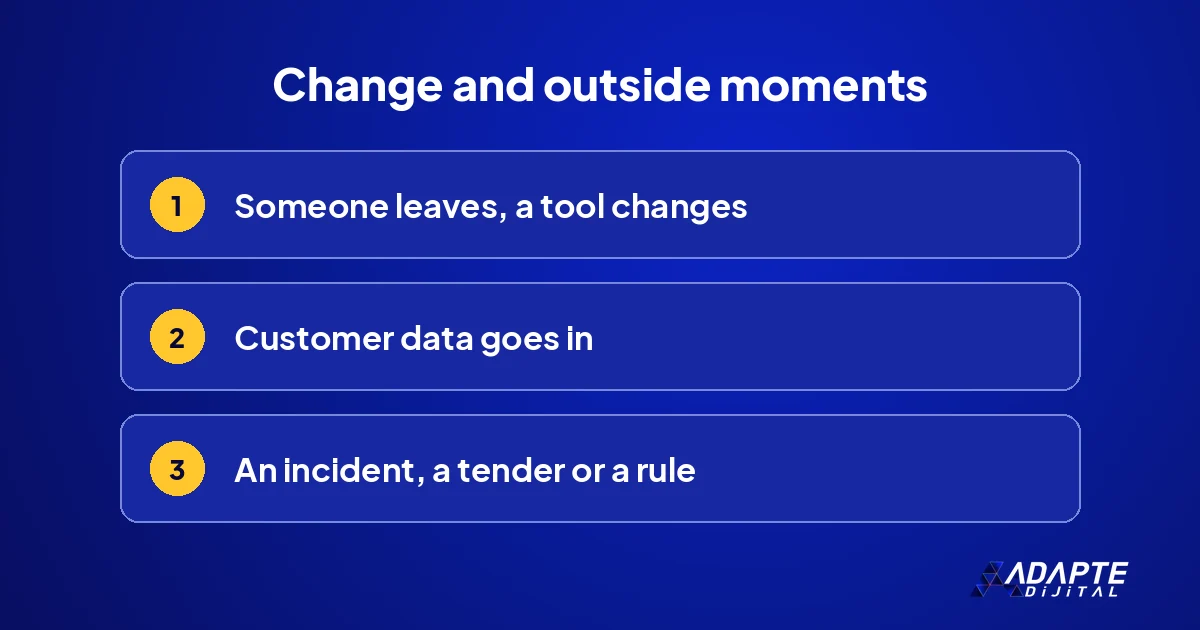
- Four: when someone leaves
- Five: when the tool, provider or model changes
- Six: when customer data goes in
The next three moments are when something changes and old assumptions no longer hold.
Four: when someone leaves
When an employee, a freelance developer or an agency leaves, keys and access may have left with them. According to GitGuardian’s 2026 report, 64 per cent of the valid secrets leaked in 2022 had still not been revoked four years later. On the day of departure the key is rotated and ownerless flows are reassigned. 🚪
Five: when the tool, provider or model changes
When you move to a new tool, the old tool’s key, data and subscription usually stay in place. When the model changes, price, behaviour and output quality change too. Instructions written for the old model can give different results on the new one. In the first week after a switch, outputs and the bill are watched closely.
Six: when customer data goes in
While AI works with your own content, the risk is limited. The day a customer’s name, order, health or payment details go in, personal data rules apply. Which data goes where, how does the provider store it, and has the customer been informed? Those questions are asked before the data goes in. The risk carried by unregistered tools is described in where AI risk hides in a company. 🪪
Outside moments: when does the question come from outside?
BU BÖLÜMÜN ÖZETİ
- Seven: an incident or complaint
- Eight: a large customer, a tender or a rule
- What the eight moments share
You do not choose the last two moments. If you are prepared they take a day; if not, weeks.
Seven: an incident or complaint
A bot making a wrong promise, a faulty image spreading or a customer complaint is a clear signal for an audit. According to IBM’s 2025 report, 97 per cent of the organisations that reported an AI-related breach had no proper access control. An audit after an incident looks not only for that incident but for others that could grow from the same root. The first hour of such a day is covered in when to shut down a chatbot. 🚨
Eight: a large customer, a tender or a rule
A large customer, a tender specification or an investor may ask about your use of AI. Article 4 of the EU Artificial Intelligence Act has required AI literacy among staff since 2 February 2025. For a business that sells into Europe, that question can come at any time. A business that has the answer gets through the process quickly.
What the eight moments share
The same thing happens in all eight: an assumption changes. The assumption that spending is fixed, that access is known, that data stays inside, or that nobody will ask. An audit is comparing the assumption with reality. The first step on the usage side is in the business AI usage audit. 🔍
How is a regular rhythm set?
BU BÖLÜMÜN ÖZETİ
- The cost formula
- A three-layer calendar
- Five questions asked in an audit
Alongside event-driven audits a light calendar is needed too. The two work together.
The cost formula
Think of the cost of a delayed audit like this: daily cost of the gap × days until it is noticed. The daily cost may be small: a flow running to no purpose, a subscription nobody uses. But the number of days is large. A small leak unnoticed for three months can cost more than a large leak caught in a day. The job of an audit is to shorten the number of days. 🧮
A three-layer calendar
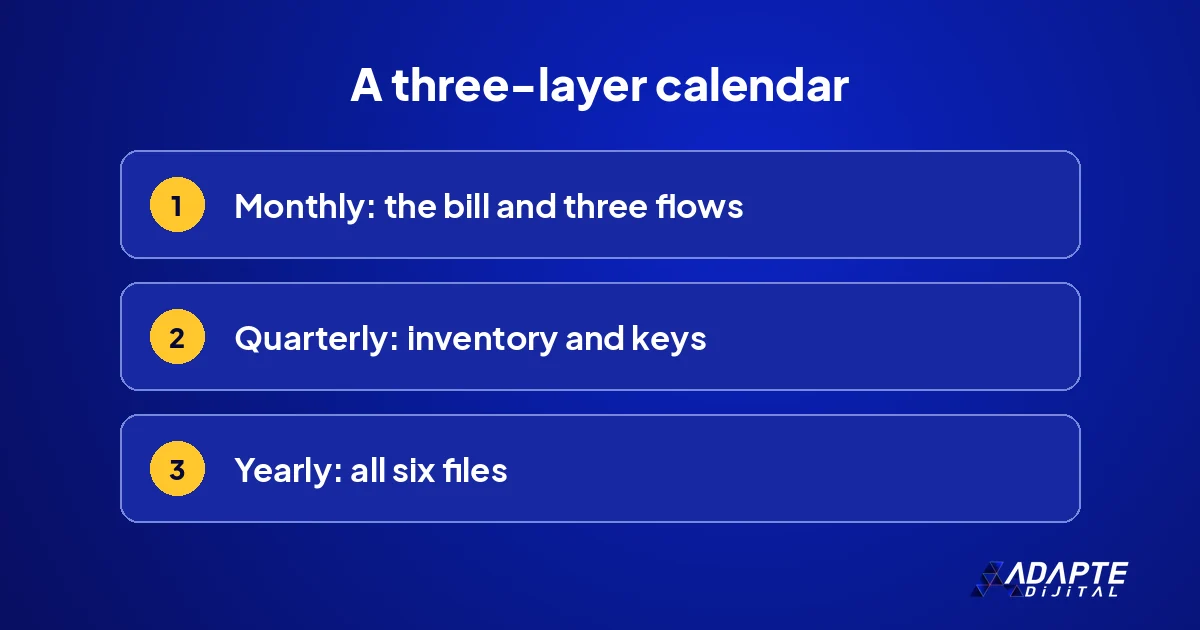
Monthly: ten minutes on the bill and the three most expensive flows. Quarterly: the inventory, keys and permissions are reviewed. Yearly: all six files are opened. NIST’s framework also describes risk management as a continuous cycle, not a one-off. In a small business this calendar is one person’s hour a month.
Five questions asked in an audit
One: which of the eight moments occurred in the last six months? Two: was a check made at that moment? Three: whose job is the monthly look at the bill? Four: when was the inventory last updated? Five: when is the next full audit? Forecast: an AI audit will become a regular business routine, like closing the books. Update log. 18 November 2026: first publication. Forecasts on this page are re-read when they fall due; one that proves wrong is corrected here, not deleted.
When does Adapte Digital recommend an audit?
BU BÖLÜMÜN ÖZETİ
- A single delivery package
- What comes out
- Where to start
In the first meeting we go through the eight moments together: which occurred, at which was a check made, and which was left open?
A single delivery package
Adapte Digital does not charge a monthly management fee. Work starts with a single delivery package whose scope is written down in advance: 36,000 TRY + VAT. If the work grows, the new need is defined as a separate add-on package, priced by what will be delivered rather than by the hours spent. 📦
What comes out
The scan shows whether a full audit is needed and which file to start from, so that the work begins where the exposure is greatest.
Where to start
The written scope of each package, with current pricing and capacity, is on our campaign pages. 🧭
Quick Summary
- An AI audit is tied to events, not to the calendar.
- Growth moments: the first key or box, the first agent or automation, a bill spike.
- Change moments: a person leaving, a tool or model changing, customer data going in.
- Outside moments: an incident or complaint; a large customer, a tender or a rule.
- The cost of a delayed audit: daily cost of the gap × days until it is noticed.
- A light calendar: a monthly look, a quarterly review, a yearly full audit.
Short Glossary
- Inventory
- An inventory is a record that shows a company’s AI tools, keys and flows in a single list.
- AI literacy
- AI literacy is the knowledge and skill staff need in order to use AI in an informed way.
- Incident review
- An incident review is the work done after a problem to find its cause and a way to prevent a repeat.
Frequently Asked Questions
Next Step
Write the eight moments on a sheet of paper and mark the ones you have been through in the last six months. Each one you marked but did not check is a half-hour job for today.
Sources: NIST — AI Risk Management Framework · IBM — 2025 Cost of a Data Breach Report: Navigating the AI rush · GitGuardian — The State of Secrets Sprawl 2026 · EU Artificial Intelligence Act — Article 4: AI literacy
Updated: November 2026
Sık Sorulan Sorular
If one of the eight moments has occurred, a short check is needed. Having had no problem does not mean there is no gap; most gaps are noticed through an invoice or a complaint.
Not by itself. AI use changes from month to month; a yearly look sees a door left open for eleven months only at the end.
No. For most moments a half-hour internal check is enough. Outside support makes sense for the first full audit and after an incident.