
Will AI Audits Become Mandatory? The EU, Türkiye and ISO 42001
An AI audit is not a legal obligation for most businesses today. But the question may be asked from the wrong side. Obligation usually arrives from customers, tenders and insurers before it arrives from the law. 📜
This article summarises the rules in Europe, the ISO standard and the position in Türkiye, then discusses which door obligation will come through. This article is for information only and is not legal advice; consult a lawyer about your own situation. The scenario file is fiction. It does not describe a real company; it is written to show how the risk works.
Scenario file: what happens when a tender includes an AI section?
BU BÖLÜMÜN ÖZETİ
- The list of questions
- An unprepared answer
- The lesson
Picture a software company. It is preparing for a tender from a customer in Germany. The annex to the specification contains an unexpected section.
The list of questions
The annex has ten questions: which AI tools do you use, does customer data go into them, are outputs checked by a person, have your staff been trained? None of them cites an article of law. The customer simply wants to know. 📋
An unprepared answer
The company uses AI every day, but has no written answers to the questions. The team spends three days collecting who uses which tool. Some answers are guesses. The bid goes in on the last day and its AI section is weak. A competitor with tidier answers wins the work.
The lesson
No law had compelled the company. What compelled it was the customer’s list of questions. For the next tender the company prepares its inventory and a short usage policy. The audit was done not out of fear of a penalty but because of a lost contract. 💼
What is mandatory in the European Union today?
BU BÖLÜMÜN ÖZETİ
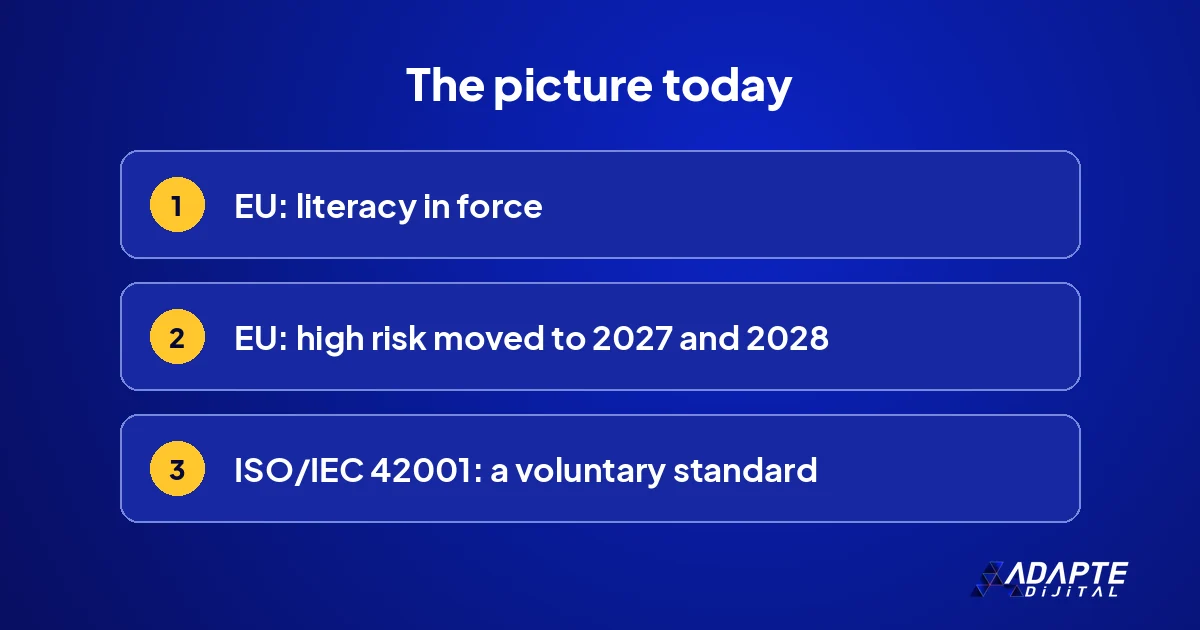
- In force: literacy
- Tied to the timetable: high risk
- What it means for a business outside the EU
The EU Artificial Intelligence Act sets different obligations according to the type of use. They did not all take effect at once.
In force: literacy
Article 4 of the Act has applied since 2 February 2025. In its original form it required organisations that provide and use AI to ensure a sufficient level of AI literacy among their staff. The regulation that amended the Act in 2026 softened that wording: organisations are now expected to take measures to support AI literacy. The duty is lighter; it still stands as an expectation that covers small businesses too. No particular certificate is required; being able to show the measures you took remains useful. 🎓
Tied to the timetable: high risk
Uses such as screening job applicants and assessing credit are classed as high-risk and carry heavy obligations. Under the amending regulation, the dates for these obligations were postponed to 2 December 2027 for stand-alone systems and to 2 August 2028 for systems embedded in products. Postponement does not mean the obligation has gone.
What it means for a business outside the EU
The Act can reach organisations outside Europe where a system’s output is used in Europe. For a business that serves Europe, sells software there or processes a European customer’s data, the subject is not distant. Whether your own situation falls within scope should be settled with a lawyer. A written usage rule helps in any case, as how to write an AI usage policy explains. 🇪🇺
What is ISO/IEC 42001, and is it mandatory?
Alongside the laws there is a standard. The two are often confused.
What it is
ISO/IEC 42001, published in December 2023, is the first international standard written for an AI management system. It is certifiable: an independent body can audit a business’s management system against the standard and issue a certificate. The standard can be applied by any organisation that develops, provides or uses AI. 🏅
What it is not
The standard is voluntary; as far as we know, holding this certificate is not a legal requirement in any country. The certificate approves not a model or a product but the management system: processes, roles and records. Under the EU Act, too, the certificate does not count as conformity by itself. Holding the certificate does not mean the obligations have been met.
What is the position in Türkiye?
BU BÖLÜMÜN ÖZETİ
- Existing rules
- The certification side
- The cost formula
In Türkiye the picture is more fragmented. Instead of one law, existing rules are applied to AI.
Existing rules
As far as we know, there is no general AI-specific law in force in Türkiye. But rules on personal data protection, consumers and advertising also cover the use of AI. An amendment to the advertising rules that took effect in August 2026 includes provisions on AI-generated content. So ‘no law’ does not mean ‘no rules’. ⚖️
The certification side
An academic study published in 2026 concludes that accreditation and standardisation work needs strengthening for ISO/IEC 42001 to be applied in Türkiye. That shows the subject has reached the agenda there too. A business that prepares early, while the infrastructure is being built, gains time.
The cost formula
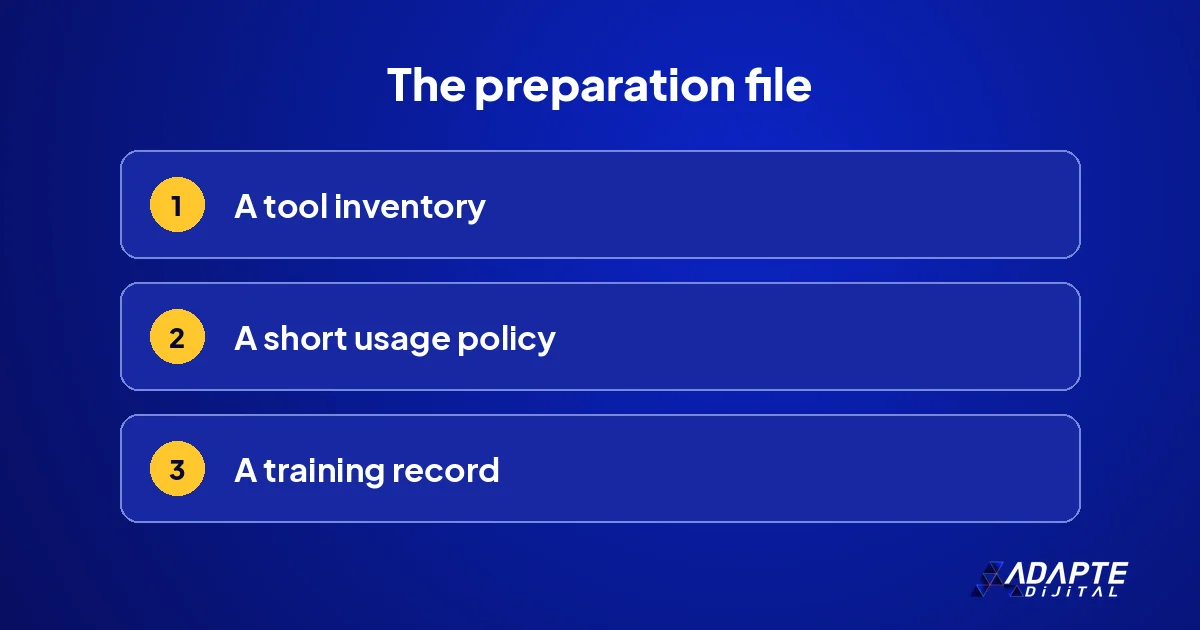
Compare the cost of preparing like this: cost of preparation against lost business × likelihood. For most small businesses the cost of preparation is a few days of work: an inventory, a short policy, a training record. On the other side is a lost tender or a contract negotiation that drags on. The sum usually favours preparing. 🧮
Which door will obligation come through?
BU BÖLÜMÜN ÖZETİ
- Forecast: the contract comes before the law
- Forecast: insurance and tenders
- Five questions asked in an audit
This whole section is forecast. We will correct on this page whatever proves wrong.
Forecast: the contract comes before the law
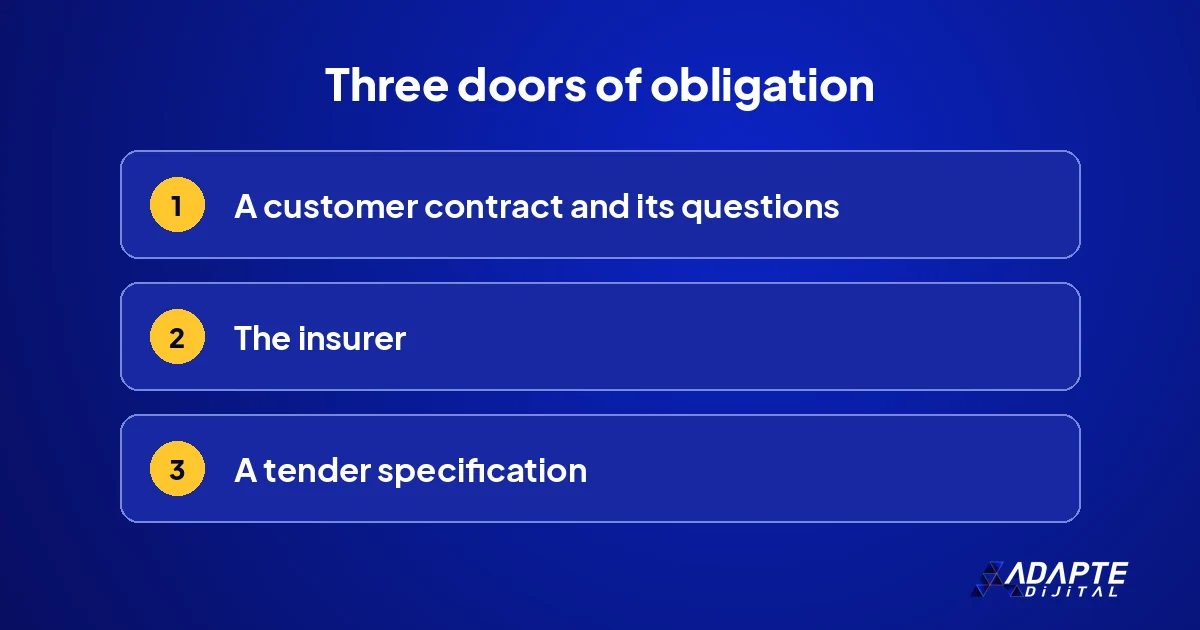
Forecast: for most businesses the duty to audit will arrive not through an article of law but through the annex to a customer contract. Large companies will pass their own obligations to suppliers through lists of questions. The list of questions will be the small business’s de facto regulation. 📎
Forecast: insurance and tenders
Forecast: insurers and tendering bodies will look for an inventory and a record-keeping routine as a precondition. We describe the movement on the insurance side in AI insurance. Similar questions can be expected in public procurement, and court rulings such as those in AI copyright lawsuits and their lessons add to the pressure.
Five questions asked in an audit
One: do you do business in Europe, and has your lawyer assessed the scope? Two: has AI training been given to staff and recorded? Three: do you have a written usage policy? Four: if a customer’s list of questions arrived, could you answer it in a day? Five: do you know when you need to have an audit done? We answer that last question in when to run an AI audit. Update log. 18 November 2026: first publication. Forecasts on this page are re-read when they fall due; one that proves wrong is corrected here, not deleted.
How does Adapte Digital look at compliance preparation?
BU BÖLÜMÜN ÖZETİ
- A single delivery package
- The file prepared
- Where to start
We do not give legal opinions. We arrange the output of the audit so that it answers a customer’s or a tender’s list of questions.
A single delivery package
Adapte Digital does not charge a monthly management fee. Work starts with a single delivery package whose scope is written down in advance: 36,000 TRY + VAT. If the work grows, the new need is defined as a separate add-on package, priced by what will be delivered rather than by the hours spent. 📦
The file prepared
An inventory, a draft usage policy and a training record template are delivered in one file that your lawyer can review before it is sent to a customer.
Where to start
The written scope of each package, with current pricing and capacity, is on our campaign pages. 🧭
Quick Summary
- An AI audit is not a legal obligation for most businesses today.
- In the EU the AI literacy article has applied since 2 February 2025; in 2026 it was softened from ‘ensure’ to ‘take measures to support’.
- High-risk system obligations were postponed to 2 December 2027 and 2 August 2028.
- ISO/IEC 42001 is a voluntary, certifiable management system standard.
- Obligation usually comes from customers, insurers and tenders.
Short Glossary
- Management system standard
- A management system standard is a document describing how an organisation should manage a subject through processes and responsibilities.
- Certification
- Certification is the process in which an independent body audits a business against a standard and issues a certificate of conformity.
- High-risk system
- A high-risk system is the class in the EU rules for AI uses that can seriously affect people’s rights.
Frequently Asked Questions
Next Step
Ask yourself a customer’s question today: ‘Which AI tools do you use, and does our data go into them?’ If you can write the answer on one page, half the preparation is done.
Sources: EU Artificial Intelligence Act — Article 4: AI literacy · Kiwa — ISO 42001: The New Global Standard for AI Governance · Denetişim Dergisi — ISO/IEC 42001 ve ISO/IEC 42006’nın Türkiye’de sertifikasyon açısından değerlendirilmesi · NIST — AI Risk Management Framework
Updated: November 2026
Sık Sorulan Sorular
For companies selling AI-based products or services to large customers, the certificate is a short route to proving trust. For a small business it is usually more than is needed. But the standard’s questions are useful to everyone: inventory, responsibility, risk assessment, incident records. You can use its list without obtaining the certificate. ✅
If you do business in Europe, the literacy obligation may concern you. Rules on personal data and advertising already apply locally. Consult your lawyer about your own situation.
Unless you sell AI-based services to large customers, usually not. Using the standard’s list of questions for your own internal order may be enough.
Because the question arrives from a customer before it arrives from the law. Preparing takes a few days of work; being caught unprepared can cost a contract.