
Watsons and L’Oréal meet women producers in Kuşadası, what does CSR add to a retail brand?

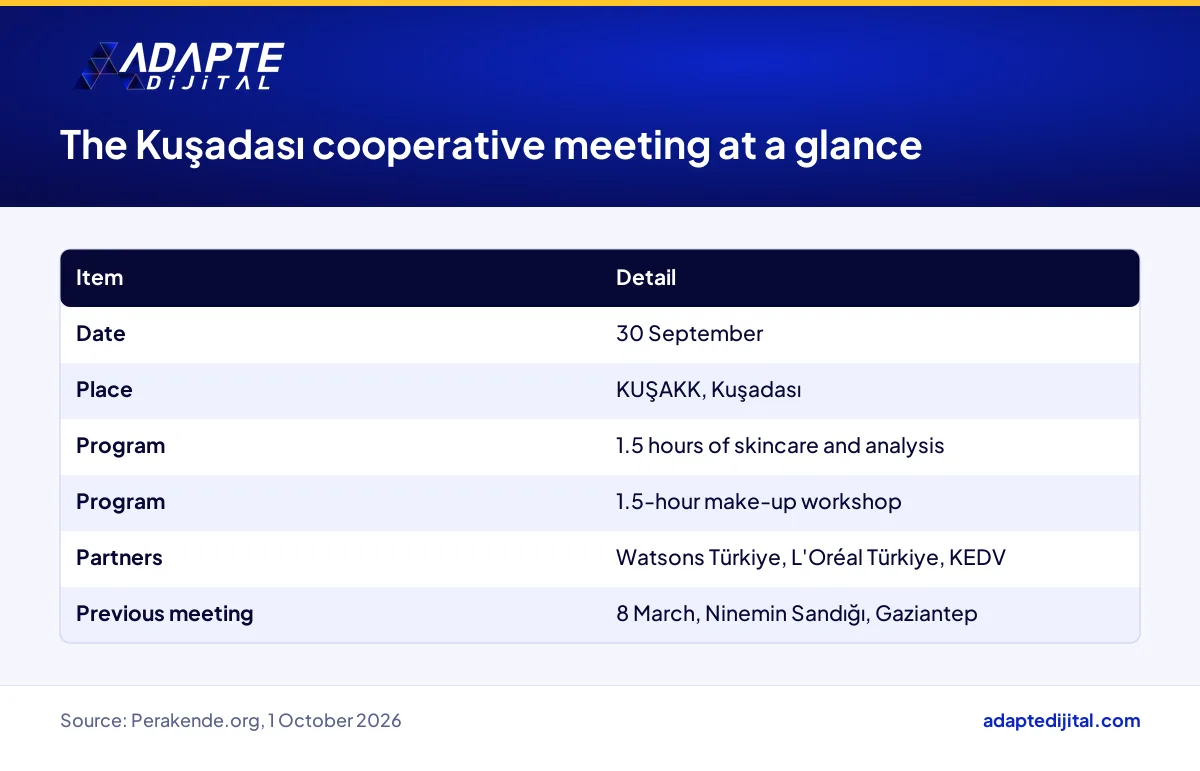
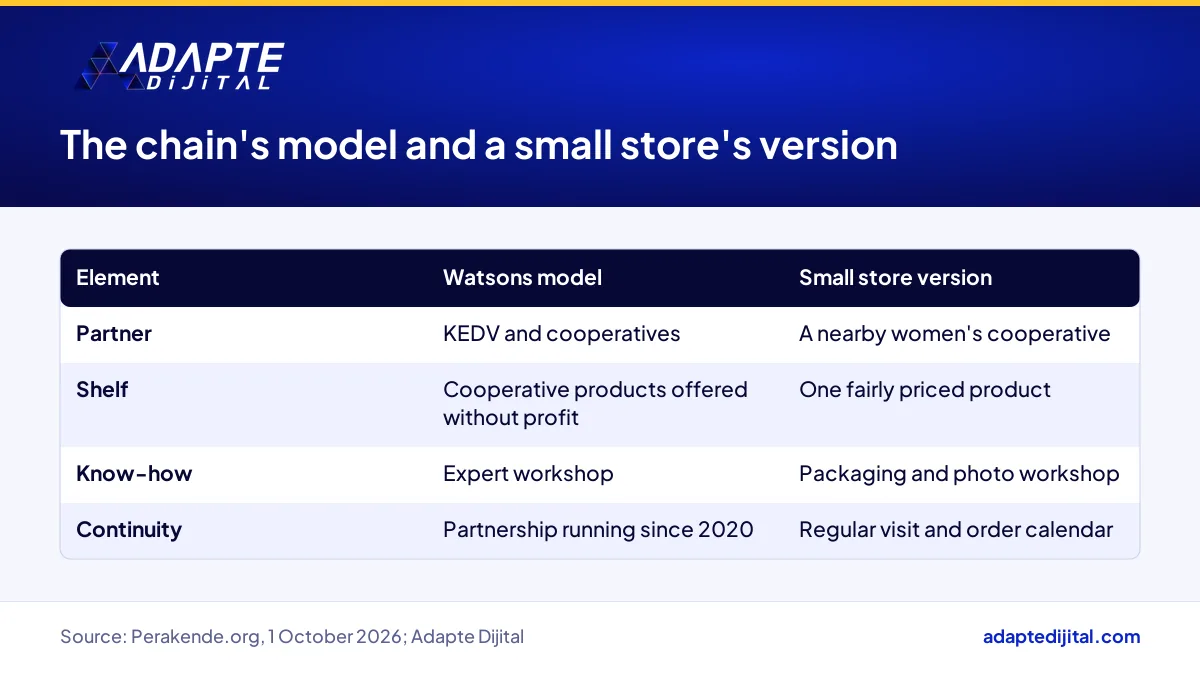
On 30 September, Watsons Türkiye and L’Oréal Türkiye held a three-hour skincare and make-up workshop for women producers at KUŞAKK, the Kuşadası Women’s Enterprise Production and Business Cooperative (Perakende.org, 1 October 2026). The visit is the second cooperative meeting in the “Watsons İyilik Hareketi” (Watsons Kindness Movement) partnership with KEDV, the Foundation for the Support of Women’s Work, which has run since 2020; cooperative products are reported to be offered to customers on a not-for-profit basis.
What it means for you: working with local women producers is not only for big chains. Making room for one cooperative product and sharing your team’s know-how with its makers is a model a small store can build too. Set up well, it gives your brand a story and gives your customers a reason to drop by.
What happened at the Watsons and L’Oréal cooperative meeting in Kuşadası?
The women producers got a two-part program: 1.5 hours of skincare and skin analysis, then a 1.5-hour make-up workshop. Watsons Türkiye’s sustainable living ambassadors and beauty experts from the region took part. The report does not say how many women attended. This is the second cooperative meeting in the partnership.
What does offering cooperative products without profit give the Watsons partnership?
It gives it a story and trust. Here is the unexpected part: the partnership takes no profit from these products, yet each time a customer meets the product, it shows what the brand stands behind. An ad tells; a product in the customer’s hand shows.
Which retailers does a women’s cooperative partnership affect, and how?
It matters most to small retailers and local brand owners selling cosmetics, personal care, food and home goods. They can stand apart from the chains by putting local products on the shelf. The ones who struggle are stores that tie their whole shelf to the same suppliers; customers see the same products everywhere and walk out.
How can a small store set up a partnership with a women’s cooperative?
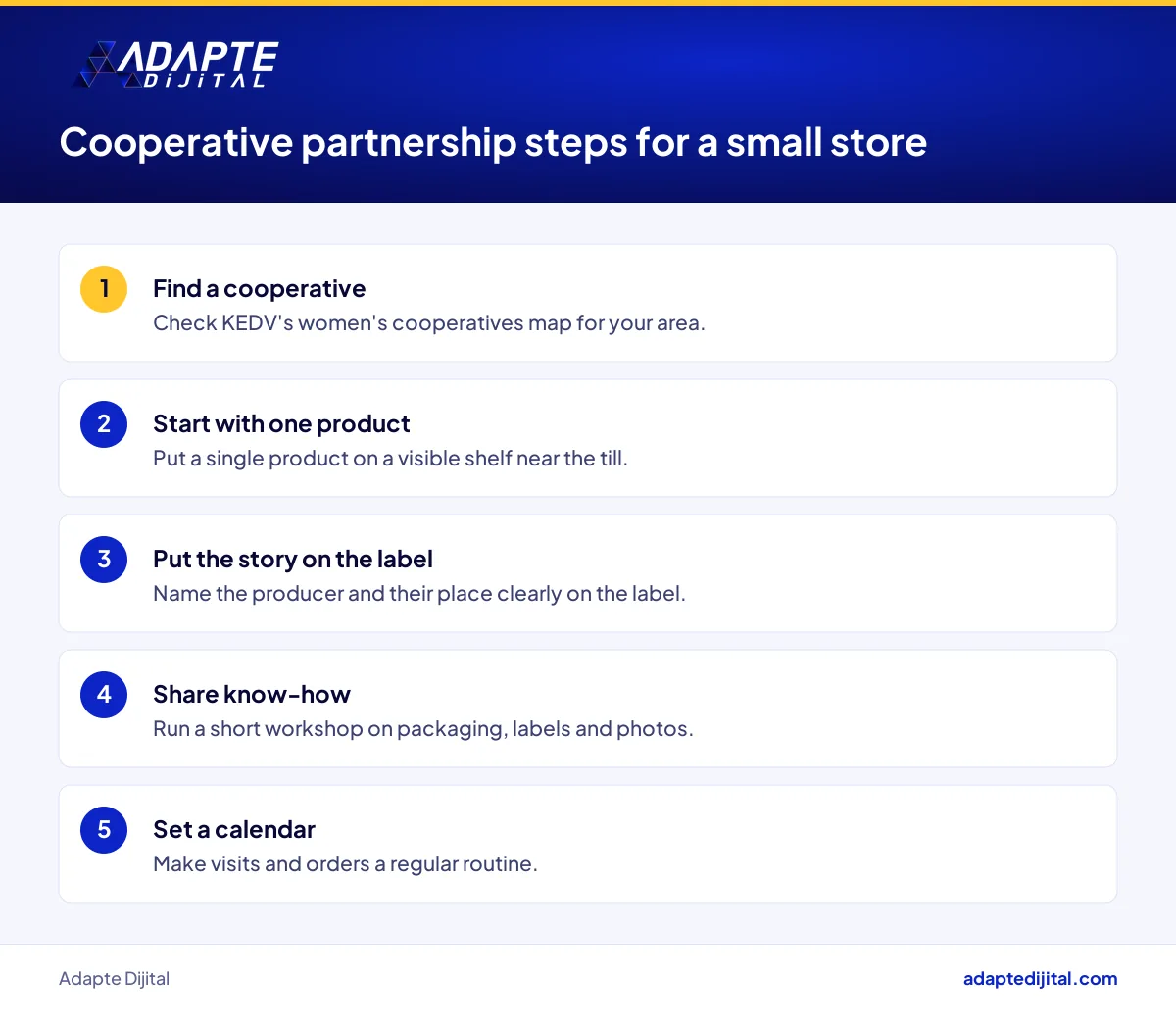
In four steps: find a nearby cooperative, start with one product, share your team’s know-how and make it a routine. Let’s say you run a small cosmetics shop in Aydın, the province around Kuşadası. You roll up the shutter in the morning, and on the shelf by the till there is something new this week: handmade soaps from the cooperative down the road. The label carries the cooperative’s name and its village.
How does a cooperative partnership show up in a retail brand’s digital visibility?
It shows up as a real story. Local, original content sets you apart from similar stores in search results and on social media. A page featuring the cooperative’s name, its product and photos from your meeting adds to your store’s visibility in local search.
What should a business owner considering a cooperative partnership do this week?
Three things this week: list the women’s cooperatives in your area, visit one, and clear space on your shelf for one product. You do not need a big budget; you need a calendar that keeps the relationship going. On the terms of any trade deal with a cooperative, verify with the official source and your adviser; this is not legal or financial advice.
Quick Summary
- Watsons Türkiye and L’Oréal Türkiye visited the KUŞAKK cooperative in Kuşadası on 30 September (Perakende.org).
- The program combined 1.5 hours of skincare with a 1.5-hour make-up workshop (Perakende.org).
- The meeting is the second cooperative visit in a partnership with KEDV that has run since 2020 (Perakende.org).
- The partnership is said to have contributed about TL 11 million to women producers, with no breakdown given (Perakende.org).
- A small store can build a similar model with one product, a visible shelf and shared know-how.
Short Glossary
- Women’s cooperative
- A women’s cooperative is the term used for an economic organization that women set up to produce and sell together.
- Corporate social responsibility
- Corporate social responsibility is the concept used to describe the work a company does for the benefit of society and the environment.
- Shelf space
- Shelf space is the retail term used for the display area a store gives to products.
Frequently Asked Questions
Next Step
If you want to turn a partnership with local producers into your brand’s story, fill in the consult your expert form and let’s plan it together.
Sources: Perakende.org, “Watsons Türkiye ve L’Oréal Türkiye’den üretici kadınlara güzellik ve bakım molası”, 1 October 2026 · KEDV corporate site · AYD-Akademetre AVM Index (via Bloomberg HT)
Updated: October 2026
Sık Sorulan Sorular
The first meeting was held on 8 March at Ninemin Sandığı Women’s Enterprise Production and Business Cooperative in Gaziantep, in south-eastern Türkiye. The report does not state the year of that meeting.
KEDV has worked since 1986 to strengthen women’s leadership in local development. It runs cooperative-building and economic empowerment programs, and sells cooperative products in a shop called Nahıl. You can explore its work on KEDV’s corporate site.
The report says the partnership has contributed about TL 11 million to women producers since 2020. It does not explain whether that is sales revenue or donations, or how it splits across the years. Because it covers a long period, read it with Turkish inflation in mind.
A cooperative product is not there to raise the average basket. It is there to create an extra reason to stop by. A shopper curious about a handmade item may pick up other products on the way to the till, so even a zero-margin item can lift sales on the shelf next to it.
A beauty adviser’s know-how is one of a retailer’s most valuable assets. Sharing it with women producers turns the relationship from one-way buying and selling into a two-way bond. What partner brand L’Oréal Türkiye contributes, whether product, experts or funding, is not stated in the report.
When the event happens once and is forgotten. A one-off photo breeds suspicion, not trust. In the Watsons case, a partnership running since 2020 and now reaching a second cooperative underlines continuity.
The cosmetics shop in a tourist town, the neighborhood deli and the concept store. In these businesses a local product offers visitors something “only from here”. For an Aegean coast store in autumn 2026, a cooperative shelf can be the one corner a chain cannot copy.
The store that gives shelf space only to high-margin SKUs and decides without looking at stock turnover. A cooperative product may carry a thin margin, so it is better counted as a brand investment than as a sales line.
The cooperative itself and other small producers in the area. When a retailer opens a shelf, a producer reaches a new channel. We see a similar export and branding question in Günsan’s push to build its brand in more than 35 export markets.
KEDV publishes a map of women’s cooperatives and a report on the state of women’s cooperatives in Türkiye. Pick one whose product category fits your store.
Start with one product and place it somewhere visible, close to the till. Put the producer’s name and story on the label. In the afternoon a customer picks up the soap and asks about it, and your cashier explains who the cooperative is in two sentences. For that scene to work, your team needs to know the story.
Watsons takes its experts to the cooperative, and you can do the same on a small scale. A short workshop on packaging, labels, pricing or product photos helps the producer bring goods that are more shelf-ready.
Open a short page about the cooperative: who they are, what they make and why their product sits on your shelf. Name the producer on the product page too. That content helps you show up for searches such as “local cooperative products”.
Show the process instead of a product shot: the workshop day, the label being made, the product going onto the shelf. Tag the cooperative and put their account forward. Leave the praise to the producer; a brand looks more credible standing at the edge of the story.
The AYD-Akademetre shopping mall index plans to add a personal care and cosmetics category in 2026. Once the category is measured on its own, talking about a brand story’s effect on sales gets easier. We cover the outlet side of the same category in Beymen Beauty Studio’s store at Florentia Village.
Talk about production capacity, delivery schedule and the product’s label information. For cosmetics and food, ask about regulatory requirements too.
In the Watsons partnership, cooperative products are offered without profit; you do not have to take the same route. What matters is a price that is fair to the producer and clear to the customer.
To fit a cooperative partnership into your brand positioning, we do this work through our brand consultancy service. On our retail page, where we interpret the retail agenda for you, you can follow similar cases. One principle: social responsibility adds value to a brand when it stays on the shelf, not just in the photo.
The women’s cooperatives map published by KEDV is a good starting point for finding cooperatives near you. You can begin with a single product from a cooperative whose category fits your store.
No. In the Watsons partnership the products are offered without profit, but that is not a requirement. A price that is fair to the producer and clear to the customer matters more.
That is not disclosed. The report says about TL 11 million has been contributed to women producers since 2020; whether it is sales or donations, and how it splits across the years, is not shared.