
What Brands Learn From the Tesla Roadster Launch: Musk’s 6 Presentation Techniques
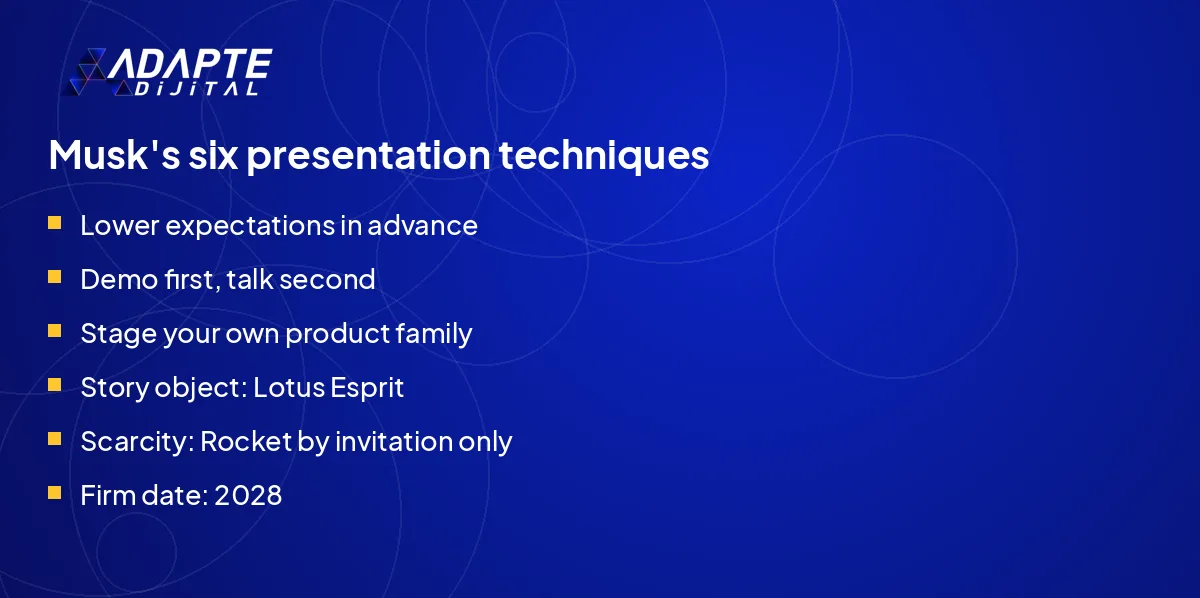
On the evening of October 15, 2026, Tesla unveiled the nine-years-late Roadster in Texas, and the launch played less like a product reveal than a lesson in presentation. Musk used six techniques: he lowered expectations in advance, put the demo before the talk, staged his own product family instead of a rival, displayed a story object, sold the top version by invitation only and gave a firm date. Each technique rests on a fact recorded the same night.
None of the six techniques needs a budget. What worked at the Roadster launch was not the rocket thrusters but the order and the language of the presentation. Below, each technique is given first with the fact from Waco, Texas, then with its equivalent at a small business launch. The sources are TechCrunch, InsideEVs and Tesla’s official X account; all technical figures are Tesla claims with no independent verification.
Technique 1: Why does lowering expectations in advance work?
Right before the demo Musk said, “Success is not guaranteed.” That sentence did two things: it legitimized a possible failure in advance, and it amplified the effect when success came. When the demo ended he said on the same stage, “This is going to be the real car on the roads.” The gap between low expectation and high result is what stays in the audience’s memory.
The fact
The launch had already been postponed once: it was first announced for October 1 and moved to October 15 because of severe weather. Back in late 2025, when he pushed the schedule to April 1, 2026 at a shareholder meeting, Musk had said he wanted “some plausible deniability”. Expectation management started months before the night, not on it.
The limit
The technique only works when the result arrives. Nine years of delays show the cost of lowering expectations too: deposit holders are asking “Is this a prank?”. Stacked low expectations turn into lost trust.
Technique 2: Demo first, talk second
The backbone of the launch was two demos. First the Roadster drove upside down on an inverted ramp using its suction fan, flew off the ramp, flipped and landed on its wheels. Then, while moving, it jumped over a line of Tesla models using its thrusters. The spec reading and the price talk came after those images.
The order matters. The audience saw what the car could do before hearing a single technical figure. Tesla’s claimed 0.81-second 0-60 mph time and 2G suction only gained meaning after the footage. Tesla’s official X account followed the same order: first the video with the note “Do a kickflip!”, then the technical statement about the COPV tanks. The full demo sequence is in the Waco launch report.
Technique 3: Stage your own product family, not a rival
The vehicles the Roadster jumped over in the second demo were not rival brands but five of Tesla’s own models: Cybercab, Cybertruck, Semi, Model Y and Model 3. The tallest obstacle was the Semi at 13.5 feet (about 4.1 meters). Six products appeared in a single scene; one flew and five were brought to mind.
This choice avoids a comparison trap. Had a rival car been on stage, the debate would have shifted to “which is better”. With its own product family on stage, the debate stayed on “what Tesla can do”. Tesla’s X statement built the same frame: “Our design language has evolved from S3XY to Cybertruck, Cybercab and Optimus.” The product line was presented as a family tree.
Technique 4: The story object. Why was the Lotus Esprit on stage?
The Lotus Esprit owned by Musk, the car that turns into a submarine in The Spy Who Loved Me, was on display at the event. Musk called the Roadster “better than the James Bond car”. The Esprit explains nothing technical, but it gives the idea of a “flying car” a reference everyone knows. The audience ties the new product to a familiar story.
The fact
Musk said he had wondered “Am I crazy?” when he pitched the thruster car to his team. That line is part of the story object too: the product was presented not as an engineering decision but as a childhood dream coming true. Naming the SR-71 and the F-35 as design inspirations continues the same language.
The limit
A story object does not change the facts. In early 2026 Musk had said: “If safety is your number one priority, don’t buy a Roadster.” The Bond car reference does not remove that warning; it only makes the product memorable.
Technique 5: Scarcity. Why is the Rocket version invitation only?
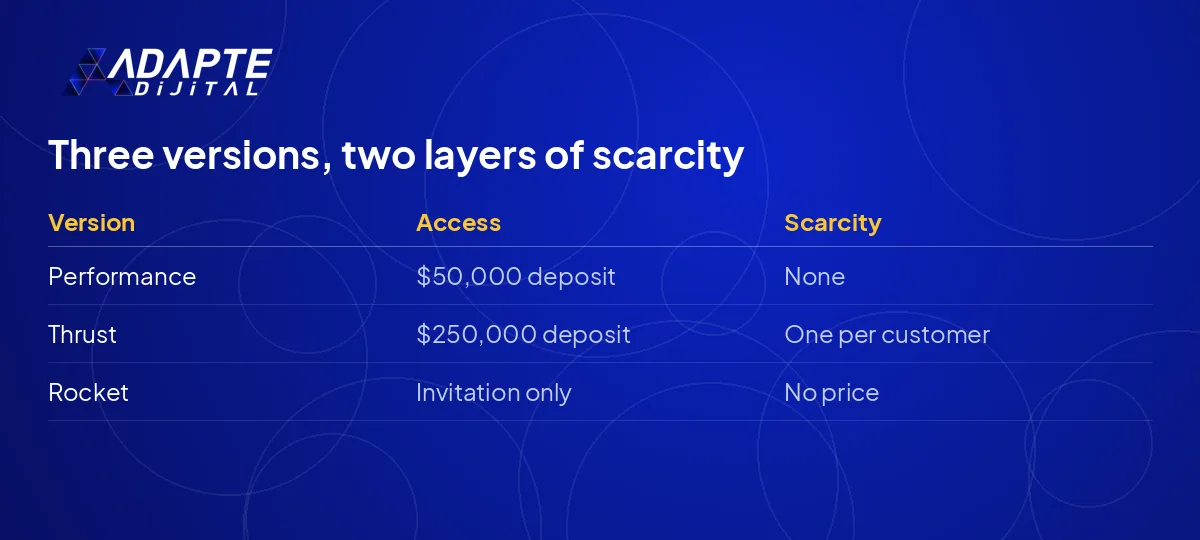
Tesla’s reservation page lists three versions. Performance takes a $50,000 deposit, and Thrust takes a $250,000 deposit with a limit of one per customer. Rocket, the single-seat version with 10 thrusters and the full flight system, is invitation only. The most talked-about product cannot be bought, which makes people talk about it even more.
| Version | Access | Scarcity tool |
|---|---|---|
| Performance | $5,000 + $45,000 deposit | None |
| Thrust | $5,000 + $245,000 deposit | One per customer |
| Rocket | Invitation only | Not even a price |
Reservations are accepted from the United States, Canada and China; Turkey is not on the list. No final sale price has been announced for any version. Scarcity here has two layers: a country limit and an invitation limit. The versions are detailed in the guide what is the Tesla Roadster.
Technique 6: A firm date: 2028 and “for real this time”
Musk gave 2028 for production and added: “for real this time”. The date is not a vague “soon”; it is a four-digit year. And the addition does not hide the earlier delays; it admits them. The audience gets both a calendar and a confession of why that calendar deserves doubt.
The fact
The Roadster was revealed on November 16, 2017 with delivery promised for 2020, then delayed in 2020, 2021, 2023 and 2024. Lars Moravy and Franz von Holzhausen confirmed Gigafactory Texas as the production site. The firm date came with a firm place.
The limit
A firm date alone does not build trust; keeping it does. Thomas Hundal of The Autopian wrote that skepticism about reaching the targets is “absolutely warranted”. As a presentation technique it is right; as a commitment it is still open.
What it means for you: how do six techniques apply to a small business launch?
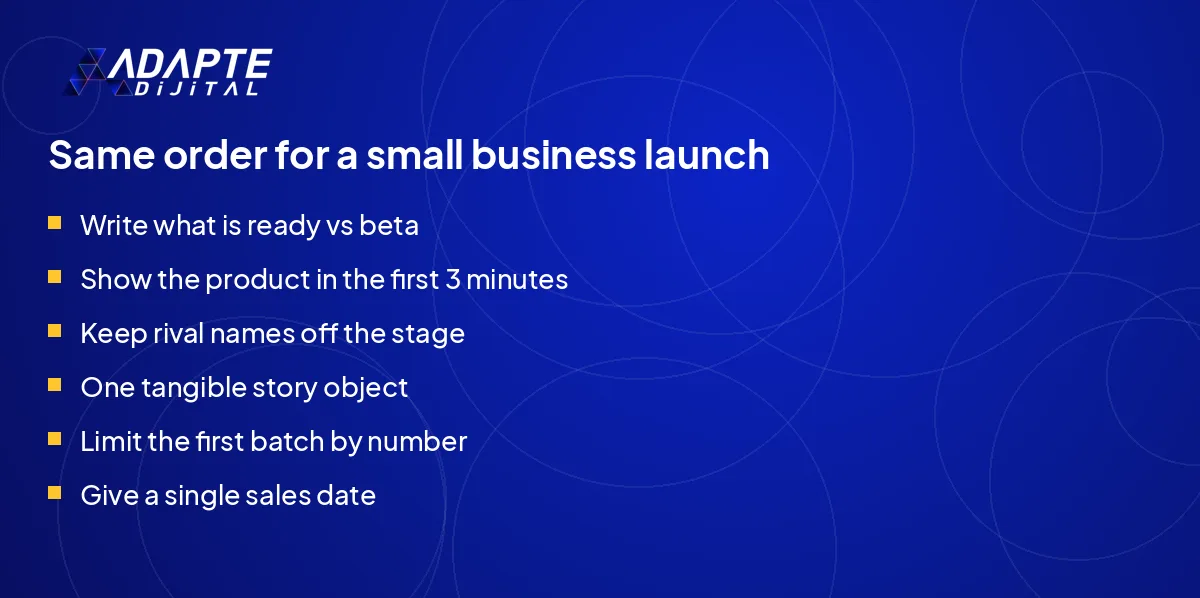
None of the six techniques needs a SpaceX facility. A software release, a new service package or a store opening can follow the same order: frame expectations honestly, show before you tell, put your own products side by side instead of a rival, choose a story object, keep one thing limited and give a single date. The list below translates each technique to the scale of a small or medium-sized business.
- Expectations: In the launch announcement, state plainly what is ready and what is still in beta. That is the small business version of “Success is not guaranteed.”
- Demo first: Put the working product, not the slide deck, in the first three minutes. A screen recording, live use or a real customer transaction.
- Product family: Show the new product in the same frame as your existing products. Keep rival names off the stage.
- Story object: Choose one tangible object, photo or first customer order that stands for the idea behind the product.
- Scarcity: Limit the first batch, the first 50 customers or the founder price, and write the limit as a number.
- Firm date: Give a single date for the start of sales, and if you slip, admit it openly as Musk did.
Common mistake: picking one technique instead of using all six together. At the Roadster launch, scarcity without the demo or expectation management without the date would not have worked. The techniques are a sequence; they work as a chain, not one at a time.
The full record of the launch is in TechCrunch’s report, the demo order in InsideEVs’ story, Tesla’s own language in its official post on X, and the reservation terms on tesla.com/roadster. All articles in the series sit in the flying cars archive; the event as a whole is in the flying car era article.
Frequently Asked Questions
Quick Summary
- Musk lowered expectations before the demo with “Success is not guaranteed.”
- Two demos came before the spec and price talk.
- The Roadster jumped over five Tesla models, not a rival.
- The Lotus Esprit served as the story object, the Rocket version as the scarcity tool.
- The production target is 2028; the delays were openly admitted.
- All six techniques are free; the sequence maps directly onto a small business launch.
Short Glossary
Expectation management is the technique of framing the likely outcome for the audience before a presentation to reduce the risk of disappointment.
A story object is a tangible stage element that ties a new product to a narrative the audience already knows.
Scarcity is a sales arrangement that concentrates demand by limiting access to a product through numbers, invitations or regions.
Next Step
Request a consultation to plan your own launch with Adapte Dijital
Sources
- TechCrunch – Tesla reveals SpaceX-powered Roadster that flies and falls with style
- InsideEVs – Tesla Roadster backflip, suction, 2G
- Tesla X – “Do a kickflip!” video
- Tesla – Roadster reservation page
Updated: October 2026
Sık Sorulan Sorular
Six: expectation management (“Success is not guaranteed”), demo before talk, staging his own product family, a story object (the Lotus Esprit), scarcity (Rocket by invitation only) and a firm date (2028).
The thrusters rest on SpaceX’s cold-gas technology; Musk had tweeted about a “SpaceX option package” in 2018. The Rocket Development and Test Facility in Waco/McGregor put that link on stage.
Yes; none of them depends on budget. Order and language matter: show first, set honest expectations, offer something limited, name a single date.