
Why Google reviews matter: how a business with few reviews loses in 3 seconds
Why Google reviews matter comes down to two places: the customer’s decision and Google’s ranking. On the results screen a customer sees the business name, the stars, the review count and a few words from a review. Most of the time they choose within the first few seconds.
Google also says reviews can help a business stand out. So a business with few reviews loses twice. First it slips down the list, then, even when it does appear, nobody picks it.
Say you run a tyre shop in Avcılar, Istanbul. At seven in the evening a driver with a flat tyre types “tyre shop” on the roadside. Three shops appear: one with 4.8 stars and 212 reviews, one with 4.6 stars and 37 reviews, yours with 5.0 stars and 3 reviews. The driver most likely taps the one with 212 reviews.
Your rating is the highest, yet you lose. The numbers are hypothetical; the logic holds in every neighbourhood.
What does a customer look at in 3 seconds on the results screen?
BU BÖLÜMÜN ÖZETİ
- First, they look at the count
- Then, how recent the last review is
- Finally, your reply
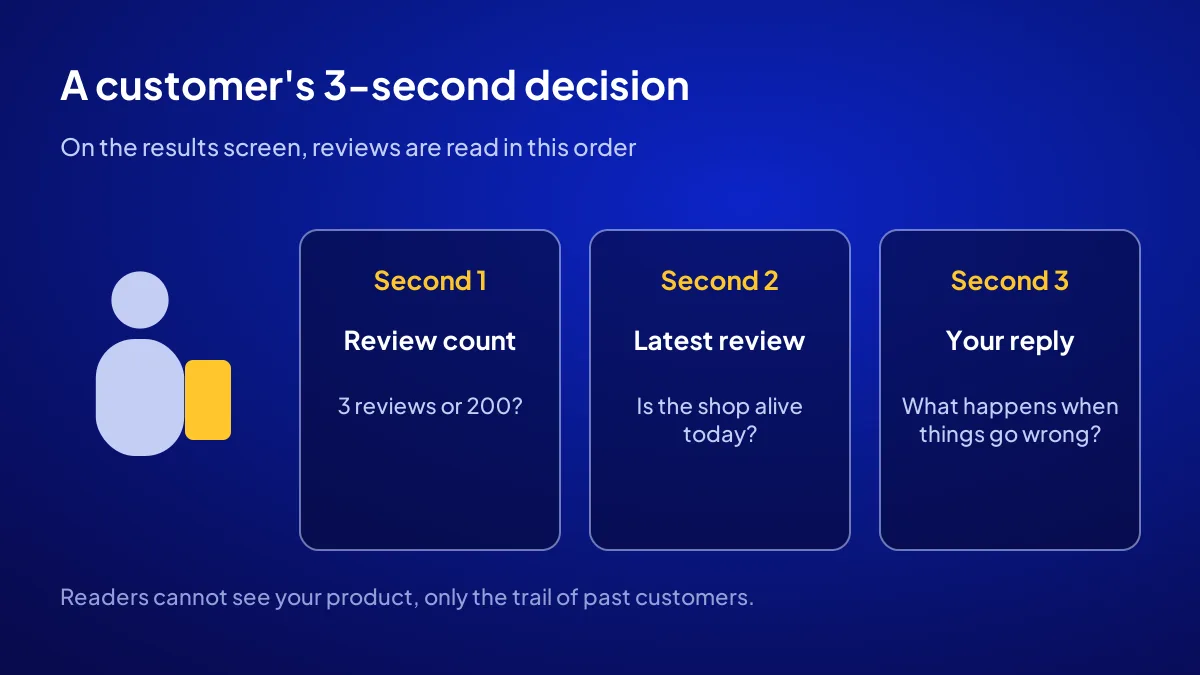
Someone running a local search on a phone is in a hurry. They see the rating, the review count and a short snippet, and they narrow the list in seconds. The only proof they see is the trail left by the customers who came before.
First, they look at the count
The stars catch the eye, but the number in brackets next to them makes the decision. Three reviews are three people’s opinions. Two hundred reviews read like the voice of a whole neighbourhood.
Then, how recent the last review is
Reviews from two years ago do not answer whether the shop is open today. A review from the last few weeks shows the business is alive.
Finally, your reply
When a negative review has a calm reply from the business underneath, the reader sees how you handle things. An unanswered complaint leaves the impression of a shop that does not fix problems.
Why are five stars not convincing on their own?
Here is the surprising part: a perfect rating combined with few reviews raises a question instead of trust. The reader sees 5.0, but with a 3 next to it they wonder whether these are friends. The review count carries the weight of the rating.
The problem with a 5.0 from three reviews
Three reviews can come together by chance. Readers sense this without any statistics. To them, a 4.6 from forty reviews is firmer ground than a 5.0 from three.
Why a few critical reviews do no harm
The occasional criticism, with a decent reply, makes the picture real. Nobody expects a shop to be flawless every day.
How do reviews affect your place on Google?
Google looks at a measure called prominence in local results. According to its help page, reviews can help your business stand out and appear next to your profile on Maps and Search. A review sits in the shop window and also feeds one of the measures behind your ranking.
Reviews are part of the shop window
A review is not decoration at the bottom of your profile. It sits in the middle of the screen where customers decide whether to choose you.
Reviews will not rescue a broken profile
A profile with the wrong category and missing hours will not stand up on reviews alone. Reviews build on a sound profile. We cover the profile gaps through six reasons in business not showing on Google Maps.
Why do happy customers not leave reviews?
BU BÖLÜMÜN ÖZETİ
- Nobody asks
- The path is too long
- The timing is wrong
In most businesses with few reviews, customers are satisfied but silent. Happy customers do not write as quickly as unhappy ones. You need to show them a short way in and remind them with one sentence the moment the job is done.
Nobody asks
Many shop owners feel awkward asking for reviews. Yet Google openly suggests asking customers for them. One extra sentence while saying thank you is enough.
The path is too long
Telling a customer to “find us on Google and write a review” hands them a four-step task. The short review link or QR code that Google provides turns that path into a single tap.
The timing is wrong
The best moment to ask is when the job is done and the customer is pleased. The tyre is on, the car is about to leave, and that is the moment. A message sent a week later often goes unanswered.
How should you ask for reviews, and what should you never do?
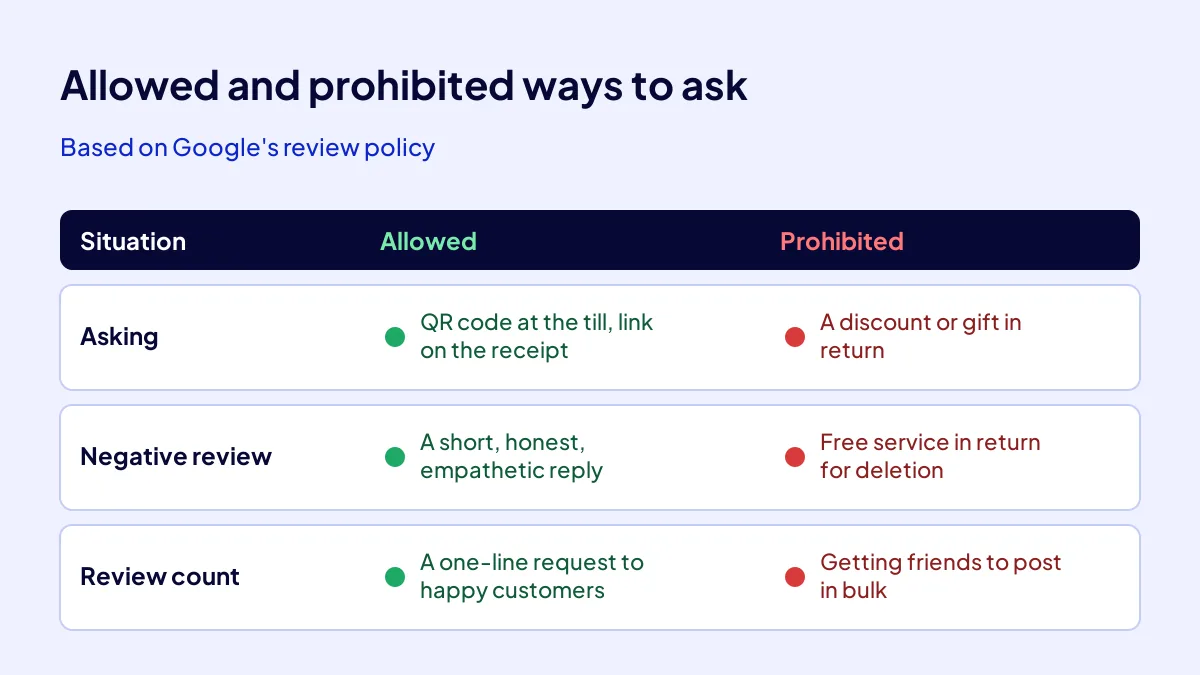
Google suggests using a link or a QR code and reminding customers in your shop. The same page draws a clear line. Offering free or discounted goods or services in return for posting, changing or removing a review is prohibited and treated as fake engagement.
| Situation | The right way | The prohibited way |
|---|---|---|
| Asking for reviews | QR code at the till, short link on the receipt | A discount or gift in return |
| Negative review | A short, honest, empathetic reply | Free service in return for deletion |
| Review count | A one-line request to every happy customer | Getting friends to post in bulk |
A QR code at the till
Place a QR code next to the till where it is visible at payment. Add one line underneath: “If you were happy, one sentence is enough.”
Why can ads and followers not carry a profile without reviews?
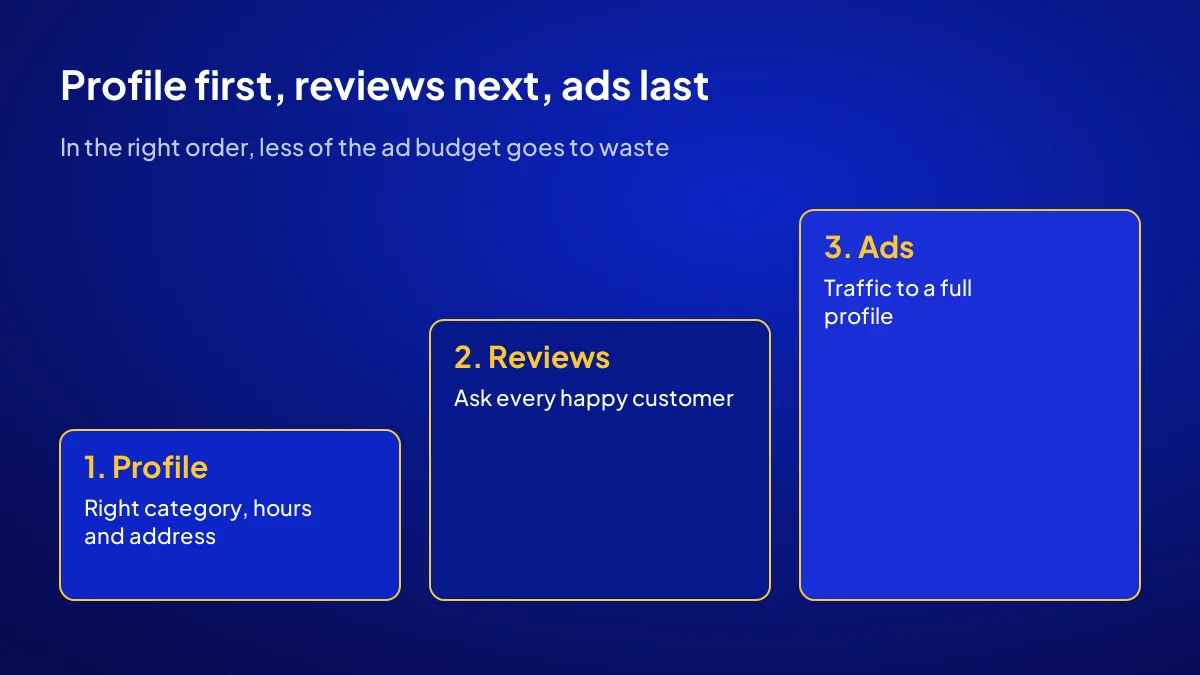
Customers who arrive through ads also check reviews before they decide. Ads bring you onto the screen, but trust brings people through the door. Running ads to a profile without reviews is like carrying water in a leaky bucket. Profile and reviews first, ads second, burns less money.
Follower count is not a substitute for trust
Some businesses have thousands of Instagram followers and still cannot sell. Followers show interest; reviews show that a purchase really happened. We unpack this difference in followers but no sales.
Reviews complete the ad budget
Picture two shops with the same ad budget, one profile full, the other empty. The clicker stays on the first and hits back on the second.
Which recipe connects reviews to sales?
Collecting reviews requires a sound Google Business Profile and a page that welcomes the customer. The Website Recipe in the Get Visible Online campaign builds that base: a mobile-friendly sales page, contact buttons, a Google Business Profile, basic SEO and visitor tracking. Once the profile is in place, the ad recipes make more sense.
The package framework
The campaign costs TRY 36,000 + VAT, paid upfront at a fixed price, and runs for 3 months. You fill in a needs form and Adapte suggests the right recipe. In the ad recipes, the ad budget is paid separately to Google or Meta. Full details are on the Get Visible Online campaign page.
Quick Summary
- Customers check your review count, recency and replies on the list.
- A high rating from few reviews does not convince readers.
- According to Google, reviews can help a business stand out.
- Links and QR codes are allowed; incentivised reviews are prohibited.
- Customers who arrive through ads also read reviews.
- The Website Recipe builds the profile base that reviews need.
Short Glossary
Prominence: Prominence is the local ranking measure Google uses to gauge how well known a business is.
Fake engagement: Fake engagement is the Google policy term used for reviews produced through incentives or without a real experience.
Review link: A review link is the short Google address used to take customers straight to the business review screen.
Next Step
For reviews to work, you first need a solid profile and a page that welcomes customers. Apply for the Get Visible Online campaign and let us build that base in 3 months with the recipe that fits you.
Frequently Asked Questions
Source: Google Business Profile Help — Tips to get more reviews
Sık Sorulan Sorular
A review given in return for something reflects the incentive, not the real experience. Google counts this as fake engagement.
Write briefly, calmly and honestly. If there was a mistake, own it, and sign the reply with your name or initials. Not only the person who complained reads that reply, but every customer who comes after.
The recipe differs for a neighbourhood shop, an appointment-based service or a business selling online. We go through six business types in who the visibility package is for. For where packages fit in the first 3 months, see digital marketing packages.
One principle is enough: before customers know you, they listen to the people who already do.
In most cases the Website Recipe fits, because it sets up the Google Business Profile and a mobile sales page together. When you fill in the needs form, Adapte suggests the recipe that best suits your situation.
No. Google prohibits offering free or discounted goods or services in return for reviews and treats it as fake engagement. Asking politely with a link or a QR code is allowed.
Rather than trying to remove a negative review based on a real experience, write a short and honest reply. Later customers look at how you handled the problem.
Updated: October 2026