
What did Mehmet Şimşek mean by ‘digital company regime’, and did two ministries agree?
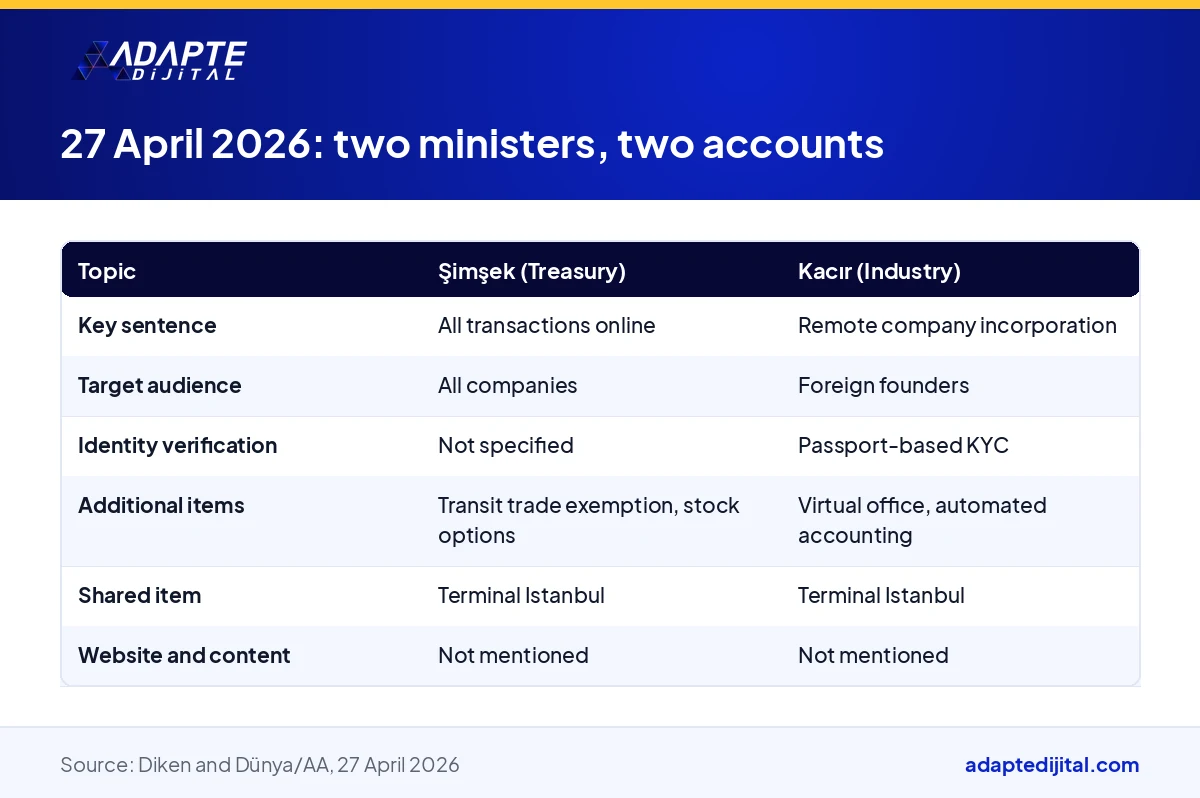
Treasury and Finance Minister Mehmet Şimşek said on 27 April 2026 that “we are introducing a digital company regime”: company incorporation, operations and every transaction will be possible online (Diken, 27 April 2026). On the same day, Minister of Industry and Technology Mehmet Fatih Kacır described remote company incorporation (Dünya/AA, 27 April 2026). Both look at the same target: a company’s dealings with the state move onto a screen. The Ministry’s digital company (dijital şirket) definition had not been published as of October 2026.
What this means for you: the regime the two ministers described covers your dealings with the state. The side that faces customers and AI, meaning the domain, website and content, is built by none of them. You build it.
What exactly did Mehmet Şimşek say about the digital company regime on 27 April 2026?
The statement came at a meeting chaired by Vice President Cevdet Yılmaz. The sentence reported by Diken is short: “We are introducing a digital company regime; company incorporation, operations and all transactions will be possible online.” The sentence announces a target, not an article of law.
How did Minister Kacır describe the digital company the same day, and how does it differ from Şimşek?
BU BÖLÜMÜN ÖZETİ
- Remote incorporation and passport-based identity checks
- Virtual office, automated accounting and a tax exemption
- What the two statements share: transactions on a screen, no customer
Kacır’s account is more concrete and aimed at foreign founders. Şimşek spoke about all transactions; Kacır listed how incorporation would work. The two accounts complete each other.
Remote incorporation and passport-based identity checks
According to Kacır, a foreign founder will be able to set up a company through passport-based KYC without travelling to Türkiye. That route is not open today; the current procedure asks for a potential tax number and apostilled documents. Details are in our guide to remote setup and foreign founders.
Virtual office, automated accounting and a tax exemption
Kacır listed virtual offices, automated accounting, a tax exemption up to a certain scale and Terminal Istanbul privileges. No criteria were announced for any of them. These lighten the company’s back office; they do not build its shop window.
What the two statements share: transactions on a screen, no customer
Şimşek said “all transactions”, Kacır said “remote incorporation”. In both, the actors are the state and the company. How a customer or an AI will find the company appears in neither. That gap is the founder’s job.
Which documents did the digital company regime enter between April and October 2026?
BU BÖLÜMÜN ÖZETİ
- 4 June 2026: the single provision in Law No. 7582
- 18 June 2026: the lawyers’ open questions
- September and October 2026: a programme target and a KOSGEB line item
Four documents followed the statement: a legal provision, a legal analysis, a programme and a KOSGEB rule. None completed the regime; all stayed tied to the definition.
4 June 2026: the single provision in Law No. 7582
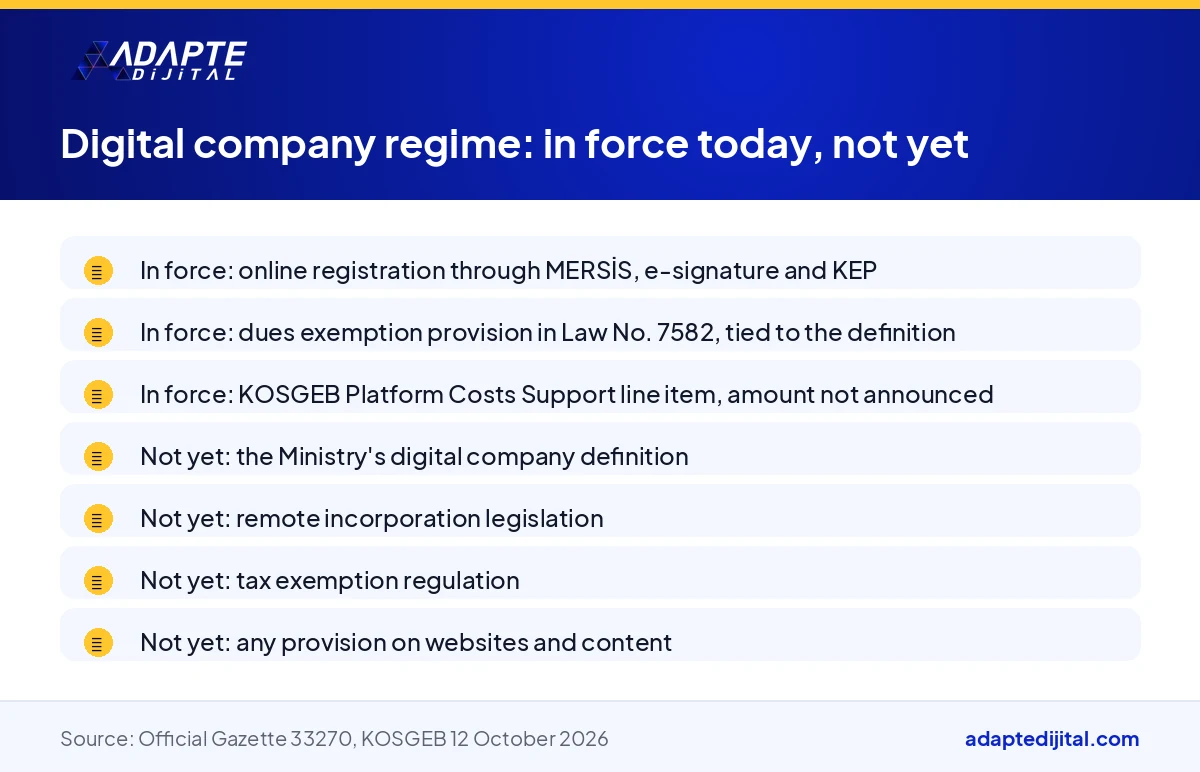
Article 11 of the law gave companies founded by incubator entrepreneurs (kuluçka girişimcisi) and matching the Ministry’s definition an exemption from TOBB, chamber and exchange dues for up to three years. This is the only digital company provision in force. The online transaction order Şimşek described did not enter the law.
18 June 2026: the lawyers’ open questions
Vircon Legal listed the open questions: company type or status, the legal basis of remote KYC, bank accounts, the tax threshold and whether a virtual office can serve as the address for official notices. No secondary legislation has been published. The questions are still open in October 2026.
September and October 2026: a programme target and a KOSGEB line item
The 2027-2029 Medium-Term Programme wrote down a “digital company scheme” and a “one-stop office” as targets. On 28 September, Ertan Barut proposed a “company passport” and a “once-only data” principle in the daily Dünya. On 12 October, KOSGEB added a Platform Costs Support for digital companies to its Business Setup Support (İş Kurma Desteği); the amount was not announced.
What does the digital company regime give a founder today, and what does it not?
BU BÖLÜMÜN ÖZETİ
- What it gives: the direction of state procedures moving onto a screen
- What it does not give: status, tax exemption, remote incorporation
- The second meaning: a company that runs its business digitally
Today it gives only direction. It does not give status, exemption or remote incorporation. A founder who misses this distinction either waits for nothing or relies on a right that does not exist.
What it gives: the direction of state procedures moving onto a screen
Registration already runs through MERSİS, Türkiye’s Central Registry System, with an e-signature and KEP (registered e-mail). The regime promises to extend that chain. The direction is clear: fully online dealings with the state, which calls the company’s own digital presence up to the same level.
What it does not give: status, tax exemption, remote incorporation
Without a definition there is no status. The tax exemption is a statement, not a rule in force. Remote incorporation legislation has not been written. No business plan should rest on these today.
The second meaning: a company that runs its business digitally
“Digital company” has a second meaning beyond status: a company that runs its processes and customer relations over digital networks. That meaning is a way of managing; it can be built today. The distinction is explained in our guide to the two meanings of a digital company.
While the digital company regime moves procedures onto a screen, where will customers and AI find the company?
BU BÖLÜMÜN ÖZETİ
- Domain name and website: not on the regime’s list, demanded by the business
- AI SEO and 108 articles: getting AI to recognise the company
- Accounts and measurement: turning visibility into numbers
The state’s door is MERSİS; the customer’s door is the search engine, the map and the AI answer. The regime arranges the first. The second is opened by a domain, a website, content, accounts and measurement.
Domain name and website: not on the regime’s list, demanded by the business
No statement mentioned a website; customers and AI look for one on day one. The domain must be registered in the company’s name. An AI-ready and user-friendly corporate website is built with 6 top-level pages, 12 sub-pages and 6 categories; every page answers one question.
AI SEO and 108 articles: getting AI to recognise the company
An AI answer names the company it has read and found consistent. That takes structured data, answer blocks and 108 AI SEO articles across 6 keyword groups. AI-ready content starts with incorporation; content added later trails for months.
Accounts and measurement: turning visibility into numbers
3 social media accounts and WhatsApp Business are the doors in the customer’s hand. Search Console and GA4 show who came through which door. Without measurement, “am I visible” has no answer; the AI-SEO Diagnostic Card measures entry into AI answers.
What should a founder waiting for the digital company regime do this month?
BU BÖLÜMÜN ÖZETİ
- Read the statement as intention, not legislation
- Build the digital side now
- Follow the definition from three sources
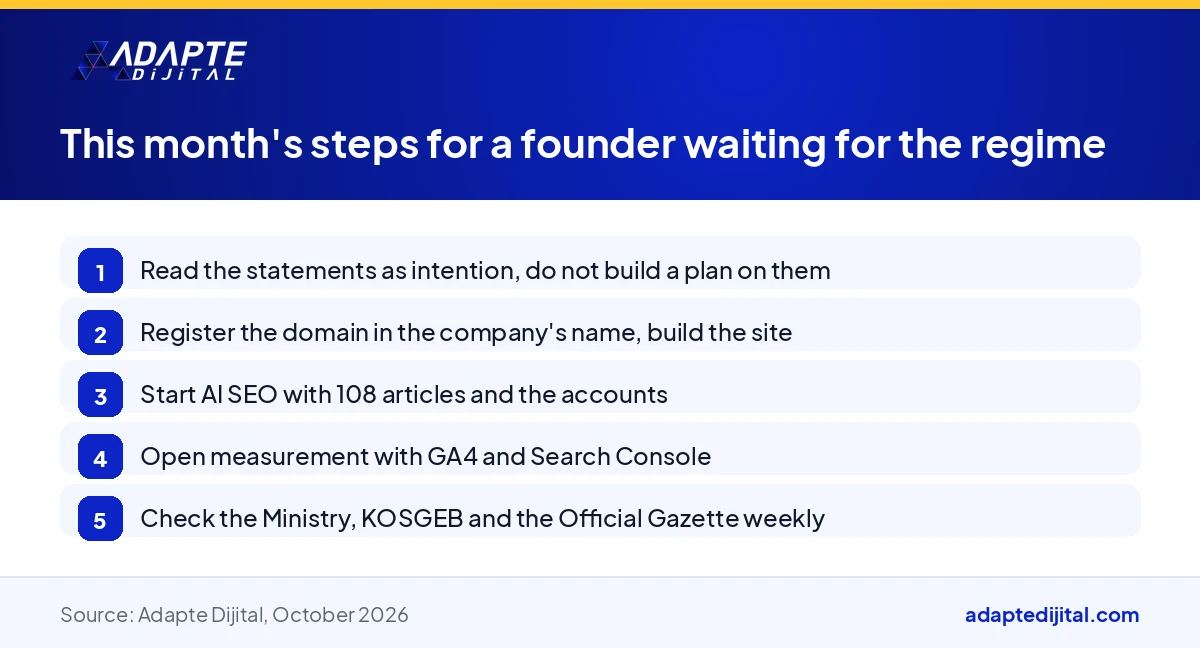
Three jobs: read the statement correctly, build the digital side, follow the definition. The first two are done today; the third is a weekly routine.
Read the statement as intention, not legislation
Şimşek’s and Kacır’s sentences give direction, not rights. Whether to tie your incorporation calendar to the definition is weighed with the criteria in our guide on waiting or incorporating now. When the regime arrives, a ready website is adapted; a missing one starts from zero.
Build the digital side now
Domain name, 1 year of hosting, an AI-ready and user-friendly website, 108 articles, 3 accounts and measurement are delivered as one package. Our My Digital Company (Dijital Şirketim Olsun) campaign builds these items turnkey for TL 36,000 + VAT. We then keep up your AI visibility with our AI consultancy service.
Follow the definition from three sources
Check the Ministry of Industry and Technology, KOSGEB and the Official Gazette once a week. We collect updates on our digital company page. When the definition is published, the site’s about page and structured data are updated the same day.
Quick Summary
- 27 April 2026: Şimşek said “we are introducing a digital company regime”; all transactions will be online (Diken).
- Same day, Kacır: remote incorporation with passport-based KYC, virtual office, automated accounting (Dünya/AA).
- 4 June 2026: the dues exemption in Law No. 7582 is the only provision in force.
- 12 October 2026: Platform Costs Support was added to KOSGEB Business Setup Support; the amount was not announced.
- The Ministry’s definition had not been published as of October 2026; a website and AI SEO do not wait for the definition.
Short Glossary
- Regime
- Regime is the word used for the set of rules under which transactions in a given field are carried out.
- KYC
- KYC is the “know your customer” process used to verify a customer’s identity remotely.
- Secondary legislation
- Secondary legislation is the set of regulations and communiqués issued to determine how a law is applied.
Frequently Asked Questions
Next Step
To put your company’s own digital side next to the procedures the state is moving online, book a discovery call on our digital company page and review the delivery list.
The definition and conditions of the digital company scheme are not final yet; support amounts and conditions may change. Check the latest information with the Ministry of Industry and Technology, KOSGEB and the Official Gazette before deciding. This is not legal or financial advice.
Sources: Diken, Mehmet Şimşek statement (27 April 2026) · Dünya/AA, Minister Kacır statement (27 April 2026) · Vircon Legal, Is a digital company coming to Türkiye (18 June 2026) · KOSGEB, Entrepreneur Support Programme renewed (12 October 2026) · Dünya, Ertan Barut column (28 September 2026)
Updated: October 2026
Sık Sorulan Sorular
Incorporation, operations and transactions point at three separate stages. Incorporation means registration; operations mean ledgers and tax returns; transactions mean steps such as amendments, share transfers and liquidation. All three are done with the state. Customers are not in the sentence.
Şimşek also described a corporate tax exemption for transit trade: 100 percent inside the Istanbul Finance Centre, 95 percent outside. The package also included the Terminal Istanbul start-up hub and employee stock option plans. What the hub will offer is in our guide to the Terminal Istanbul perks.
It is not. The regime is a statement; the only provision in force is the dues exemption in Law No. 7582, published on 4 June 2026. That provision is also waiting for the Ministry’s definition. The whole concept is in our guide to what a digital company is.
An order in which company incorporation, operations and all transactions can be done online. The statement dates from 27 April 2026; it has not become a law or regulation yet, and the Ministry’s definition has not been published.
No, they described two faces of the same target. Şimşek spoke about all transactions going online; Kacır listed remote incorporation, virtual offices and automated accounting. Neither covers the customer side.
No. The regime arranges dealings with the state; customers and AI look for the company today. A domain, a website and 108 articles built alongside incorporation are adapted in a day once the definition is published.